HOW A JAPANESE COURT ACCESSORY OF CYPRESS AND PAPER BECAME A MING SCHOLAR'S CANVAS, A EUROPEAN TRADE GOOD AND A HOTEL EMBLEM
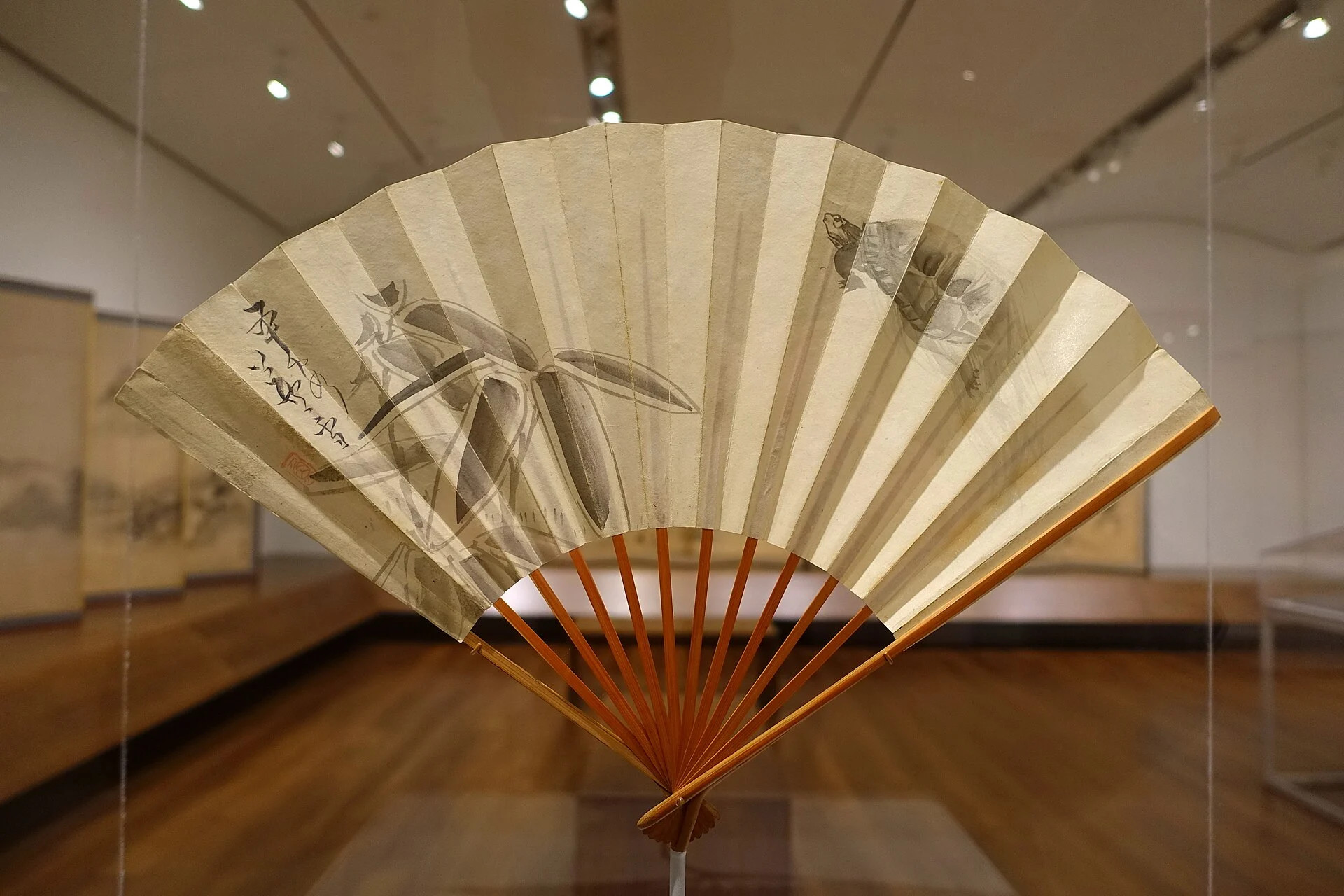
A folding fan is a hand fan made of sticks joined at the base by a rivet or pin, so that it opens into a semicircle and closes into a narrow bundle. In most examples a pleated leaf of paper or silk is mounted on the sticks, and the two outer sticks, called guards, protect it when the fan is closed. A brisé fan has no leaf: its broad sticks overlap and are tied at the top with a ribbon or thread. The folding fan was invented in East Asia, and Japanese institutions place its beginnings in the Nara and Heian periods. It reached China as a Japanese export, came into fashion there under the Ming dynasty (1368 to 1644) and was carried to Europe by Portuguese traders. An eleven-bladed folding fan is now the emblem of the Mandarin Oriental hotel group.
WHERE DID THE FOLDING FAN COME FROM?
The origin of the folding fan is not documented, and institutions give different dates for it. Britannica reports that its invention by the Japanese in the 7th century is sometimes claimed. Leicester Museums states that the folded fan probably originated in Japan in the 8th century, where it is called ogi. The Suntory Museum of Art in Tokyo, which describes the folding fan as a Japanese invention, dates its earliest type, the hiogi, to the Nara period (710 to 794). A Government of Japan publication places the first folding fans in the Heian period, from the late 8th to the late 12th century.
The most widely repeated explanation for the form links it to mokkan, the thin wooden tablets used in early Japan for keeping written records. Leicester Museums sets out the theory: people carried several tablets at once and joined them with a rivet, and the pivoted slats could then be spread open, giving the basic structure of the fan. The Traditional Craft Industries Promotion Association presents this as one belief about the fan's origin, not an established fact. According to Leicester Museums, the decorated early versions of this pivoted form were the hiogi.
HIOGI AND KAMIOGI: FOLDING FANS AT THE HEIAN COURT

Two types of folding fan were in use at the Japanese court by the Heian period (794 to 1185). The hiogi was made of thin, overlapping strips of hinoki cypress tied together. The kamiogi, which the Suntory Museum of Art dates to the start of the Heian period, had a leaf of paper or silk glued to a bamboo frame. According to the Government of Japan account, men used the hiogi first and ladies of the court later adopted it, and these wooden fans served more as objects of etiquette than as a way of keeping cool. Paper fans with wooden ribs and a leaf pasted to one side followed as the practical type.
By the mid-Heian period, fans formed part of the aristocratic dress code. Courtiers carried cypress fans in winter and paper fans in summer, and the cypress fan was also worn with formal attire in every season, which gave it a ritual role beyond cooling. Demand for fans suited to the season and to the owner's position encouraged their decoration, and painters covered fan leaves with scenes from classical literature such as The Tale of Genji and with auspicious patterns. Fans also had religious uses. The Suntory Museum of Art records them as objects of worship in Shinto rites, as donations buried in Buddhist sutra mounds and as offerings placed inside Buddhist statues.
HOW FOLDING FANS SPREAD THROUGH JAPANESE SOCIETY
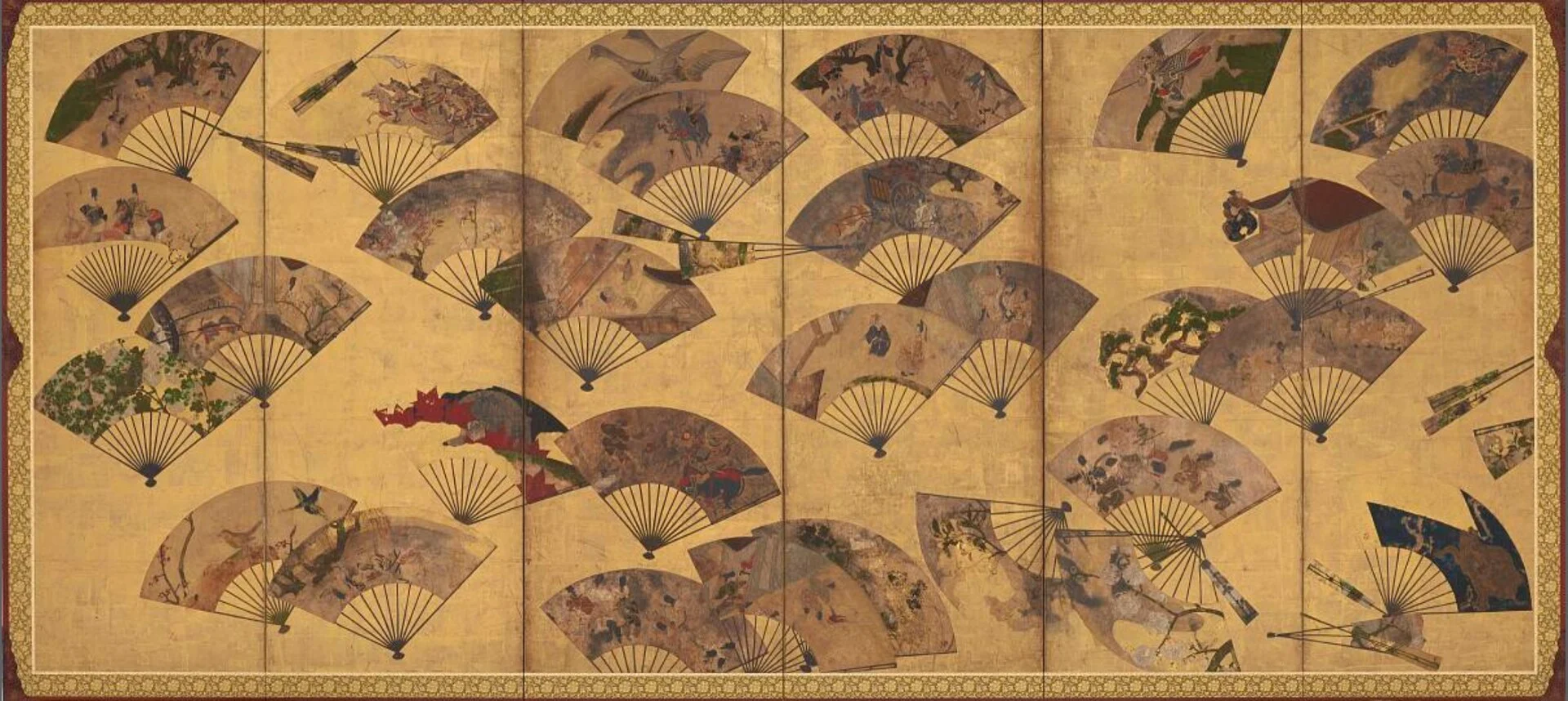
From the medieval period, fans moved beyond the court. They were exchanged as seasonal gifts, and by the mid-14th century ready-made fans were sold in shops, which made fan painting available across social classes. During the Muromachi period (1336 to 1573), according to the Traditional Craft Industries Promotion Association, fans began to be made for incense, the tea ceremony and dance, and they later became standard props in the tea ceremony and on the noh stage. The late Muromachi period also produced a painting genre called ogi no soshi: fan-shaped paintings paired with waka poems, in which viewers guessed the poem from the image.
In the Edo period (1603 to 1868), nearly every painter produced fan paintings, from the Kano and Tosa schools to newer ones, and fan painting became a fashionable and widely collected art form. By the mid-Edo period, sellers of folding fans and of fan paper went door to door in the cities. The Government of Japan account notes that fans reached ordinary people in this period and became more varied, as advances in printing allowed komon patterns, produced by stencil dyeing, to be applied to fan leaves.
HOW DID THE FOLDING FAN REACH CHINA?

China had long used rigid fans. Britannica states that rigid fans were apparently more common there until the end of the Song dynasty, and the National Palace Museum in Taipei records that round silk fans were popular in the Song and Yuan dynasties. Folding fans came from Japan. The Suntory Museum of Art states that Japanese fans were sent to the Asian mainland as tribute items from the late 10th century, and the Traditional Craft Industries Promotion Association dates the export of bamboo and paper fans to China to around the 13th century. The National Palace Museum notes that a few were imported during the Song and Yuan, but that the format was not yet common.
The change came under the Ming. During the Hongwu reign, Japanese envoys brought folding fans as tribute, and the emperor Zhu Yuanzhang (1328 to 1398) gave them to high officials. The Yongle emperor, Zhu Di (1360 to 1424), valued the folding fan for its convenience and had craftsmen copy it. Gifts of fans became a court custom: at the Duanwu Festival, officials received fans inscribed with maxims by Hanlin Academicians, and the emperor Xuanzong, Zhu Zhanji (1399 to 1435), painted and wrote on fans himself. In trade, the Suntory Museum of Art notes that fans ranked with folding screens and swords as major Japanese exports to Ming China.
Chinese scholars adopted the folding fan as a surface for painting and calligraphy. Members of the Wu School, including Shen Zhou (1427 to 1509), Zhu Yunming (1461 to 1527), Wen Zhengming (1470 to 1559) and Tang Yin (1470 to 1524), produced fan paintings and calligraphy as gifts, and professional artists also worked in the format. Britannica observes that many of China's great painters decorated fans, and that some decorated fans were never mounted for use. Under the Qing, the Kangxi emperor favoured calligraphy on fans as court gifts, and the Qianlong emperor had the court's fan collection organised and sent fans to workshops in Suzhou for repair and remounting.
HOW DID FOLDING FANS ARRIVE IN EUROPE?
Britannica suggests that a few East Asian folding fans may have reached Europe in the Middle Ages, but that the Portuguese traders who opened the sea route to China were probably the first to bring them in any quantity. Leicester Museums dates the introduction of the folded fan through trade between East Asia and Portugal to around the 16th century, and states that fans first became popular in Spain. By the 17th century, according to the same source, fans were established in European dress, France was the main centre of production, and fans appeared in aristocratic portraits as a sign of wealth.
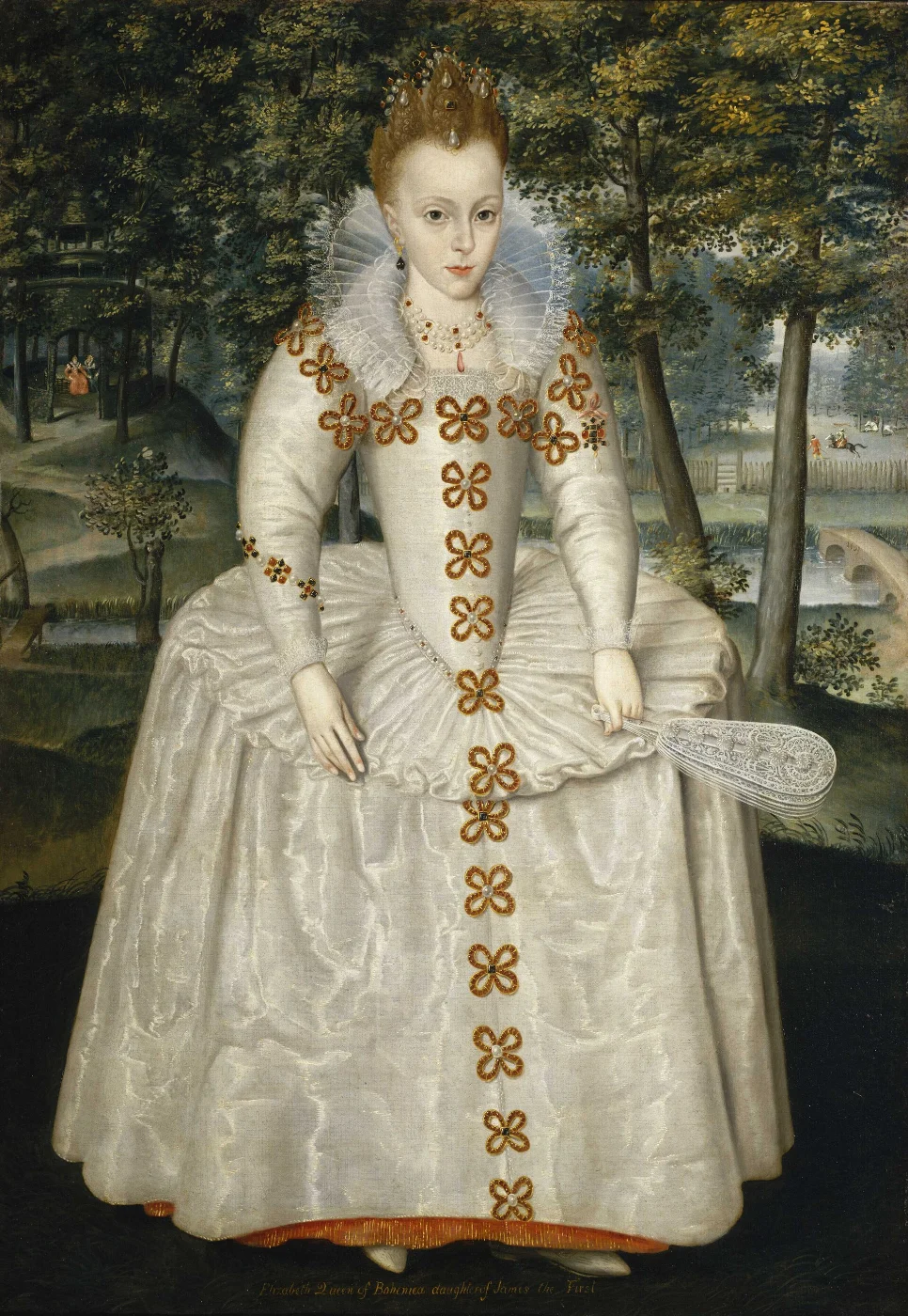
The earliest fan in the collection of the Victoria and Albert Museum is a brisé fan of the 1620s, probably made in Florence, then a major centre of straw work. Its seven sticks are shaped like cock feathers and made of cut straw applied to silk-covered pasteboard, reinforced with metal rods and joined by a green silk ribbon. The museum suggests that a brisé construction may have been the only way to make a folding feather fan at a time when feather handscreens were fashionable. Fans of similar shape appear in a 1603 portrait of Elizabeth Stuart, later Queen of Bohemia, by Robert Peake the Elder, and in portraits by Girolamo Forabosco of the 1660s.
CHINESE EXPORT FANS AND THE 19TH-CENTURY FAN
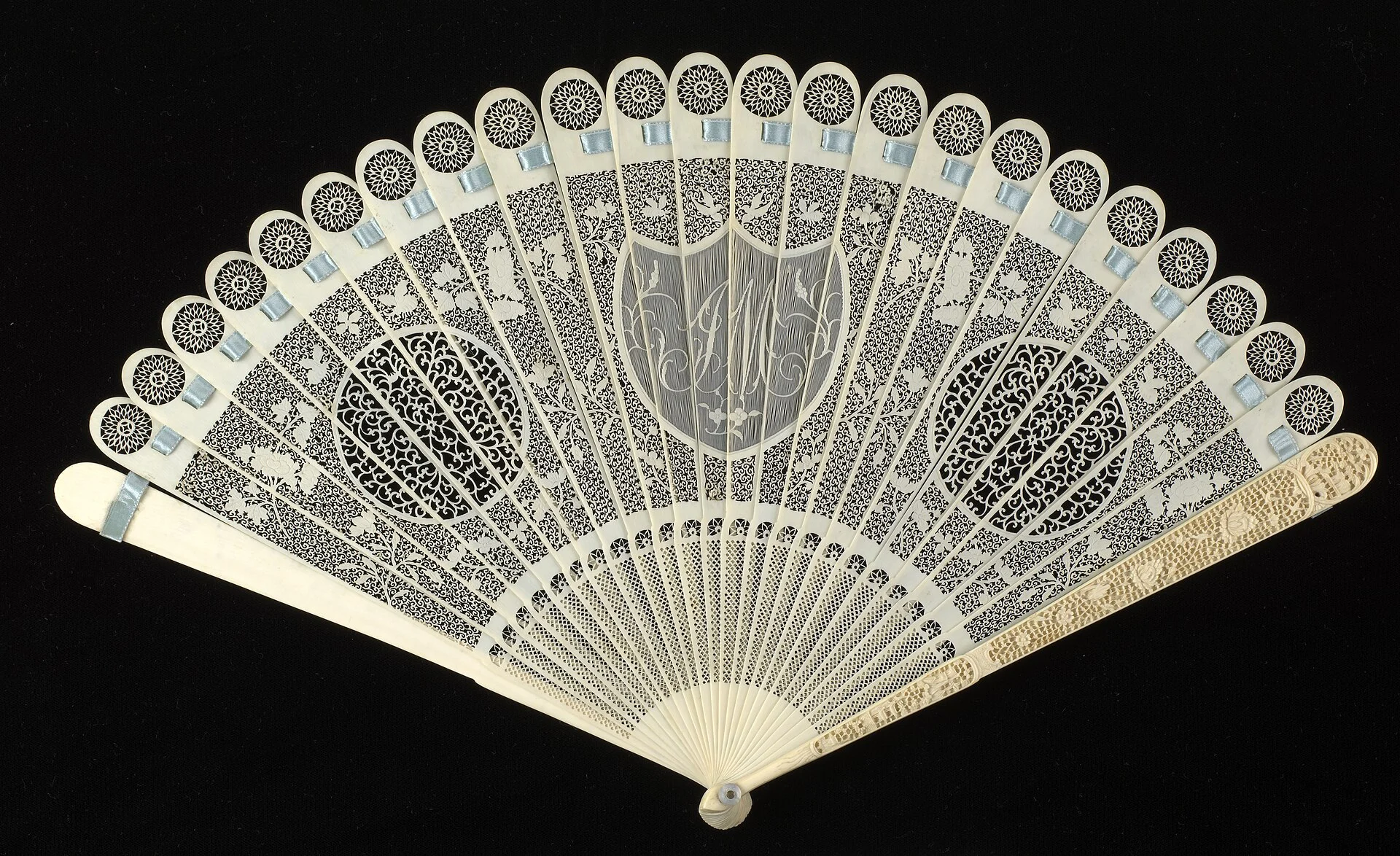
By the end of the 17th century, Britannica records, enormous consignments of Chinese and, to a lesser extent, Japanese fans were reaching Europe, most of them of lower quality and made for the European market. The East India Company exported many fans made in China. A V&A example made between 1720 and 1730 is a brisé fan of carved, pierced, painted and gilt ivory sticks held together with silk cord, decorated in panels with figures, birds, pavilions, willow, lotus and camellia. The museum notes that Chinese makers often followed European models, and that the decoration mixes Chinese motifs with Rococo, Baroque and Gothic elements in the blend known as chinoiserie.
Fans also travelled back to Japan. The Traditional Craft Industries Promotion Association records that folding fans which reached Europe and were adapted there into Western-style fans were later brought back to Japan as kinusen, or silk fans. Japanese fans in turn returned to Europe as works of art. The Suntory Museum of Art reports that in 1878 Japan presented about 100 fans at the Paris International Exposition, chosen to represent the range of Japanese painting, and that they fed the wider European and American fascination with Japan known as Japonism.
In 19th-century Europe, fan sizes followed fashion. Britannica gives a radius of about 8 inches for fans of the first three decades of the century, while Victorian fans exceeded 20 inches. Leicester Museums notes that fans lost favour among the wealthy after the French Revolution and that cheaper imitations weakened their association with luxury, until the Paris fan maker Duvelleroy revived interest and Jules Duvelleroy published The Language of Fans. Britannica dates the decline of the fan in everyday use to after about 1900. In Kyoto, fan making continued: Kyo sensu was designated a traditional craft of Japan on 14 October 1977, and each fan passes through 16 production steps over about one month.
MANDARIN ORIENTAL'S FOLDING FAN EMBLEM AND THE CLUB LOUNGE

The folding fan is the emblem of the Mandarin Oriental hotel group. According to the company, its eleven-bladed fan represents the Group's oriental heritage and unites its hotels as one group, and each Mandarin Oriental hotel also has its own signature fan. The Prague hotel's fan was designed by Jarmila Mucha Plocková, granddaughter of the Art Nouveau artist Alfons Mucha. It is hand-painted on rice paper, with a peacock taken from Mucha-designed curtains in the Municipal House as its central motif. At Mandarin Oriental, Singapore, the designer Hans Tan made a ceramic fan with Peranakan batik motifs, unveiled in May 2024 and displayed in the hotel lobby.
The Club Lounge at Mandarin Oriental Jumeira Dubai was completed by Silverfox Studios in 2019. Rattan window seating and hanging planters overlook the skyline and the Burj Khalifa. A white marble and timber buffet stands under a black steel frame, and the lounge area has a cushioned banquette, a dark timber armchair and a large abstract painting, along with sofas, timber display shelving and a bar counter. Marble-topped tables sit under a cove-lit ceiling with timber beams. Timber and rattan recur through the room, natural materials of the kind used in the earliest folding fans: the hiogi of overlapping hinoki cypress strips and the kamiogi on its bamboo frame.
SOURCES
- Britannica Fan: history, types and uses in decorative arts
- Government of Japan, Highlighting Japan Sensu folding fans, December 2022
- Suntory Museum of Art Folding fans exhibition, 28 November 2018 to 20 January 2019
- Traditional Craft Industries Promotion Association KYO Sensu (Folding Fans)
- National Palace Museum The Art of a Gentle Breeze: Painting and Calligraphy on Folding Fans
- Leicester Museums Folded Hand Fans: An International Cultural Icon
- Victoria and Albert Museum Brisé fan, probably Florence, 1620s
- Victoria and Albert Museum Brisé fan, China, 1720 to 1730
- Mandarin Oriental Symbol of the Fan, Mandarin Oriental, Prague
- Mandarin Oriental Mandarin Oriental, Singapore unveils new signature fan by Hans Tan