HOW THE FRENCH WORD FOR BREWERY CAME TO NAME PARIS'S BEER-SERVING RESTAURANTS AND THEIR LISTED INTERIORS
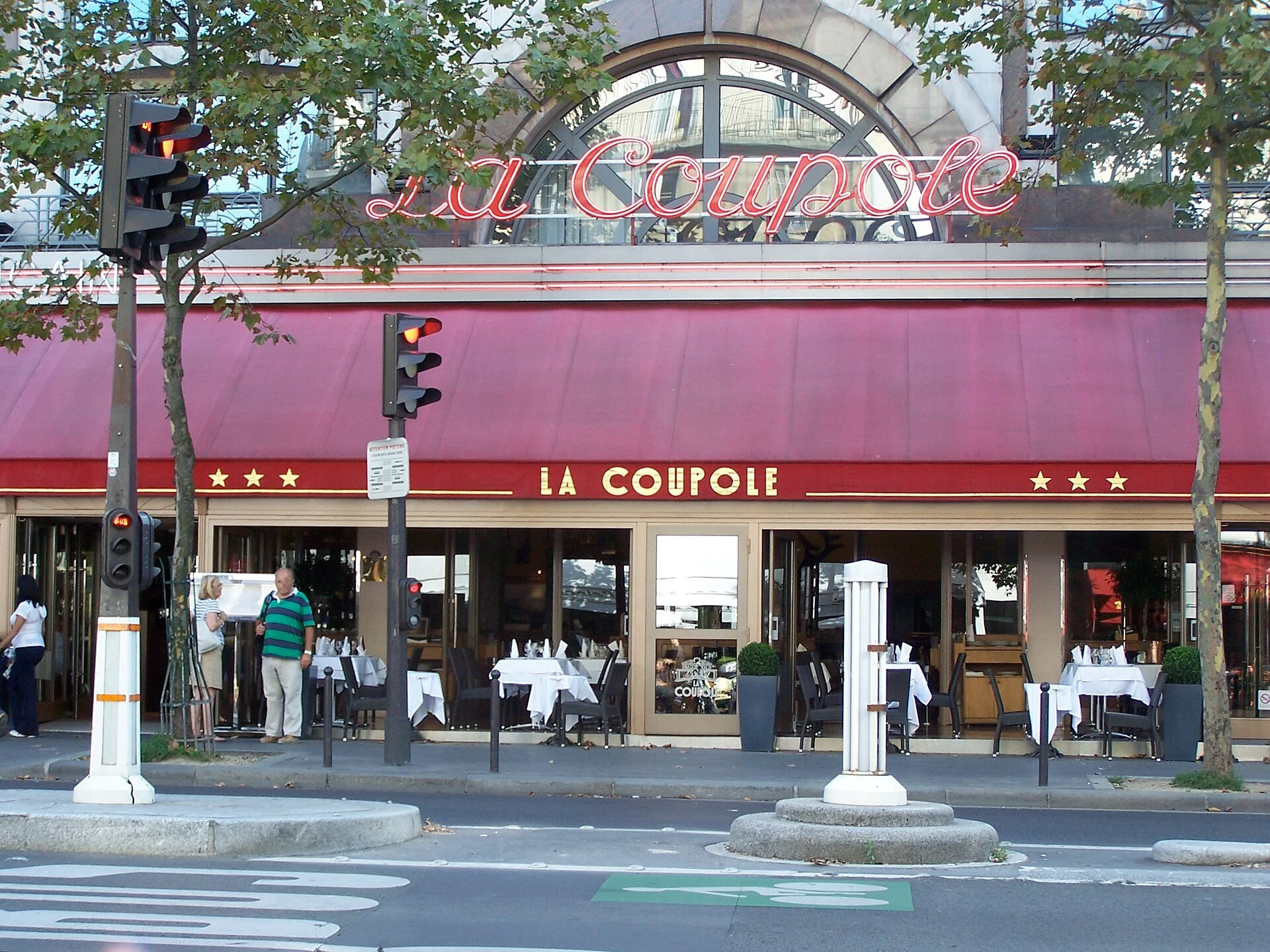
A brasserie is a French restaurant serving beer with simple, hearty food, and the word itself means brewery. In Paris the brasserie took its familiar form in the second half of the 19th century, when Alsatian proprietors opened beer-serving restaurants with dishes from their home region, choucroute above all. Bofinger, founded near the Bastille in 1864 by an innkeeper from Colmar, became the first Parisian brasserie to serve beer on tap in 1870. Léonard Lipp, also from Alsace, opened his brasserie on the boulevard Saint-Germain around 1880, and La Coupole opened in Montparnasse in 1927. These rooms were fitted with ceramic panels, stained glass, mosaic and painted canvases, and between 1988 and 1997 the French state protected the interiors of La Coupole, Bofinger, Lipp, Mollard and Julien as historic monuments.
WHAT DOES BRASSERIE MEAN?

Merriam-Webster defines a brasserie as an informal, usually French, restaurant serving simple hearty food, and records the first known use of the word in English in 1825. In French the word literally means brewery. It comes from the Middle French verb brasser, to brew, which derives from Old French bracier and the Vulgar Latin braciare. The Latin word is of Celtic origin and is related to the Welsh brag, meaning malt. A brasserie was therefore first a place where beer was made, and the name then passed to the establishments where beer was served and drunk with food.
Bofinger, on the corner of the rue de la Bastille and the rue Jean-Beausire in the 4th arrondissement, shows that change in a single building. It was founded in 1864 by Frédéric Bofinger, an innkeeper from Colmar in Alsace. According to the French Ministry of Culture's heritage record, it became the first Parisian brasserie to serve beer on tap in 1870, and part of its original decoration may date from around 1880. The record lists the brasserie across three street numbers, 3, 5 and 7 rue de la Bastille, as well as 1 rue Jean-Beausire, an extent the brasserie reached through enlargements in 1919 and 1930.
HOW ALSATIANS SHAPED THE PARIS BRASSERIE
A study published through RUDN University in 2020 dates the spread of the Paris brasserie to the years after 1870, when Alsatians who had left their home region settled in Paris and opened beer-serving restaurants. Their kitchens served the food of Alsace: choucroute, onion soup and tarte flambée. The study also notes that these brasseries quickly became regular meeting places for writers, poets, philosophers, artists and musicians. Bofinger's founder from Colmar had set the pattern in the 1860s; the establishments opened by later arrivals carried the same combination of Alsatian beer and Alsatian cooking to other parts of the city.
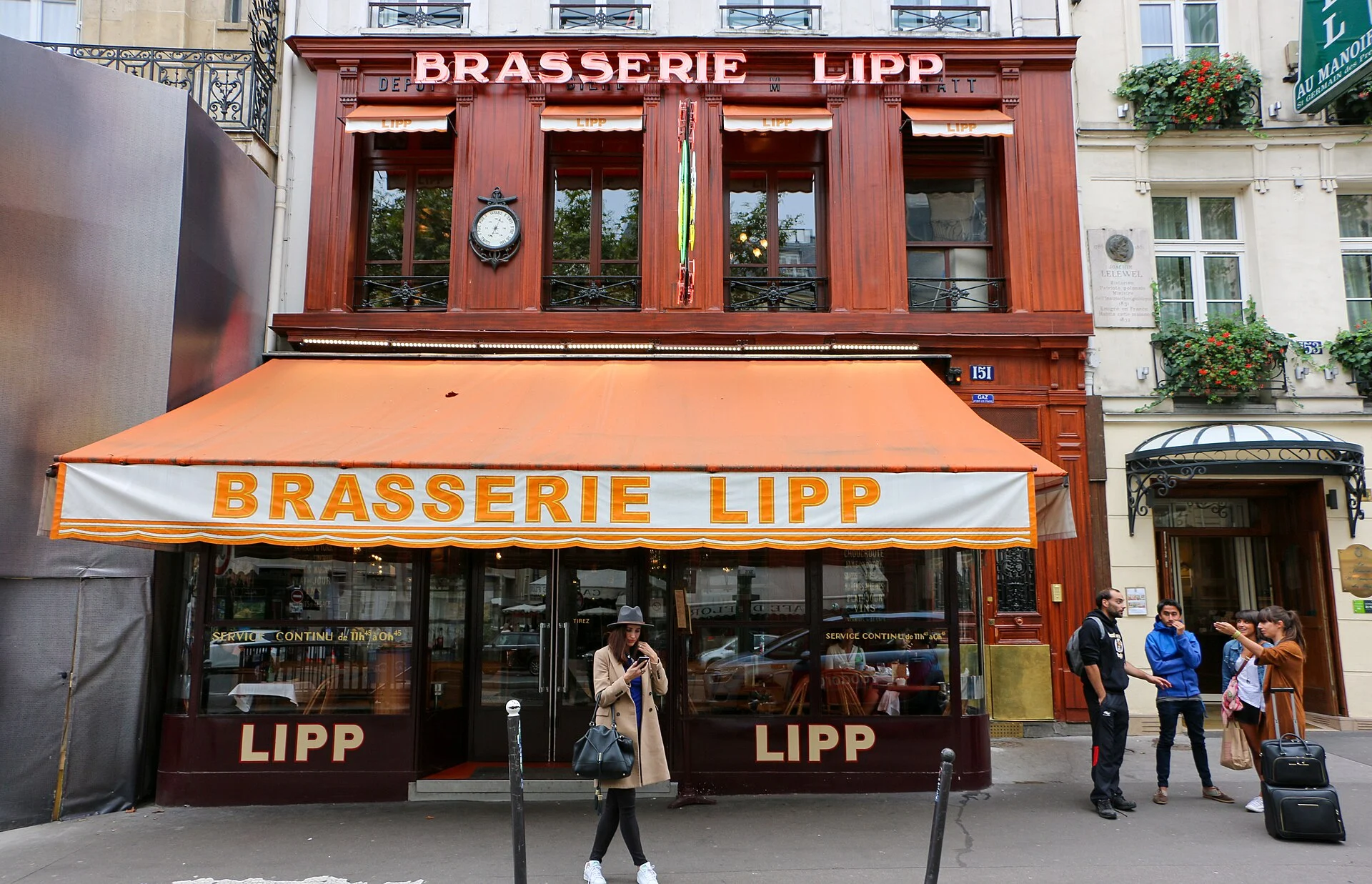
Brasserie Lipp is the clearest example. Around 1880 Léonard Lipp, an Alsatian, opened a brasserie known as the Bords du Rhin, the banks of the Rhine, at 151 boulevard Saint-Germain in the 6th arrondissement. Its shopfront, which rises over two levels, probably dates from this first period. In 1920 the business was bought by Marcellin Cazes, and in 1926 it opened under its present name. The Ministry of Culture's record notes that the brasserie went on to play an important part in the literary life of Paris.
WHAT DOES A FRENCH BRASSERIE SERVE?
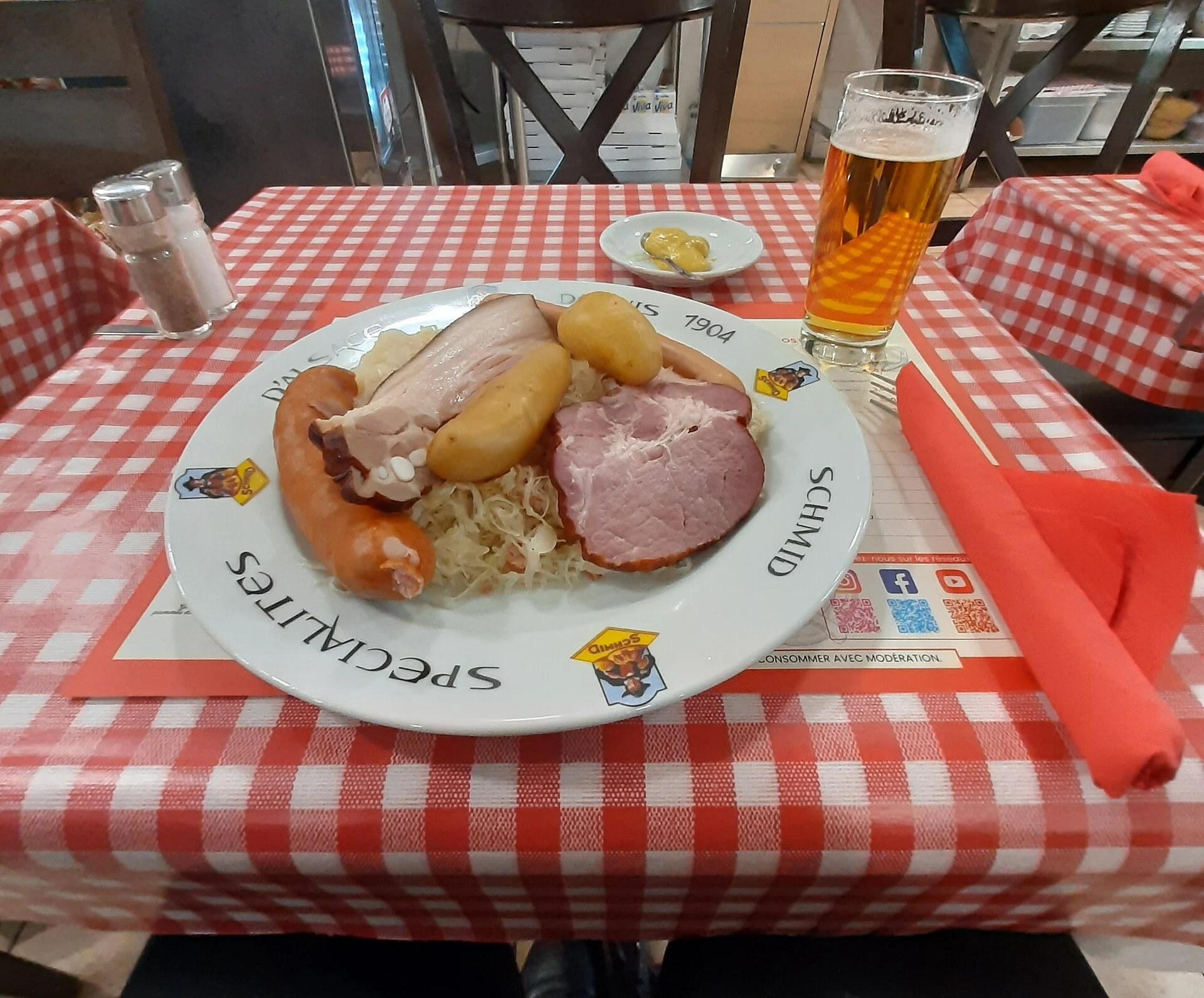
Choucroute, the French word for sauerkraut, is the dish most closely tied to the brasserie. Britannica describes sauerkraut as finely shredded white cabbage layered with salt in a large crock or wooden tub under a weighted lid, then left to ferment, ideally below 15.5°C, for at least a month. Caraway seeds, peppercorns or juniper berries are sometimes added during fermentation. Served with smoked meats and sausages, it becomes choucroute garnie. Britannica adds that the preparation was known to the Romans, was later lost in the West, and was reintroduced from China by the Tatars in the 13th century.
A guide published by the Paris tourist office includes several brasseries and their dishes. It names Bofinger's choucroute and flambéed kouglof as its signature dishes, and describes L'Alsace on the Champs-Élysées, a brasserie since 1968, as open 24 hours a day, seven days a week, with choucroute on the menu. Seafood is the other constant. Le Grand Café Capucines, opened in 1875, is listed for its seafood platters, Le Vaudeville on the rue Vivienne runs an oyster bar, and the office describes Wepler on the place de Clichy as the first oyster bar in Paris. At La Coupole, a lamb curry à l'indienne has been on the menu since 1927.
ART NOUVEAU BRASSERIE INTERIORS: MOLLARD AND JULIEN
Art Nouveau, which Britannica dates from about 1890 to about 1910, is defined by a long, sinuous, organic line and was applied to architecture, interior design, glass, posters and illustration. Paris brasseries and restaurants built in these years used it for their dining rooms. Brasserie Mollard, at 113 to 115 rue Saint-Lazare in the 8th arrondissement, was built in 1895 to designs by the architect Édouard Niermans. Its heritage record dates the main building campaign to that year and protects the interior decoration, which the Paris tourist office describes as a 1900-style interior.
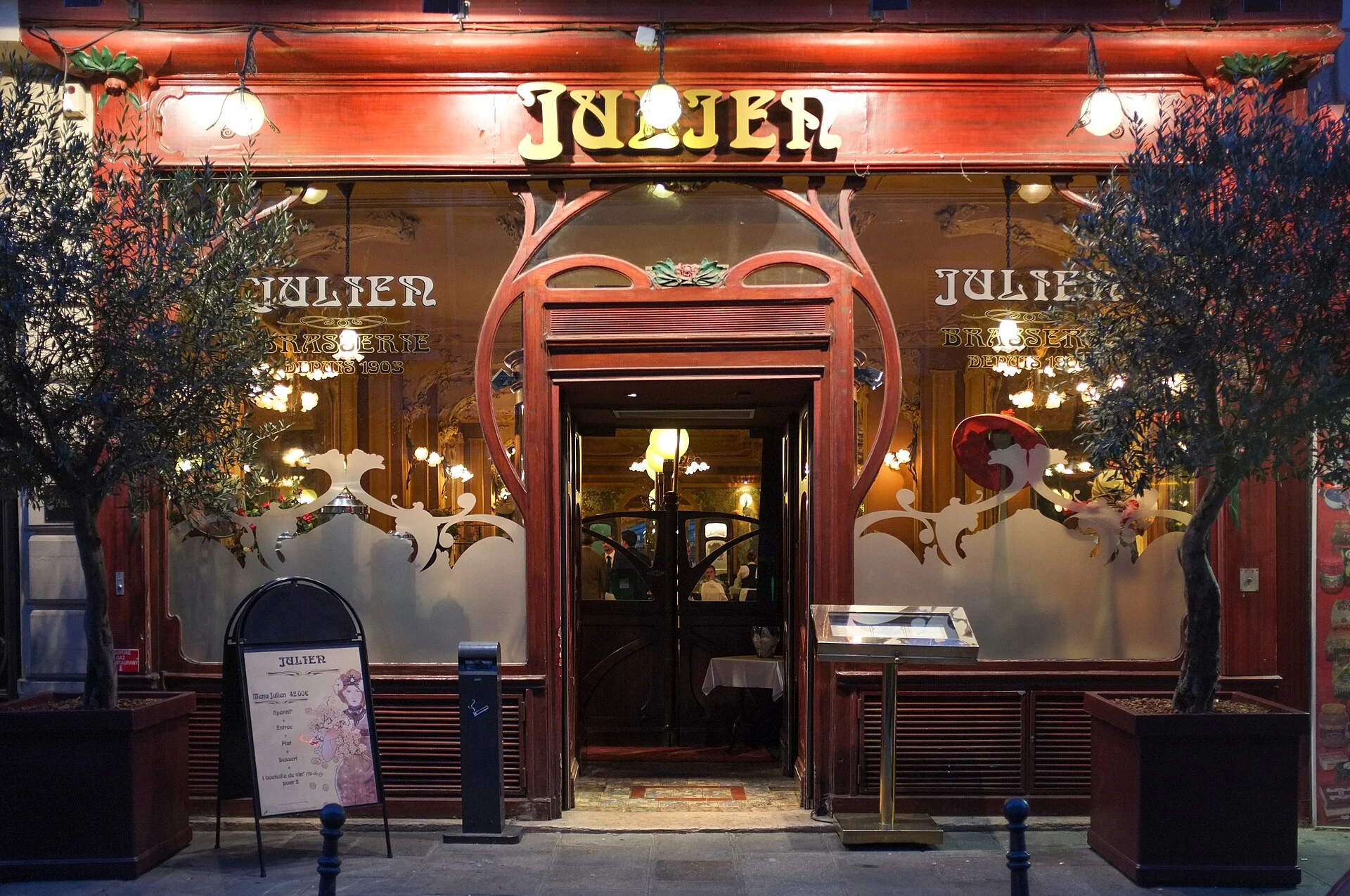
Julien, at 16 rue du Faubourg-Saint-Denis in the 10th arrondissement, has a fuller record. A restaurant stood on the site in 1850. The present room was created between 1902 and 1905 by Edouard Fournier, its architect-engineer and owner, and first traded as Gandon-Fournier. It later became a Chartier bouillon before taking the name Chez Julien in 1938. Its walls carry painted panels on pâte de verre made in the workshops of Louis Trézel at Levallois-Perret. Four panels of the seasons draw directly on the work of Alphonse Mucha, panels of peacocks are signed A. Segaud, and the mahogany bar near the entrance is attributed to Louis Majorelle, the cabinetmaker from Nancy. Plant-motif mouldings in staff, a plaster-based material, frame the panels.
BOFINGER AND LIPP: HOW THE BRASSERIE INTERIOR GREW AFTER 1919
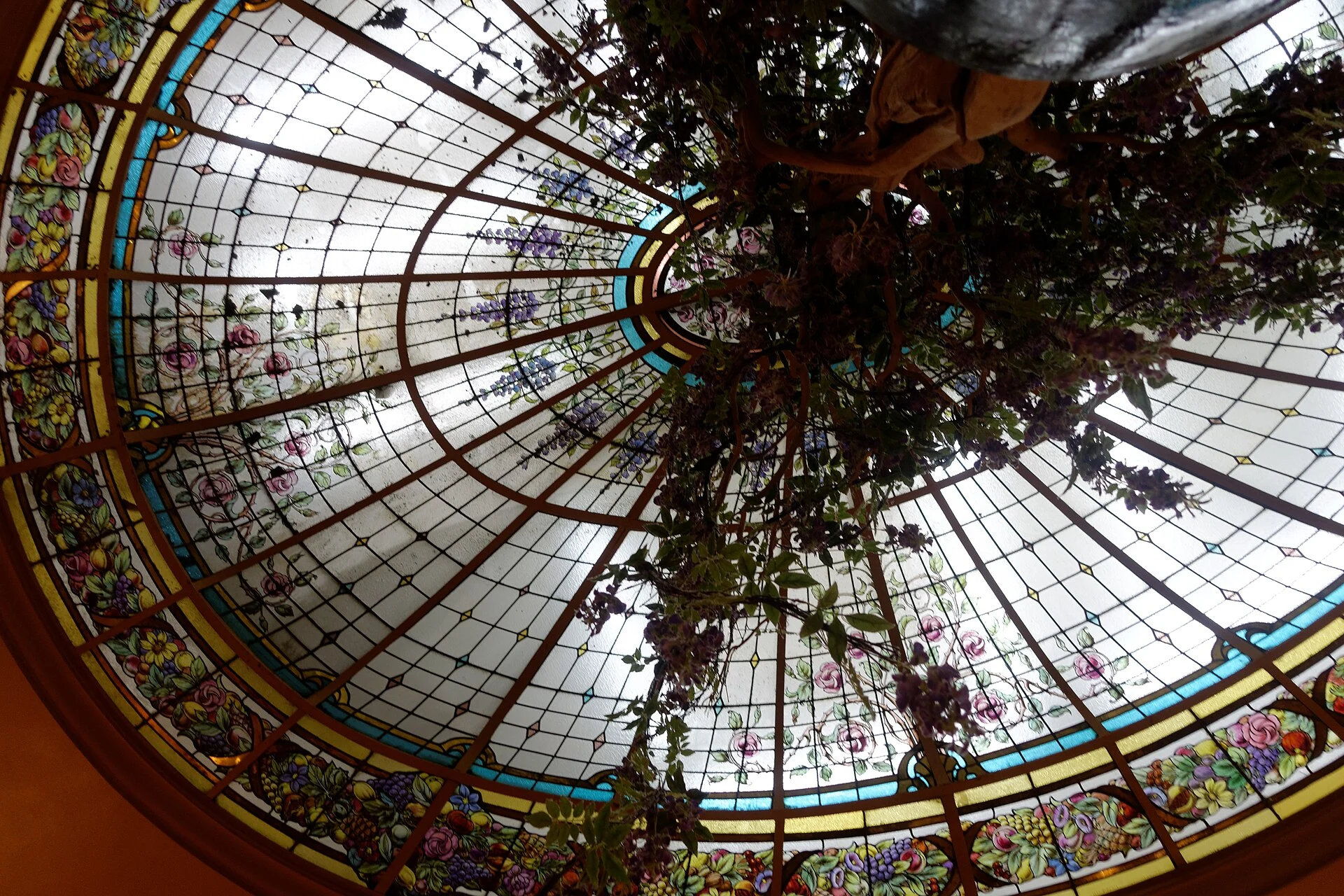
In 1919 Bofinger expanded into three neighbouring shops, and from 1919 to 1921 the architect Legay and the decorator Mitgen redecorated the enlarged brasserie. Their work includes the oval dome with floral motifs over the main room. The master glaziers G. Neret and E. Royer signed the first-floor stained glass, which shows Gambrinus, the figure the heritage record calls the king of beer, and the sculptor Jérôme Massier made the ceramic herons. A further enlargement followed in 1930. In 1931 a room was painted with Alsatian landscapes by Jean-Jacques Waltz, known as Hansi, who also designed the brasserie's sign. In 1982 the shopfront was rebuilt in oak to its 1919 design.
Lipp's interior was created in large part in the early 20th century. The ceramicist Léon Fargue made the panels in the original room, which show exotic plants, including banana trees, cacti, palms and bamboo, drawn with close botanical accuracy. The painter Charley Garry decorated the ceilings. After Marcellin Cazes bought the business in 1920, the architect Léon Madeline added a second room in 1925 and repeated Fargue's panels there in mosaic. The enclosed terrace on the boulevard was added in 1947. Lipp therefore has two rooms with the same plant designs in different materials: ceramic in the original room and mosaic in the second.
LA COUPOLE AND THE MONTPARNASSE BRASSERIE OF 1927
La Coupole, at 102 boulevard du Montparnasse in the 14th arrondissement, was built in 1927 for the restaurateurs Ernest Fraux and René Lafon to designs by the architects Barillet and Le Bouc. Its heritage record explains that the name followed those of its neighbours, Le Dôme and La Rotonde. The building was planned as three establishments in one: a dancing hall in the basement, a brasserie on the ground floor and a summer restaurant upstairs. In 1931 the upper restaurant was covered with a dome of glass slabs. La Coupole opened two years after the 1925 Paris Exposition, and the Paris tourist office describes it as an Art Deco brasserie.
The decoration was organised by the decorator Solvet with 32 artists from Montparnasse, who painted canvases fixed to the top of the pillars in the ground-floor dining room. Fernand Léger is among the painters named, although the heritage record states that the attribution of individual canvases is uncertain. The ground-floor room was listed as a historic monument on 12 January 1988. In the same year the building was raised and renovated: six floors of offices now stand above the brasserie, behind a facade designed to recall the architecture of the 1930s, while the 1927 room with its painted pillars remains in use at street level.
HOW PARIS PROTECTED ITS BRASSERIE INTERIORS
Between 1988 and 1997 the French state protected the decoration of five Paris brasseries and restaurants as historic monuments. La Coupole's ground-floor room was listed in January 1988. Bofinger followed on 13 March 1989, with protection covering its facades on the first two levels, including the sign, and its interior decoration. Lipp's two-level shopfront and ground-floor interiors were listed on 26 May 1989, and Mollard's interior decoration on 9 November 1989. All are privately owned, and in each case the protection is partial: it applies to the decorated rooms and shopfronts rather than to the whole building.
Julien took longer. Its interior decoration was first listed on 23 February 1990, a decision that was later annulled. On 21 October 1997 its dining room was classified as a historic monument, and the street facade, the restaurant shopfront and the corresponding roof were listed by the same order. The protection dossiers for all five were prepared in 1992. Each record also notes that the building lies within a site inscrit, a protected site, and for Bofinger, Mollard, Julien and La Coupole that designation dates from an order of 6 August 1975.
BREWING ON SITE AT BROADWAY, EMIRATES PALACE ABU DHABI

The word brasserie began as the French for brewery, and beer runs through the history of the Paris brasserie: Bofinger served it on tap from 1870, Lipp was opened by an Alsatian around 1880, and La Coupole combined a ground-floor brasserie with a basement dancing hall in 1927. Broadway at Emirates Palace Abu Dhabi, completed by Silverfox Studios in 2023, is a brasserie and brewery bar, and beer is brewed on site. Its design is based on a 1920s warehouse brewery in New York's theatre district, the area that grew up around Times Square.
The interior refers to the 1920s through painted surfaces and lettering. Its brick walls are painted with faded 1920s advertising in the manner of ghost signs, and The Cellar lounge has a brick vaulted ceiling with theatre ghost art. The lettering uses a 1920s typeface, with Broadway spelled out in neon. The same decade shaped the main Paris brasserie interiors: Bofinger was redecorated from 1919 to 1921, Lipp gained its second room in 1925, and La Coupole opened with its painted canvases in 1927.
SOURCES
- Ministère de la Culture, POP (Mérimée) Brasserie Bofinger (PA00086249)
- Ministère de la Culture, POP (Mérimée) Brasserie Lipp (PA00088494)
- Ministère de la Culture, POP (Mérimée) Brasserie Mollard (PA00088884)
- Ministère de la Culture, POP (Mérimée) Immeuble abritant le restaurant Julien (PA00086515)
- Ministère de la Culture, POP (Mérimée) Restaurant La Coupole (PA00086635)
- Merriam-Webster Brasserie: definition and etymology
- RUDN University In Search of Paris Brasseries (2020)
- Paris je t'aime, Paris Tourist Office Brasseries and restaurants for business lunches in Paris
- Encyclopaedia Britannica Sauerkraut
- Encyclopaedia Britannica Art Nouveau