HOW A CARRIAGE-MAKING DISTRICT IN MIDTOWN MANHATTAN BECAME THE CENTRE OF AMERICAN THEATRE
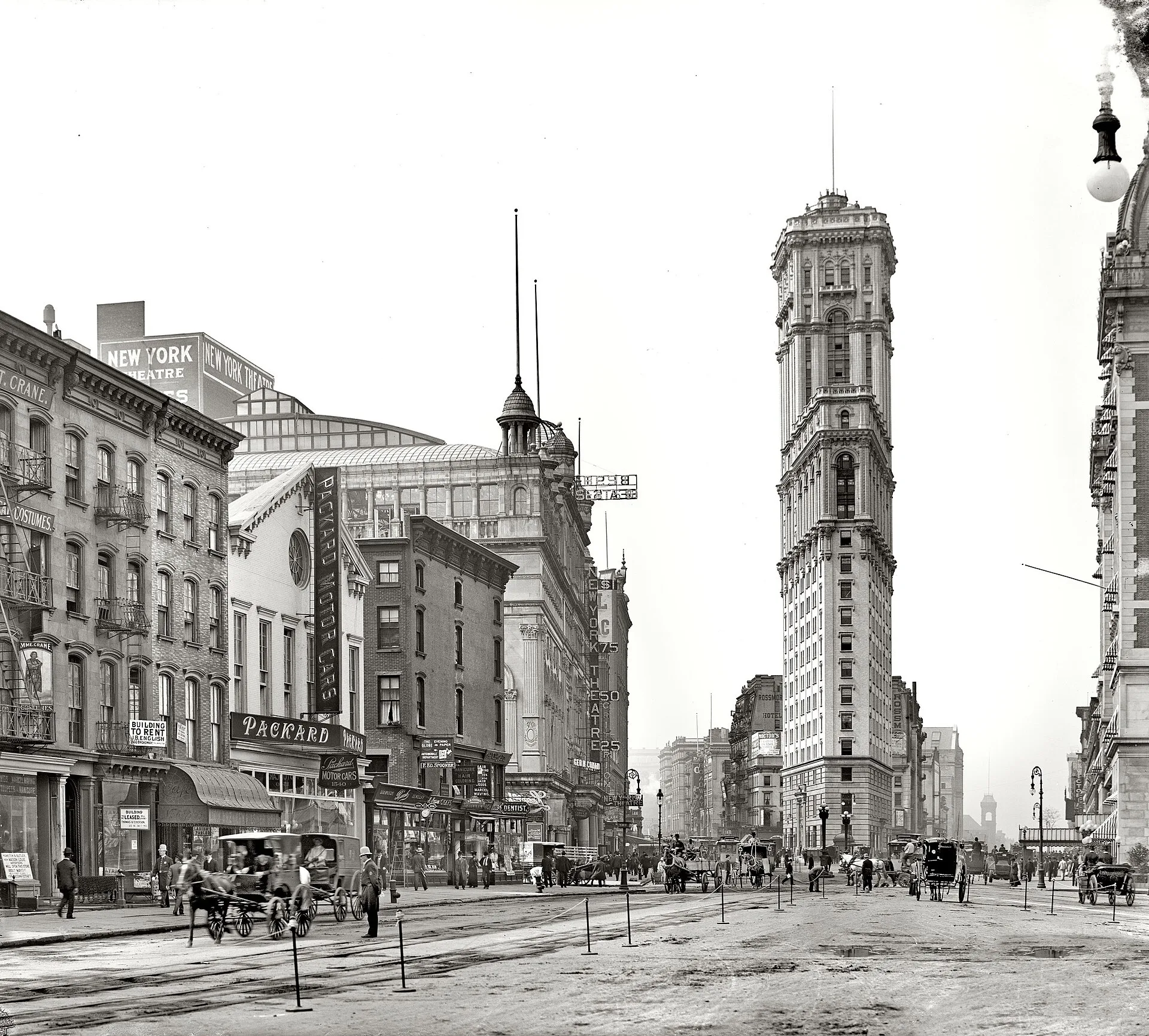
Times Square is the junction of Broadway, Seventh Avenue and 42nd Street in Midtown Manhattan, and the centre of New York's Theatre District. Until 1904 it was called Longacre Square, an area of carriage makers, stables and horse dealers. Within three decades it held most of the city's theatres. According to the New York City Landmarks Preservation Commission, 43 theatres were built in midtown between 1901 and 1920, and around 30 more went up in the Times Square area after the First World War. The Christian Science Monitor records that in the 1927 to 1928 season nearly 300 plays and musicals opened at some 60 theatres. The growth of the Broadway theatre district had several causes: the steady northward movement of New York's theatres, a commercial rivalry between producers, a newspaper's new headquarters, the subway and electric light. The Depression then ended the boom, leaving a stock of theatres that is now protected by landmark designation.
LONGACRE SQUARE BEFORE THE THEATRES
In the late 19th century the area was the centre of New York's carriage-making trade, and it took its name from Long Acre, the carriage district of London, according to the Rockwell Center for American Visual Studies at the Norman Rockwell Museum. The Times Square Alliance, the district's business improvement organisation, records that it was the early site of William H. Vanderbilt's American Horse Exchange. In a 1999 history of the square, The Christian Science Monitor described the 19th-century Longacre Square as a ramshackle area of horse stables, carriage-repair shops, bars and brothels. Transport links arrived before the theatres. The Landmarks Preservation Commission's report on the Hudson Theatre notes that a horsecar line ran across 42nd Street in the 1860s, and that in 1871 Grand Central Depot opened and the Third and Sixth Avenue elevated railways were completed.
HOW THE THEATRE DISTRICT MOVED NORTH TO TIMES SQUARE
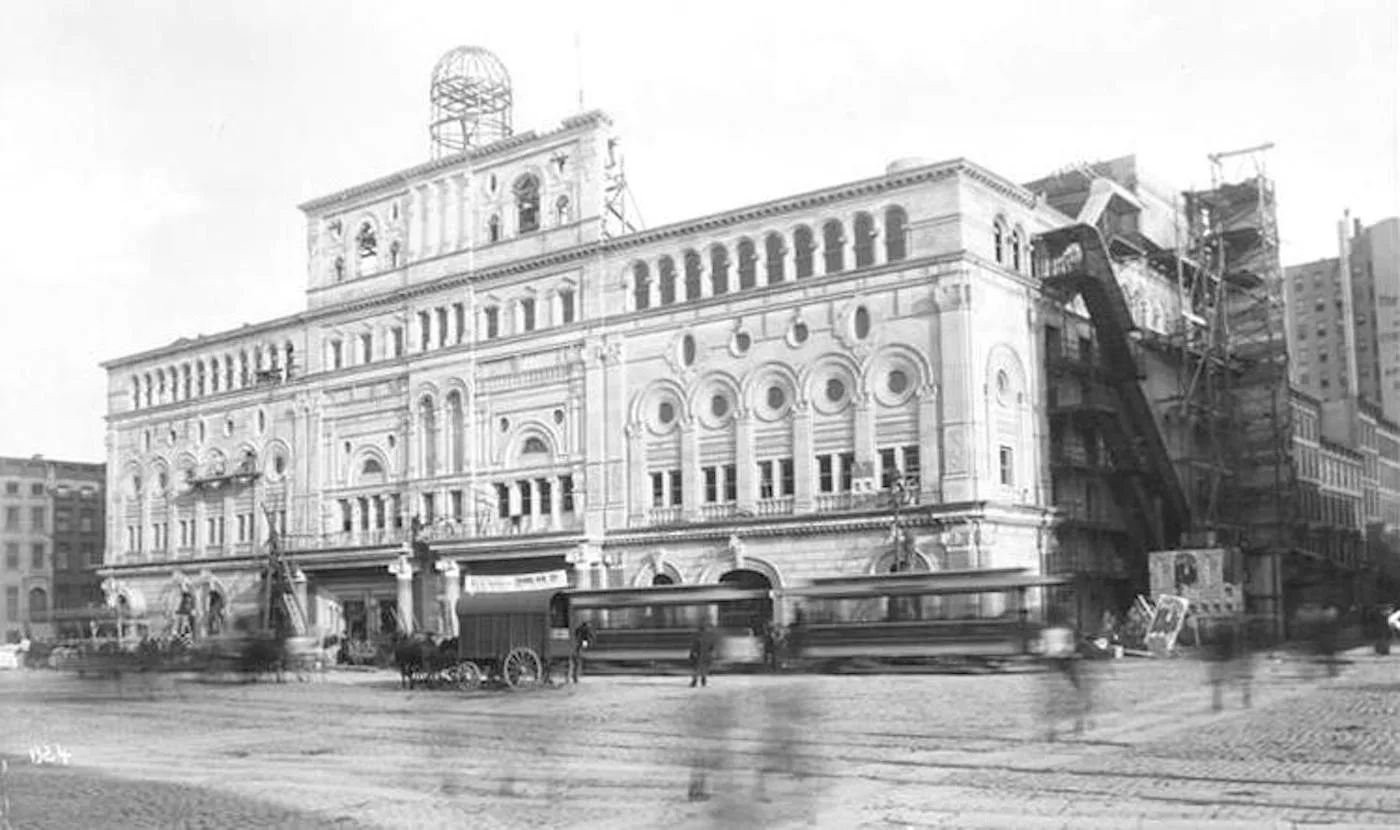
New York's theatres moved up Broadway throughout the 19th century. The Commission's reports describe managers pushing the district north from lower Broadway, with stops at Union Square, Madison Square and Herald Square, before it reached Long Acre Square. By the 1880s and 1890s the leading edge was in the high 30s and low 40s. The Casino Theatre opened at Broadway and 39th Street in 1882, the Metropolitan Opera House on Broadway between 39th and 40th Streets in 1883 and the Broadway Theatre at Broadway and 41st Street in 1888. The American Theatre, Abbey's Theatre and the Empire Theatre all opened in 1893.
The first theatre in the square itself was Oscar Hammerstein's Olympia, built between 44th and 45th Streets. Its Lyric section opened on 25 November 1895 and its Music Hall a little over three weeks later. The Olympia closed two years after opening, but it established the square as a place for theatre, and the Commission records that Hammerstein became known as the Father of Times Square. The Rockwell Center dates the area's shift towards theatres, restaurants and electric signs to the Olympia's opening. Others followed within a few years: the Hudson Theatre and the New Amsterdam both opened in 1903.
WHY WAS LONGACRE SQUARE RENAMED TIMES SQUARE?
The name came from a newspaper. Adolph S. Ochs, owner and publisher of The New York Times from 1896 to 1935, built the Times Tower in the square, and on 8 April 1904 Longacre Square was renamed Times Square after it, at Ochs's suggestion, according to the Rockwell Center. The Times Square Alliance records that Mayor George B. McClellan signed the renaming resolution, that the tower was then the second-tallest building in the city, and that the paper moved into its new headquarters between 42nd and 43rd Streets in January 1905. Ochs also staged a New Year's Eve event at the building, and from 1907 a ball of electric lights was lowered there on New Year's Eve, an idea the Rockwell Center attributes to him. The Times itself did not stay long: by 1913 it had moved to West 43rd Street.
The renaming coincided with the subway. The Commission notes that the subway opened in 1904 with a major station at 42nd Street and Broadway. The Interborough Rapid Transit Company was New York's first rapid transit system, and according to the Times Square Alliance its Times Square station served almost five million passengers in its first year, 1905. By the late 1920s subway, elevated and bus lines all stopped at West 42nd Street. Hotels followed the crowds. The Alliance records that the Astor and the Knickerbocker hotels were established in the square, and the Monitor notes that the tenor Enrico Caruso kept a 14-room apartment at the Knickerbocker, at 42nd Street and Broadway.
THE THEATRE BUILDING BOOM OF 1901 TO 1920
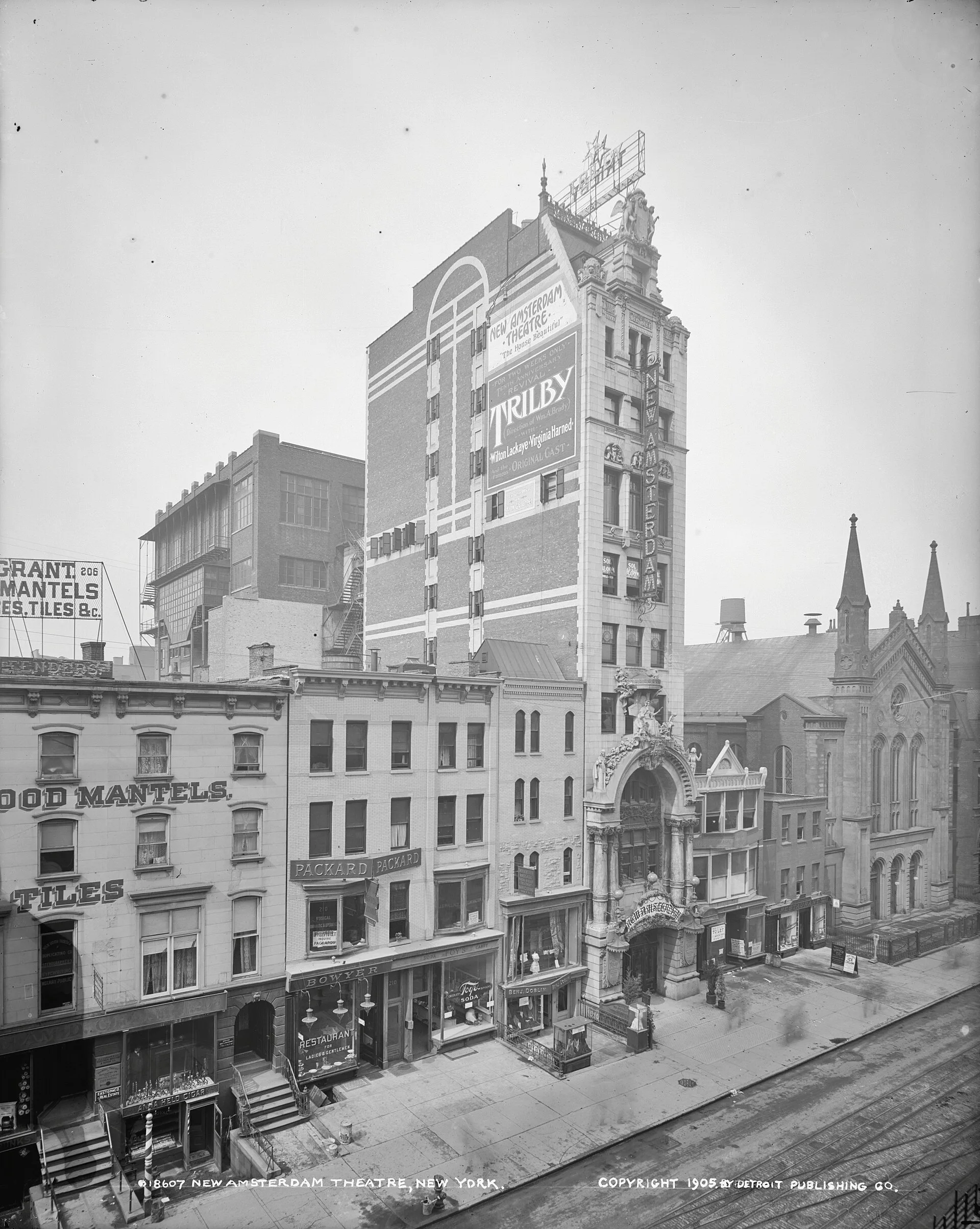
The largest wave of construction came between 1901 and 1920, when 43 theatres were built in midtown, mostly on the side streets east and west of Broadway. The Commission attributes much of it to competition between the Theatrical Syndicate and the Shubert brothers for control of touring productions. One of the most important was the New Amsterdam on West 42nd Street. Klaw & Erlanger bought the site in 1902, the architects Herts & Tallant designed it, and it opened on 26 October 1903. It became a leading musical comedy house, and Florenz Ziegfeld presented his Follies there from 1913 to 1920, from 1922 to 1925 and in 1927.
Herts & Tallant designed several other theatres in the district, including the Lyceum (1903), the Liberty (1904), the Gaiety (1909) and, in 1913, the Booth, the Longacre and the Shubert. The Hudson Theatre on West 44th Street, completed by Israels & Harder, opened on 19 October 1903 with Cousin Kate, starring Ethel Barrymore, and later presented Man and Superman (1905) and Clarence (1919), with Helen Hayes and Alfred Lunt. On West 46th Street the producer Charles Dillingham opened the Globe on 10 January 1910, naming it after Shakespeare's theatre. The Globe staged Apple Blossoms in 1919, the first American musical to star Fred and Adele Astaire. The Times Square Alliance notes that by the First World War most of New York's legitimate theatres had moved to Times Square.
BROADWAY IN THE 1920S AND THE GREAT WHITE WAY
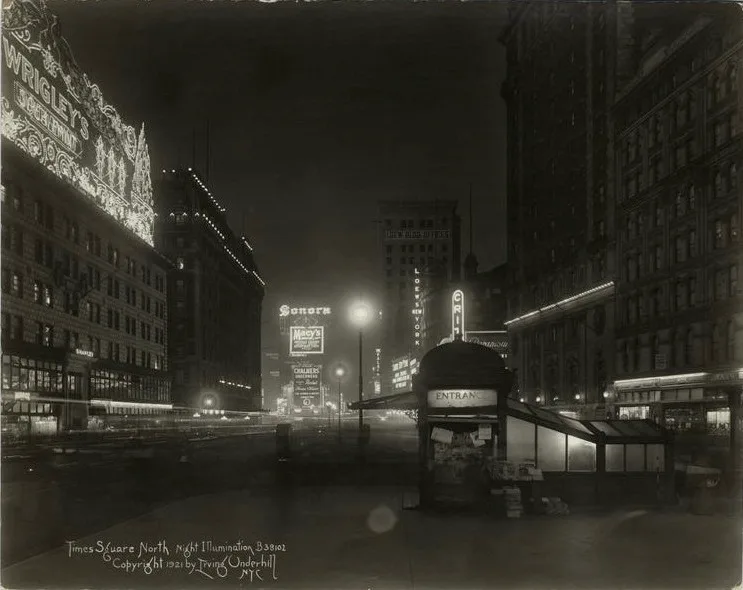
After the First World War, general prosperity paid for about 30 more playhouses in the Times Square area, and the district spread from just west of Eighth Avenue to Sixth Avenue and from 39th Street to Columbus Circle. Much of the building was done by large organisations such as the Shuberts and the Chanins. The Music Box on West 45th Street, built in 1920 and opened on 22 September 1921 with Irving Berlin's Music Box Revue, was one of the few theatres of the decade built for an individual producer, and it later staged Chicago (1926). At the Globe, No! No! Nanette! ran for 329 performances from 1925. In the 1927 to 1928 season, the Monitor records, nearly 300 plays and musicals opened at 60-odd theatres, with at least 11 theatres on 42nd Street between Broadway and Eighth Avenue alone.
Electric light was part of the district's identity. The Rockwell Center traces the signs back to Thomas Edison's incandescent lamp of 1879, and notes that by 1912 a White Rock sign at 47th Street and Broadway was famous enough to appear in print advertising under the line "The Great White Way at Times Square". Theatres with gas-lit marquees multiplied in the area, according to the Monitor. In 1928 the Times Tower added an electric news sign. The Times Square Alliance records that it stayed lit until May 1942, when Mayor Fiorello La Guardia ordered a wartime dimout and the sign went dark for the first time since its debut.
THE DEPRESSION AND THE THEATRES THAT SURVIVED
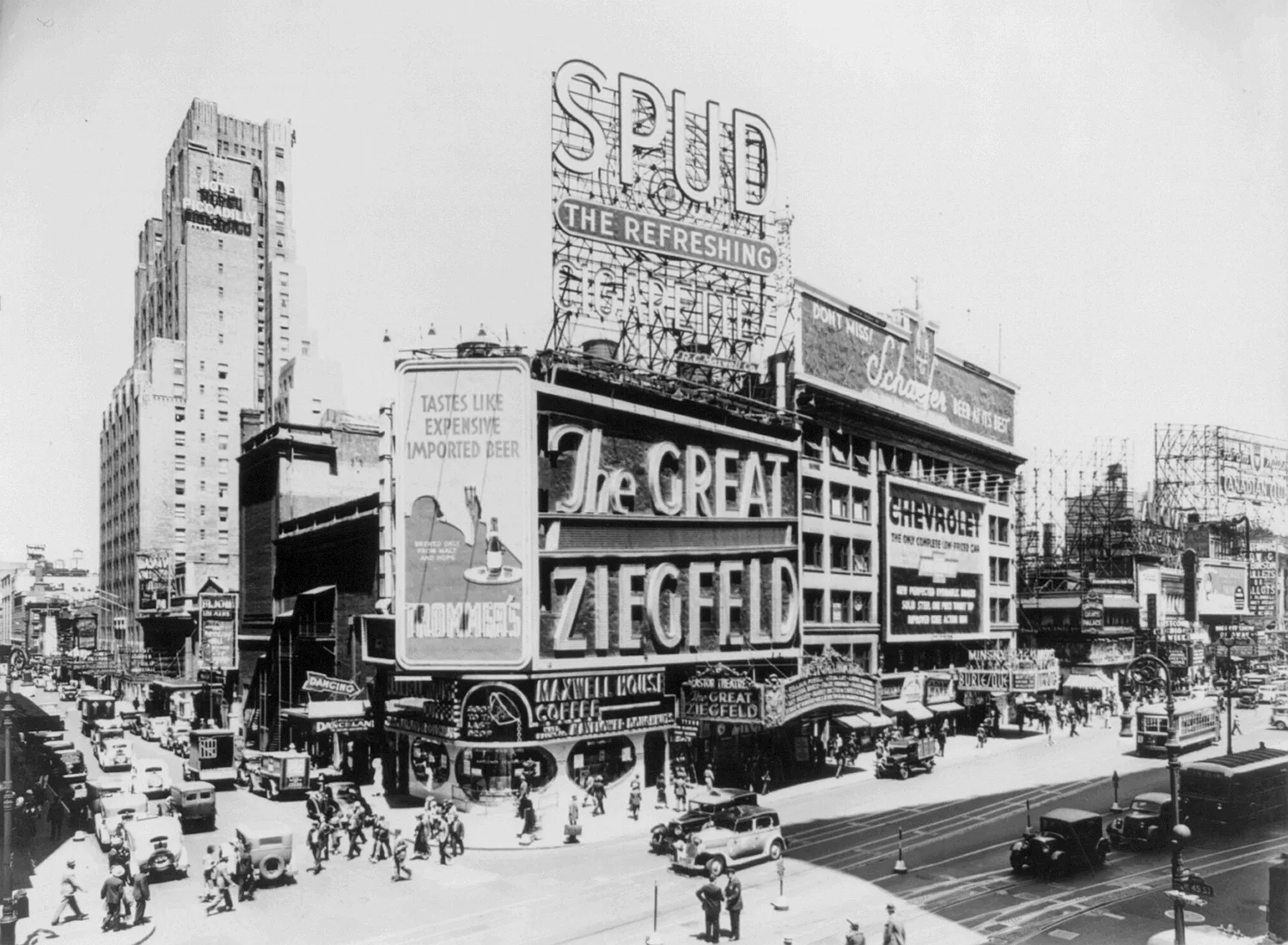
The 1929 stock market crash ended the boom. The Commission records that theatre activity fell sharply: some playhouses were demolished, many became cinemas and some later became radio and television studios, and no new Broadway theatre was built from the Depression until the 1960s. Individual buildings show the pattern. Dillingham lost his fortune, and the Globe went into receivership in 1932 and showed films until 1957, reopening as the Lunt-Fontanne in 1958. The New Amsterdam's mortgage was foreclosed in 1936, and it showed films after its sale in 1937. CBS leased the Hudson as a radio playhouse in 1934, and it returned to live theatre in 1937. The Times Square Alliance notes that during the Depression many theatres became cheap grinder houses showing sexually explicit films.
The surviving theatres were later protected. The Landmarks Preservation Commission designated the New Amsterdam a landmark in 1979, and in November and December 1987 designated the Hudson, the Lunt-Fontanne and the Music Box among a series of Broadway theatres. In 1999 the Monitor counted 33 theatres remaining in the area and reported the view of Brendan Sexton of the Times Square Business Improvement District that zoning laws and landmark status would ensure their survival. The Broadway League recorded attendance of 14.77 million in the 2018 to 2019 season, the highest in its season figures, which begin in 1980 to 1981, and grosses of about 1.91 billion dollars in the 2025 to 2026 season.
BROADWAY AT EMIRATES PALACE

Broadway at Emirates Palace Abu Dhabi is a brasserie and brewery bar designed by Silverfox Studios and completed in 2023. It is imagined as a brewery set up in a 1920s New York warehouse in the theatre district, and beer is brewed on site. Brick columns and walls are painted with faded 1920s advertising to create an aged ghost art effect. In The Cellar, a lounge under a brick vaulted ceiling, the ghost art advertises theatre productions. Signage throughout uses a 1920s typeface, with the Broadway name in neon lettering.
SOURCES
- Britannica Times Square
- Rockwell Center for American Visual Studies, Norman Rockwell Museum The New Broadway: The Street That Knows No Night
- Times Square Alliance History of Times Square
- The Christian Science Monitor How Times Square Became Times Square
- New York City Landmarks Preservation Commission Hudson Theater Designation Report (LP-1340)
- New York City Landmarks Preservation Commission Hudson Theater Interior Designation Report (LP-1341)
- New York City Landmarks Preservation Commission New Amsterdam Theater Designation Report (LP-1026)
- New York City Landmarks Preservation Commission Lunt-Fontanne Theater Designation Report (LP-1350)
- New York City Landmarks Preservation Commission Music Box Theater Interior Designation Report (LP-1360)
- The Broadway League Statistics: Broadway NYC