FLORENZ ZIEGFELD, JOSEPH URBAN AND THE BROADWAY REVUE, 1907 TO 1931
The Ziegfeld Follies were a series of Broadway revues produced by Florenz Ziegfeld Jr., beginning with The Follies of 1907 on a roof theatre at Broadway and 44th Street. Modelled on the revues Ziegfeld had seen in Paris, the shows combined comedy sketches, songs and dance, and the series ran under his management until 1931. Over those years the Follies moved to the New Amsterdam Theatre on West 42nd Street, took on the Viennese designer Joseph Urban as scenic artist from 1915, and featured Fanny Brice, Bert Williams, Will Rogers, W.C. Fields and Eddie Cantor. In 1927 Ziegfeld opened a theatre of his own on Sixth Avenue, designed by Urban. The Depression ended the series under Ziegfeld.
WHERE DID THE ZIEGFELD FOLLIES BEGIN?
Ziegfeld grew up in Chicago, where his father headed the Chicago Musical College. The biographical note of the Florenz Ziegfeld Collection at the Harry Ransom Center, University of Texas at Austin, records that he became the conservatory's assistant manager in 1885, and that in 1893 he and his father opened the Trocadero, a variety hall headlined by the strongman Eugene Sandow. In 1896 he brought the performer Anna Held from Europe; she made her American debut that year in A Parlor Match, his first Broadway production, according to PBS, and they married in 1897. Britannica describes how his publicity for Held, including stories about her milk baths, established his method of building stars. The Ransom Center note traces the idea for the Follies to revues he saw in Paris in 1905, and Britannica names the Folies-Bergère as the model, calling Ziegfeld's version less risqué.
The first edition was staged on a roof. The Internet Broadway Database (IBDB), maintained by the Broadway League, records that Oscar Hammerstein built the Olympia at Broadway and 44th Street in 1895, and that its roof garden later became a theatre in its own right, reopening as the Jardin de Paris on 8 July 1907 with Ziegfeld as manager. The Follies of 1907 opened on that roof, one of the New York roof gardens of the period, the same night. IBDB credits Ziegfeld as having conceived and produced it, with sketches by Harry B. Smith, principals directed by Herbert Gresham and the chorus directed by Julian Mitchell. The show moved on 26 August to the Liberty Theatre, later played the Grand Opera House, and closed on 10 November after 79 performances. The Jardin de Paris housed the first five editions, from 1907 to 1911, and in 1911 the series was renamed the Ziegfeld Follies.
HOW DID THE ZIEGFELD FOLLIES REVUE FORMAT WORK?
A revue was assembled from separate numbers rather than built around one story. Writing for EBSCO Research Starters, Jonas Westover describes the Follies as a combination of comedy scenes, chorus and solo songs and dancing. Early editions had a script, but critics considered the plot the least important element of the evening. Britannica credits Ziegfeld with developing the revue into a spectacular form, and describes the Follies as a mixture of pageantry and comedy that ran each year until the Depression. Its account of his career attaches to his name the slogan "Glorifying the American Girl". In 1929 Ziegfeld used it as the title of a motion picture revue, Westover records.
The Ransom Center note dates Ziegfeld's mastery of the form to the 1915 edition, when he began presenting high-quality talent, costumes and sets, and it identifies 1915 to 1919 as the peak years of the series. Westover writes that by the 1920s each Follies cost thousands of dollars to produce. Ziegfeld ran other productions alongside the revue. Britannica lists his other stage hits Sally (1920), Rio Rita (1927) and Show Boat (1927), and the Ransom Center adds the Somerset Maugham play Caesar's Wife. In 1914 he married the actress Billie Burke, after his divorce from Anna Held, and their daughter Patricia was born in 1916.
THE NEW AMSTERDAM THEATRE AND THE MIDNIGHT FROLIC
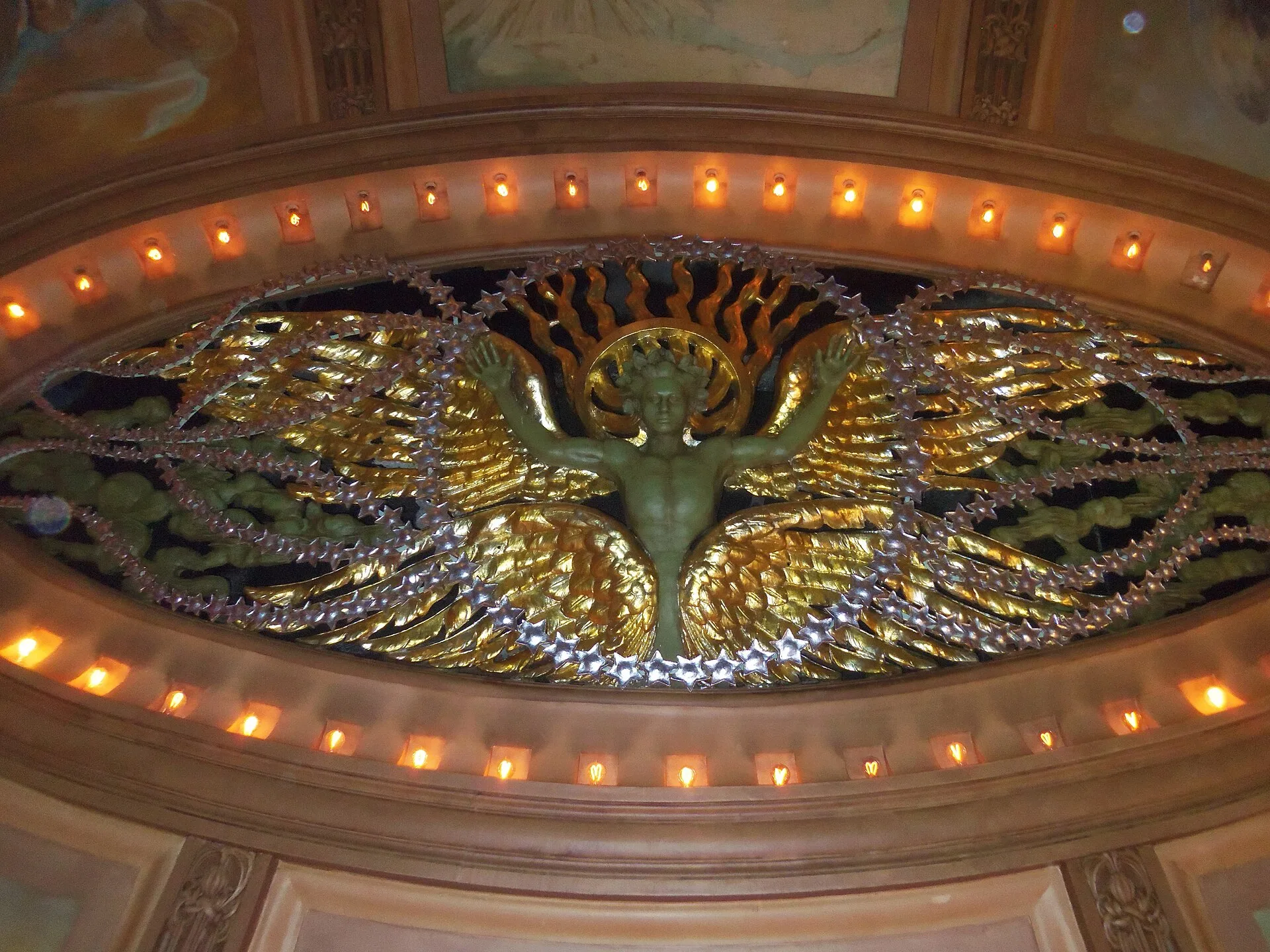
In 1913 the Follies moved to the New Amsterdam Theatre on West 42nd Street, which the Commission describes as for many years one of the most prestigious theatres of the Times Square theatre district. The theatre was built in 1902 to 1903 for the producers Klaw & Erlanger to designs by Herts & Tallant, and opened on 26 October 1903 with A Midsummer Night's Dream, according to the New York City Landmarks Preservation Commission, which designated it a landmark on 23 October 1979. The Commission records that Ziegfeld presented the Follies at the New Amsterdam from 1913 to 1920, from 1922 to 1925 and in 1927, and that his association with the building lasted until his death. Its list of performers who appeared there includes Fanny Brice, Ina Claire, Ed Wynn, W.C. Fields, Will Rogers and Eddie Cantor.
The building also had a rooftop theatre. The Commission notes that the roof theatre is carried on a girder weighing 70 tons, 90 feet long and 14 feet high, and that from 1915 Ziegfeld used it for his Midnight Frolic, a late-night revue. The Ransom Center describes the Frolic as a training ground for Follies performers, and records a second show, the Nine O'Clock Frolic, later renamed the Nine O'Clock Revue, from 1918. Both depended heavily on sales of food and drink, and the arrival of Prohibition had ended them by 1922. Ziegfeld revived the Frolic briefly in 1928 and 1929.
JOSEPH URBAN AND THE DESIGN OF THE ZIEGFELD FOLLIES
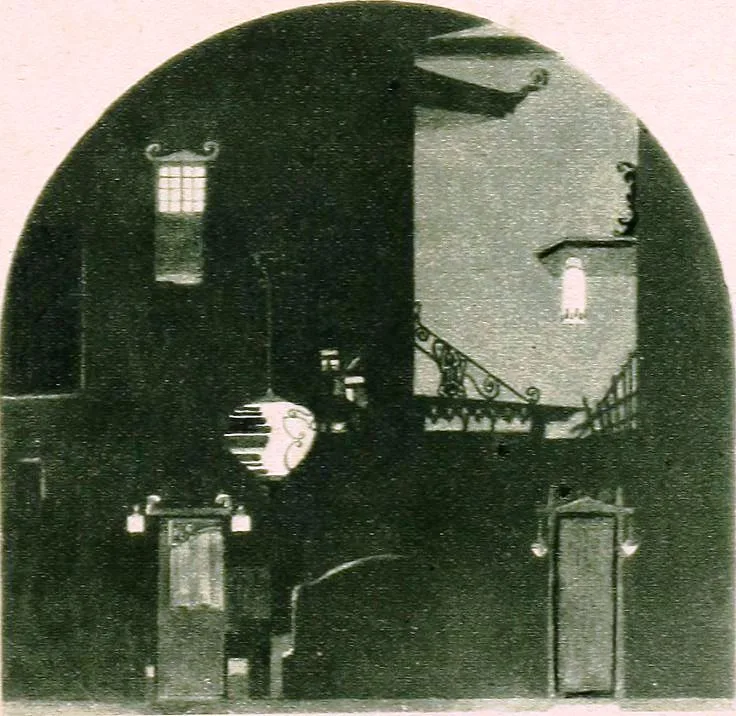
Joseph Urban (1872 to 1933) was born in Vienna and studied architecture at the Akademie der bildenden Künste there, according to Columbia University Libraries, which hold his papers. He worked as an architect, book illustrator, exhibition designer and set designer, and co-founded the Hagenbund with Heinrich Lefler. Columbia states that he emigrated to the United States in 1912, at the age of forty, to become designer for the Boston Opera Company, where he introduced the innovations of the European New Stagecraft; the company went bankrupt in 1914. A Cooper Hewitt post by the reference librarian Elizabeth Broman gives his arrival as 1911. He settled in New York a few years later.
Urban became scenic designer for the Follies in 1915. Cooper Hewitt gives his tenure as 1915 to 1931, and Columbia states that he designed the Follies and all other Ziegfeld productions from 1915 to 1932. He also designed for the Metropolitan Opera, where Columbia records that he worked until his death in 1933. The Ransom Center note records that his lavish sets for the editions of 1915 to 1919, the peak years of the series, drew praise. Among the Urban material at Columbia is the Blue Nursery Scene, a theatre set model in gouache, watercolour and graphite made for the Follies of 1931.
THE STARS OF THE FOLLIES
PBS records that Bert Williams was born in 1874 in New Providence, Nassau, in the British West Indies, and became a showman in 1893 when he joined Martin and Seig's Mastodon Minstrels. There he met George Walker, and the Williams and Walker act made its New York debut at the Casino Theatre in 1898 in The Gold Bug. After Walker fell ill in 1909, Williams worked on his own, and in 1910 Ziegfeld hired him as one of the stars of the Follies. He appeared in the series almost continually from 1910 until he left in 1920. Williams died in New York on 4 March 1922.
Fanny Brice made her Follies debut in the same year as Williams, according to Westover. He writes that W.C. Fields appeared intermittently from 1915 until 1925, that Will Rogers performed in the series well into the mid-1920s, and that Eddie Cantor was a major draw in the 1920s, when he was known for "If You Knew Susie Like I Know Susie" (1925). The Ransom Center adds Nora Bayes, Jack Norworth, Ann Pennington, Ed Wynn and Marilyn Miller to the performers the Follies featured or made famous. Britannica names Marilyn Miller, Will Rogers, Leon Errol, Bert Williams, Fanny Brice and Eddie Cantor among the stars Ziegfeld developed.
THE ZIEGFELD THEATRE OF 1927
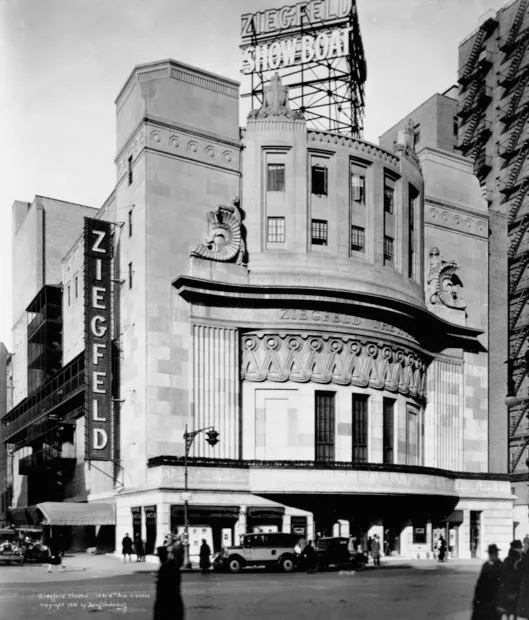
In 1927 Ziegfeld opened a theatre under his own name at the corner of Sixth Avenue and 54th Street. Cooper Hewitt credits the design to Joseph Urban and the theatre and cinema architect Thomas W. Lamb. PBS records that the Ziegfeld Theatre opened with Rio Rita, which ran for nearly 500 performances, and that it was followed among his productions by Show Boat (1927), Rosalie, The Three Musketeers and Whoopee! (1928). The Landmarks Preservation Commission notes that Ziegfeld continued to produce shows at the New Amsterdam even after his own theatre opened, and the 1927 edition of the Follies was staged there.
Urban set out his intentions in his 1929 book Theatres, quoted by Cooper Hewitt, describing the building as a "modern playhouse for modern musical shows" and writing that "the keynote of such a theater must be its brilliance". The auditorium was decorated with one continuous mural that covered the entire room, uninterrupted by mouldings or other architectural elements. Two panels of that mural, titled The Joy of Life, survive and were shown in the Cooper Hewitt exhibition The Jazz Age: American Style in the 1920s. Cooper Hewitt adds that the theatre served as the offices of the Ziegfeld Follies. The Ransom Center note records that, as a business, the new theatre was not particularly successful.
HOW THE ZIEGFELD FOLLIES ENDED
By the early 1920s the Follies were one of several revues competing on Broadway. Westover names the Greenwich Village Follies, Earl Carroll's Vanities, the Music Box Revues and George White's Scandals as its competitors, at a time when the Shubert brothers owned a significant part of the American theatre industry. PBS records that Ziegfeld suffered major losses in the Wall Street crash of 1929, and that his later productions Simple Simon, Smiles and Hot-Cha (1932) were flops. Britannica states that the Great Depression ended the annual shows, and Westover gives 1931 as the end of the Follies' run under Ziegfeld.
Ziegfeld's revival of Show Boat opened at the Casino Theatre on 12 May 1932 and was a substantial hit, which PBS says kept him from bankruptcy. He died in Hollywood on 22 July 1932. The Ransom Center records that Billie Burke presented editions of the Follies in the 1930s, and Britannica counts four further editions after his death, the last in 1957. Westover writes that by the mid-1950s televised revues had become more popular than those on stage. PBS records that the film The Great Ziegfeld (1936), with William Powell as the producer, won two Academy Awards.
BROADWAY AT EMIRATES PALACE

Broadway is a brasserie and brewery bar at Emirates Palace in Abu Dhabi, completed in 2023, with beer brewed on site. Its concept is a 1920s New York theatre-district warehouse brewery. That decade covers the later years of the Ziegfeld Follies under Ziegfeld: the editions staged at the New Amsterdam Theatre on West 42nd Street from 1922 to 1925 and in 1927, the rival revues of the early 1920s, and the opening in 1927 of the Ziegfeld Theatre at Sixth Avenue and 54th Street, designed by Joseph Urban and Thomas W. Lamb.
The brick at Broadway is painted with faded 1920s advertising, a treatment described as ghost art, and The Cellar lounge has a brick vaulted ceiling and theatre ghost art. The venue's graphics combine a 1920s typeface with neon Broadway lettering. In the same decade, the Landmarks Preservation Commission records, Ziegfeld went on producing shows at the New Amsterdam after his own theatre opened in 1927, while the Midnight Frolic on the New Amsterdam roof had closed by 1922, according to the Ransom Center.
SOURCES
- New York City Landmarks Preservation Commission New Amsterdam Theater Designation Report (1979)
- Harry Ransom Center, University of Texas at Austin Florenz Ziegfeld: An Inventory of His Collection
- Encyclopaedia Britannica Florenz Ziegfeld, Jr.
- PBS Broadway: The American Musical, Florenz Ziegfeld
- PBS Broadway: The American Musical, Bert Williams
- Internet Broadway Database Jardin de Paris
- Internet Broadway Database Ziegfeld Follies of 1907
- Cooper Hewitt, Smithsonian Design Museum Lost Urban Theatres
- Columbia University Libraries Jewels in Her Crown: Joseph Urban, Blue Nursery Scene
- EBSCO Research Starters Ziegfeld Follies