HOKUSAI'S 1831 PRINT FROM THIRTY-SIX VIEWS OF MOUNT FUJI

The Great Wave off Kanagawa is the popular name of Kanagawa oki nami ura (Under the Wave off Kanagawa), a colour woodblock print designed by Katsushika Hokusai (1760 to 1849) and published in Edo, now Tokyo, around 1831 by Nishimuraya Yohachi. It belongs to the series Fugaku sanjūrokkei (Thirty-six Views of Mount Fuji). The print shows three boats beneath a breaking wave with Mount Fuji low in the distance, and much of its effect comes from Prussian blue, a synthetic pigment then new to Japanese printmakers. Thousands of impressions were printed while demand lasted, and the survivors are now held in museum collections in London, New York, Chicago, Genoa and elsewhere.
WHAT IS THE GREAT WAVE OFF KANAGAWA?
According to the Art Institute of Chicago, Hokusai began Thirty-six Views of Mount Fuji in 1830, when he was 70 years old. Museum records date the Great Wave itself to between about 1830 and 1833, and the British Museum places its impressions in 1831, probably late in the year. Each sheet is a horizontal ōban measuring roughly 25 by 37 centimetres. The Art Institute transcribes the signature as Hokusai aratame Iitsu fude, and the British Museum assigns the whole series to the period in which the artist used the name Iitsu.
Mount Fuji is the subject of every print in the series, seen near or far, in different weather and seasons and from many directions. Despite the title, the series has 46 designs. The Ōta Memorial Museum of Art in Tokyo, which owns a complete set, notes that ten were added to the original 36 because of strong sales and popular demand. The Art Institute credits the series with popularising the landscape print, a popularity it says has lasted to the present, and the Great Wave is its best known design.
NISHIMURAYA YOHACHI AND THE 1831 LAUNCH

Nishimuraya Yohachi traded under the firm name Eijudō. According to the Metropolitan Museum of Art, Eijudō advertised Thirty-six Views of Mount Fuji in time for the New Year festivities of 1831, as a series of prints of Japan's most sacred mountain featuring a pigment newly available to the print market: Prussian blue. The project followed the division of labour described in how ukiyo-e prints were made and sold. The British Museum's record states that although Hokusai designed the image, the blocks were made in the workshop of a master carver commissioned by the publisher, and the carved blocks then went to a separate specialist workshop for printing.
British Museum scientist Capucine Korenberg notes that Nishimuraya was recognised for a very high standard of carving and printing. The carvers and printers who worked for Eijudō are anonymous; Marco Leona, the Met's scientist in charge, points out that Hokusai is the only one of the several people involved whose name is known. A letter dated 1836 indicates that the publisher was in economic difficulty by the mid-1830s. Korenberg connects this with the poorer blocks seen in very late impressions, proposing either that Nishimuraya sold the blocks to a publisher with lower standards or that he could no longer afford high-quality replacements, while acknowledging that the cause may never be known.
HOW WAS THE GREAT WAVE CARVED AND PRINTED?
The British Museum describes the carving of a print of this period: the artist's brush drawing was pasted onto a block of mountain cherry (yamazakura), chosen for its dense, durable grain. The master carver cut along either side of each line and removed the surrounding wood, leaving a network of raised ridges that printed the outlines. For the Great Wave this outline block, the keyblock, had very fine ridges, and the original blocks are now lost. A standard colour print might need four or five woodblocks cut on both sides, and the British Museum's record notes that the Great Wave needed relatively few blocks compared with many of Hokusai's other prints.
The colour blocks listed in that record are three for the different shades of blue in the water, with further blocks for yellow on the sides of the boats, black in the lower sky, pale grey on the boat sides and the rest of the sky, and pink for the clouds. At the Met, a 3-D scanning microscope produced a topographical map of a detail, showing that the untouched white paper sits highest, the medium blue printed once sits lower, and the deep blue printed twice sits lowest. Each pass pressed the paper into the carved block and left a slight indentation, which Leona says gives viewers a sense of depth.
PRUSSIAN BLUE AND THE GREAT WAVE OFF KANAGAWA

Prussian blue, known in Japan as bero-ai, is a synthetic pigment that caused a sensation when it became widely available in the late 1820s. It was imported from China and the Netherlands, the only countries Japan traded with in the 1830s; the Art Institute of Chicago, calling it Berlin blue, notes that it had recently become inexpensive. Before it arrived, printmakers used indigo and dayflower blue, which Korenberg describes as much less vibrant. Prussian blue was stable and lightfast, while the earlier natural blues faded. The first designs in Thirty-six Views were printed solely in Prussian blue and indigo; later designs, including the Great Wave, added other colours.
Eijudō's printers did not simply replace indigo with the new pigment. Analysis by the Met's Department of Scientific Research found that they printed the dark vertical stripes of the wave first, in a mixture of Prussian blue and indigo that produced a dark gunmetal blue. They then printed the hollow of the wave in pure Prussian blue over those stripes, which darkened the bright blue without reducing its intensity. Leona argues that Prussian blue made landscape printing both possible and popular in the period, and credits the printers' handling of the new colour with much of the visual impact of the Great Wave.
WHAT DOES THE GREAT WAVE OFF KANAGAWA DEPICT?
The composition has three main elements: the stormy sea, the boats and Mount Fuji. The boats are oshiokuri-bune, barges 12 to 15 metres long used to transport fish while still alive, each operated by eight rowers and carrying two passengers, according to the Edoardo Chiossone Museum of Oriental Art in Genoa. The British Museum describes fishermen crouching in three skiffs as the wave is about to crash down on them, and the Met notes that the towering wave breaks over the leftmost boat. Hokusai played with perspective so that Japan's grandest mountain appears as a small triangular mound within the hollow of the cresting wave.
The US Geological Survey notes that Hokusai's real intent is unknown, and suggests that the exaggerated scale of the waves against the mountain may express both fear of and respect for the ocean. The wave is often called a tsunami, but the survey argues it is better read as a large rogue wave, because tsunamis do not usually crest and break in this way until they reach shallow water. Given the position of Fuji and the direction of the boats, it adds, the waves appear to be breaking towards the shore. The Genoa museum reads the print as nature dominating man, set against the volcano of Fuji as the national symbol of Japan.
HOW MANY IMPRESSIONS OF THE GREAT WAVE SURVIVE?

No production records survive, but experts estimate that around 8,000 impressions were printed while buyers kept wanting the design. Prints were cheap and not treated as valuable, and earthquakes and fires destroyed many more. Korenberg gathered photographs of 111 original impressions, and put them in sequence by wear on the keyblock. The first breaks appear in the delicate title cartouche at the top left of the print, with others in the outline of Mount Fuji and in a wave on the right. A wave outline beneath one boat is well defined in early impressions and has almost disappeared in later ones.
The colouring changed as well. Later impressions have a more colourful sky, with the grey block inked to suggest rain. Very late printings used two newly carved blocks, one for the light blue patterns in the sea and one for the yellow parts of the boats, and in four very late impressions the boats are pink and the clouds dark brown with a gradation effect. Korenberg concludes that there is no single definitive version of the print, while noting that early impressions matter most because the colours and printing effects were probably chosen for them.
The British Museum holds three impressions. One acquired in 2008 was collected by René Druart (1888 to 1961) and sold at Sotheby's, Paris, in 2007; the museum judges it an early and fine impression on thick paper, probably among the top twenty or so surviving. The Met has four, including one from the H. O. Havemeyer Collection, bequeathed in 1929, which is probably one of the earliest printed. The Art Institute of Chicago's three, all printed after the first state of the design, include one Clarence Buckingham bought from Yamanaka & Company of New York in December 1905, which his sisters gave to the museum in 1925.
HOW WAS THE GREAT WAVE RECEIVED IN EUROPE?

Japanese prints reached Western collectors in quantity after Japan opened to trade with the West in the 1850s, the wider story told in Japonism. The British Museum notes that the Great Wave came very quickly to be celebrated among French collectors and artists, beginning in the late 1870s. Hokusai had been praised in Paris earlier: in his Chefs-d'oeuvre des Arts industriels of 1866, the critic Philippe Burty wrote that Hokusai's work had the elegance of Watteau, the fantasy of Goya and the movement of Delacroix. Monet owned Hokusai prints. The Genoa museum records that the Great Wave became famous in the West at the end of the nineteenth century and was much loved by the Impressionists.
The composer Claude Debussy (1862 to 1918) kept a framed print of the Great Wave on the wall of his Paris studio. When A. Durand & Fils published the first edition of his orchestral work La Mer in 1905, the cover used a detail of the print, and Debussy, who curated the covers of his scores, placed his name in the position Hokusai's occupies on the original. Both the British Museum and the Met record that it is said to have been inspired by the print, and the Met adds Rilke's Der Berg (The Mountain).
MOUNT FUJI AND CRASHING WAVES AT THE AUBREY
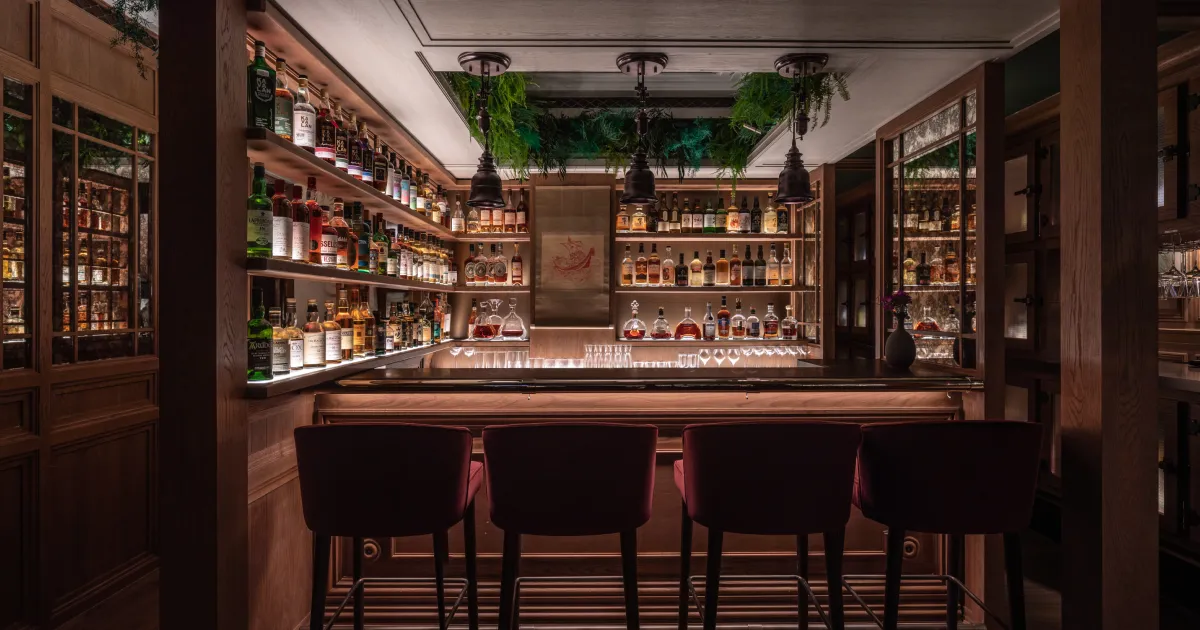
The Aubrey is a Japanese izakaya and bar on the top floor of Mandarin Oriental, Hong Kong, completed in 2021. Its concept is the manor of an eccentric English gentleman, shaped by a collector's obsession with Japan, and it is named after Aubrey Beardsley. The design draws on Japonisme and ukiyo-e motifs: Mount Fuji, a pagoda, torii and crashing waves. Mount Fuji and a breaking wave are the two natural elements that Hokusai set against each other in the Great Wave, the print French collectors and artists took up from the late 1870s.
The interior is lined with dark timber panelling, gilded frames and gallery walls, and includes a curio lounge fitted with bespoke display cabinetry. Several of the museum impressions of the Great Wave described above came from private collectors: Edoardo Chiossone, whose collection the Genoa museum records as acquired in 1898; Clarence Buckingham, who bought his impression from a New York dealer in 1905 and whose sisters gave it to the Art Institute of Chicago in 1925; the Havemeyers, whose impression was bequeathed to the Met in 1929; and René Druart, whose impression was sold in Paris in 2007.
SOURCES
- The Metropolitan Museum of Art Under the Wave off Kanagawa (Kanagawa oki nami ura), also known as The Great Wave
- The Metropolitan Museum of Art The Great Wave: Anatomy of an Icon
- The Metropolitan Museum of Art Hokusai and Debussy's Evocations of the Sea
- British Museum Kanagawa-oki nami-ura (Under the Wave off Kanagawa), museum number 2008,3008.1
- British Museum The Great Wave: spot the difference
- British Museum The technique of making a good impression
- Art Institute of Chicago Under the Wave off Kanagawa, Clarence Buckingham Collection (collection record)
- Ōta Memorial Museum of Art Katsushika Hokusai: Thirty-six Views of Mt. Fuji
- US Geological Survey Hokusai: Under the Wave off Kanagawa
- Musei di Genova The Great Wave off Kanagawa, Edoardo Chiossone Museum of Oriental Art