

FIVE CENTURIES OF GLAZED TILE, FROM SEVILLE IMPORTS TO LISBON'S METRO STATIONS
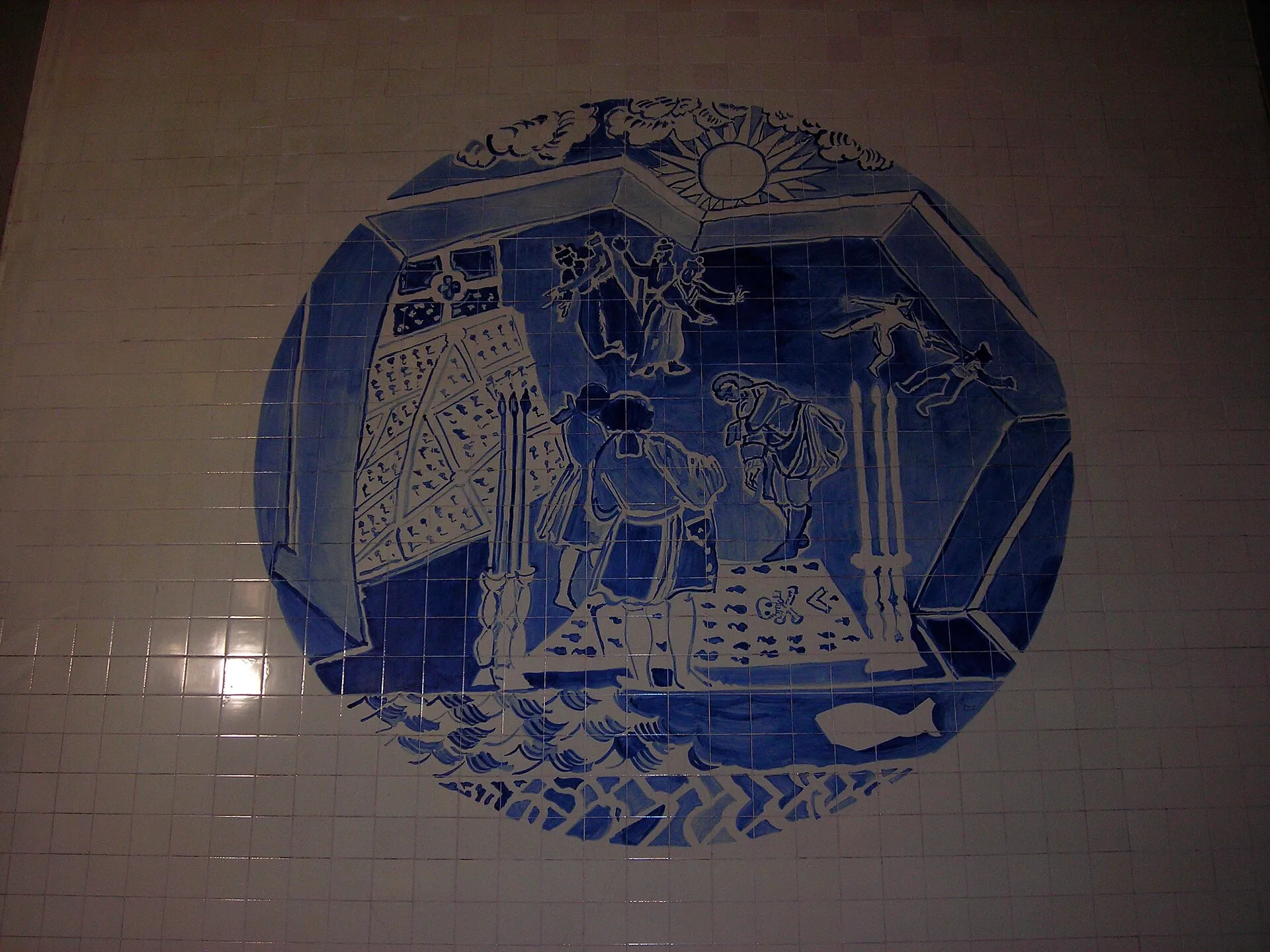
Azulejos are the glazed ceramic tiles found across Portugal on church interiors, palace walls, house façades and public buildings. Portugal began by importing them from Spain in the early 16th century, started producing its own in Lisbon in the second half of that century, and over the following 300 years developed the tile into an art form closely tied to national identity: patterned wall coverings in the 17th century, large blue-and-white panels in the 18th, cheap repeat patterns for the rebuilding of Lisbon after the 1755 earthquake, and industrially produced façade tiles in the 19th. The tradition continued into the 20th century through artists' commissions and the stations of the Lisbon Metro. Lisbon's Museu Nacional do Azulejo (National Tile Museum), housed in a convent founded in 1509, documents the full sequence.
WHAT AZULEJOS ARE AND WHERE THE WORD COMES FROM
Despite the resemblance to azul, the Portuguese word for blue, azulejo comes from Arabic. The American Ceramic Society traces it to an Arabic term meaning 'little polished stone', a link that reflects the tile's origins in the Islamic decorative tradition of the Iberian Peninsula. Muslim Berbers and Arabs who conquered the peninsula in the early 8th century brought with them geometric mosaics of cut glazed tile, known as alicatados.
The National Tile Museum identifies Islamic culture as the first major influence on Portuguese tile, and with it a taste for covering every available surface with decoration. Portuguese azulejos are typically made from red clay and fired twice, with a white tin-oxide glaze applied between the two firings and colours made from metal oxides. The museum dates the emergence of the three main uses of the azulejo, pattern, figurative and ornamental, to the 17th century. Tiles were laid on floors before they covered walls: glazed mosaic pavements of plain coloured geometric pieces were used in Portugal from the 13th century, and from the second half of the 15th century floor tiles were imported from Manises, near Valencia.
SEVILLE AND THE HISPANO-MORESQUE TILE: CORDA SECA AND ARESTA

Azulejos became a common wall covering in Portugal only in the early 16th century, and the first large commissions were imported from Spain. According to the National Tile Museum, these tiles were made in Seville and Toledo. In 1503 Bishop Jorge de Almeida commissioned Seville tiles for the cathedral of Coimbra, where they covered the walls and pillars, and in 1508 King Manuel I ordered more for his palace at Sintra, where his emblem, the armillary sphere, appears in the tilework. The American Ceramic Society notes that tiles of this period were installed in the Arab Room of the Sintra National Palace.
These Hispano-Moresque tiles were made with two techniques, corda seca and aresta. The American Ceramic Society describes the faster method for which Seville became known: a mould was pressed into the unfired tile, leaving thin clay ridges that kept the colours from bleeding into each other during firing. The designs also changed over the period. The museum notes that motifs moved from geometric patterns of Islamic origin to Gothic and then Renaissance designs, most of them based on plant forms.
MAJOLICA AND THE FIRST LISBON WORKSHOPS

The next change came from Italy. Italian potters opened workshops in Seville in the early 16th century and brought majolica techniques with them, which, the American Ceramic Society notes, allowed a much wider range of figurative subjects than moulded tiles. In Portugal, azulejo production began in Lisbon in the second half of the 16th century, encouraged by Flemish artisans who introduced new techniques. The National Tile Museum describes this phase as the arrival of faience in Lisbon, and it marks the shift from imported tiles to a local industry.
The museum's principal example from this phase is the panel of Nossa Senhora da Vida (1580), attributed to Marçal de Matos. Made of 1,498 tiles, it uses trompe l'oeil to imitate a three-part gilded altarpiece, with the Adoration of the Shepherds at the centre and Saints John and Luke at either side. It was designed to work with the light from a window, linking the architecture of the church to the message of the image. The panel originally stood in the Church of Santo André in Lisbon, which was partly destroyed in 1755.
BLUE AND WHITE: THE 17TH AND 18TH CENTURY BOOM
In the 17th century Portuguese azulejos took on many of the forms now considered characteristic. Pattern tiles were built from repeating modules, from 2 by 2 up to 12 by 12, and the National Tile Museum notes that a 12 by 12 module of 144 tiles was the most complex tile pattern in Europe at the time. The most intricate patterns were placed high on walls so they could be read from below. Colours were blue, green and yellow, or blue on white. The Church was the main client, while the nobility commissioned figurative panels on secular themes, particularly after Portugal restored its independence from Spain in 1640. Many scenes were copied from European engravings, and altar frontals imitated Indian textiles, the panos da Índia.
Between the 17th and 18th centuries, according to the museum, production was dominated by cobalt blue painted on white, owing to Dutch influence. Portugal imported blue-and-white tiles from the Netherlands until it was producing its own, and the American Ceramic Society notes that the colours were modelled on Chinese porcelain. Between 1690 and 1725, a period the museum calls the Cycle of the Masters, painters worked more freely from their engraved sources, gained the status of artists and often signed their work. Demand from Portugal and Brazil in the early 18th century led to mass production, in what is known as the golden age of the azulejo. One type from this period, the invitation figure, a life-size tile figure placed at the entrance of a building, is described by the museum as an original Portuguese creation.
AFTER THE 1755 EARTHQUAKE: POMBALINE TILES AND 19TH CENTURY FAÇADES

The Lisbon earthquake of 1755 destroyed much of the city, and its reconstruction under the Marquis of Pombal (1699 to 1782) changed how tiles were used. Large painted panels gave way to smaller tiles with repetitive patterns, which were cheaper and quicker to install, and pattern tiles clad the interiors of the new buildings. They are known as pombalino tiles after the minister who led the rebuilding. The National Tile Museum describes them as cheap and effective. Later in the century the Real Fábrica de Louça ao Rato in Lisbon began producing tiles influenced by Neoclassicism in the 1790s, and ornamental tile surrounds became popular with the middle class.
In the 19th century tiles moved onto the outside of buildings. Production grew on a semi-industrial and industrial scale to supply pattern tiles for the façades of urban buildings, with the main centres in Lisbon, Porto and Gaia. The museum notes that façade tiles helped distinguish otherwise similar buildings and could signal the owner's status. Factories in the north, particularly around Porto with its strong Baroque tradition, favoured tiles with pronounced relief, which produced stronger effects of light and shadow than those made in Lisbon. The Fábrica de Massarelos in Porto, founded in 1763, is known for relief examples moulded by hand. Part of the large output of the most active factories of the second half of the century was shipped to Brazil.
THE NATIONAL TILE MUSEUM AND AZULEJOS IN THE LISBON METRO

The Museu Nacional do Azulejo in Lisbon occupies the former convent of Madre de Deus, founded in 1509 by Queen Leonor, and its collection runs from the 15th century to the present day. Among its holdings is the Grand Panorama of Lisbon (1700), attributed to the Spanish painter Gabriel del Barco. The blue-on-white panel is about 22 metres long and shows some 14 kilometres of the riverfront, including the Castle of São Jorge, the Ribeira Palace and the Tower of Belém, together with scenes of daily life such as the Ribeira market. The museum describes it as the most complete view of Lisbon from the Tagus before the 1755 earthquake. It was first installed as wall tiling in the palace of the Counts of Tentúgal on Rua de Santiago. The collection also covers the turn of the 20th century, when industrial production made tile a standard façade cladding and, alongside it, work by individual named artists emerged. Rafael Bordalo Pinheiro's pattern panel with butterflies (1905), made for the Caldas da Rainha factory, shows the Art Nouveau influence from France.
In the 20th century azulejos moved into public infrastructure. The museum points to the transport network, and especially the Underground, as one of the main settings for modern tile. Maria Keil (1914 to 2012), who was married to the architect responsible for the Lisbon Metro project, designed geometric abstract tile panels for its stations, according to a University of Coimbra doctoral thesis on her work, and other architects commissioned tile work from her in the 1950s. Other artists who worked in the medium include Júlio Pomar, Querubim Lapa and Manuel Cargaleiro, and at the Lisbon Oceanarium in 1998 Ivan Chermayeff used tiles in a pixelated style.
PORTUGUESE CERAMICS AND THE BLUE PALETTE AT TASCA
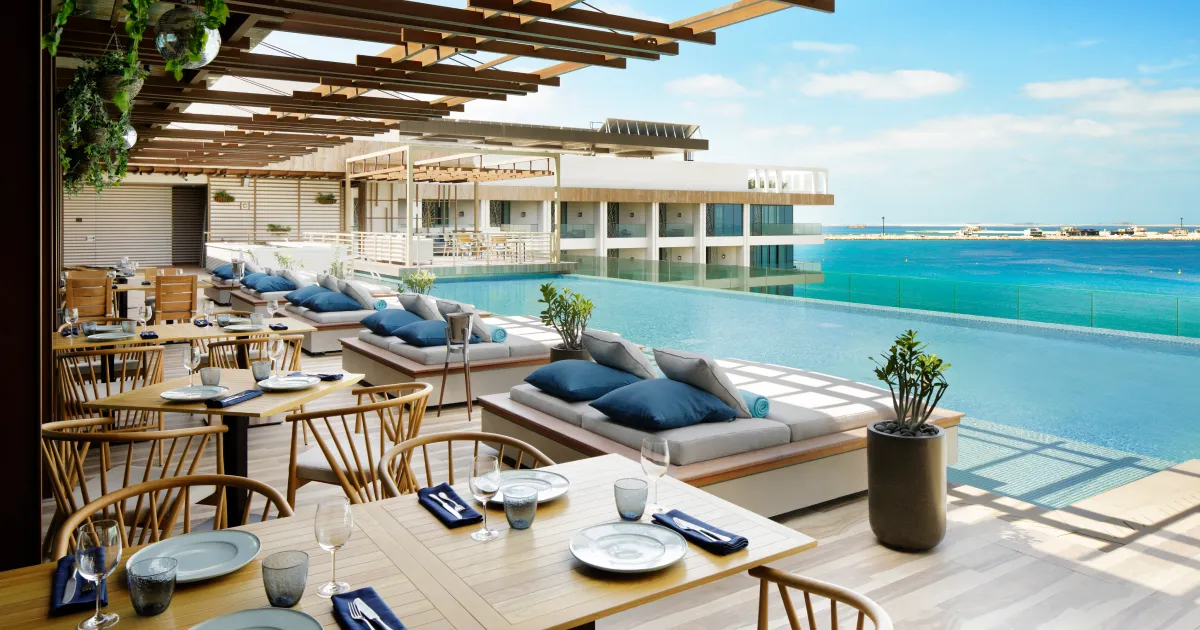
Tasca at Mandarin Oriental Jumeira Dubai is a contemporary Portuguese restaurant by chef José Avillez, with terrace and bar dining, designed by Silverfox Studios and completed in 2019. It holds One MICHELIN Star. Blue is used as an accent colour, in turquoise glassware and blue cushions, a palette that connects to the blue-and-white tradition that dominated Portuguese tile in the 17th and 18th centuries. The National Tile Museum attributes the dominance of cobalt blue on white to Dutch influence, and the American Ceramic Society links those colours to Chinese porcelain.
The rest of the interior is built from timber and stone: timber tables, a slatted timber ceiling and marble bar counters, with a rooftop terrace overlooking the Arabian Gulf. In Portuguese interiors azulejos were rarely the only decorative material; the National Tile Museum notes that narrative tile series in churches were often combined with oil paintings and gilt-wood carving. At Tasca, ceramics appear as objects on illuminated shelving, set against timber and marble.
SOURCES
- Museu Nacional do Azulejo, via Google Arts & Culture The Azulejo in Portugal: an identitary art, a world heritage
- Museu Nacional do Azulejo, via Google Arts & Culture 15th and 16th centuries: The Hispanic-Moresque Azulejo
- Museu Nacional do Azulejo, via Google Arts & Culture 17th century azulejo's room
- Museu Nacional do Azulejo, via Google Arts & Culture Pattern azulejo panel, Fábrica de Massarelos
- Museu Nacional do Azulejo, via Google Arts & Culture Grand panorama of Lisbon, Ribeira Royal Palace
- The American Ceramic Society Azulejos: A Portuguese tradition influenced by globalization
- Turismo de Lisboa National Tile Museum
- Universidade de Coimbra Maria Keil, uma operária das artes (1914-2012). Arte Portuguesa do século XX


