FROM MULBERRY LEAF AND COCOON TO WOVEN CLOTH
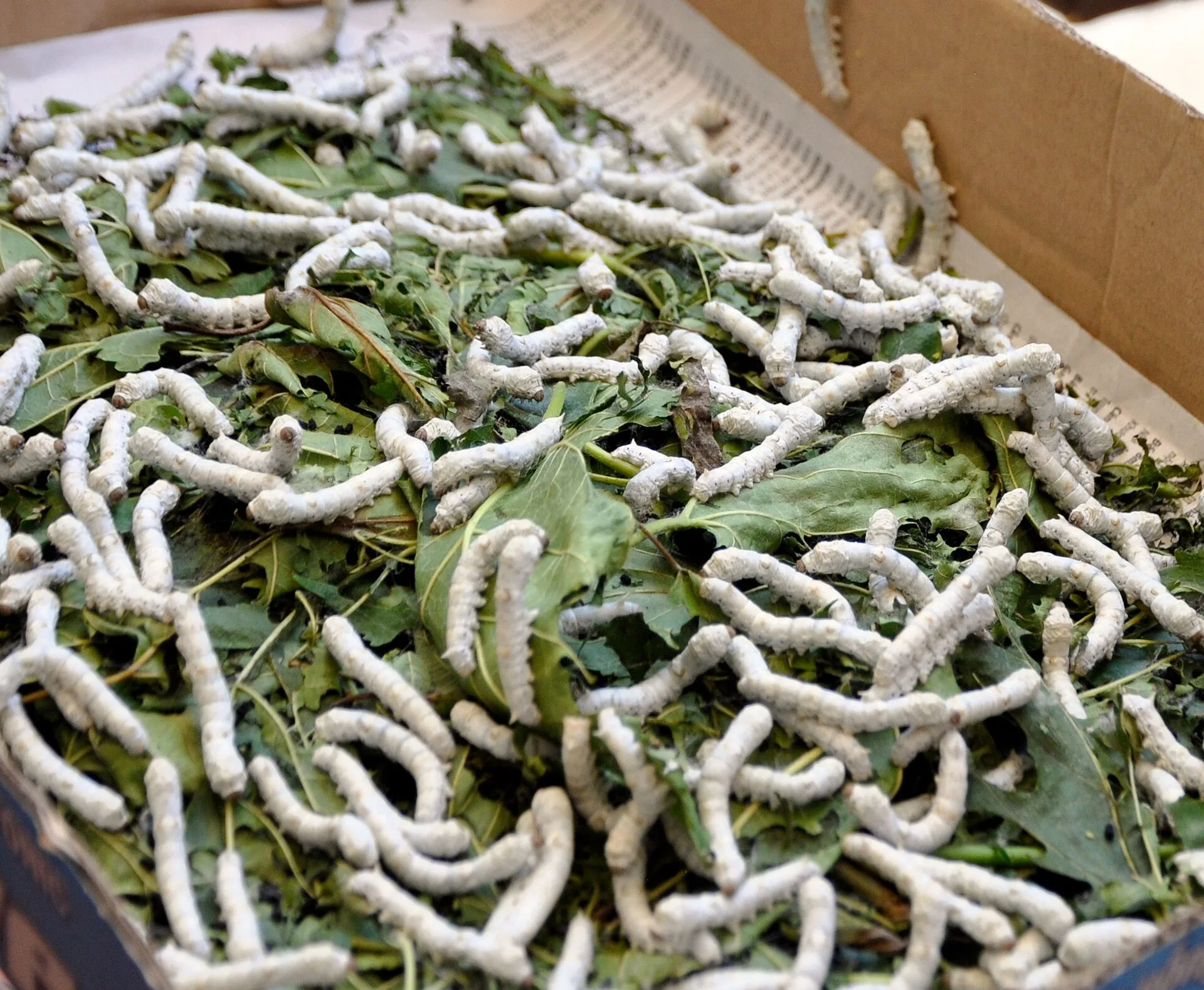
Silk is a protein fibre spun by the caterpillar of the domesticated silk moth, Bombyx mori, and turning it into cloth involves several separate crafts. How silk is made can be followed as a chain of work that begins with mulberry trees and silkworm eggs, passes through cocoons, hot water and reels, and ends with twisting, degumming and weaving. Archaeologists have traced the start of that chain in China to the Neolithic period. The knowledge later reached India, Khotan, Byzantium, Italy, France and Japan, and silk went into clothing, embroidery and the carpets of the Islamic world.
WHAT IS SILK AND WHICH INSECT MAKES IT
Britannica defines silk as an animal fibre that certain insects and arachnids produce for their cocoons and webs, and notes that commercial silk comes from the cocoons of silkworm caterpillars of the Bombyx genus. The Horniman Museum in London, which holds a box of twelve Bombyx mori cocoons, describes the species as originating in northern China and now extinct in the wild: it exists only in captivity, bred for silk. As the American Historical Association (AHA) points out, the silkworm is not a true worm but the larva of the silk moth, and it feeds on the leaves of the mulberry tree.
The fibre forms inside the caterpillar. According to Britannica, the silkworm produces fibroin, a protein that hardens on contact with air into a continuous filament, while a second pair of glands secretes sericin, a gummy substance that holds the filament together as the cocoon is built. The Horniman notes that the silk glands make up about a quarter of the larva's body weight. Each cocoon is wound from a single unbroken thread, which Britannica puts at roughly 1 km and the Horniman at about 1,000 metres.
WHEN DID CHINA BEGIN MAKING SILK

A legend from central China, cited by the University of Science and Technology of China (USTC), credits Leizu with first inventing the technique of breeding silkworms. Britannica identifies the figure of the legend as the wife of the mythological Yellow Emperor and notes that the empress was ceremonially associated with sericulture throughout Chinese history. By native record, it adds, silk production existed in China before the middle of the 3rd millennium BCE. In 1926 Li Ji, often called the founding father of Chinese archaeology, found half of a cocoon from the Yangshao culture, a Neolithic culture of the Yellow River, which experts believe had been cut in half.
The South China Morning Post (SCMP) reports that many cocoons and chrysalises have since been found in good condition in Yuncheng in southern Shanxi, and that in 2020 scientists announced a stone chrysalis about 6,000 years old. The oldest evidence so far comes from Jiahu, a Neolithic site in central China. A USTC team led by Professor Gong Decai detected silk fibroin in soil from 8,500-year-old tombs there, where rough weaving tools and bone needles had also been excavated. Their study, published in PLOS ONE in 2016, moved the history of silk-making back by about 4,000 years.
HOW SILK IS MADE: RAISING SILKWORMS ON MULBERRY
Sericulture, the raising of silkworms for silk, begins with eggs. The Horniman Museum describes a cycle in which each female moth lays 300 to 400 eggs and dies almost immediately afterwards. Farmers can store the eggs in a cool place and incubate them when they are needed. The larvae eat mulberry leaves constantly for about four weeks and grow to 10,000 times their hatching weight. They shed their skin four times, the stages between moults being called instars, and stop eating after the fifth instar. Each larva then spins a supporting structure on wooden frames provided by the farmer and builds its cocoon from the outside inwards over two to three days. The worms need silence, since disturbance stops the spinning and breaks the continuity of the thread.
In 2009 UNESCO inscribed Sericulture and silk craftsmanship of China on the Representative List of the Intangible Cultural Heritage of Humanity. The inscription is based in Zhejiang and Jiangsu provinces near Shanghai and covers the full sequence of planting mulberry, raising silkworms, unreeling silk, making thread, and designing and weaving fabric. UNESCO describes the farming system that links these stages: silkworm waste is fed to fish in village ponds, pond mud fertilises the mulberry trees, and the leaves feed the silkworms. Each April, women silkworm farmers wear flowers made of silk or paper and make harvest offerings during the Silkworm Flower festival.
HOW SILK IS MADE: REELING, THROWING AND DEGUMMING
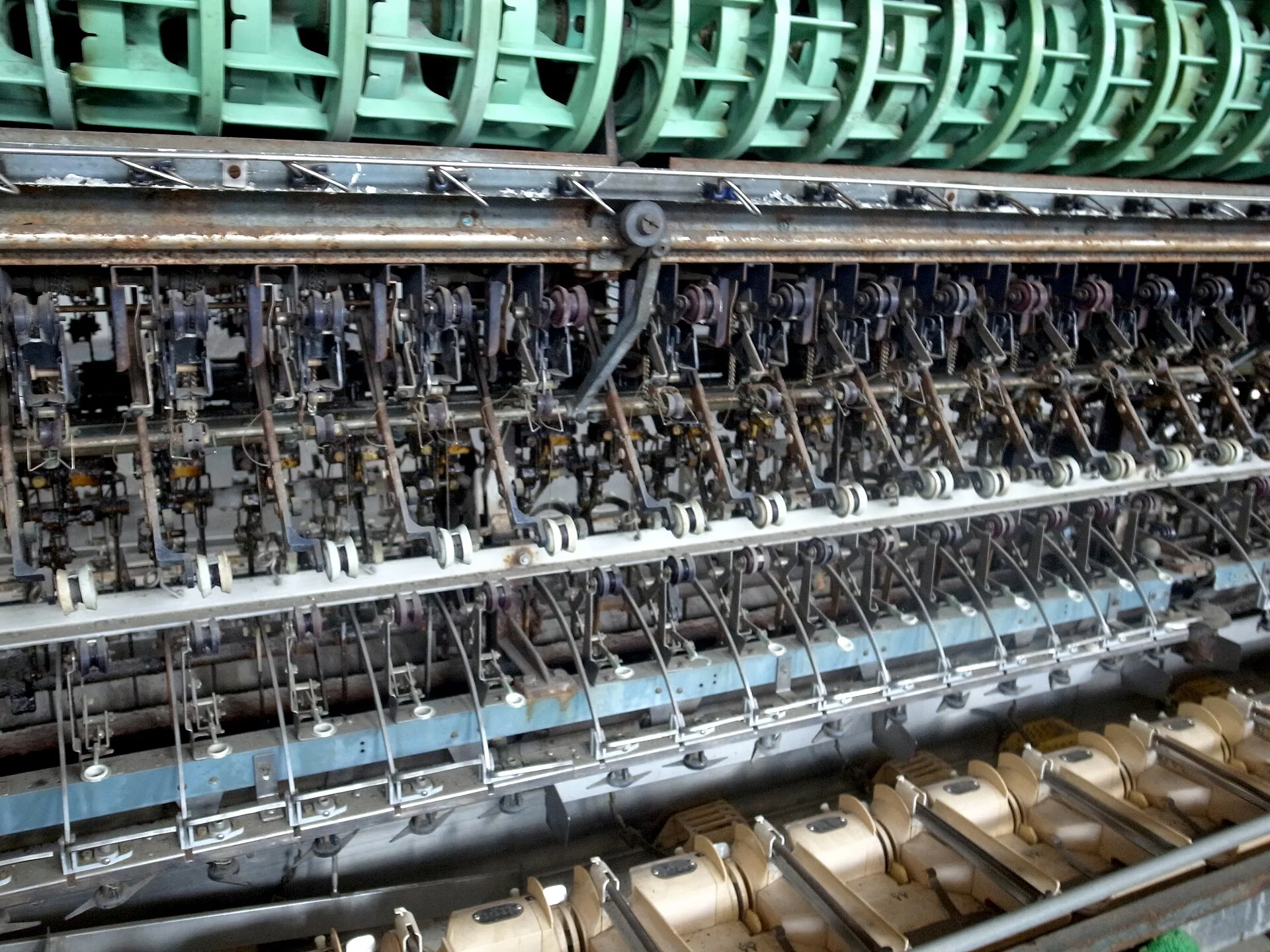
Most cocoons are never allowed to hatch. The Horniman explains that farmers let only as many moths emerge as they need for breeding, and that most pupae are killed by roasting, steaming or fumigation; Britannica describes the use of steam or hot air at the cocoon stage. The reason is the moth itself. As the SCMP explains, a silkworm turning into a moth secretes an enzyme to break free of the cocoon, ruining much of the silk. Silkworms are therefore harvested at the cocoon stage, before they emerge as moths.
Reeling unwinds the cocoon. Soaking in hot water softens the sericin so that the filament can be drawn off, and the Horniman notes that about ten threads are wound onto a reel together to form raw silk, which is sold for weaving. In Japan, Tomioka Silk Mill in Gunma opened in October 1872 as a government enterprise and the country's first mechanised silk-reeling mill, where French-made reeling machines and a steam power plant drew the threads from cocoons and wound them onto spools. The mill and three related sites were inscribed on the UNESCO World Heritage List in 2014 as Tomioka Silk Mill and Related Sites.
Raw silk still carries its gum, and Britannica describes two further stages before the cloth is made. In throwing, several filaments are twisted together into a single yarn to give it strength. Degumming then removes the sericin, which reduces the silk's weight by up to 30 percent and increases its sheen. The yarn is dyed and woven, and the finished fabric can carry intricate patterns. Britannica lists strength, elasticity and moisture absorbency among the qualities for which silk is valued.
HOW CHINESE WEAVERS USED SILK
Britannica records that the weaving of damask probably existed in China in the Shang dynasty. Finds from the 4th to 3rd centuries BCE at Mashan, excavated in 1982, include brocade, gauze and embroidery. Under the Han dynasty silk weaving became a major industry and one of China's chief exports, and Han textiles have been found in Egypt, at Noin-ula in northern Mongolia and at Loulan. Silk also reached Syria and Rome, where, according to Britannica, weavers and dyers worked mostly with silk unravelled from Eastern fabrics.
Under the Song dynasty Chinese weavers perfected kesi, a very fine silk tapestry woven on a small loom with a needle as the shuttle, covered in our article on kesi silk tapestry in imperial interiors. Silk thread was also the material of Chinese needlework, from the embroidery recovered at Mashan to the regional traditions described in the Four Great Embroideries of China. The AHA notes that China was the primary supplier of silk from the Han through the Tang periods and was highly protective of its silk trade secrets.
HOW SERICULTURE SPREAD BEYOND CHINA
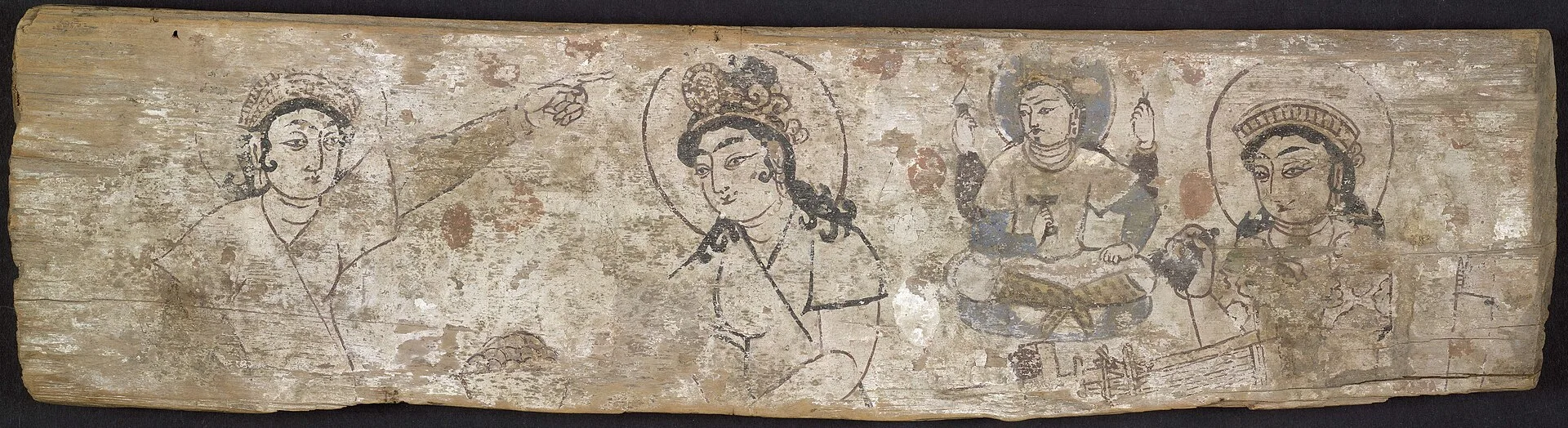
Several of the stories told about the spread of sericulture are legends. According to legend, Britannica reports, sericulture and silk spread overland from China to India around 140 BCE, and by the 2nd century CE India was shipping its own raw silk and silk cloth to Persia. The best-known story concerns Khotan. The seventh-century Chinese traveller Xuanzang, in his Great Tang Records on the Western Regions of 646, tells of silkworms brought secretly from China to Khotan. In the version illustrated on a British Museum panel, a Chinese princess about to marry the king of Khotan hides silkworm eggs and mulberry seeds in her headdress.
The painted wooden panel was found by Aurel Stein at Dandan-Oilik near Khotan during his expedition of 1900 to 1901 and entered the British Museum in 1907. Scholars have dated it to the 6th century or to the 7th to 8th century. The princess is shown with a basket of cocoons in front of her while an attendant points to her headdress. A woman stands at a loom with a beating comb, and a seated four-armed deity, probably the god of silk, holds a goblet, a weaver's comb and a shuttle.
Two competing accounts explain how silkworms reached Byzantium. Procopius, writing in the mid-sixth century, describes monks from India who told the emperor Justinian they had learned silk-making in Serinda and later brought him silkworm eggs. Theophanes Confessor, in the early ninth century, credits a Persian who carried eggs out of the land of the Seres in a walking stick. The AHA treats both as legends, while Britannica, giving a version with monks, states that these silkworms were the origin of the varieties used in European sericulture until the 19th century. Silk culture later flourished in the Italian city-states and, from 1480, in France. When a silkworm plague appeared in 1854, Louis Pasteur was asked in 1865 to study it and found its cause and a means of control.
SILK IN CARPETS AND FURNISHINGS
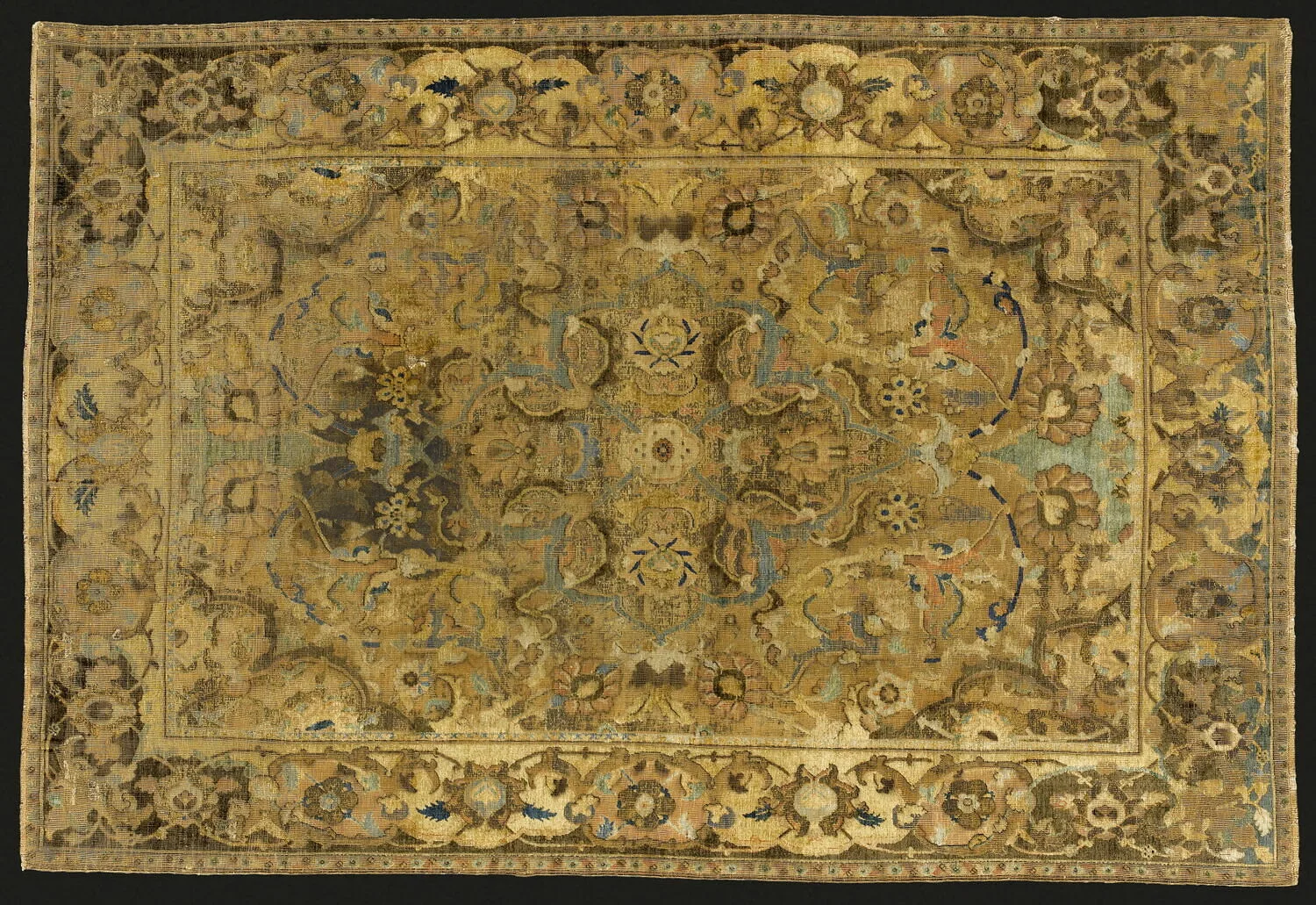
The Metropolitan Museum of Art's essay on carpets from the Islamic world, written by Marika Sardar, notes that carpet weaving was transformed from a minor craft under the Ottoman, Safavid and Mughal dynasties, and that carpets traded to Europe and the Far East were used to cover furniture or hung on walls. The carpets it illustrates show silk in different parts of the weave. The Emperor's Carpet, from the second half of the 16th century, has a silk warp and weft beneath a wool pile. The Anhalt Medallion Carpet, probably from the first half of that century, combines a cotton warp, a silk weft and a wool pile.
In Iran, the Met explains, Shah 'Abbas, who ruled from 1587 to 1629, made the carpet and textile industries part of a programme for restructuring the economy, and moved silk merchants and weavers to his new capital, Isfahan. Of the carpets exported in this period, the Polonaise type was the most popular, with over 300 in foreign collections. The museum's own 17th-century Polonaise carpet has a cotton warp and weft, a silk weft and pile, and brocading in metal-wrapped thread. A tapestry-woven carpet in the same collection, dated 1774, uses silk among its wefts together with metal-wrapped silk thread.
SILK AT MAN WAH, MANDARIN ORIENTAL HONG KONG

Man Wah is the Cantonese restaurant on the 25th floor of Mandarin Oriental Hong Kong, redesigned by Silverfox Studios in 2021. The restaurant holds One MICHELIN Star. Its design interprets the Hong Kong skyline and Victoria Harbour, both seen from the restaurant's windows, together with references to the hotel's heritage, which is set out in Mandarin Oriental Hong Kong history. The harbour's part in the city's development is covered in how Victoria Harbour shaped Hong Kong's skyline and urban identity.
Silk is used on the floor. The restaurant has a bespoke blue and gold carpet in silk, with hand-carved patterning that evokes light on the harbour outside the windows. The walls are lined with navy panelling with gold trim, and on a navy wall panel is an embroidered artwork of a dragon and flowers. The lanterns reinterpret the original Man Wah lanterns: each is a cluster of brass cages carrying embroidered, pleated shades. Embroidery therefore appears twice in the room, on the wall panel and on the lantern shades.
SOURCES
- UNESCO Intangible Cultural Heritage Sericulture and silk craftsmanship of China
- Encyclopaedia Britannica Silk
- Encyclopaedia Britannica How Is Silk Made?
- Horniman Museum and Gardens Bombyx mori (HC.2004.192)
- University of Science and Technology of China Scientists Find Human Probably Made Silk 8500 Years Ago
- South China Morning Post A 5,200-year-old stone-carved chrysalis provides window into the earliest days of Chinese silk
- The British Museum Legend of the Silk Princess (1907,1111.73)
- American Historical Association Legendary Silk Heists
- Gunma Prefecture Tomioka Silk Mill and Related Sites
- The Metropolitan Museum of Art Carpets from the Islamic World, 1600 to 1800