CALCITE FROM SPRING WATER, FROM TIVOLI TO THE GETTY CENTER
Travertine stone is a banded variety of limestone made of calcite and deposited by spring and river water. The Romans quarried it near Tibur, the modern town of Tivoli east of Rome, and called it lapis Tiburtinus, the stone of Tibur. Tivoli travertine went into the Colosseum in the first century AD and, centuries later, into St Peter's Basilica and Bernini's colonnade. In Tuscany, the quarries of Rapolano Terme have supplied the stone since the 16th century. In 1929 Mies van der Rohe combined Roman travertine with golden onyx and green marble in the German national pavilion for the Barcelona International Exposition, and in Los Angeles Richard Meier clad the Getty Center in 16,000 tons of travertine from Bagni di Tivoli. The same process is still building terraces at Pamukkale in Turkey and at Mammoth Hot Springs in Yellowstone.
WHAT IS TRAVERTINE STONE AND HOW DOES IT FORM?
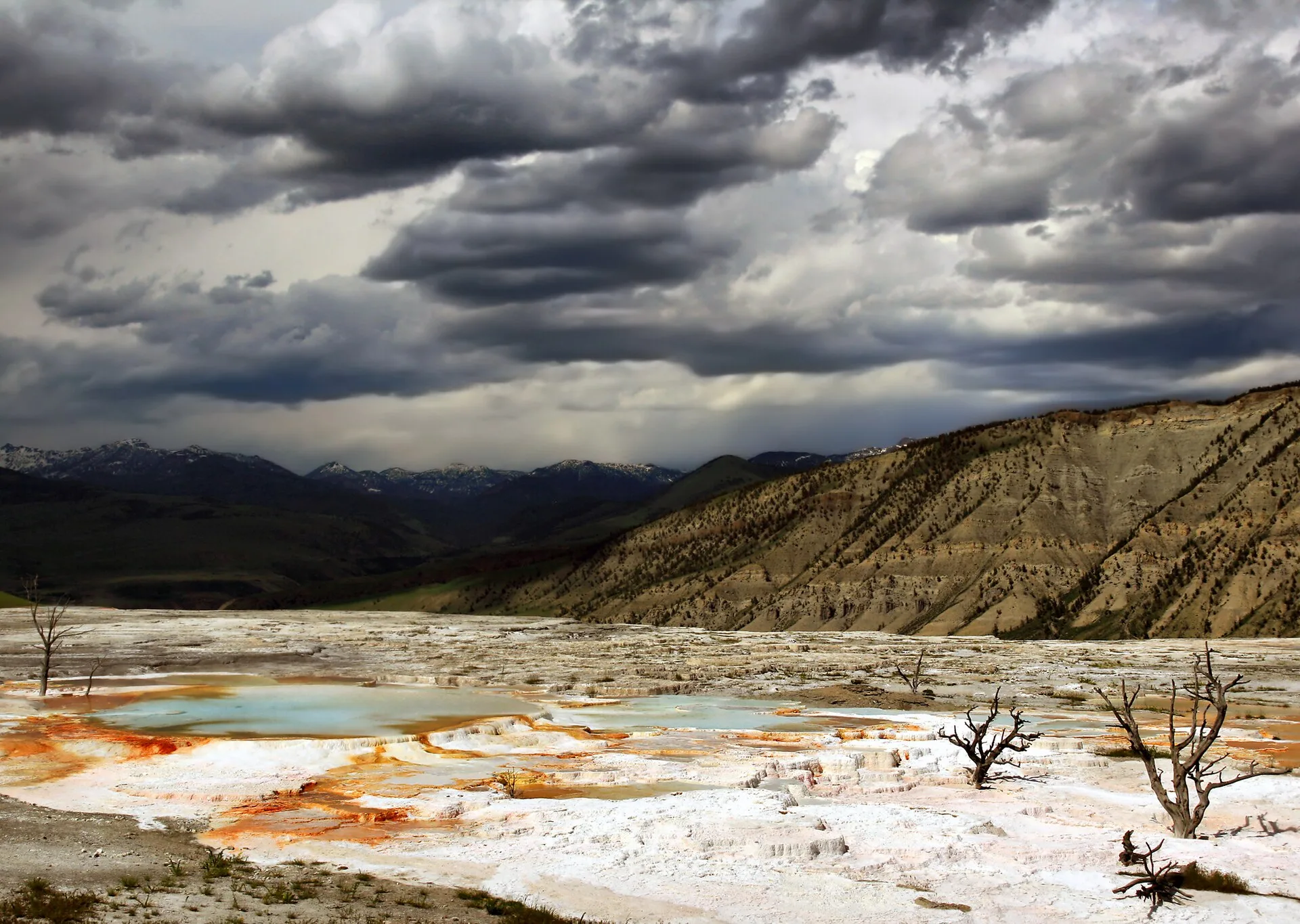
Britannica defines travertine as a dense, banded rock composed of calcite (calcium carbonate), and classes it as a type of limestone that develops from the evaporation of river and spring water. The geologists Alessandro Mancini, Marco Brandano and colleagues, writing in Frontiers in Earth Science in 2024, describe it as calcium carbonate precipitated from supersaturated, non-marine waters, typically linked to the circulation of hydrothermal fluids. The US National Park Service sets out the process at Mammoth Hot Springs in Yellowstone. Thermal water rises through limestone, carrying dissolved calcium carbonate. At the surface, carbon dioxide is released and calcium carbonate is deposited as travertine.
The texture of the stone comes from the way it grows. In their study of the Tivoli deposits, Mancini and colleagues record travertine laid down in pools, shallow lakes and ponds, and as crystalline crusts on slopes and rims. The Associated Press, reporting from the Tivoli quarries in 2026, describes Roman travertine as formed hundreds of thousands of years ago by deposits of calcium, sulphur and other minerals, with the region's history of volcanic eruptions, forests and fossils visible in its striated layers. Its colour ranges from a warm white with irregular black holes to sandy beige with grey, brown or greenish veins. Britannica adds that travertine takes a good polish and is often used for walls and interior decoration in public buildings.
HOW DOES TRAVERTINE DIFFER FROM LIMESTONE AND MARBLE?
Travertine, limestone and marble are all made largely of calcite. The difference is where and how each rock forms. The limestone that faces Jordan's capital is a sedimentary rock deposited on a marine shelf, as traced in our article on Amman limestone. Travertine is deposited from spring and river water. Marble, in Britannica's definition, is granular limestone or dolomite recrystallised under the influence of heat, pressure and aqueous solutions, in deeply buried, strongly folded regions affected by igneous intrusion. The result is a mosaic of calcite grains, the process behind the white stone described in our article on Carrara marble.
Trade names blur these categories. Britannica notes that commercially the word marble is applied to any decorative, calcium-rich rock that can be polished. It describes the so-called onyx marbles, built up in concentric zones of calcite or aragonite from cold-water solutions, as neither marble nor onyx in the strict sense, because true onyx is a banded chalcedony. The stones also weather differently. Marco Ferrero, professor of civil engineering at Sapienza University of Rome, told the Associated Press that travertine is solid, resistant and noble but "not showy like its cousin, marble", and that marble does not fare as well over time when exposed to the elements.
WHERE IS TRAVERTINE QUARRIED? TIVOLI, LAPIS TIBURTINUS AND RAPOLANO
Mancini and colleagues trace the Italian word travertino to lapis Tiburtinus, the Latin name for the stone of Tibur. It comes from the Acque Albule Basin, the eastern part of the Roman Basin, bounded by the Apennine ranges to the north and east and by the Aniene River and the Colli Albani volcanic complex to the south. The travertine there formed during the Late Pleistocene. It covers about 28 square kilometres and reaches a maximum thickness of about 90 metres. Several thermal springs rich in carbon dioxide still rise in the basin, mostly close to faults running north to south, at around 23°C, and their surface waters drain into the Aniene. The Getty places Bagni di Tivoli 15 miles (24 kilometres) east of Rome.
The quarries are still worked. At the Degemar Quarry near Tivoli, now headed by Vincenzo De Gennaro, the Associated Press reports that the pit has been drilled to 30 metres below sea level and that flatbed trucks haul slabs weighing 33 tons up to street level. The stonecutting firm Mariotti Carlo SpA has carved travertine to order for four generations, and its commissions include the Getty Center in Los Angeles, the Bank of China headquarters in Beijing and the Great Mosque in Algiers. The Tivoli quarries still supply stone for churches, temples, mosques, banks, museums, government buildings and private homes around the world.
Tuscany has a second centre of production at Rapolano Terme, in the Sienese territory a few miles from Siena. Visit Tuscany, the regional tourism board, records that the porous but strong travertine there has been mined since the 16th century and remains an important local industry. Stone from the Rapolano quarries was used for the church of San Biagio in Montepulciano and the façade of Pienza cathedral. As at Tivoli, the stone lies close to thermal water: hot mineral water rises from the subsoil at Rapolano and supplies the town's spas, where old travertine bathing pools survive.
HOW DID ROME BUILD WITH TRAVERTINE? THE COLOSSEUM AND ST PETER'S
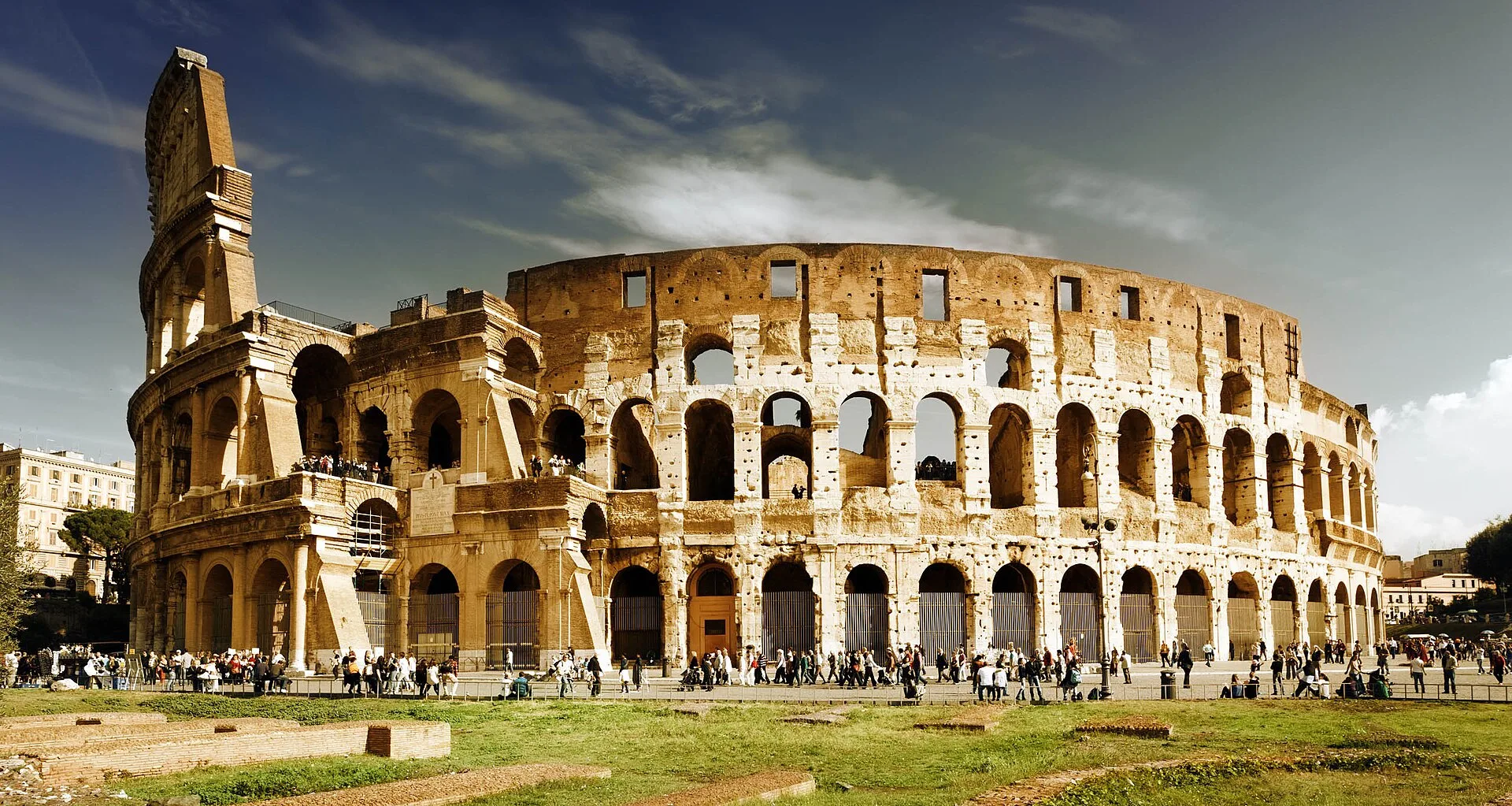
Mancini and colleagues date Roman use of the Tivoli travertine to the first century BC, when it was quarried mostly as an ornamental and building stone, and cite the Colosseum, built between AD 70 and 80, as an example. The Associated Press traces the Colosseum's stone to the same quarries, where the Romans cut blocks and floated them downstream on rafts to craftsmen. Its reporting describes the stone as strong, plentiful and resistant to weather, and Ferrero calls it "truly the stone of the Romans". De Gennaro, the quarry owner, told the Associated Press that Roman structures still standing after about 2,000 years are the guarantee of the stone's durability.
Centuries after the Colosseum, the Tivoli quarries supplied Rome again. According to the Associated Press, the stone of St Peter's Basilica and of Bernini's colonnade came from the same source, and Bernini sourced brilliant white travertine at the Degemar Quarry for the 284 columns and 88 pillars of the colonnade that embraces St Peter's Square. He spent so long selecting his stone that he kept a house overlooking the quarry, which still stands. Its tower still holds the coop for the homing pigeons that carried orders to the quarry from Rome.
MIES VAN DER ROHE AND RICHARD MEIER: TRAVERTINE IN MODERN ARCHITECTURE
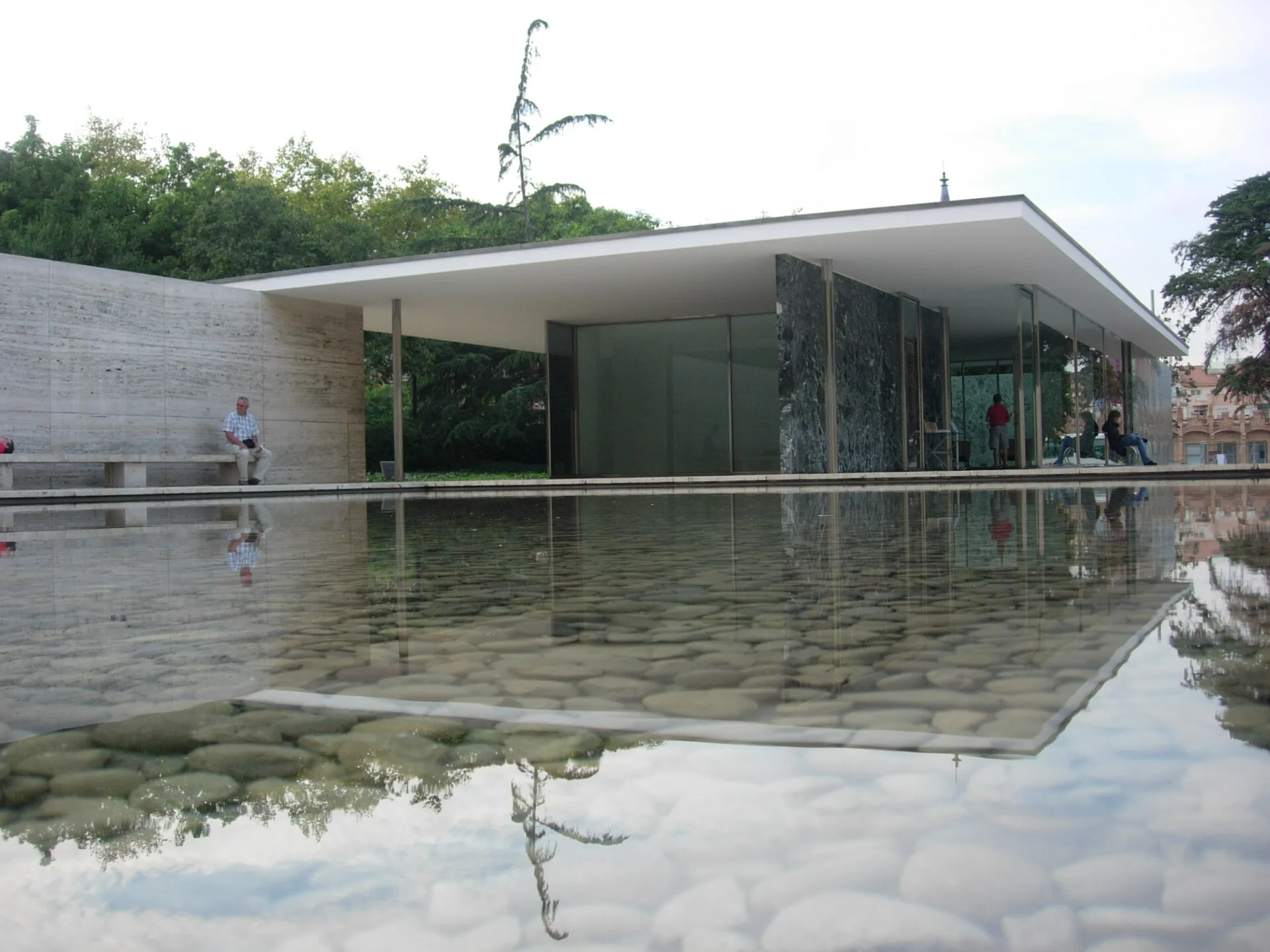
The German national pavilion for the 1929 Barcelona International Exposition, designed by Mies van der Rohe, was built of glass, steel and four kinds of stone. The Fundació Mies van der Rohe lists them as Roman travertine, green Alpine marble, ancient green marble from Greece and golden onyx. The building was dismantled in 1930, after the exposition closed. In 1980 Oriol Bohigas, then head of Barcelona's Urban Planning Department, launched a project to rebuild it. Work began in 1983 and the pavilion reopened on its original site in 1986, in stone of the same characteristics and provenance as the materials Mies used in 1929.
At the Getty Center, on a hilltop in the Santa Monica Mountains in Los Angeles, stone covers about 1.2 million square feet. According to the Getty, the 16,000 tons of travertine came from Bagni di Tivoli. Richard Meier chose stone because it has been historically associated with public architecture, and the Getty lists the qualities it expresses as permanence, solidity, simplicity, warmth and craftsmanship. The stone is highly textured and ranges in colour from light beige to honey. The Getty notes that it reflects sharply in the morning light and gives off warmth in the afternoon, and that the tiles were split along the natural grain of the stone.
WHERE IS TRAVERTINE STILL FORMING? PAMUKKALE AND MAMMOTH HOT SPRINGS
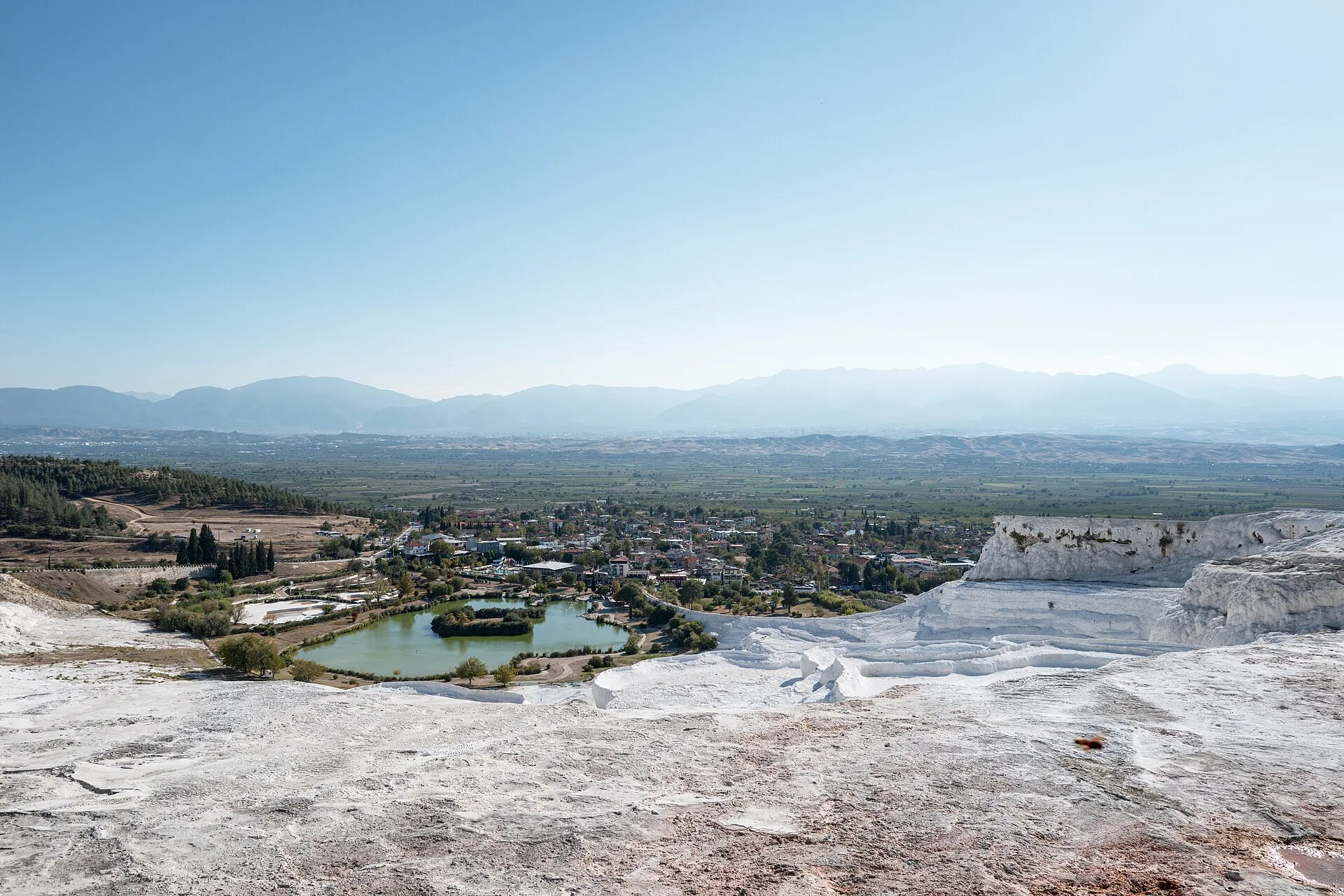
At Pamukkale in Denizli province, south-west Turkey, calcite-laden hot springs emerge from a cliff almost 200 metres high overlooking the plain. UNESCO describes the mineral forests, petrified waterfalls and terraced basins the water has created, some less than a metre high and others as high as six metres. Fresh deposits of calcium carbonate give them a white coating, and the Turkish name Pamukkale means cotton castle. Above the terraces, the Attalid kings of Pergamon founded the spa town of Hierapolis at the end of the 2nd century BC. UNESCO calls it an exceptional example of a Greco-Roman thermal installation, with remains of baths, temple ruins, a monumental arch, a nymphaeum, a necropolis and a theatre.
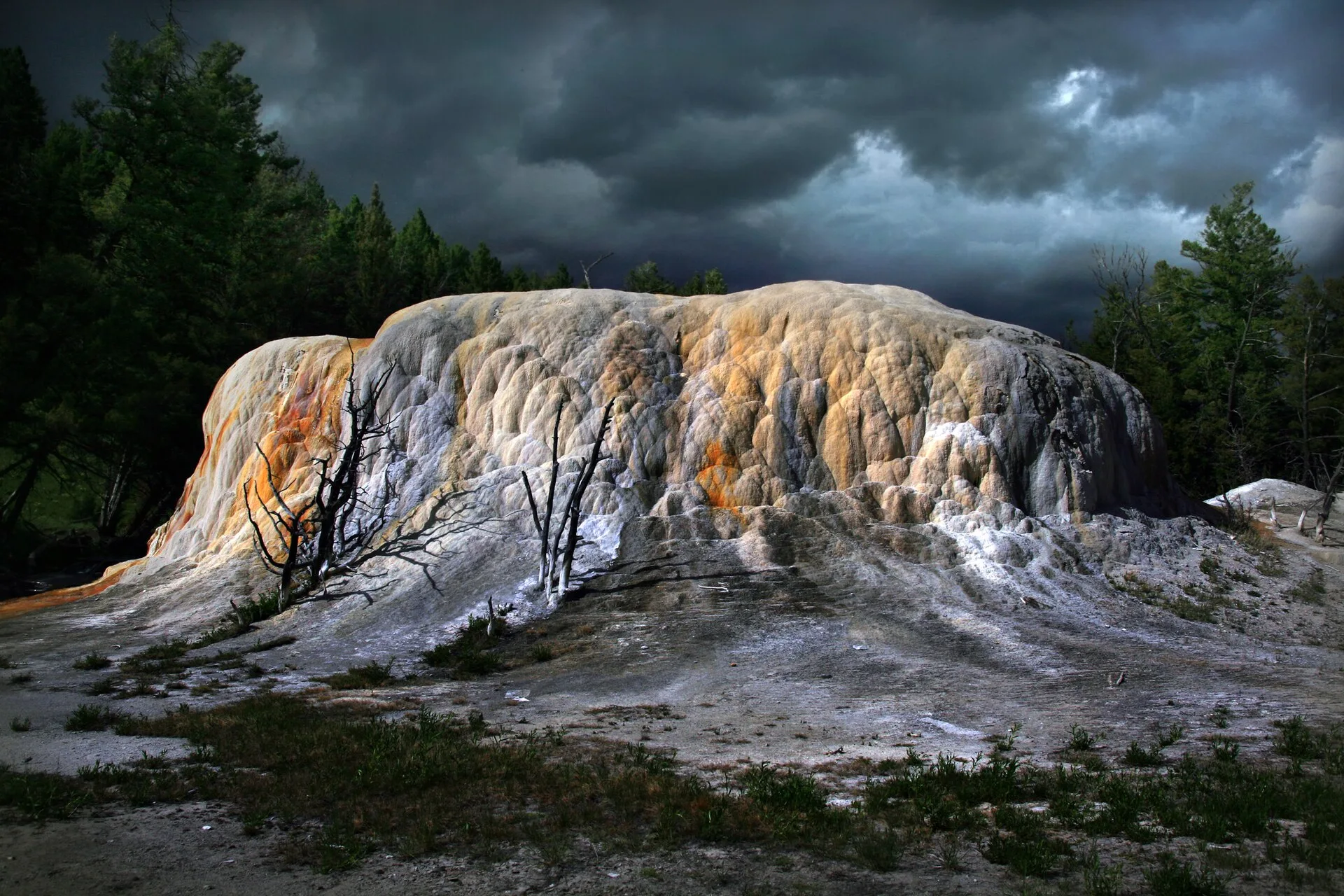
In the United States, Britannica identifies Mammoth Hot Springs in Yellowstone as a site where travertine is still being deposited. The National Park Service calls the springs a surface expression of the deep magmatic forces at work beneath Yellowstone, and notes that the underlying limestone allows large terraces to form above ground. The colours on the terraces come from thermophiles, heat-loving organisms that form coloured stripes, with the bands shifting where one group reaches the limit of the temperature it tolerates. Travertine also forms underground: Britannica notes that it makes up the stalactites and stalagmites of limestone caves, such as Carlsbad Caverns in New Mexico.
HOW IS TRAVERTINE STONE CUT AND FINISHED?

Because travertine is laid down in layers, the direction of the saw matters. In a 2015 study in the Turkish Journal of Earth Sciences, Mehmedi Vehbi Gökçe notes that travertine is used in architecture cut either perpendicular or parallel to its bedding planes. He took blocks from six quarries supplying commercial products in Turkey and abroad, cut samples both ways, and tested them with the Böhme abrasion test, which measures how much material a surface loses to wear. He then used image analysis to measure the size, distribution and area of the pores on each cut face and compared them with the abrasion results.
The blocks cut perpendicular to the bedding lost less material. Their pores were smaller, flatter and discontinuous, while surfaces cut parallel to the bedding showed larger pores, connected to each other and with a greater surface area. Gökçe concludes that travertine laid without attention to its cutting direction can wear quickly where foot traffic is heavy. The Getty Center took a third approach, splitting its stone along the layers. The Getty notes that this exposed fossilised leaves, feathers and branches in the tiles, revealed along the natural grain of the stone, and it describes the finished cladding as highly textured.
PALE VEINED STONE AT HYATT REGENCY HENGQIN

Silverfox Studios designed Hyatt Regency Hengqin, which was completed in 2019. The hotel is the anchor of Lai Sun Creative Culture City in Novotown on Hengqin Island, and has 493 rooms and suites. The island is connected to Hong Kong and Macau by the crossing described in our article on the Hong Kong-Zhuhai-Macao Bridge. The design was shaped by the hotel's views to the Hengqin hills and to Macau, and the interiors are built on a palette of four materials.
Those materials are vertical timber slats, woven linen, rattan and pale veined stone. The linen belongs to a fibre whose production from flax is traced in our article on how linen is made. In travertine, as described above, the direction of the cut relative to the bedding changes both the pattern and the pores of a slab. At Hyatt Regency Hengqin, the pale veined stone sits in the same palette as the vertical timber slats and the woven linen and rattan.
SOURCES
- Britannica Travertine
- Britannica Marble
- Frontiers in Earth Science Using stable isotopes in deciphering climate changes from travertine deposits: the case of the Lapis Tiburtinus succession (Acque Albule Basin, Tivoli, Central Italy) (Mancini et al., 2024)
- Associated Press The travertine quarries that built ancient Rome are carving rock for a new generation of temples
- Turkish Journal of Earth Sciences The effects of bedding directions on abrasion resistance in travertine rocks (Gökçe, 2015)
- US National Park Service Hydrothermal Features, Yellowstone National Park
- UNESCO World Heritage Centre Hierapolis-Pamukkale
- Visit Tuscany Rapolano Terme
- Fundació Mies van der Rohe The Pavilion
- Getty Getty Center Architecture