FROM CATALAN FORGES TO CATHEDRAL REJAS AND GAUDÍ'S FIRST HOUSE

Spanish wrought iron is best known through the reja, the forged iron screen that encloses the choirs and chapels of the country's cathedrals. The smiths who made them, the rejeros, also produced grilles for windows and balconies. The craft peaked in the 16th century, when Spain's cathedrals commissioned screens 7.5 to 9 metres tall, and its Renaissance models were still followed in 1763, when the choir screen now at The Metropolitan Museum of Art was installed at Valladolid. The tradition reached the 1880s in the wrought-iron fence of Antoni Gaudí's Casa Vicens in Barcelona.
WHAT IS WROUGHT IRON, AND HOW DOES IT DIFFER FROM CAST IRON AND MILD STEEL?
Wrought iron is iron worked, or wrought, by a smith while hot. Historic England distinguishes two historic kinds: charcoal iron, the earlier form, and puddled iron, refined in a reverberatory furnace and not produced industrially since the 1970s. Both contain inclusions of slag, mainly silicates, which give the metal a fibrous structure. Each historic piece was forged by hand, so no two components are identical. As it corrodes, wrought iron splits along its layers, opening cracks around punched and drifted holes, and under impact it bends rather than breaks. It is joined by fire welding, riveting or pinning, and a good fire weld is strong and hard to detect.
Cast iron differs from wrought iron mainly in carbon, a difference Historic England puts at 3 to 4 per cent. It is poured into sand moulds taken from patterns, giving near-identical parts with slightly tapered sides, and is joined with screws, bolts and pins. It is brittle, so a bent piece is almost certainly not historic cast iron; the pairing of the two metals in 19th-century building is covered in the history of cast iron architecture. Mild steel, like cast iron, is homogeneous. Much mass-produced work advertised as wrought iron is steel, which can reproduce the traditional fixings and motifs of old ironwork, though the smith has to work harder to achieve them. Historic England's rule of thumb is that ironwork made before about 1900 is almost certainly wrought.
WHERE DID SPANISH WROUGHT IRON COME FROM? THE CATALAN FORGE

The farga catalana, or Catalan forge, made malleable iron directly from ore in a single small hearth, without melting it. Estanislau Tomàs of the Societat Catalana de Tecnologia, writing in the Institut d'Estudis Catalans journal Contributions to Science in 1999, records slag deposits in the Canigó massif of the eastern Pyrenees dating from the start of the Christian era, in a region with abundant ore suited to direct reduction. Documents use the term molina ferri for water-powered wheels, and Catalonia appears to have been among the first regions to drive forge hammers by water, from the 12th century.
The furnace was a low hearth about 60 centimetres a side, with a square base from around 1600. In the 17th century the forges adopted the hydraulic trompe, invented in Italy a few decades earlier: water falling through a tube drew in air, which was fed to the furnace at an adjustable pressure. Each operation produced a bloom of some 150 kilograms, soft common iron or harder steel, which water-driven hammers compacted to drive out the slag. Basque smiths used the same process. Tomàs notes that the forges of the County of Foix were first called Biscayne forges, after their workers from Biscay, and that the Basque forge of El Bierzo used water-wheel bellows in place of the trompe.
WHAT IS REJERÍA? THE SPANISH WROUGHT IRON SCREEN
Rejería is the craft of the reja, the Spanish iron grille, and its makers were called rejeros. The Met describes them as ironworkers who made grilles for windows and balconies and, above all, screens dividing the parts of a church. Britannica notes that before the 15th century Spanish ironwork resembled that of France and England, with square rods twisted along their length, flat bars coiled into scrolls, and crestings on church screens and window grilles. It attributes the Mudéjar style to the blending of work by Moorish craftsmen with Gothic forms.
Britannica places the height of the craft in the Renaissance. The smiths were busiest in the 16th century, and the cathedral rejas dominated the trade for more than a century. A typical example stands 7.5 to 9 metres tall, built from horizontal tiers of balusters with vertical divisions of hammered work and friezes of arabesques, under a cresting that often carried figures and coats of arms. Britannica states there is at least one in every large Spanish cathedral, naming Barcelona, Zaragoza, Toledo, Seville, Burgos, Granada and Córdoba, and that many cathedrals have two rejas facing each other. The Met records that early in the 16th century Spanish smiths began replacing square or twisted bars with slender, baluster-shaped spindles, set in two or three tiers and hammered from solid iron, then decorated with foliage cut with a cold chisel. Colour, silvering and gilding were applied to the finished iron, using methods described in the history of gold leaf and gilding.
SEVILLE AND GRANADA: THE RENAISSANCE CATHEDRAL REJAS
Seville Cathedral credits Sancho Muñoz and Fray Francisco de Salamanca, a Dominican friar, with technical innovations in 16th-century wrought ironwork. The choir grille, made between 1518 and 1523, was seriously damaged in 1888; the two lateral grilles of the high altar date from the same years. The main grille before the high altar was designed by Bartolomé de Jaén, with the design documented in 1523, and made by Fray Francisco and Juan de Ávila, who completed it in 1533. It is built in superimposed bodies of classical balusters, medallions and scrolls, with Christ and the Entombment in its iconography.
Seville had no nearby iron deposits, so the metal was imported by merchants from Biscay and Gipuzkoa. The rejeros kept workshops and rented houses near the Corral de San Miguel and the Postigo del Carbón, and the largest grilles, for the high altar and the choir, were built in rooms of the Alcázar. The cathedral chapter paid for the work alongside private donors who endowed chaplaincies, and the cathedral's master of works, the Maestro Mayor, supplied designs for many of the grilles.
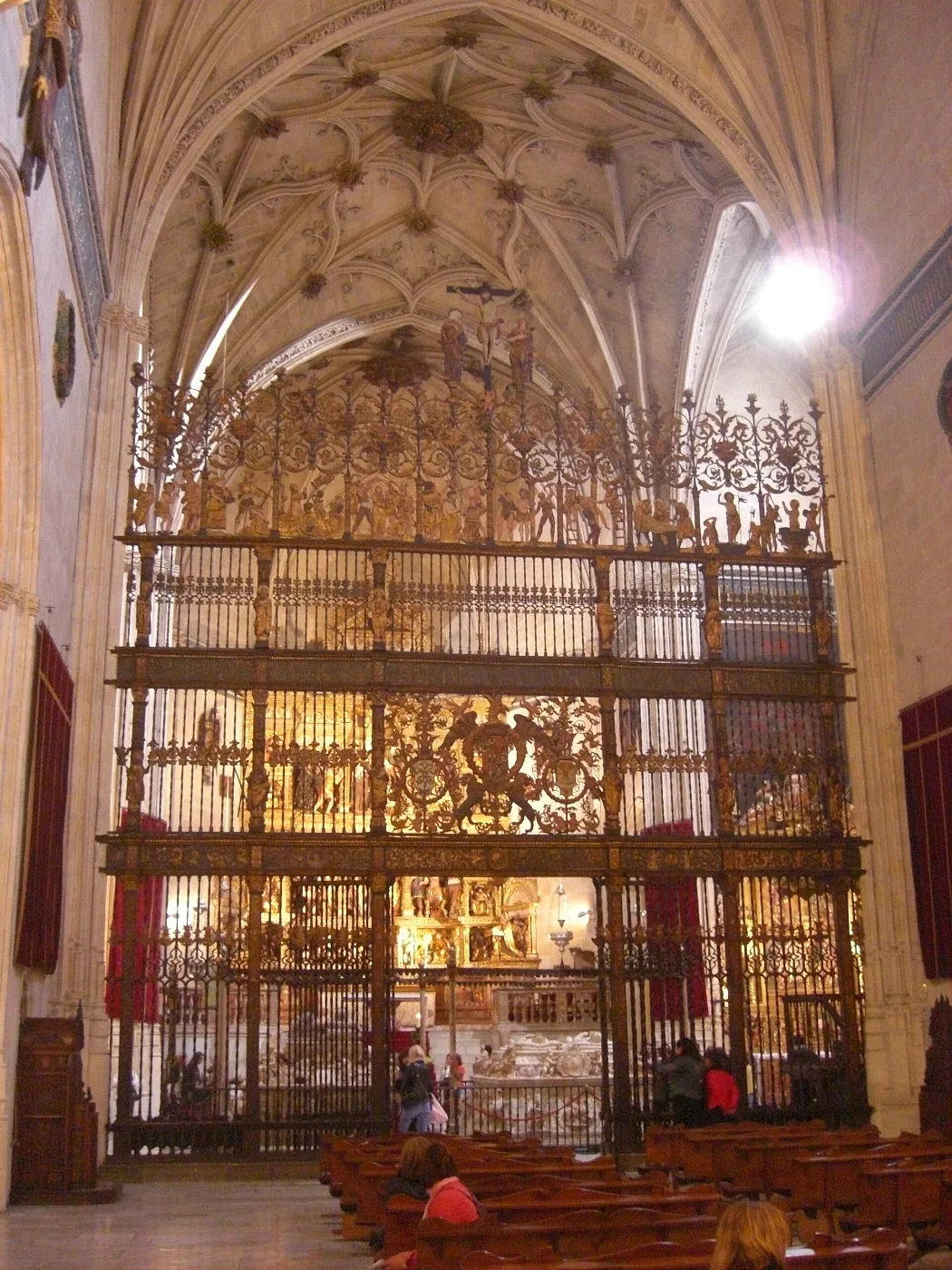
In Granada, the Royal Chapel credits its main grille to maestro Bartolomé, with grotesque ornament on the pillars of the first tier by Cubillana. The grille rises in three tiers and an attic, divided into five vertical bays by pillars, with a central bay of double width. The second tier carries the arms of the Catholic Monarchs and six apostles under Gothic canopies. The attic links the grille to the high altarpiece, with scenes of the Passion and the two Saints John culminating in Christ on the Cross with the Virgin and Saint John.
THE VALLADOLID CHOIR SCREEN AT THE MET
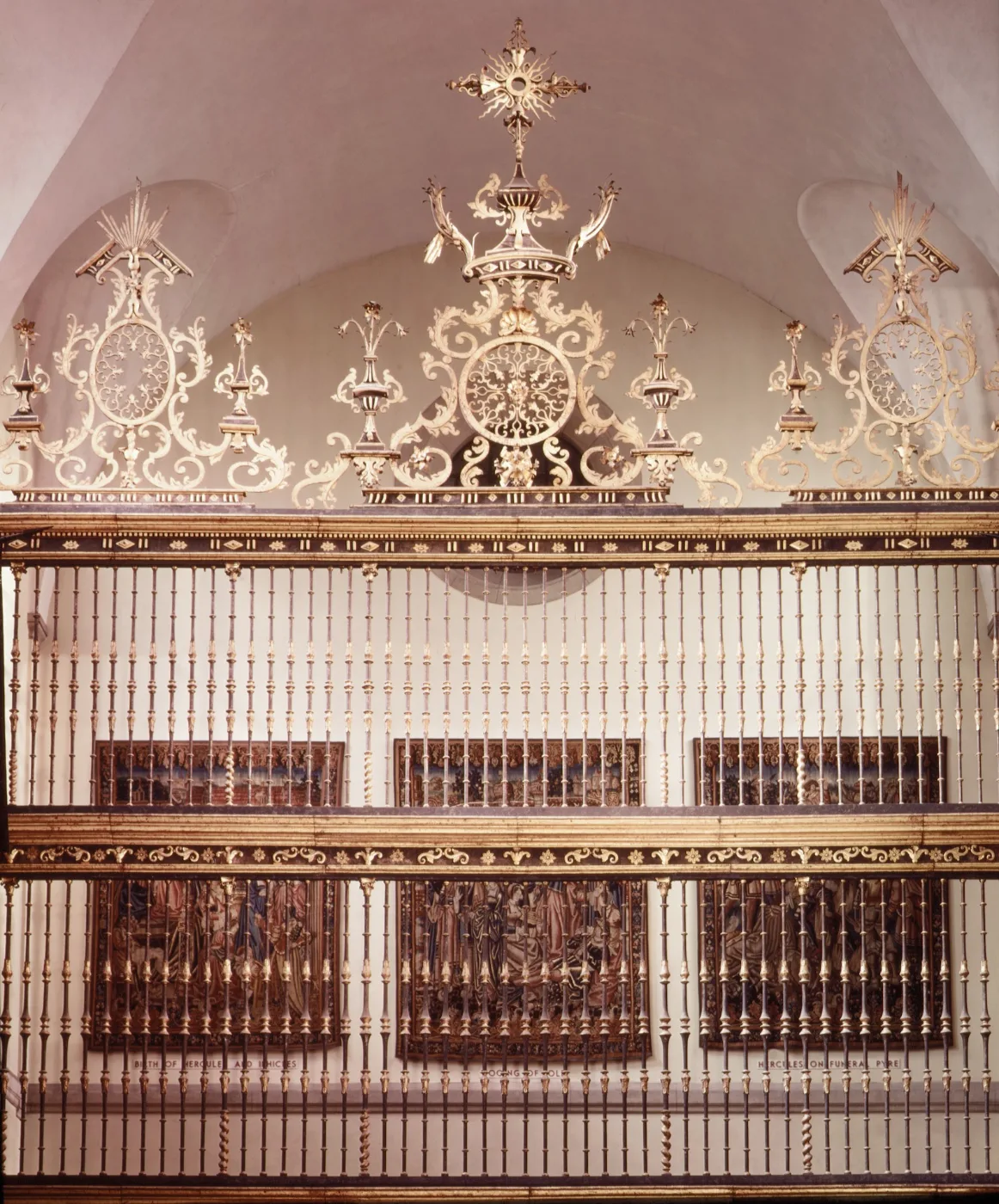
The Met notes that Renaissance rejas proved so satisfactory for screening choirs and chapels that they long remained models for Spanish ironworkers, and its choir screen from the Cathedral of Valladolid is an 18th-century work closely based on them. Commissioned by Isidro Cosío y Bustamante, bishop of Valladolid, it was installed in 1763 in the nave, where it separated the choir from the high altar; its cresting and gilding were completed a year later. It is iron, gilded and painted, on a limestone base, and measures 15.85 by 12.8 metres (52 by 42 feet). The Hearst Foundation gave it to the museum in 1956.
The screen had been believed to be a 17th-century work until Jesús Urrea of the University of Valladolid, writing in volume 13 of the Metropolitan Museum Journal, dated it almost a century later from documentary evidence. In 1668 the ironworker Pedro Juan had made two choir screens for the cathedral; the present screen was installed on 7 December 1763 and painted and gilded in 1764. Because the bishop paid from his own funds, it does not appear in the cathedral account books. Urrea attributes it to the Amezúa family of ironworkers from Elorrio in Biscay, and the Met to Rafal (Rafael) Amezúa, who in 1740 made two screens for the sanctuary of Cuenca Cathedral that share its twisted columns.
BALCONIES, WINDOW GRILLES AND WROUGHT IRON CHANDELIERS
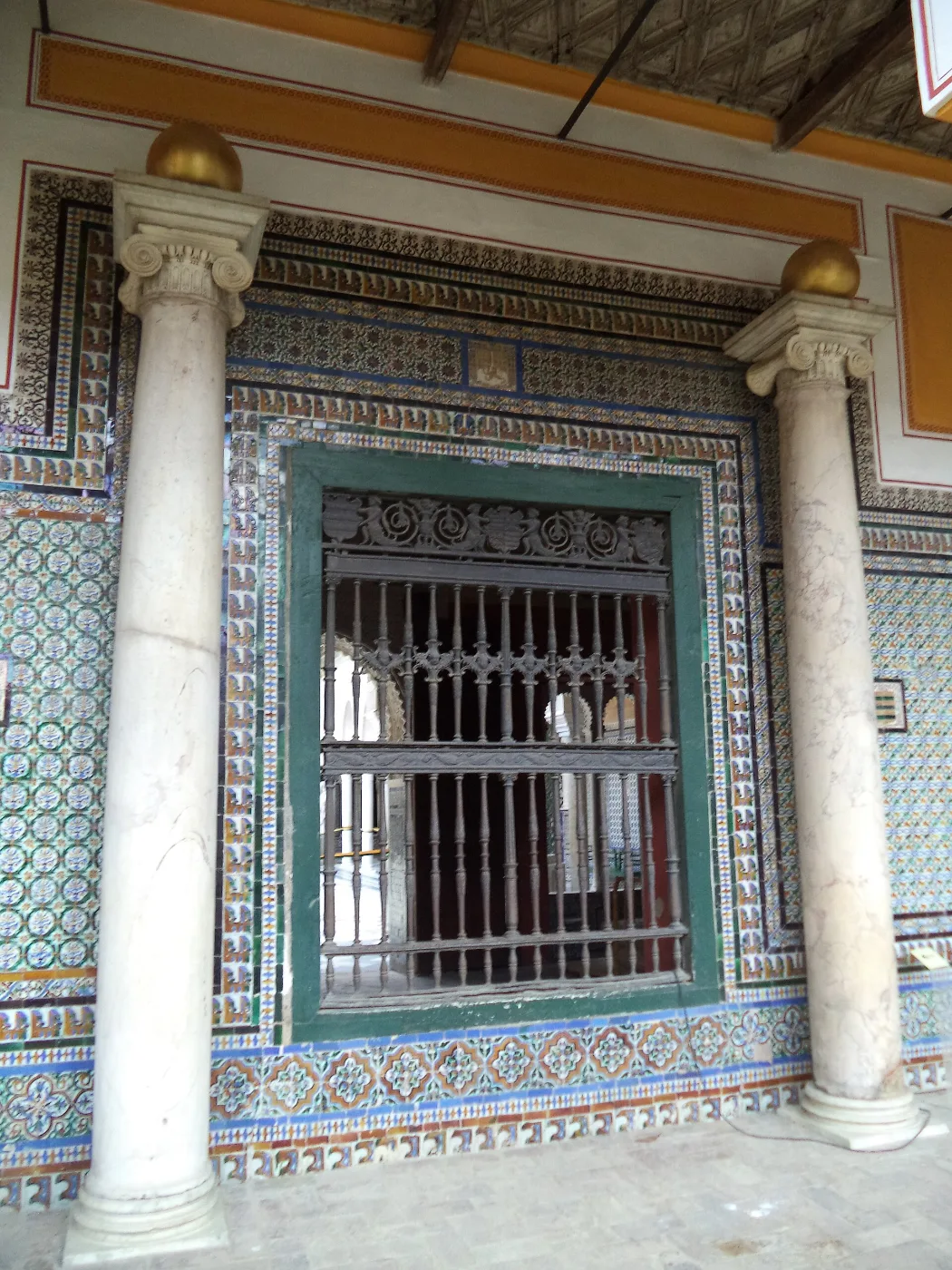
Rejeros applied the same techniques at a domestic scale. Britannica records Spanish wrought iron in gates, balconies and window screens, in iron pulpits, and in hammered and pierced panels, coloured and gilded, set into domestic architecture; many doors carried elaborate nailheads or embossed studs. Seville Cathedral describes its own grilles as a record of the stylistic evolution of Andalusian grillwork, and most of its 16th-century altars keep their original grilles and railings. Spanish smiths also took the craft abroad: Britannica notes that Spanish and French smiths forged the earliest ironwork in New Orleans, where the gateway of the Cabildo, the town hall, is the most important survivor of the Spanish work.
Iron was also used for lighting. The V&A explains that the chandelier developed from the candle-beam, and that from the 15th century ring and crown designs became popular in cathedrals and wealthy households, most of them cast in brass. Its own rare iron example, made in Germany between 1450 and 1500, is wrought iron, painted and gilded, with cusped arches, pinnacles and Gothic foliage, and six branches ending in candle pans edged with openwork. A central socket held a thin candle or a figure of a saint. The chandelier stands 97.4 centimetres high and weighs 10.72 kilograms.
HOW DID SPANISH WROUGHT IRON CHANGE IN THE 19TH CENTURY?
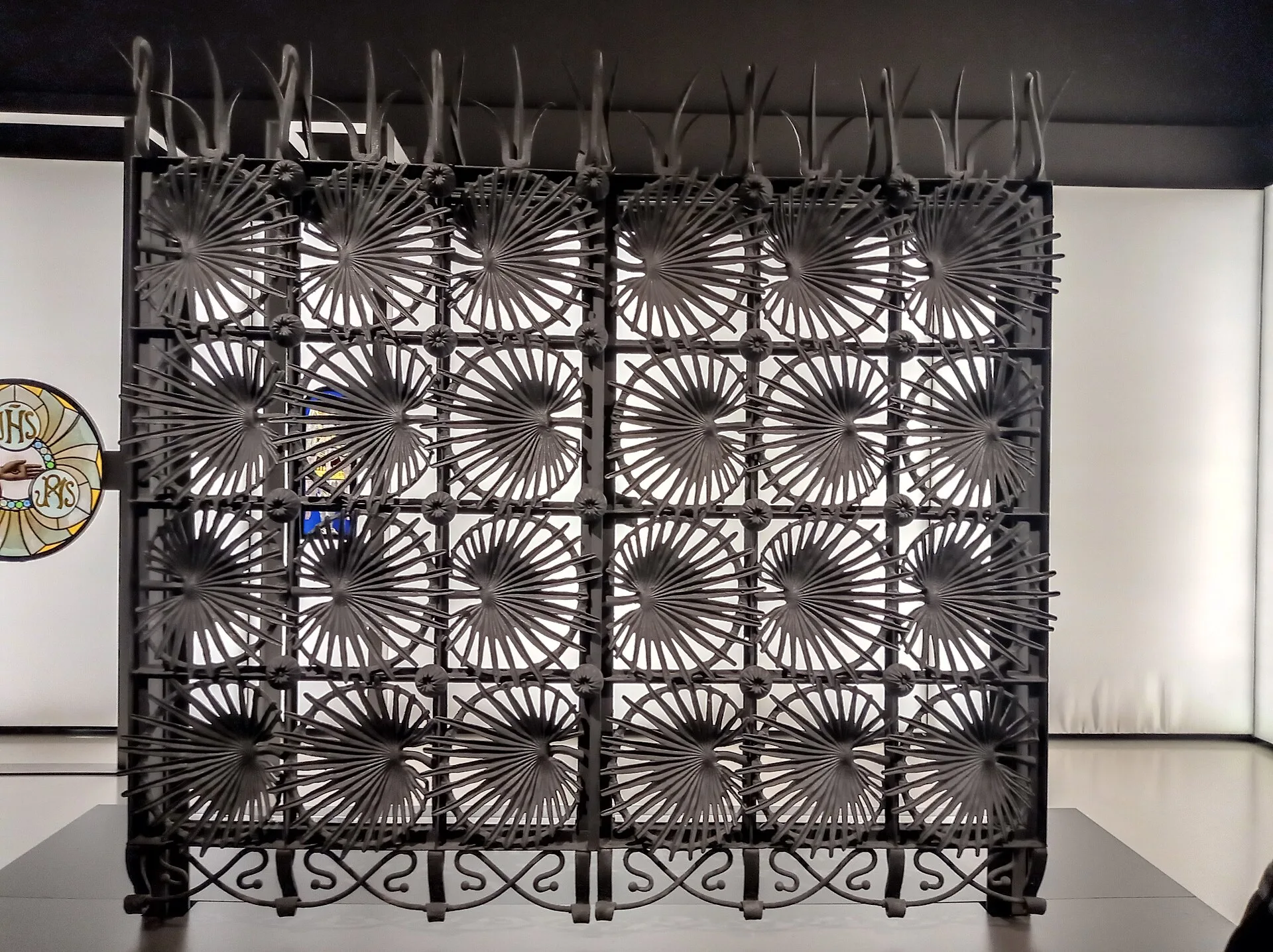
The Catalan forges did not survive industrial steelmaking. Tomàs records that indirect production, smelting in a blast furnace followed by refining, replaced the direct method, and that from the mid-19th century the low hearth could not compete with blast furnaces or with the Bessemer and Siemens-Martin steel processes. By the end of the 19th century every farga had shut down. In the same decades Antoni Gaudí built his first house, Casa Vicens, at Carrer de les Carolines 20 to 26 in Gràcia, between 1883 and 1885, as a summer residence for the stockbroker Manel Vicens i Montaner.
According to La Pedrera, the house's exterior wrought-iron fence repeats a motif of buds among the leaves of the dwarf fan palms that were abundant on the estate grounds. It stands in front of an exterior of exposed stone, brick and ceramic tiles, for which Gaudí used a single carnation-motif tile combined with two standard tiles. La Pedrera lists ironwork, with ceramics and prefabricated elements, among the techniques used at the house. Casa Vicens was declared a Historic-Artistic Monument in 1969 and inscribed on the UNESCO World Heritage List in 2005 as part of the Works of Antoni Gaudí.
TAPAS AT MANDARIN ORIENTAL SHENZHEN

Tapas is a restaurant and bar at Mandarin Oriental Shenzhen, completed by Silverfox Studios in 2022. Its walls are exposed brick, with a glass-fronted wine display set into the brickwork, and its glazing is steel-framed. Steel is the homogeneous modern material that Historic England distinguishes from hand-forged wrought iron, which carries slag inclusions and is joined by fire welding, riveting or pinning. The room is furnished with red leather banquettes and framed photographs, and the marble bar counter has views of the city.
The metalwork in the restaurant and bar includes suspended black metal shelving and a wrought-iron chandelier. The V&A traces the chandelier as a fitting to the candle-beam and to the ring and crown designs hung in cathedrals and wealthy households from the 15th century, most of them cast in brass rather than iron. In Spain the following century brought the baluster screens of Seville and Granada, hammered by rejeros from solid wrought iron and finished with the cold chisel, colour and gilding.
SOURCES
- The Metropolitan Museum of Art Choir screen from the Cathedral of Valladolid
- The Metropolitan Museum of Art A New Date for the Choir Screen from Valladolid, Metropolitan Museum Journal 13
- Britannica Metalwork: Spain
- Institut d'Estudis Catalans The Catalan process for the direct production of malleable iron and its spread to Europe and the Americas
- Historic England Webinar on the Conservation of Architectural Metalwork: Part 2 Iron Gates and Railings
- Catedral de Sevilla Decorative Arts
- Catedral de Sevilla Hierro, fe y Renacimiento: la reja del altar mayor de la catedral
- Capilla Real de Granada Las rejas de la Capilla Real
- Victoria and Albert Museum Chandelier, 1450 to 1500
- La Pedrera Casa Vicens