HOW EDO'S PRINT DESIGNERS ADVERTISED KABUKI PLAYS AND SOLD THE FACES OF THEIR STARS
Yakusha-e are the kabuki actor prints of Japan's ukiyo-e trade, single sheets that showed named actors in the roles they were playing that season. Their history begins with the theatre signboard: Torii Kiyomoto, originally a kabuki actor, started painting billboards in around 1690, and the Torii school he founded went on to hold a monopoly of commissions for theatre posters. From the 1760s Ippitsusai Bunchō and Katsukawa Shunshō introduced recognisable facial likenesses, and in ten months from May 1794 Tōshūsai Sharaku issued about 142 actor portraits. Utagawa Kunisada, the most commercially successful print designer of all, gave about 70 per cent of his output to kabuki actors, while Osaka printmakers built a separate kamigata-e tradition. Toyohara Kunichika's death in 1900 marked the end of the full-colour woodblock actor print, but Torii artists were still painting kabuki signboards in the 20th century.
THE TORII SCHOOL AND THE EDO KABUKI SIGNBOARD
The Torii school is a family lineage of ukiyo-e artists that began in the Genroku era (1688 to 1704) and has continued to the present. Its founder, Torii Kiyomoto (1645? to 1702), was originally a kabuki actor and started to paint billboards in around 1690. The school stayed closely tied to the kabuki world and won a monopoly of commissions for painting theatre posters and portrait prints of popular actors. The early masters were Torii Kiyonobu (1664 to 1729) and Torii Kiyomasu, active in the early 18th century.
The early Torii style was exaggerated. Kiyonobu and Kiyomasu drew figures with hyōtan ashi, gourd-shaped feet, and outlined them in wavy lines with thick-and-thin accents, a manner suited to actors playing rough male roles in dramatic poses, the aragoto style of Edo kabuki. The same style is still found on kabuki posters. Later heads widened the school's range. Torii Kiyonaga (1752 to 1815), the fourth head, attracted special attention as a painter of beautiful women, but in theatre prints he added the jikata musicians to degatari-zu compositions and showed actors in their daily lives off stage.
HOW DID KABUKI PRINTS ADVERTISE PERFORMANCES?
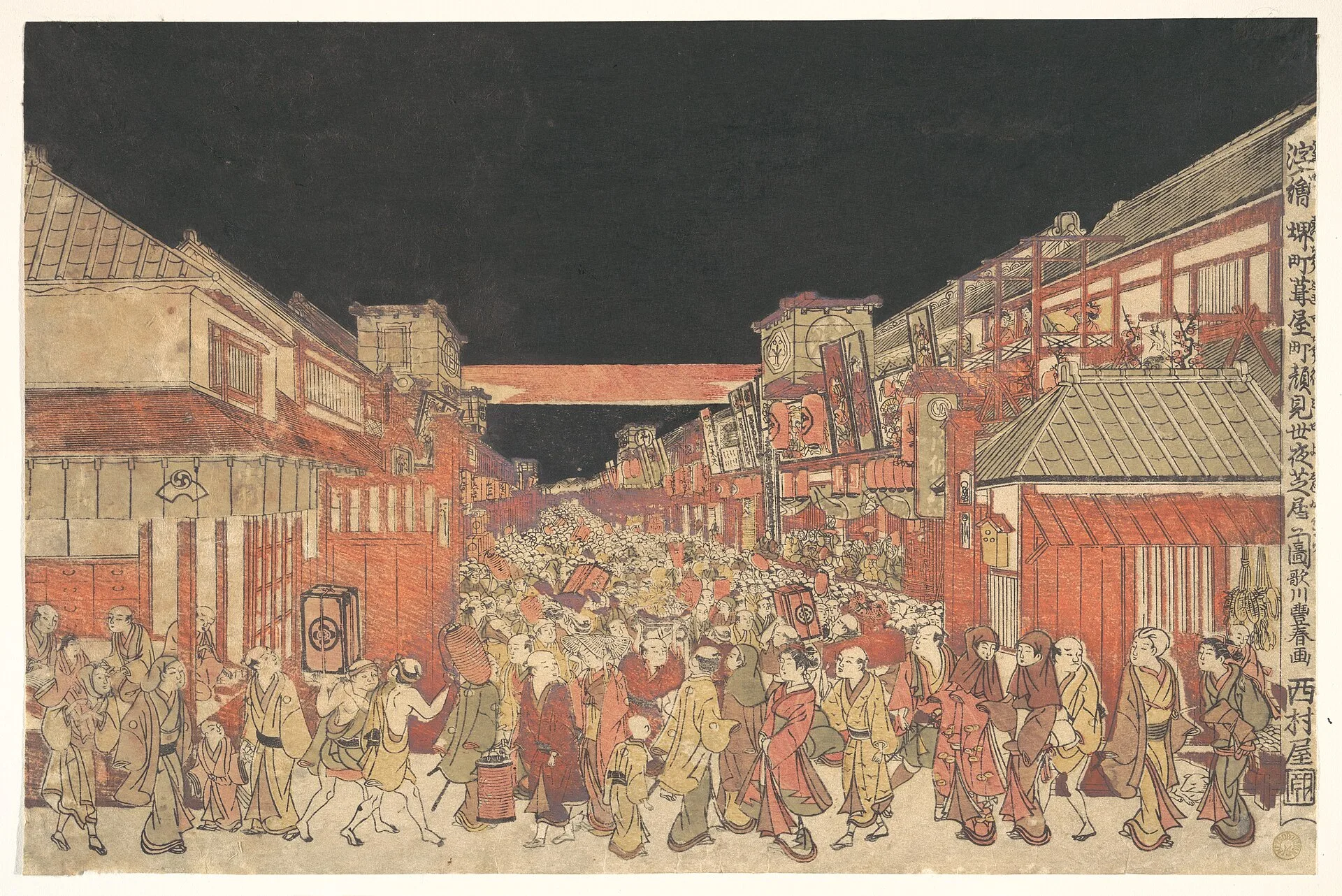
The shibai banzuke, the printed kabuki playbill, helped develop the ōban single-sheet actor print. The kaomise banzuke, or debut playbill, was published in the middle of the 10th month to announce the new company that would make its first appearance in the 11th month. It listed the actors first, then the musicians and the jōruri company. The format appeared in Kyoto, Osaka and Edo in the 1660s or 1670s and was largely settled by the mid-18th century. Osaka and Kyoto debut playbills carried no pictures, while Edo versions included portraits of the leading actors, drawn during and after the Genroku era by the theatre specialists of the Torii school.
For wider publicity, theatres issued the tsuji banzuke, or street playbill, a leaflet put up in bathhouses, barber shops and other busy parts of town and handed out by actors, teahouse managers and ushers. Each carried woodblock pictures copied from the theatre posters. A surviving tsuji banzuke in the Tsubouchi Memorial Theatre Museum at Waseda University, 23 by 32.8 centimetres, advertises the Morita-za production of Kanadehon Chūshingura in 1749, with illustrations in the upper tier and a cast list of actors. The play had opened as a puppet drama at the Takemoto-za in Osaka in 1748, and the Morita-za was the first of Edo's three major theatres to stage it.
Single-sheet prints worked on the same calendar. Edo had three licensed theatres, the Ichimura, Morita and Nakamura, and their season opened with the kaomise from the 1st day of the 11th month. Certain plays were tied to the year: the Soga revenge plays at New Year and Sukeroku in spring. Prints were nearly always published to coincide with particular performances and were intended to be sold immediately, in editions of several thousand. An ōban print cost twenty mon, about the price of a haircut or an inexpensive meal and half the cheapest kabuki ticket, and fans pasted prints of their favourite actors on their walls and screens.
WHO WAS SHARAKU? THE LIKENESS IN KABUKI ACTOR PRINTS
A new kind of actor picture arrived with nigao-e, literally face likeness pictures, which in ukiyo-e mainly means actor portraits that capture an actor's distinguishing features so that he can be recognised by his face alone. Ippitsusai Bunchō (active about 1765 to 1792) and Katsukawa Shunshō (1726 to 1792) created this new style in the early full-colour woodblock prints, departing from the stylised work of the Torii school. Shunshō's followers Shunkō (1743 to 1812) and Shun'ei (1762 to 1819) carried it on, and by the late 18th century portraying individual traits had become a stronger priority in the actor print.
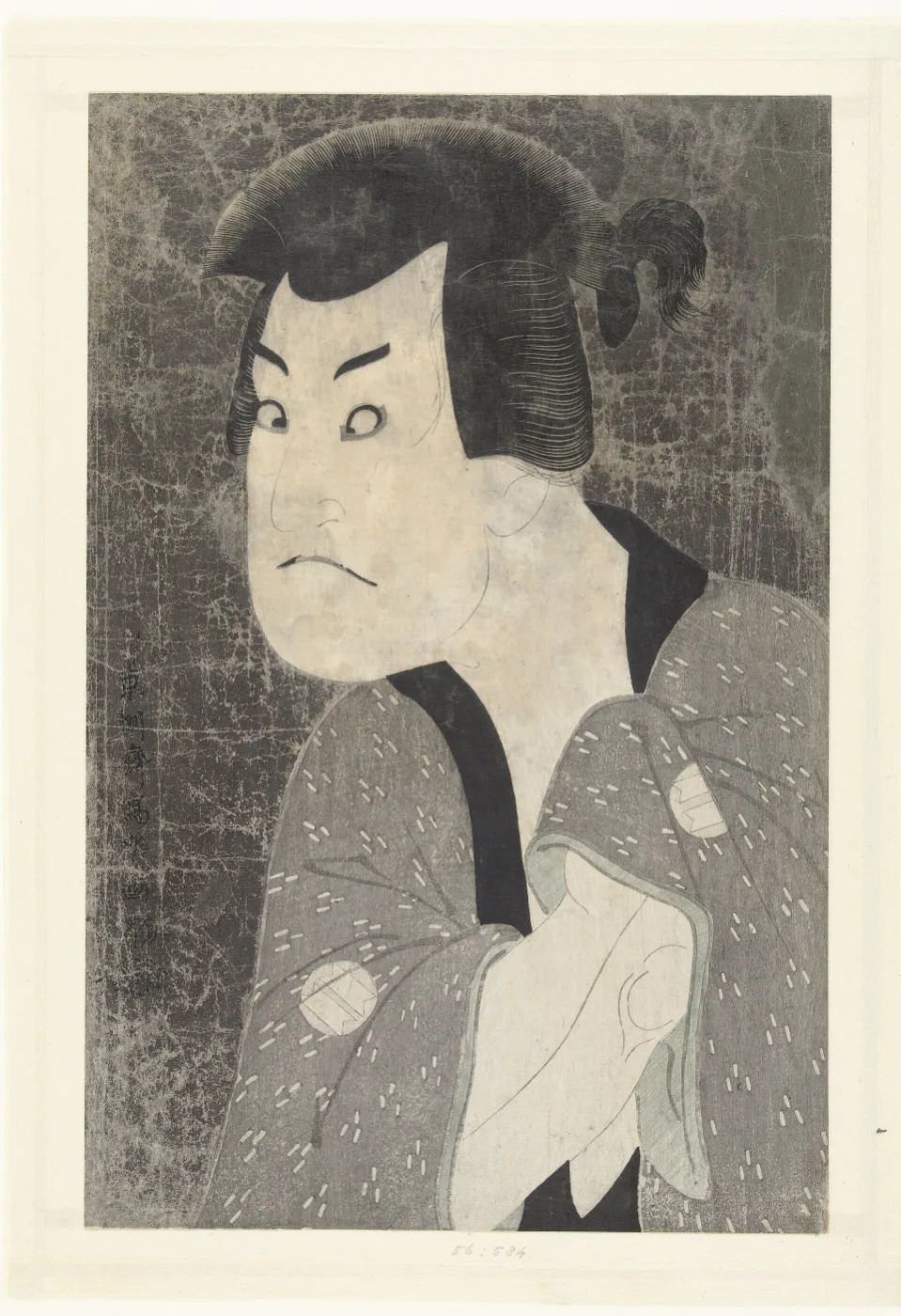
The approach reached a peak with Tōshūsai Sharaku. In the 5th month of 1794 the publisher Tsutaya Jūzaburō issued his first actor portraits, printed in colour over a ground of black mica powder. That first group comprised 28 ōkubi-e, large-head pictures of the head and upper body. Over the following ten months Sharaku published 142 actor portraits, with some sources giving 143 to 145, plus a few pictures of sumo wrestlers. His work appeared in four releases: 28 prints in the 5th month of 1794, 38 in the 7th and 8th months, 64 in the 11th month and its intercalary month, and 12 in the 1st month of 1795, after which he left the trade.
The first-period portraits, such as Sakata Hangorō III as Fujikawa Mizuemon and Ichikawa Komazō III as the villain Shiga Daishichi in the Tokyo National Museum, combine the role's expression with a boldly distorted version of the actor's own face. The later full-length prints in tall, narrow formats were poorly received. The writer Ōta Nanpo recorded that Sharaku "tried too much to draw the truth" in portraying actors. Almost nothing is known of his life: Saitō Gesshin recorded the theory that he was a Noh actor of the Awa domain named Saitō Jūrobei. A German study titled Sharaku, published in 1910, helped build his reputation in Europe and the United States.
UTAGAWA TOYOKUNI, KUNISADA AND THE MIE POSE IN PRINT
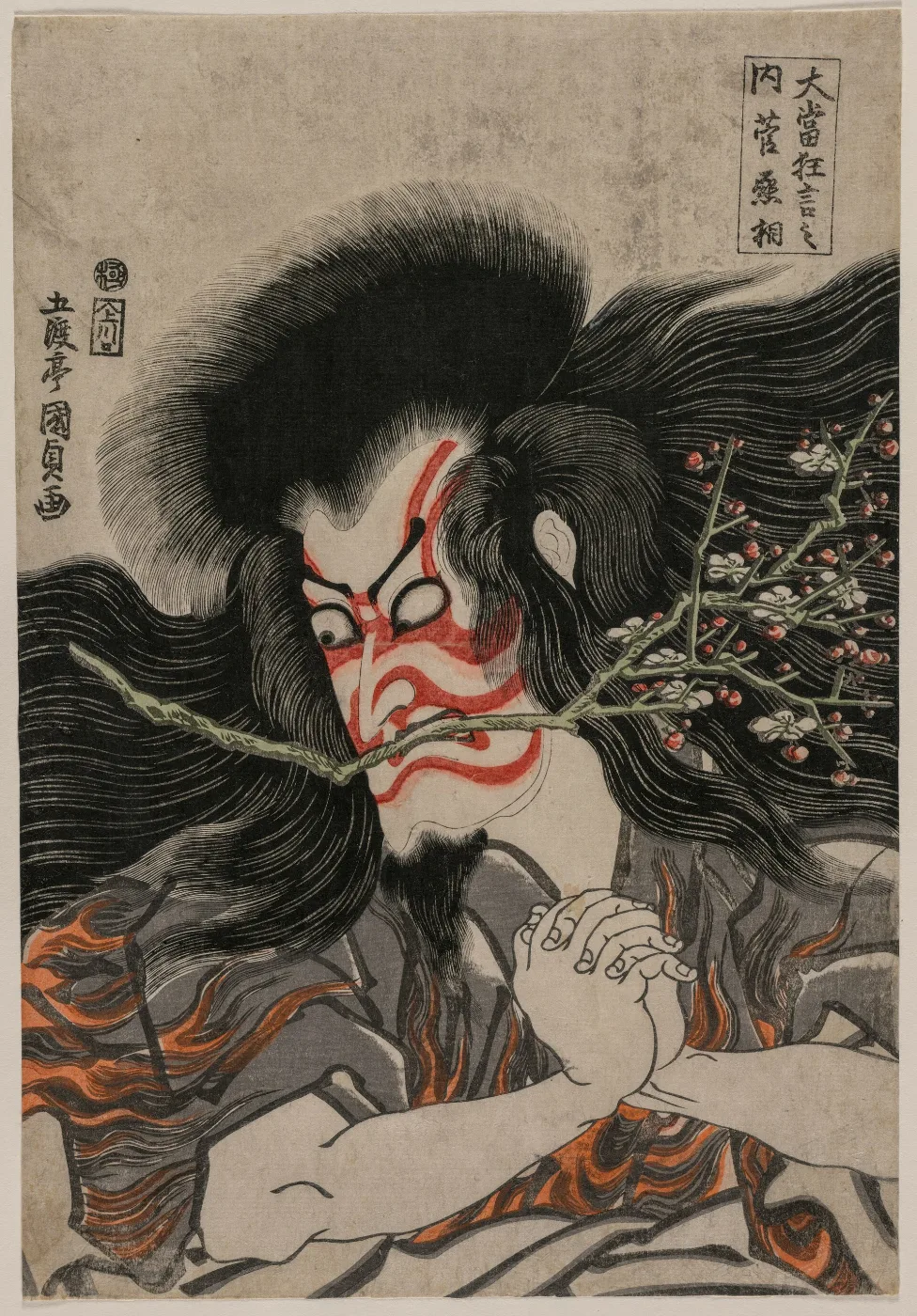
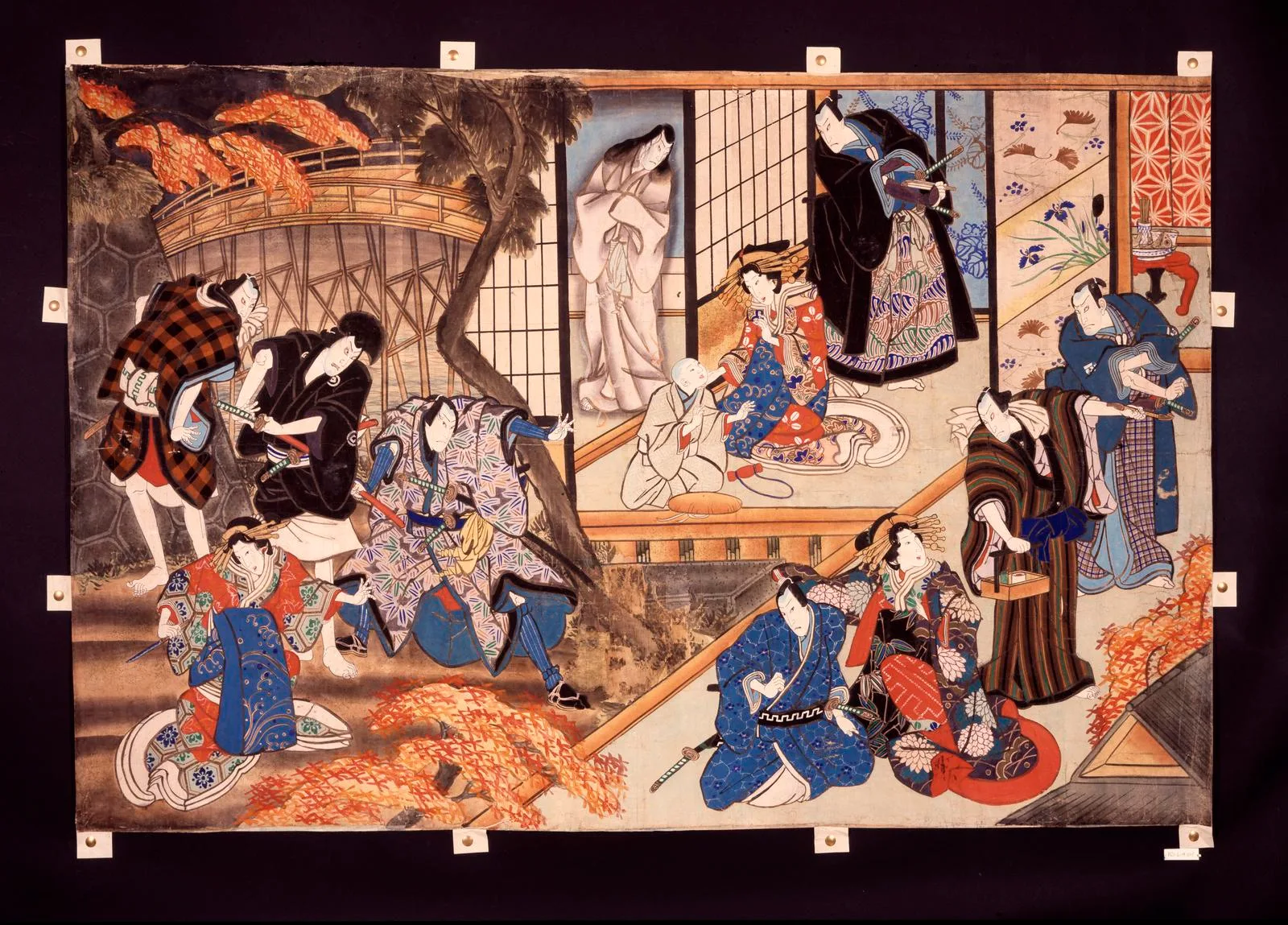
Leadership of the actor print then passed from the Katsukawa school to the Utagawa school. Utagawa Toyokuni gained popularity with actor portraits that applied a certain amount of beautification, and was dubbed Nigao-eshi Toyokuni, Toyokuni the likeness painter, in 1793. His pupil Utagawa Kunisada (1786 to 1865) became the most prolific and commercially successful of all woodblock print designers. Kabuki actors formed about 70 per cent of his output. Kunisada established a style distinct from his teacher's in the 1820s and 1830s, and after 1844 he adopted his master's name and signed his prints Toyokuni.
Kunisada's late actor prints used luxury effects: the gleam of metallic pigments and mica, karazuri patterns embossed without ink, and tsuyazuri patterns burnished into the printed surface with ivory or a tooth, from as many as twenty blocks. He also designed surimono, privately issued prints that combined images and poems. His surimono, made mainly in the 1820s and 1830s, were almost entirely devoted to kabuki, and several document his closeness to the leading actors Ichikawa Danjūrō VII (1791 to 1859) and Onoe Kikugorō III (1784 to 1849). The Utagawa artists went on producing actor likenesses until the end of the Edo period in 1868.
The moment these prints most often show is the mie. At an emotional high point the actor strikes a stylised pose and facial expression and holds it, sometimes distorting his face or crossing his eyes, while the tsuke player slowly beats out three sounds on wooden blocks with two hard sticks. The pose marks the point at which a character's inner feelings break through his outward behaviour, on the verge of passion, rage, madness or violence. Woodblock prints of famous actors depict this pose more often than any other, and a toned-down version appears in Japanese film, manga and anime.
WHAT IS KAMIGATA-E? OSAKA'S KABUKI ACTOR PRINTS
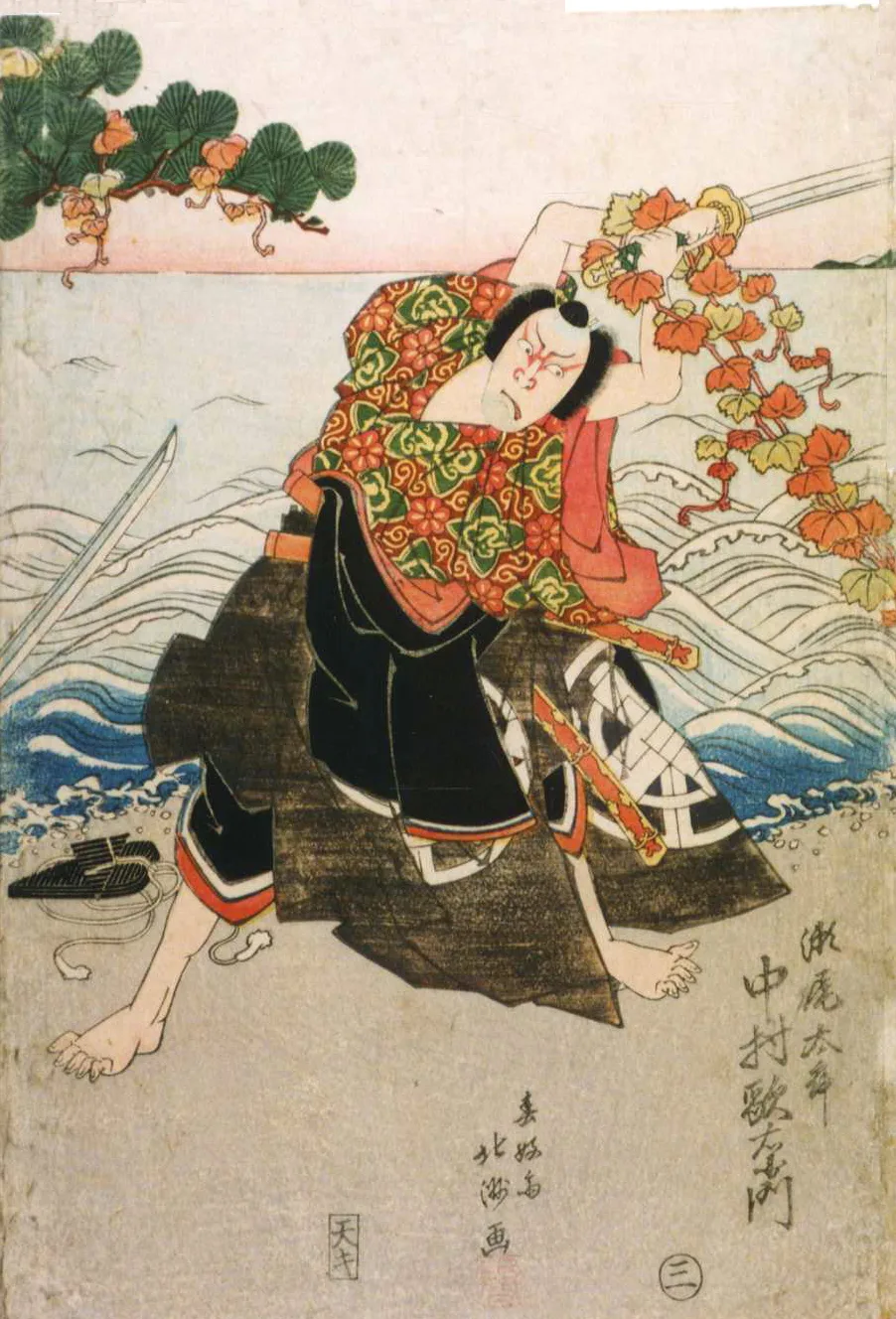
Kamigata-e, also called Ōsaka-e, are the ukiyo-e prints of the Osaka and Kyoto region, as distinct from the Edo-e of the capital. The earliest were black-and-white illustrations for popular fiction, mostly by unknown artists, with Yoshida Hanbee, active from 1660 to 1692, the earliest notable name. By the late 17th century Edo was rapidly becoming the centre of ukiyo-e printmaking. Osaka stayed strong in book publishing, but its smaller number of publishers meant less competition, fewer commissions and less experiment. Kamigata printmakers popularised kappazuri, a stencil method of colour printing, and Ōoka Shunboku designed the first known book to use it in 1746.
Apart from privately commissioned surimono, single-sheet kamigata-e mostly showed kabuki actors. Ryūkōsai Jokei designed the first full-colour single sheets in Osaka, published in 1792 and 1793, and his pupil Shōkōsai Hanbee and the designer Shunkōsai Hokushū followed. Hokushū popularised large multi-sheet sets of full-length actor portraits, which became a hallmark of the Osaka school. Artists in the two cities influenced each other: Katsushika Hokusai visited Osaka, largely to use its better printing facilities. Some bold Osaka designs may predate similar work in Edo.
FROM KUNICHIKA TO THE 20TH-CENTURY KABUKI POSTER
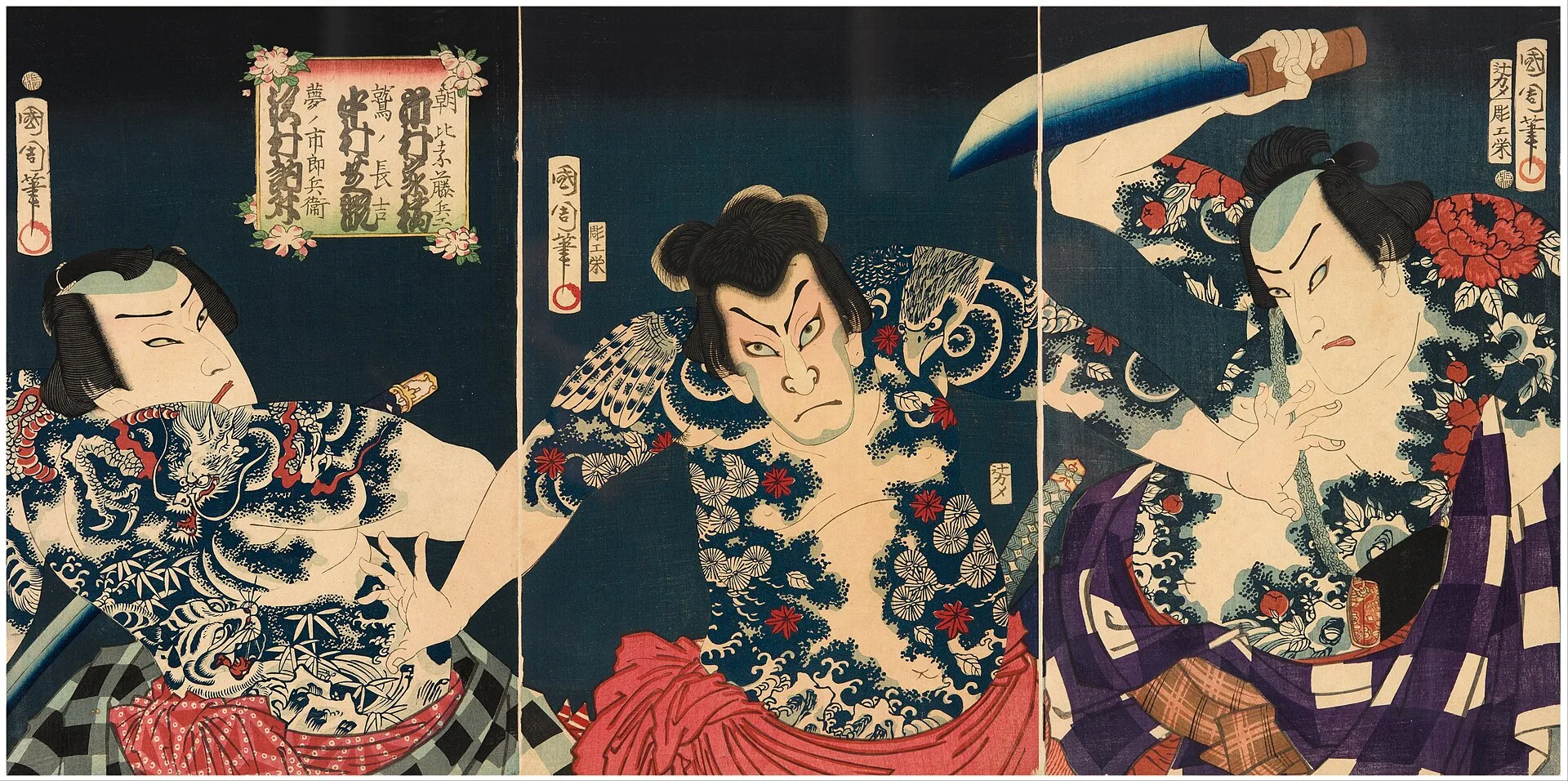
The last major designer of the colour actor print trained under Kunisada. Toyohara Kunichika (1835 to 1900) was born in Edo, became Kunisada's apprentice in 1848 and took the name Kunichika in 1854. He spent long hours backstage watching kabuki actors to record their poses and expressions, and his use of colour is regarded as the most skilful aspect of his art. He is known for bust portraits of actors and dramatic kabuki triptychs, and he worked until shortly before his death in 1900 at the age of 65. His death marked the end of an era of full-colour woodblock actor prints.
Torii artists continued to paint theatre signboards after 1900. Torii Kiyotada VII, seventh head of the Torii school, retired in about 1929 and is believed to have been succeeded by his eldest son, Torii Kotondo (1900 to 1976), as eighth head. Kotondo trained under Kaburaki Kiyokata, a painter of the Utagawa Kuniyoshi lineage, and became known for shin-hanga prints of beautiful women, but he also produced many theatre signboards and stage designs. The Torii lineage continued after him to Torii Kiyomitsu, born in 1938, and the school's gourd-footed, thick-and-thin outline remains in kabuki posters.
NETSU AT MANDARIN ORIENTAL JUMEIRA DUBAI

Netsu is a Japanese robata restaurant by chef Ross Shonhan at Mandarin Oriental Jumeira Dubai, completed in 2019. Its double-height interior is designed around a kabuki theatre concept, with the robata grill as the central stage. Guests watch the grill from several levels, which include an upper bar and DJ lounge. A raised walkway from the back kitchen recalls the hanamichi of the kabuki stage. In the theatres of Edo, the stage was where actors struck the mie poses that woodblock prints of famous actors show more often than any other.
Columns and a wall carry 1950s-style kabuki poster graphics. The kabuki poster runs through the whole history of the actor print: Torii Kiyomoto began painting theatre billboards in around 1690, Edo theatres put up tsuji banzuke in bathhouses and barber shops, and Torii Kotondo was still producing theatre signboards in the 20th century, when the Torii outline of gourd-shaped feet and thick-and-thin lines remained in use on kabuki posters. Outside, horizontal recessed lighting references the tiered seating of a theatre.
SOURCES
- JAANUS Torii-ha (Torii school)
- JAANUS Shibai banzuke (kabuki playbills)
- Tsubouchi Memorial Theatre Museum, Waseda University Tsuji banzuke street poster for Kanadehon Chushingura
- Fitzwilliam Museum, University of Cambridge Kunisada and Kabuki
- JAANUS Nigao-e
- Japan Search, National Diet Library Toshusai Sharaku
- University of Pittsburgh Mie
- JAANUS Kamigata-e
- Museum of Fine Arts, Houston Toyohara Kunichika
- Ota Memorial Museum of Art Torii Kotondo: Kabuki Paintings and Shin-Hanga