THE OBON CUSTOM OF SENDING ANCESTRAL SPIRITS BACK ON LIGHTS FLOATED DOWN RIVERS AND OUT TO SEA
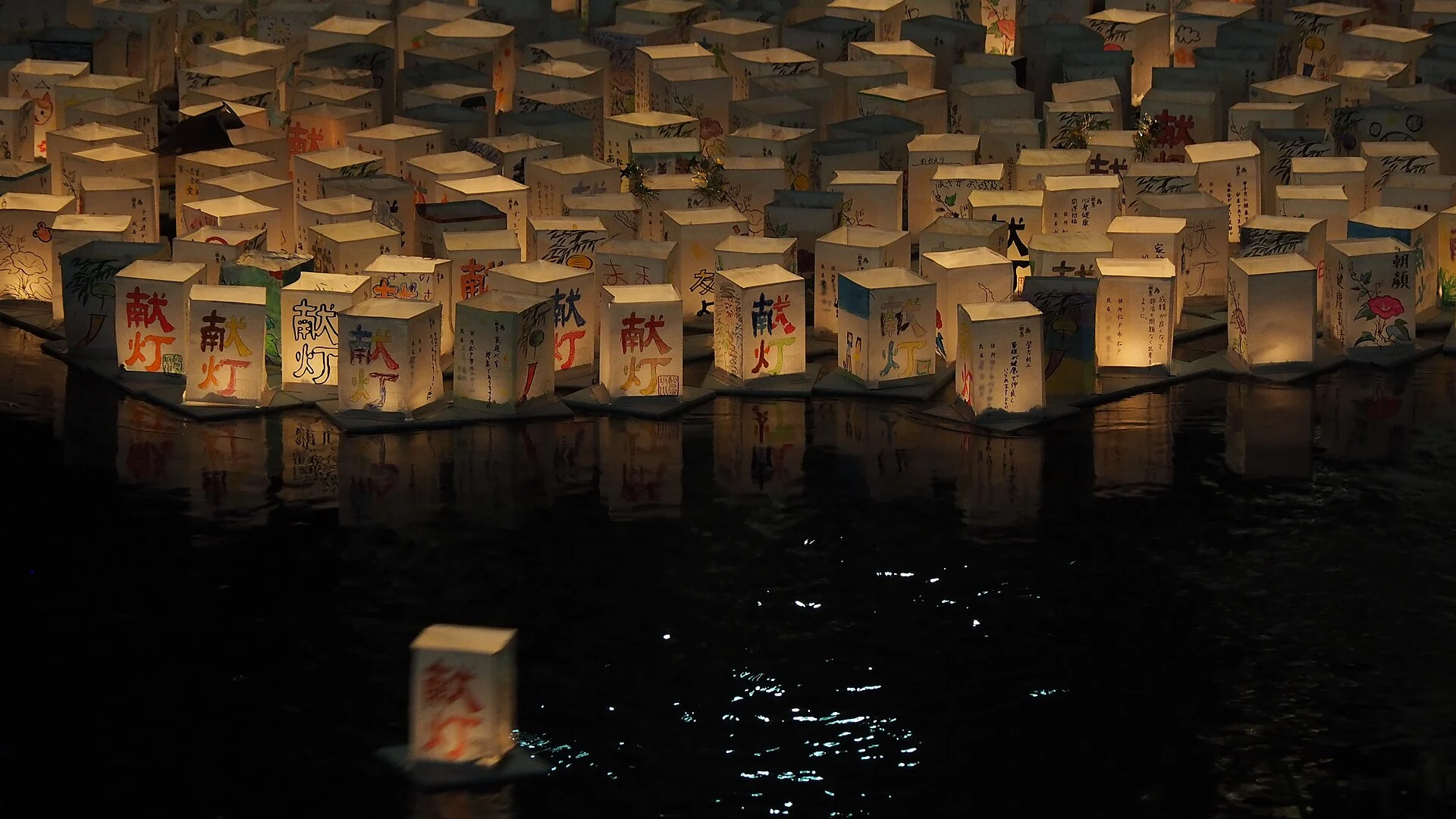
Toro nagashi (lantern floating), also called ryūtō or ryūtō-e, is a Japanese custom in which small lanterns are lit and set adrift on rivers or the sea, most often on the last night of Obon, the summer festival of the dead. It sends off the ancestral spirits that families welcome home at the start of Obon; Heibonsha's encyclopaedia records the belief that the spirits ride the lanterns downstream to an otherworld beyond the sea. Toro nagashi is a later form of shōryō nagashi, the older practice of floating offerings away on straw or wooden boats. It is usually held on 15 or 16 August, including at the Togetsukyō Bridge in Kyoto's Arashiyama and on Miyazu Bay in northern Kyoto Prefecture, where the tradition is about 400 years old.
WHAT IS OBON? THE BUDDHIST FESTIVAL BEHIND TORO NAGASHI
Obon ranks alongside New Year as one of the most important periods in the Japanese calendar, when families gather, visit graves and honour their ancestors. The name is a shortened form of Urabon'e, which derives from the Sanskrit ullambana, usually interpreted as the suffering of being hung upside down. The rite was meant to relieve the dead of that suffering in the realm of hungry ghosts. The Yamakawa dictionary of Japanese history records an alternative theory linking the word to urvan, an Iranian term meaning soul, and Britannica's Japanese encyclopaedia notes that the origin of the sutra and of the name remain unclear.
The rite rests on a story told in the Ullambana Sutra. Mokuren (Maudgalyayana), a disciple of the Buddha, learned that his mother had fallen into the realm of hungry ghosts after her death. The Buddha told him to make offerings to many monks, and the merit of those offerings freed her from suffering. The offerings were made on the 15th day of the seventh lunar month, and Obon still centres on that date. According to the Yamakawa dictionary, the Nihon Shoki chronicle records temple offering ceremonies on the 15th day of the seventh month from 606, and the first Ullambana service in 657. Shogakukan's dictionary dates its adoption as a regular court observance to 733.
HOW OBON BECAME A FESTIVAL OF RETURNING ANCESTORS

The Buddhist rite joined an older Japanese practice. Japan Search, the national digital archive run by the National Diet Library, explains that before Buddhism arrived, people held a festival of spirits, tama matsuri, on New Year's Day and again in the seventh month. After Buddhism was introduced, the summer event merged with ullambana and became Obon. Under the Kamakura shogunate, temples combined the rite with segaki, services of offerings for hungry ghosts. Britannica's Japanese encyclopaedia dates the modern form of Obon to the Edo period, when the Buddhist observance merged fully with folk beliefs about ancestors.
From the Edo period, Obon ran from the 13th to the 16th of the seventh month, in a sequence that many families still follow. Welcoming fires (mukaebi) are lit at house entrances or in cemeteries on the first day so that the spirits can find their way home. Offerings of fruit and vegetables are set out on a spirit shelf, the shōryōdana, and monks chant sutras in the home. Families also make shōryōuma, spirit animals of cucumbers and aubergines standing on chopstick legs: the cucumber horse asks the ancestors to come home quickly, and the aubergine cow asks them to travel back slowly, carrying the family's offerings. On the last day, farewell fires (okuribi) send the spirits back. Some areas keep Obon around 15 July, but most of Japan now observes it from 13 to 16 August.
WHERE DID TORO NAGASHI COME FROM?
Toro nagashi grew out of shōryō nagashi, spirit floating. The Nipponica encyclopaedia records that the earliest forms simply wrapped the Obon offerings in lotus leaves or sedge mats and set them on the water. Later, communities built boats of wheat straw, called shōryō-bune, and sent them off with more ceremony. Shogakukan's Digital Daijisen places the rite on the evening of the 15th or early morning of the 16th, with lit lanterns sometimes added. The Yamakawa dictionary treats lantern floating as a later variation of this practice. Heibonsha's older encyclopaedia explains that water was believed to purify the dead and guide their spirits to the afterlife.
A second root lies in kawa segaki, river services for the dead. Itō Tadamasa, writing in Heibonsha's encyclopaedia, links lantern floating closely to these rites, which large temples originally held for people who had died violent deaths, such as by drowning. Iinokuchi Shōji, writing in Nipponica, notes that the custom is not limited to Obon and has also served as a memorial for the drowned and for spirits without relatives. He cites the late Edo writer Sugae Masumi, who recorded that at Ōmachi in Shinano (modern Nagano Prefecture), straw bundles were lit and floated on the 16th day of Bon for the souls of the drowned.
China had a parallel tradition. Heibonsha's entry on Chūgen, the Chinese festival held on the 15th day of the seventh month, records that by the end of the Six Dynasties period it had become a festival shared by Taoists and Buddhists. Floating lanterns on rivers was practised during the Southern Song. In the Yuan and Ming periods, lanterns were made in the shape of lotus leaves and lotus flowers, and children carried them through the streets at night, within the long history of Chinese lanterns and their festivals.
HOW TORO NAGASHI LANTERNS AND SPIRIT BOATS ARE MADE
The Yamakawa dictionary lists boats made from wheat straw or ogara (hemp stalks), and in some places the cucumber and aubergine spirit animals wrapped in bundles of straw. Nipponica adds boats made from wooden boards, loaded with the offerings from the spirit shelf, to which some households add sticks of incense. Some communities build large communal boats. The Yamakawa dictionary records names such as Saihō-maru and Gokuraku-maru for these shared boats, both expressing the wish to send the spirits to the Western Pure Land of the Amida Buddha.
According to Nipponica, families holding their first Obon after a death float decorated spirit boats, while other households float sanda-wara, the round straw caps from the ends of rice bales, with candles set on them. Heibonsha's encyclopaedia notes that some lanterns are elaborate, but many have simple structures, because the aim is to put a large number of lights on the water. On Sado Island, Nipponica records a different form: young men accompany a large straw boat out to sea, set it alight and swim back to shore as it burns.
TORO NAGASHI AT ARASHIYAMA AND KYOTO'S GOZAN OKURIBI
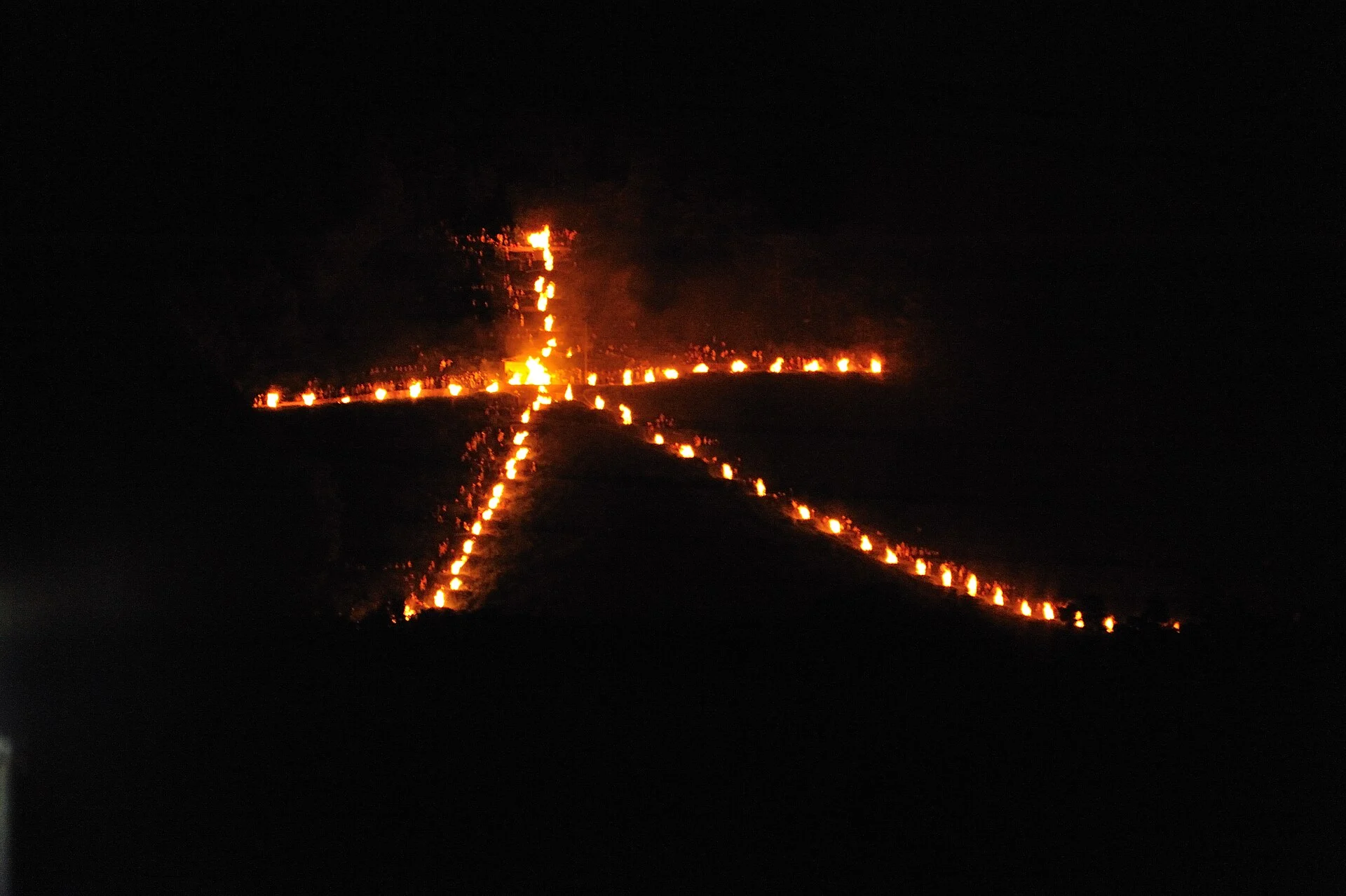
In Kyoto, ancestral spirits are believed to return to their homes from 13 to 16 August, and the city sends them back on the evening of the 16th. Heibonsha's encyclopaedia describes the Arashiyama ceremony: on that day, an altar for segaki offerings from Daikakuji temple in Saga is set up downstream of the Togetsukyō Bridge, a service for the dead is held in the evening, and lantern floating follows. The Kyoto City Tourism Association lists toro nagashi from 19:00 to 21:00 on 16 August in the Togetsukyō Bridge area and at Hirosawa Pond.
The same evening brings the Gozan Okuribi, five fires lit on mountains around the city at about five-minute intervals from 20:00, each burning for about 30 minutes: Daimonji on Nyoigatake, Myō-Hō on Mount Mantōro, Funagata on Mount Funa, Hidari Daimonji on Mount Ōkita and Toriigata on Mount Mandara. The Toriigata fire, lit at 20:20, is viewed from the Togetsukyō Bridge area, so the lanterns and the last of the five fires can be seen together. The tourism association states that the origin of the Gozan Okuribi is unknown; it became an annual event between the 15th and 17th centuries, and some historical sources describe burning torches thrown into the air rather than the fixed fire beds used today.
MIYAZU BAY AND OTHER TORO NAGASHI FESTIVALS

Miyazu, a coastal town in northern Kyoto Prefecture facing the Sea of Japan, holds its lantern floating on Miyazu Bay, near the Amanohashidate sandspit. The Miyazu Toro Nagashi Fireworks Festival is held every year on 16 August. According to the Miyazu Chamber of Commerce and Industry, interviewed by the Japanese government's Highlighting Japan magazine, the lantern floating is about 400 years old and began as a way to send off ancestral spirits after Obon. Boat-shaped seireisen, decorated in various colours, are launched first, and red and white box-shaped lanterns called okkake-tōrō, chasing lanterns, follow them across the water. Local residents make the red and white lanterns by hand each year.
Launches begin at around 19:00, and about 10,000 lanterns light the bay as the sun sets. A display of roughly 3,000 fireworks follows. The fireworks were added in 1924 to celebrate the opening of the railway. The event was suspended for four years and resumed in 2023, when it drew about 75,000 people. Encyclopaedia entries in both Nipponica and Heibonsha's Mypedia note the same broader shift: many lantern-floating ceremonies across Japan have become summer leisure and tourism events as well as rites for the dead.
SHŌRŌ NAGASHI: NAGASAKI'S SPIRIT BOAT PROCESSION
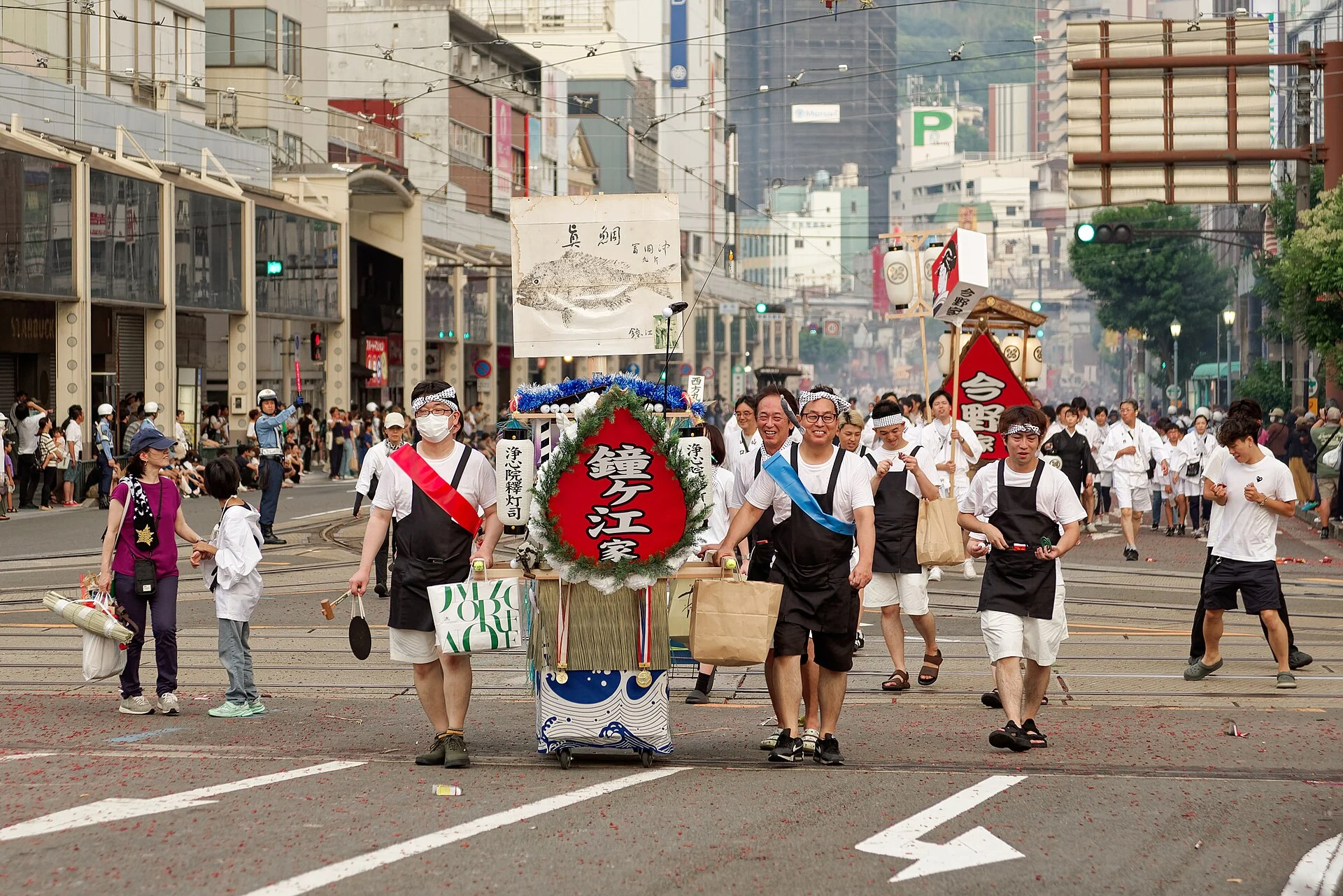
Nagasaki keeps the older boat form of the custom. Its Shōrō Nagashi is held every year on 15 August, when families pull boats made to console the spirits of the dead through the city streets, sending them to what the city's tourism association calls the Land of Happiness. Firecrackers are set off along the route, loud enough to deafen, and the procession continues late into the night. Nipponica describes large boats named after the Amida Buddha or the Pure Land, decorated and lit so that lantern light fills the harbour. The ceremony is listed among the Nagasaki Prefecture Cultural Hundred Selection of festivals and events.
Shogakukan's Digital Daijisen gives shōrō nagashi as an alternative reading of shōryō nagashi, the name of the older spirit-floating custom. Heibonsha's Mypedia notes that northern Kyushu holds particularly large spirit-floating events, including the hanabune, flower boats, of Saga and the spirit boats of Kurume as well as Nagasaki. Japan Search describes Shichiri Mihama in Mie Prefecture, where welcoming fires are lit at homes on 13 August, households observing a first Obon set up spirit shelves, and on 15 August the shelves are carried to the beach and the spirits are sent off.
NETSU: A JAPANESE ROBATA RESTAURANT DESIGNED AS A KABUKI THEATRE

Netsu at Mandarin Oriental Jumeira Dubai is a Japanese robata restaurant by chef Ross Shonhan, completed by Silverfox Studios in 2019. The concept for the interior is a double-height kabuki theatre, in which the robata grill serves as the central stage and guests watch the cooking from several levels. The upper level holds a bar and DJ lounge. Silverfox Studios set 1950s-style kabuki poster graphics on the columns and on a wall. Outside, horizontal recessed lighting references the tiered seating of a theatre auditorium.
The design is organised around viewing and procession, the two elements that also structure Japan's lantern ceremonies. Toro nagashi and the Gozan Okuribi are watched from fixed points: the Kyoto City Tourism Association lists the Kamo riverbanks, the Togetsukyō Bridge area and Hirosawa Pond among its viewing spots. In Nagasaki, spirit boats are pulled in procession through the streets. At Netsu, a raised walkway runs from the back kitchen to the central kitchen, recalling the hanamichi, the walkway a kabuki performer uses to reach the stage through the audience.
SOURCES
- Nippon.com Obon: Japan's Summer Festival for Honoring Ancestors
- Japan Search, National Diet Library Obon
- Kotobank (Shogakukan, Britannica Japan, Yamakawa Shuppansha) Urabon (盂蘭盆)
- Kotobank (Shogakukan Nipponica, Heibonsha) Tōrō nagashi (灯籠流し)
- Kotobank (Shogakukan Nipponica, Heibonsha, Yamakawa Shuppansha) Shōryō nagashi (精霊流し)
- Kyoto City Tourism Association Gozan Okuribi viewing guide
- Highlighting Japan, Government of Japan Miyazu Toro Nagashi Fireworks Festival
- Nagasaki International Tourism and Convention Association Charms of Nagasaki: Nagasaki Culture