FROM NEOLITHIC JADE AND SHANG BRONZE TO SONG PAINTING, MING PORCELAIN AND QING SILK

The dragon in Chinese art, the long, is a scaled, horned creature of water and sky that has been carved, cast, painted and worn in China for more than five thousand years. Museum collections trace it from Hongshan jades of around 3500 BC and Shang ritual bronzes to Chen Rong's Nine Dragons handscroll of 1244, court porcelain from the Jingdezhen kilns and the nine-dragon robes of the Qing court. Outside the palace, the same creature is carried through the Dragon Boat Festival and the dragon dances still performed in Chinese communities.
WHAT IS THE CHINESE DRAGON?
Britannica defines the long as a beast that dwells in rivers, lakes and oceans and roams the skies, generally depicted as a four-legged animal with a scaled, snakelike body, horns, claws and large, demonic eyes. It was considered the king of animals. Unlike its malevolent European counterpart, the Chinese dragon is associated with heavenly beneficence and fecundity. According to the same entry, it was originally a rain divinity, and Chinese emperors later appropriated its image as a sacred symbol of imperial power.
Ancient Chinese cosmogonists named four kinds of dragon: the Celestial Dragon (Tianlong), which guards the heavenly dwellings of the gods, the Dragon of Hidden Treasure (Fuzanglong), the Earth Dragon (Dilong), which controls the waterways, and the Spiritual Dragon (Shenlong), which controls the rain and winds. In popular belief only the Earth and Spiritual Dragons were significant, and they became the Dragon Kings (Longwang), gods who lived in the four oceans, delivered rain and protected seafarers. The Metropolitan Museum of Art, in its catalogue entry for a Yuan dynasty dragon painting, describes dragons as symbols of nature's elemental forces, depicted in Chinese art “from time immemorial”.
WHERE DID THE DRAGON IN CHINESE ART COME FROM?

The earliest dragon images in China are Neolithic. In a 1993 paper in the Bulletin of the Institute of History and Philology of Academia Sinica, the archaeologist K. C. Chang described a Yangshao culture burial of a man in northern Henan, flanked by a tiger and a dragon laid out in mollusc shells: the tiger on the west, to his left, and the dragon on the east, to his right. Nearby were further shell images of dragons, tigers, deer and a man riding a dragon. Chang placed the Yangshao culture in the middle Yellow River valley between 5000 and 3000 BC and, in his own interpretation, read the dragon, tiger and deer as the animal helpers of shamans, whose task was communication between heaven and earth.
In north-east China, the Hongshan culture of Liaoning carved dragon-like forms in jade. The British Museum holds part of a carved and grooved jade figure of a coiled creature, made in Liaoning about 3500 BC and 10.4 cm long, of a type described as a “pig dragon”. It was bequeathed by Brenda Zara Seligman and is on display in Gallery 33. The museum's curatorial note, citing Rawson (1992), records that small stone and jade sculptures found near buildings and in tombs include realistic turtles and birds as well as stranger creatures shaped like coiled insects or reptiles. The same note records that jade was used for ceremonial weapons and tools, and that some Neolithic peoples carved it into ornaments and small animals.
DRAGONS ON SHANG AND ZHOU BRONZES AND HAN MIRRORS
China's Bronze Age began around 2000 BCE. The Shang dynasty (about 1600 to 1046 BCE), the earliest dynasty recorded by archaeology, ruled from the Henan region along the Yellow River, and most of its ritual paraphernalia was bronze. The Metropolitan Museum of Art lists the motifs on Shang ritual vessels as the taotie, dragons, birds, bovine creatures and geometric patterns. The taotie is a frontal animal mask with a prominent pair of eyes and a nose, sometimes with jaws, fangs and horns, and many versions show a split body in profile on either side. Its significance in Shang society is unknown.
These designs were produced by piece-mould casting rather than the lost-wax method used by other Bronze Age cultures. A model was made, a clay mould taken from it and cut into sections to release the model, and the sections were fired and reassembled around a core that formed the vessel's cavity. Patterns carved or stamped into the inner face of the mould allowed sharp, intricate designs. The method was probably the only one used in China until at least the end of the Shang. The Zhou dynasty that followed ruled from 1046 to 256 BCE, and Qin unified China in 221 BCE.
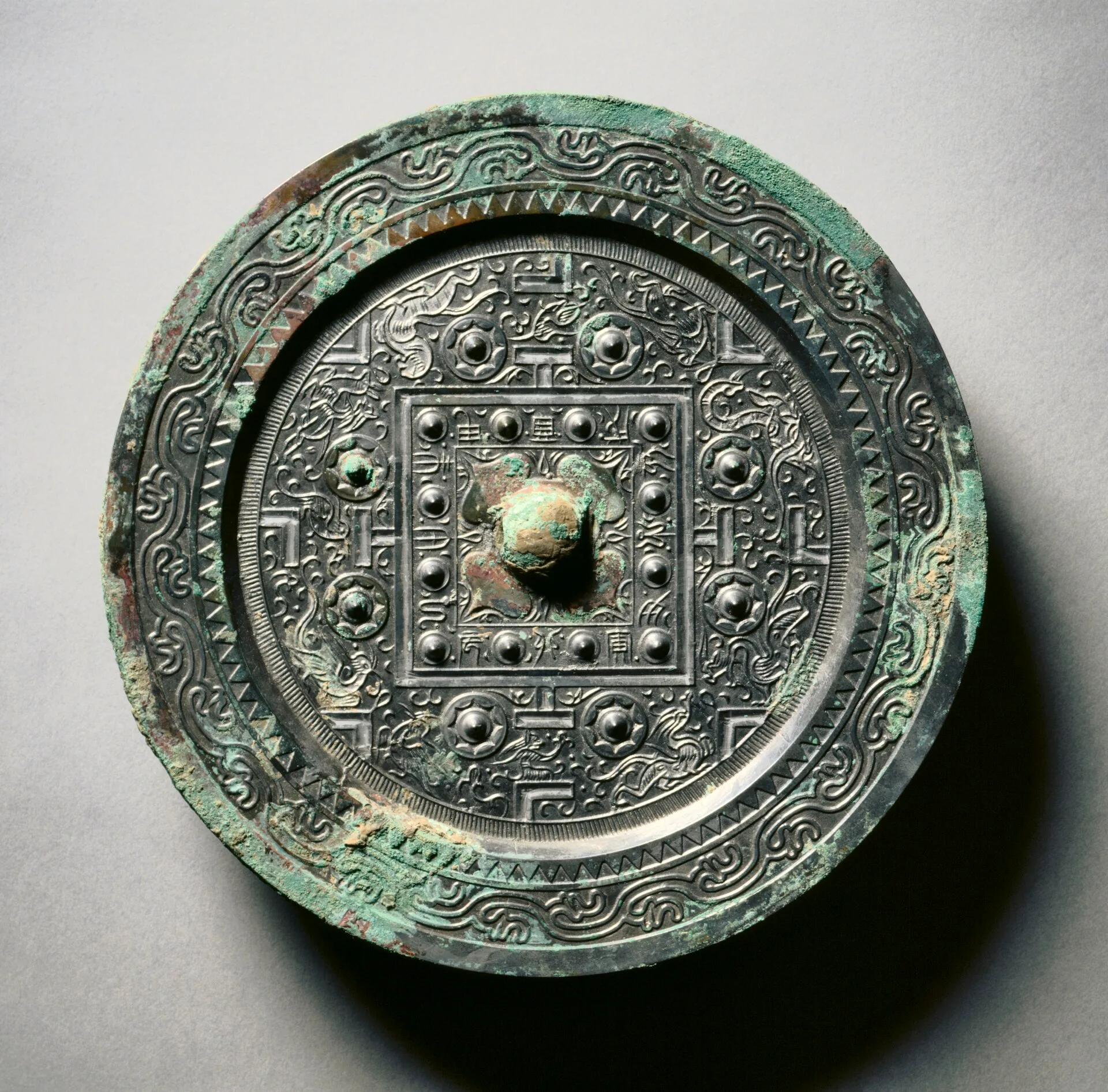
On Han dynasty (202 BCE to 220 CE) bronzes the dragon took a set place in a model of the cosmos. A Han bronze mirror of 9 to 100 CE in the Cleveland Museum of Art, 19 cm across, carries a diagram of the universe on its back: concentric rings and a cloud band for heaven, a square for earth, and four directional spirits between them. The tiger guards the west, the red bird the south, the snake-entwined turtle the north and the dragon the east, the same side as the shell dragon in the Henan burial. Helmut Nickel notes that a dragon confronting a bi disc, the ancient symbol of the heavens, may occasionally be found in Han art.
WHAT IS THE DRAGON AND PEARL MOTIF?

The dragon facing a flaming pearl is a later addition to the repertoire. In a 1991 article in the Metropolitan Museum Journal, Nickel, curator emeritus of arms and armour at the Met, found that the pairing seems to appear only at the beginning of the Tang period (618 to 907). He identified a sword from the imperial tomb at Pei-Chueu-Shan near Luoyang, in Henan, dated to about AD 600 and probably made by Chinese craftsmen, as possibly the earliest surviving example: its pommel shows two dragons facing a flaming pearl.
Nickel suggested that the motif might have originated in Central Asia. The sword's ring pommel and scabbard mounts derive from the swords of steppe nomads, and a 7th to 8th century mural at Qyzil in Eastern Turkestan shows a dragon standard on a lance with a globular pearl at its head. Western scholars generally interpret the pearl as the sun or moon, with the dragon trying to swallow it to bring on an eclipse. Nickel noted that Chinese literature does not seem to refer to the pearl as a heavenly body, but treats it as an object of great value that enhances the benign dragon who treasures it.
CHEN RONG AND THE NINE DRAGONS SCROLL
The Metropolitan Museum of Art names two Southern Song painters, Chen Rong and the Chan Buddhist painter Muqi, as masters who gave the dragon genre powerful treatment. Chen Rong's Nine Dragons handscroll, dated 1244, is in the Museum of Fine Arts, Boston. A 14th-century account quoted by the Met describes his method: he formed clouds by splashing ink and vapour by spraying water, worked in a wild, drunken manner, and smeared ink with his ink-soaked hat before finishing the image with a brush.
The scroll carries a colophon written in 1331 by Zhang Sicheng, the 39th pope of the Zhengyi (Orthodox Unity) Daoist church, who led it from 1317 to 1344. His father, Zhang Yucai (died 1316), the 38th pope, lived at Mount Longhu in Jiangxi and was commended by the Yuan court for bringing needed rain and subduing a tide monster on the eastern coast. Zhang Yucai's own handscroll Beneficent Rain (Lin yu tu), ink on silk with an image 271.8 cm long, is in the Met. It closely follows Nine Dragons in subject and style, and the museum suggests it may have been inspired by the Boston scroll or works like it.
THE FIVE-CLAWED CHINESE DRAGON ON MING PORCELAIN AND QING ROBES

A storage jar in the Metropolitan Museum of Art shows the dragon on Ming dynasty (1368 to 1644) court porcelain. The jar, 48.3 cm high and dated by an inscription on its shoulder to the reign of the Xuande emperor (1426 to 1435), was commissioned by the court from the Jingdezhen kilns. It is painted in cobalt blue under a transparent glaze with a single dragon undulating across a sparsely clouded sky. The Met calls white porcelain painted in cobalt blue “arguably the most important development in the history of ceramics”.
Dragon robes predate the Ming. Cooper Hewitt, Smithsonian Design Museum records that dragon robes, called ji fu or auspicious dress, originated in the Liao dynasty (907 to 1125) and were regulated as court dress under the Ming. The Qing (1644 to 1911) kept the practice and standardised a nine-dragon design, with the ninth dragon placed beneath the robe's overlap. The robe was worn with a hat, surcoat, collar, belt, necklace and boots, and each element showed the wearer's rank, status and gender.
Five-clawed dragons were in theory restricted to emperors and princes, although by the late Qing they circulated more widely. Colour and cut carried further distinctions. Only the emperor and his consort could wear bright yellow, ming huang, and only the emperor wore robes with four skirt slits, at the front, back and both sides. Women's robes had two side slits and men's had slits at the front and back. A brown robe in the Cooper Hewitt collection, with front and back slits, is identified on that basis as belonging to an official of the Jiaqing period (1796 to 1820) rather than to the imperial family.
DRAGON BOATS AND DRAGON DANCES

Britannica records rain rituals as early as the 6th century BCE in which a dragon image was animated by a procession of dancers, and notes that similar dances are still practised in traditional Chinese communities to secure good fortune. In Chinese New Year processions, Nickel noted, a globular lantern is carried in front of the dragon, which solves the problem of fixing a free-floating pearl to a dragon borne in procession. Nickel made the point in a note on dragon standards, which carry no pearl.
The Dragon Boat Festival begins on the fifth day of the fifth lunar month and was inscribed by UNESCO in 2009 on the Representative List of the Intangible Cultural Heritage of Humanity. It is celebrated across China and especially in the middle and lower reaches of the Yangtze River. Communities honour different figures: the poet Qu Yuan in Hubei and Hunan, Wu Zixu in South China, and Yan Hongwo among the Dai of Yunnan. UNESCO lists dragon races, dragon boating, willow shooting, feasts of rice dumplings, eggs and ruby sulphur wine, and protective customs such as hanging moxa and calamus over doors and wearing five-colour silk.
MAN WAH AT MANDARIN ORIENTAL HONG KONG

Man Wah is the Cantonese restaurant on the 25th floor of Mandarin Oriental Hong Kong, and it holds One MICHELIN Star. The restaurant was redesigned in 2021. The design interprets the Hong Kong skyline and Victoria Harbour as they are seen from its windows, and it includes references to the hotel's heritage. The walls are lined in navy panelling finished with gold trim. The lanterns reinterpret the original Man Wah lanterns as clustered brass cages fitted with embroidered, pleated shades.
The dragon appears at Man Wah as embroidered artwork, set with floral motifs on a navy wall panel. Under the Qing, according to Cooper Hewitt, five-clawed dragons were in theory restricted to emperors and princes, bright yellow robes were reserved for the emperor and his consort, and court dragon robes carried nine dragons, the ninth hidden beneath the overlap. At Man Wah the floor is a bespoke blue and gold silk carpet whose hand-carved patterning evokes light on the harbour.
SOURCES
- Britannica Long, Chinese mythology
- Academia Sinica, Institute of History and Philology K. C. Chang, Evidence for Shamanism in the Yangshao Culture of Neolithic China
- The British Museum Figure, Hongshan culture, 1973,0726.140
- The Metropolitan Museum of Art Shang and Zhou Dynasties: The Bronze Age of China
- Cleveland Museum of Art TLV Mirror with Four Spirits and Companions
- The Metropolitan Museum of Art Helmut Nickel, The Dragon and the Pearl, Metropolitan Museum Journal 26
- The Metropolitan Museum of Art Zhang Yucai, Beneficent Rain
- The Metropolitan Museum of Art Jar with Dragon, Xuande mark and period
- Cooper Hewitt, Smithsonian Design Museum Five-Clawed Dragon
- UNESCO Dragon Boat festival