RELIEF-MOULDED, COLOUR-GLAZED WALL TILES FROM ENGLAND, BELGIUM AND JAPAN THAT DECORATED STRAITS SHOPHOUSES

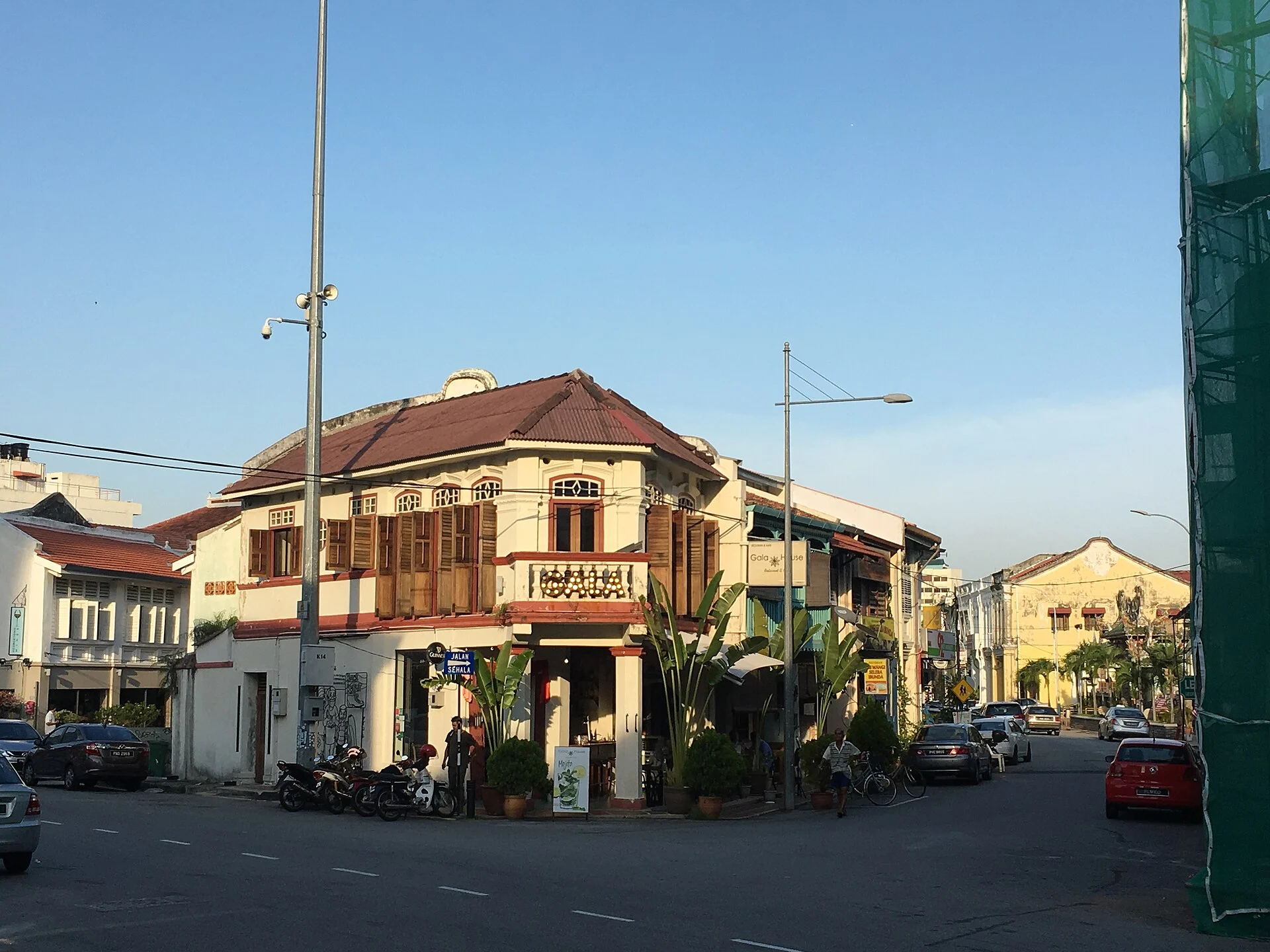
Peranakan tiles are the colourful glazed ceramic tiles found on the facades, porches and five-foot ways of pre-war shophouses and terrace houses in Singapore, Malacca and Penang. Most are majolica tiles: earthenware tiles with a raised, moulded pattern coloured with translucent lead glazes. Despite the name, they were not made by the Peranakan community. They were factory products, imported from England, Belgium, Germany and the Netherlands before the First World War and from Japan in the decades after it. Their name comes from the households that used them most visibly, Chinese and Peranakan families in the Straits Settlements, who set them into the fronts of their houses in the early 20th century. Production of the original tiles ended in the 1930s. Surviving examples can still be seen on Emerald Hill, Joo Chiat Road, Koon Seng Road, Blair Road and Neil Road in Singapore, and on Lebuh Muntri in George Town, Penang.
WHAT ARE PERANAKAN TILES?
The term Peranakan tile is a local name, not a manufacturer's category. The Science Centre Singapore notes that tiles from several countries became so closely associated with the communities that used them that they came to be known across Southeast Asia as Peranakan tiles. In Penang the same tiles are also sold and described as majolica, nyonya, Sino-Portuguese, Minton or Stoke-on-Trent tiles, according to a 2023 report in The Vibes, which lists encaustic, tube-lined, high-relief, transfer-printed and block-printed tiles among the types found on Straits shophouses.
The tiles that Singaporeans most often mean by the name are the relief-moulded majolica wall tiles of roughly 1890 to 1935. A wall tile in the National Heritage Board collection, made in Staffordshire, England, in the early 20th century, measures 15.3 by 15.3 centimetres and carries pastel floral motifs. The board's record describes mass-produced Belgian and English tiles with pastel European floral designs in the Art Nouveau style of 1890 to 1914 as especially popular with wealthy clients in the Straits Settlements. Rows of tiled facades marked out the wealth and distinctiveness of a Peranakan neighbourhood.
WHERE DID MAJOLICA TILES COME FROM?

Majolica as an English industrial product began at Minton in Stoke-on-Trent. The Victoria and Albert Museum records that the French ceramic chemist Léon Arnoux, who had studied pottery at Sèvres before joining Minton, developed majolica for the firm in 1849. The name borrowed from Italian Renaissance maiolica, but the technique differed. Renaissance maiolica was painted over an opaque white tin glaze. Minton's majolica glazes were transparent lead glazes coloured with metal oxides and painted directly onto buff earthenware, and all the colours could be fired at once. The rich glazes and dramatic modelling largely imitated the work of the 16th-century French potter Bernard Palissy.
Minton presented its new majolica at the Great Exhibition of 1851 in London. According to the V&A, the wares were well received by the public, judges and critics; Queen Victoria asked for examples to be sent to Buckingham Palace, and Minton was the only British ceramic manufacturer awarded a Council Medal by the exhibition jury. Majolica was very popular from 1850 to 1880. Other English tile makers adopted the term for their coloured relief tiles. A Maw & Co. pattern book of about 1870, issued from the firm's Benthall Works at Broseley in Shropshire and now held by the V&A, offers majolica and enamelled wall tiles alongside encaustic floor tiles and geometric mosaic pavements.
HOW PERANAKAN TILES REACHED THE STRAITS SETTLEMENTS
By the late 19th century, decorative tiles were being sold to Straits Chinese builders from catalogues. The Peranakan, the magazine of the Peranakan Association Singapore, reports that late 19th-century tile catalogues used in Singapore show many decorative and figurative Victorian designs, and that many of the tiles are Art Nouveau in style, with sinuous lines and richly coloured glazes. In the early 1900s, large quantities of majolica tiles from Britain, Belgium and Germany were brought in by Singapore importers including Tan Soo Hock & Co., A. Clouet & Co. and Malcolm, Lyon & Co. Tiles were supplied as single pieces or as vertical panels for porches, hallways, washstands and courtyards.
The supply from Europe was interrupted in 1914. The same article states that imports stopped with the outbreak of the First World War and remained low after it. Japan, which was much closer to Singapore than the European factories, filled the gap: after the war, more tiles bearing Japanese patent office numbers arrived, and many Japanese tiles of the 1910s and 1920s carried geometric patterns or auspicious Chinese designs. The Science Centre Singapore dates Japanese majolica exports to Singapore and Malaya from the 1920s.
JAPANESE MAJOLICA TILES: DANTO, FUJIMI AND SAJI
Japanese majolica tiles were developed as copies of English ones. A 2024 study in Asian Culture and History by Kana Yasuno, Yasufumi Uekita and Yuko Kikuchi explains that Western-style buildings after the Meiji Restoration created demand for tiles, and that Japanese engineers admired Victorian tiles for their designs and their resistance to water. English tile catalogues and samples reached traders in Yokohama, Kobe and Nagasaki, and some potters copied them. Around 1907, Keizo Nose of Danto and Murase of Fujimi made prototypes of hard ceramic tiles using the dust-pressing method. The INAX Museums, which held an exhibition of Japan-made majolica tiles in 2018 and 2019, date the start of domestic majolica production to the same period.
Production was concentrated in the Taisho period (1912 to 1926) and the early Showa period. The study counts more than 50 manufacturers from the late Taisho period to 1945, including Danto, Fujimi and Saji Tile Works, whose catalogues survive. In Japan the tiles were used mainly for hygiene in public bathhouses, barbershops and shop windows. Overseas, makers produced designs to order for Chinese and Indian traders, and Fujimi requested designs aimed at Chinese buyers. According to INAX, exports peaked in 1931 and 1932 and reached Southeast Asia, India, Central and South America, Australia and Africa. After the Second World War most makers stopped production, as export networks had been cut and hand painting was labour-intensive.
WHERE PERANAKAN TILES WERE USED ON THE SHOPHOUSE
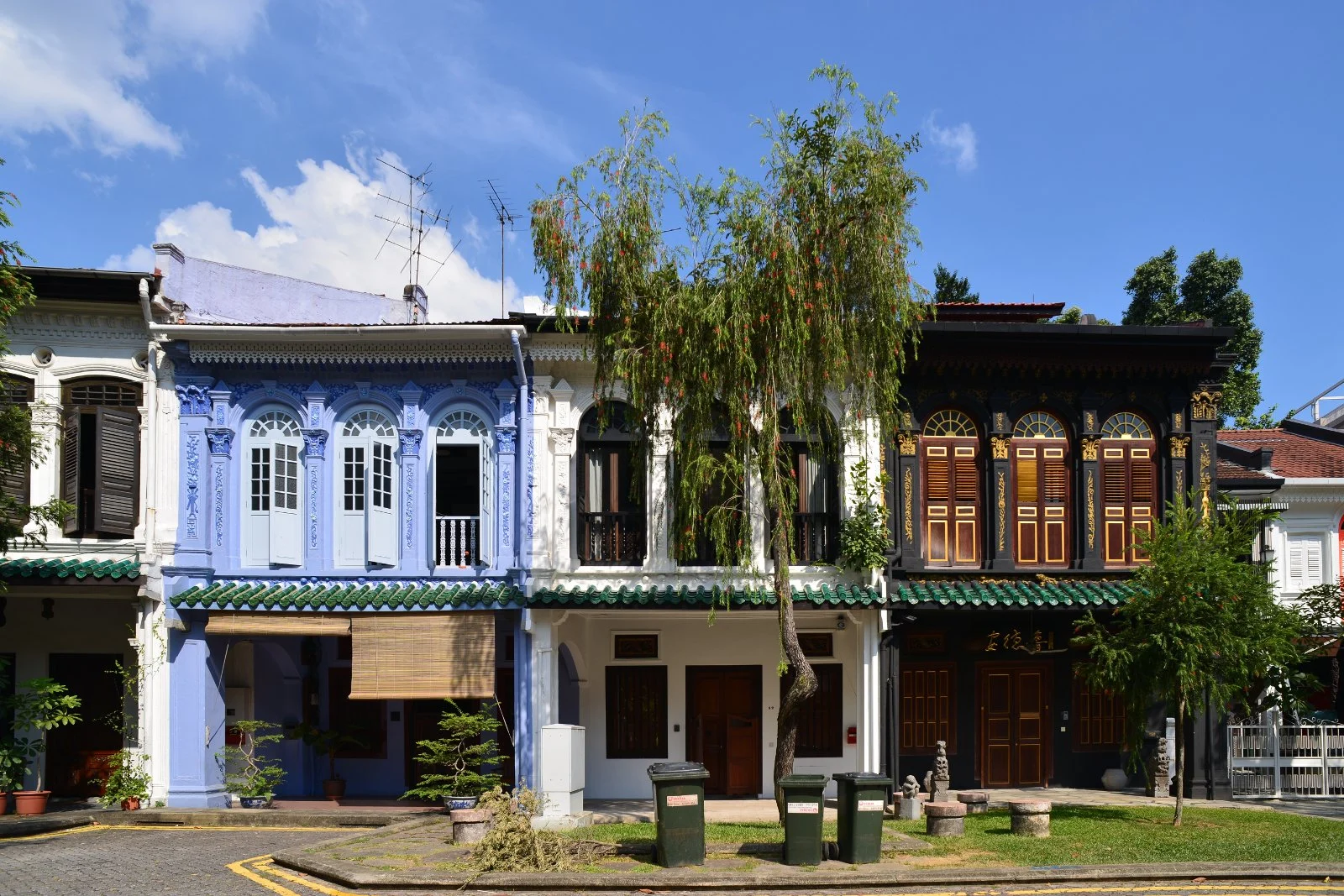
The tiles belong to a specific phase of the Singapore shophouse. Stamford Raffles's Town Plan of 1822 required each house to have a verandah open at all times, the covered walkway now called the five-foot way. BiblioAsia, the journal of the National Library Board, notes that the name is a misnomer: from the 1840s the law required at least six feet, and from 1887 at least seven. The National Heritage Board's shophouse guide describes the Early Style shophouse (1840s to 1900s) as plain, with shuttered windows. Colourful facade tiles appear with the First Transitional Style of the early 1900s and are part of the heavy ornament of the Late Style (1900 to 1940), much of it funded by the rubber boom of 1900 to 1930.
On the house itself, the tiles were placed where water and wear were greatest. The Staffordshire tile in the National Heritage Board collection was probably set on a front porch or balcony, and its record notes that similar tiles lined stairwells and inner courtyards, where they protected walls from heavy downpours. In George Town, tiles cover inside and outside walls and floors of Straits Eclectic shophouses, including the five-foot ways. The National Heritage Board cites Emerald Hill for its Peranakan tiles, set among Corinthian pilasters, full-length French windows and carved swing doors, and Petain Road for a terrace whose facades combine tiles from Europe and Japan with plaster reliefs of birds and flowers. Koon Seng Road is another surviving example.
HOW PERANAKAN TILES WERE MADE AND WHAT THEIR MOTIFS MEAN
The Science Centre Singapore summarises the process: clay was prepared, poured into a mould, dried, fired in a kiln and then glazed for a glossy finish. The original bright colours relied on metal oxides including cobalt, copper and manganese, and many of these glazes were later discontinued because they were toxic. Collector Victor Lim has stated that the toxicity concerned the production process, not the finished tile. Pre-1930s tiles are valued for the depth of their colour, glazing and relief, which set them apart from modern machine-made tiles.
The motifs changed with the source. English and Belgian tiles of 1890 to 1914 favoured pastel flowers and the sinuous lines of Art Nouveau, while later Art Deco tiles used geometric forms. Peranakan households also chose figurines, scripts, fruit, flowers, fish, birds and auspicious creatures. A fruit basket was read as a sign of abundance, fertility and longevity. The Japanese tiles added Chinese emblems such as peaches, lotuses and dragons, and a three-fruit pattern appears on overseas Chinese orders. The Science Centre records interpretations, offered by writer Ananya Mallick, that lattice designs protect a household and basket-weave designs represent unity. The tiles are laid as tessellations, with many single designs showing rotational and reflectional symmetry.
DEMOLITION, COLLECTORS AND VICTOR LIM
Many original tiles were lost when old buildings came down. The Peranakan records that in the late 1970s and 1980s, pre-war shophouses, terrace houses and bungalows were demolished for new buildings and infrastructure, and that many of their tiles ended up on dump heaps. Victor Lim, who later founded the tile company Aster by Kyra and runs the Peranakan Tile Gallery, began salvaging tiles from demolition sites in Jalan Besar, Geylang, Katong, Tanglin, River Valley, Killiney Road and Emerald Hill in his late twenties. Contractor friends alert him when heritage houses are due for demolition or renovation.
Lim's collection shows how scattered the tiles became. His five-piece peacock panel took just over 20 years to complete: the first tile came from a Singapore junk shop, the second from a Malacca antique shop about a decade later, the fourth from a Joo Chiat junk shop, and the last from a Serangoon Road junk store. He restores damaged tiles through an eight-step cleaning process that takes about 12 weeks. In Penang, decorative tiles are recognised as part of the Outstanding Universal Value of the Melaka and George Town UNESCO World Heritage Site, and the George Town Special Area Plan states that existing decorative tiles should be maintained and restored.
PERANAKAN TILES AND EMBU AT MANDARIN ORIENTAL, SINGAPORE

Embu is the all-day dining restaurant on level 3 of Mandarin Oriental, Singapore, completed by Silverfox Studios in September 2023 under Susan Heng and Patrick Waring. The restaurant's name comes from the Tembusu tree, known for its fragrant flowers and sturdy wood, and the design draws on Singapore's Garden City themes: a canopy, botanical planting, pavilions and greenhouses. Curved, louvred timber canopies and framing echo the perpendicular branching of the Tembusu, and the interior also uses open-weave rattan alongside the timber.
The floor uses Peranakan black-and-white porcelain tiles. These are not majolica: they are porcelain floor tiles in two colours rather than relief-moulded wall tiles with coloured lead glazes. The link is the Peranakan tiled surface itself. In the Straits house, tiles were laid on floors as well as walls, porches and five-foot ways, set out in repeating patterns as tessellations, and the patterns ranged from Art Nouveau florals to the geometric designs of Art Deco and of the Japanese tiles of the 1910s and 1920s. At Embu, the Peranakan reference is carried by a black-and-white tiled floor beneath the timber canopy.
SOURCES
- Peranakan Association Singapore Tiles in Style (The Peranakan magazine)
- National Heritage Board, Roots.sg Tile, Staffordshire, England, early 20th century
- National Heritage Board, Roots.sg The Singapore Shophouses
- National Library Board, BiblioAsia Give Me Shelter: The Five-footway Story
- Victoria and Albert Museum Victoria: wine cooler and cover, Minton, Hollins & Co., ca. 1851
- Victoria and Albert Museum Patterns of Maw & Co.'s Encaustic Tile, Geometrical Mosaic and Plain Tile Pavements, and Majolica and Enamelled Wall Tiles
- Asian Culture and History A Comparative Study of the Use of Japanese Majolica Tiles in Modern Japan and Japanese Colonial Taiwan (Yasuno, Uekita and Kikuchi, 2024)
- INAX Museums, LIXIL Living Culture Japan-made Majolica Tiles: Trail of Inspiration
- Science Centre Singapore Exploring Geometry with Peranakan Tiles
- The Vibes Heritage tiles: race to protect pieces of George Town's opulent past