

FROM THE PUB SERVERY TO THE SALOON LONG BAR AND THE COCKTAIL WELL

Bar counter history is recorded in surviving buildings as much as in books. Historic England lists pubs in Sussex, Dorset and Somerset that still have no bar counter at all and serve from a back room, through hatches or from casks stacked under a window. The Princess Louise in Holborn, London, keeps a large U-shaped counter with its original island bar back in mahogany. The 19th-century American saloon ran a carved bar down one side of the room, and one in Portland, Oregon, was recorded at 684 linear feet. The modern cocktail bar keeps its most used spirits in a stainless steel rack directly below the counter, known as the well or rail, so that the bottles are within easy reach of the bartender.
WHERE DOES THE WORD BAR COME FROM?
The English word comes from Middle English barre, taken from Anglo-French and ultimately from Vulgar Latin barra, according to Merriam-Webster, which dates its first known use to the 12th century. Its first sense is a straight piece of wood or metal that is longer than it is wide and serves as a lever, support, barrier or fastening. A second group of senses covers anything that obstructs or prevents passage. The drinking senses come later in the same entry: a bar is "a counter at which food or especially alcoholic beverages are served" and, by extension, a room or establishment where alcoholic drinks and sometimes food are served, for which the dictionary gives barroom as a synonym.
Guidance for planners from CAMRA, the Campaign for Real Ale, notes that the bar counter, "sometimes described as the pub's high altar", comes in two parts: the long flat top and the supporting chassis. Behind it stands the bar back, which can range from basic shelves to elaborate combinations of wood and glass, many of them embellished with mirrors, some plain and some ornate. The same guidance lists smaller fittings that may survive on old counters, such as match strikers along the side and spirit casks above the bar. CAMRA estimates that less than two per cent of the UK's roughly 47,000 pubs have escaped drastic internal alteration in recent years.
HOW WAS DRINK SERVED BEFORE THE BAR COUNTER?
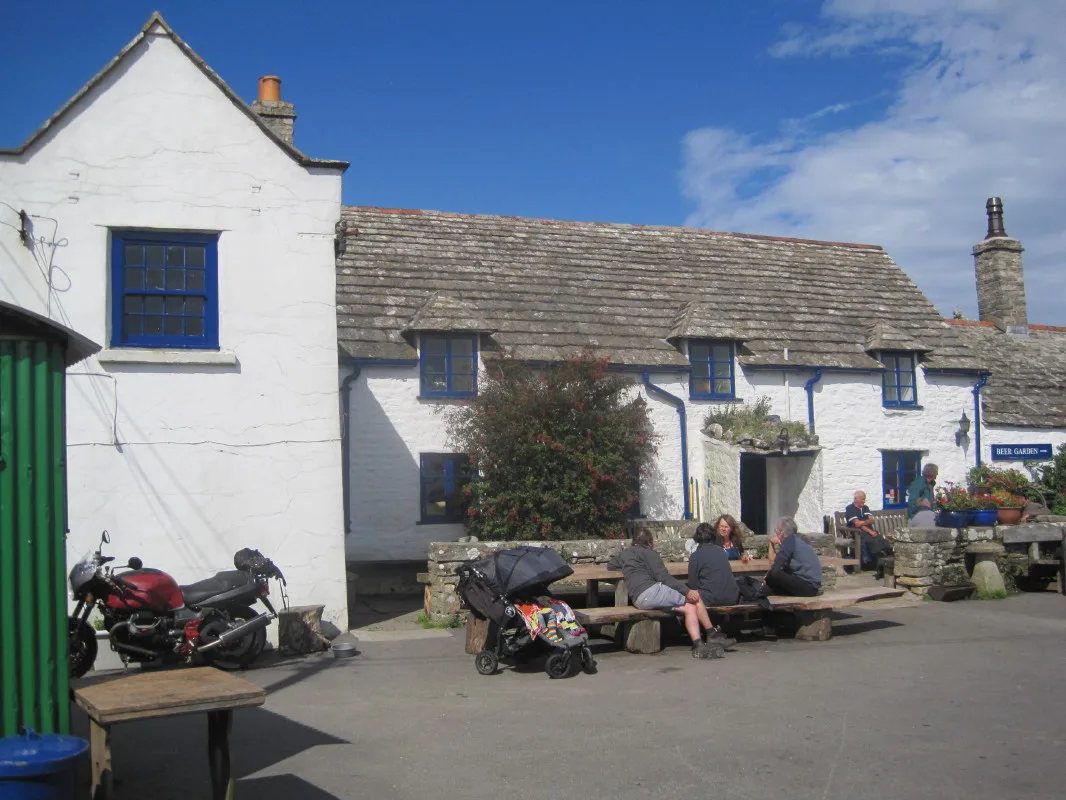
A small group of English pubs still works without a counter. When Historic England announced the upgrade of Liverpool's Philharmonic Dining Rooms to Grade I, it also revised a set of other pub listings, including four of only eight pubs in the UK known to have no bar counter. One is the Blue Ship at The Haven, Billingshurst, whose updated listing now refers to its rare tap room "servery" arrangement from the 1850s, which still survives. Another is the Square and Compass at Worth Matravers in Dorset, an 18th-century pub with 19th-century extensions. There, drink is served through hatches from a rear servery, a layout without a bar counter that Historic England treats as a rare survival adding to the building's special interest.
Two Somerset pubs on the same list show other forms. The Rose and Crown at Huish Episcopi, which dates from around 1800, has no bar counter and instead has a servery area that customers can walk into, containing shelves and hand pumps. At Tucker's Grave Inn, Radstock, there is again no counter: the casks of beer and cider are stacked below the window of the central public bar. In these pubs the drink is kept in a servery or by a window rather than behind a counter.
BAR COUNTER HISTORY IN THE VICTORIAN PUB

Historic England calls the end of the 19th century the "golden age" of pub building and counts the Philharmonic Dining Rooms on Hope Street, Liverpool, among the most spectacular pubs completed in that period. It was built from 1898 to 1900 to designs by the Liverpool architect Walter W Thomas, and its interior includes rich work in copper, mahogany, plaster and glass. First listed at Grade II* in 1966, it was upgraded to Grade I on Historic England's advice. CAMRA notes that the Victorians and Edwardians in particular loved to embellish their pub interiors with ornate glasswork and mirrors, with windows etched and cut and internal work embossed, enamelled or gilded. Its guidance treats fittings as original usually when they predate the Second World War.
The Princess Louise at 208 High Holborn, one of the interiors also described in the history of the Victorian gin palace, shows how a late Victorian counter served a divided room. Built in 1872, the pub was remodelled inside in 1891 by Arthur Chitty. CAMRA records seven drinking spaces separated by mahogany partitions with etched glass panels, abutting a large U-shaped bar counter. The counter, with its island bar back, projects out into the bar so that staff could reach customers easily. That bar back, by W H Lascelles and Co, is the original mahogany fitting in two parts, with etched and frosted panels and an archway through the centre. The screenwork was removed, probably by the 1960s, and the brewer Samuel Smith's returned it in a 2008 refurbishment.
WHAT WAS THE AMERICAN SALOON LONG BAR?

Writing in American Heritage in April 1963, Gerald Carson described the interior of the 19th-century American saloon. In a dimly lit room, the bar ran lengthwise along the left side as one entered. It was dark and heavily hand-carved, often in the Eastlake style. Some were very long: Carson records that the bar in Erickson's saloon in Portland, Oregon, measured 684 linear feet in its most celebrated years. Whole saloons could also travel in parts. When Forsyth, Montana, was the end of the line on the Northern Pacific railway, he writes, twelve saloons arrived there in sections.
Carson lists the bartender's routine at the counter: keep the walking board behind the bar dry, use a chamois on the woodwork and shine the brass. The floor in front was covered with sawdust to absorb the drip. The bar also carried the free lunch, which Carson says was not a gesture of pure philanthropy. Baked beans and peppery hot franks were set out because salty food provoked thirst, and those who ate were supposed to give the house some trade first. A gentleman poured his own whiskey, about an ounce and a half, and by custom the dram never came near the rim of the glass.
THE BACK BAR AS A DISPLAY OF GLASS, BOTTLES AND ART

Behind the saloon bartender stood the back bar. Carson describes its central section as "a kind of high altar of shining glassware". Behind the bar was the back-bar mirror, decorated with mottoes, some of them serious, such as "Don't Ask For Credit". Out on the flanks lay a bung-starter, lemons and bottles of muscatel, port, catawba and rock and rye. Carson notes that no one called for these, but they were mentioned in the retail licence, which covered "wines and liquors".
The Oxford Companion to Spirits and Cocktails records that the bar at the Hoffman House on Madison Square caused a sensation when it reopened in 1882 after an extensive renovation. The bar and the wall panelling were all carved mahogany, the floor was marble mosaic and the windows were stained glass. The walls were hung with paintings, including a Turner and a Narcissus doubtfully attributed to Correggio. Sixteen bartenders, led by Joseph McKone, worked the room, and between 1883 and its closing in 1911 it was among the city's most prominent bars. In 1896 the bar was closed and replaced by a smaller one in the building's new annex.
HOW THE AMERICAN BAR TRAVELLED TO LONDON AND PARIS
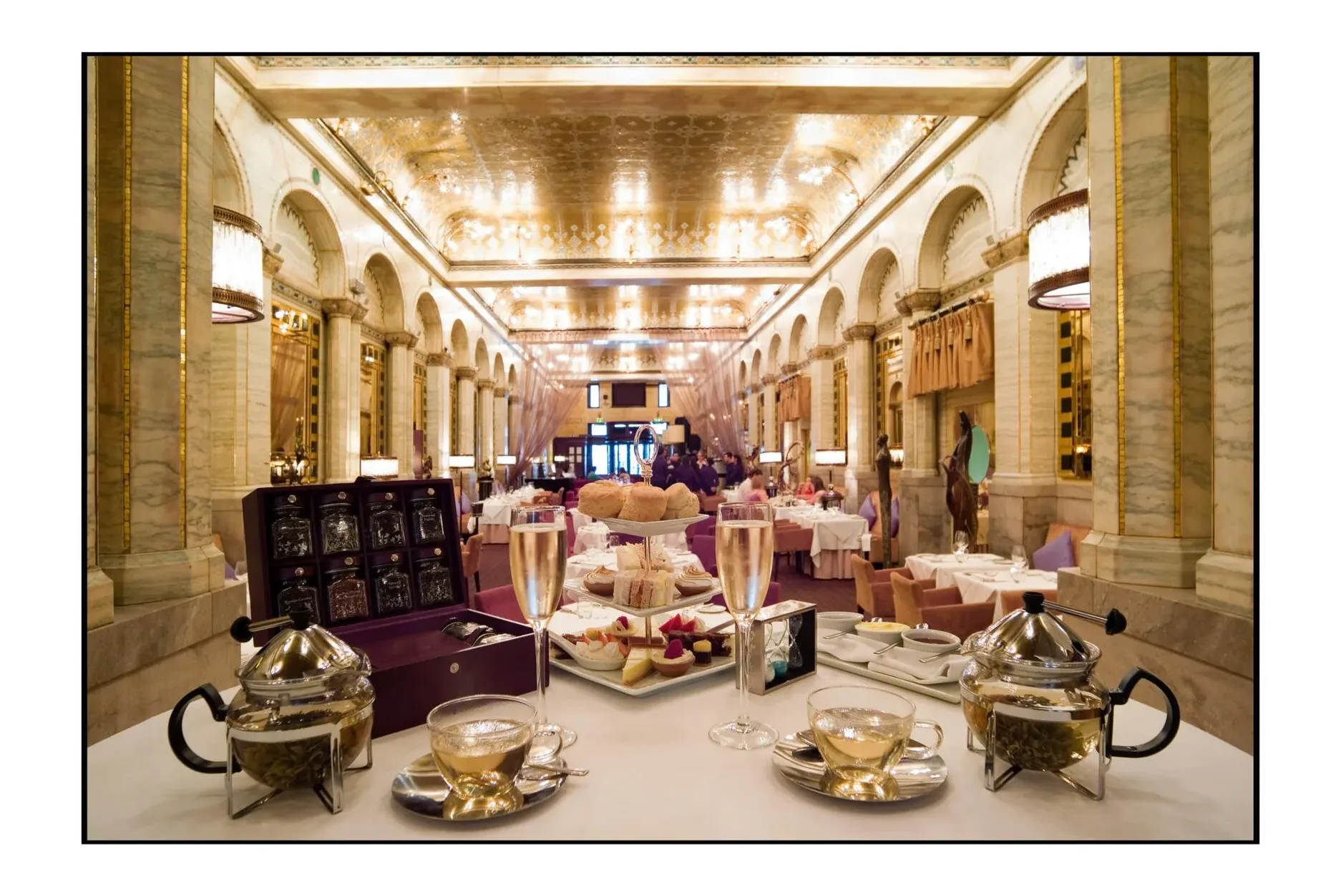
In London, the Australian caterers Felix William Spiers and Christopher Pond opened the Criterion restaurant complex at Piccadilly Circus in 1873. Its American bar, also known as the Long Bar, opened a year later and was, according to the Oxford Companion, the first fully realised American bar in London. The theatre architect Thomas Verity designed both the bar and the restaurant, the bar in a neo-Byzantine style to match the adjoining theatre. Its manager, the German American Leo Engel, had worked for Jerry Thomas and later compiled more than two hundred recipes in his book American and Other Drinks, published in London in 1878. In Arthur Conan Doyle's 1887 novel A Study in Scarlet, Dr Watson stands at the "Criterion Bar".
In Paris, the retired jockey Tod Sloan opened The New York Bar at 5 rue Daunou in 1911, with a mahogany bar said to have been imported from the United States. The Scottish bartender Harry McElhone took over in 1923, and the bar owes its current name, Harry's New York Bar, to him. The Oxford Companion describes the claims of bar lore that it created the Bloody Mary, Sidecar, White Lady and French 75 as mostly bogus, noting that they only came up after McElhone's death in 1958. In Britain, CAMRA notes, Art Deco design from the 1930s also left its mark on pub interiors.
BAR COUNTER HISTORY TODAY: WHAT IS A COCKTAIL STATION?
Behind the counter of a contemporary cocktail bar, the most used bottles sit in the well. The Oxford Companion defines the well, or rail, as the stainless steel rack of liquor bottles kept directly below the bar. It is also called the speed well, because the bottles are easy for the bartender to reach, which allows drinks to be made more quickly. The term has passed into ordering: a well drink or rail drink is a mixed drink made with an inexpensive, generic liquor of the kind usually kept in the well, rather than a named or "call" brand. Quality varies by house, the Companion notes, with some upscale bars using premium liquors for their well drinks and dives using generic or value brands.
The measure used at the station is the jigger, a word the Oxford Companion describes as an Americanism for a new device that otherwise lacks a name. The first purpose-made jiggers, silver-plated metal cones with stems, appeared in the 1870s and replaced sherry and liqueur glasses as bar measures. By the end of the 19th century the American jigger had become a double cone, joining a wineglass measure, nominally two ounces or 60 ml, to a one-ounce pony at their apexes. During the 20th century the American jigger fell to about 1.5 and often 1.25 ounces, and the Cocktail Renaissance brought back the two-ounce size. In the hands of a skilled bartender, the Companion notes, jiggers could be used practically as fast as free-pouring.
THE LONG BAR AT PROHIBITION BAR, MANDARIN ORIENTAL SHENZHEN
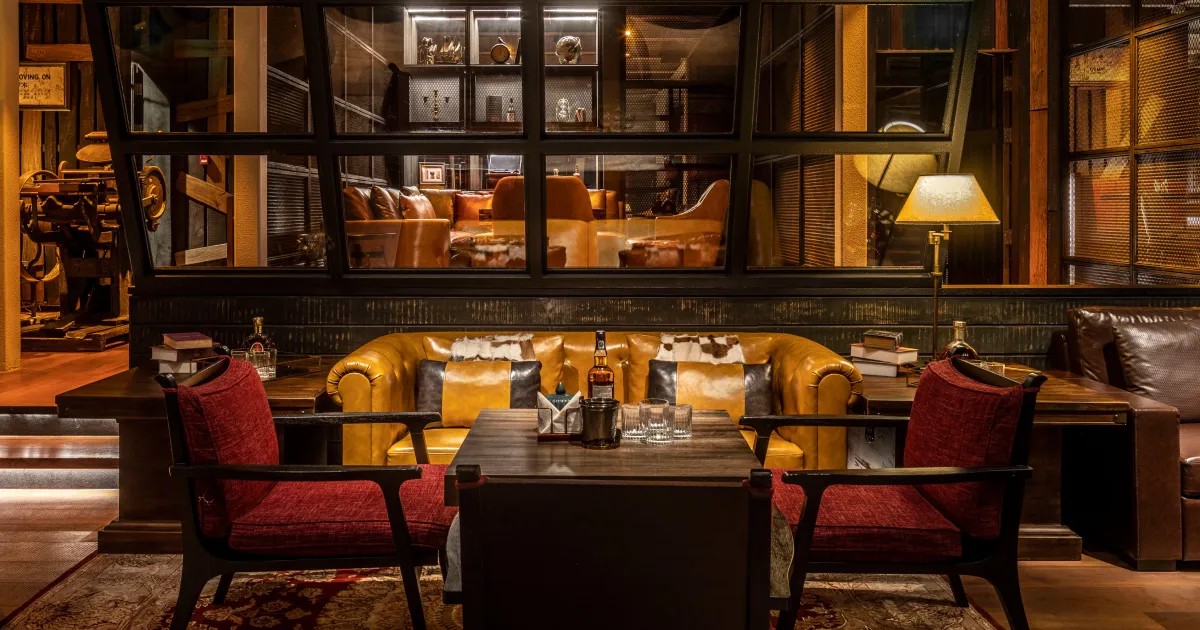
Prohibition Bar is a semi-hidden bar in the MO Bar on the 79th floor of Mandarin Oriental Shenzhen, completed in 2022, with interiors designed to recreate the intrigue of Prohibition. It is reached by a separate lift from L78 and then a long corridor. The corridor is a storage-style passage lined with aged hand-painted liquor advertisements and crates, beneath exposed ductwork. Where the 19th-century saloon described by Gerald Carson put its bar along the left side of the room as one entered, guests here reach the bar only after the lift and the length of the corridor.
Inside, a long bar with a DJ booth and a cocktail station is finished in distressed timber with steel beams. A lounge is furnished with Chesterfields and iron screens and has views of the city skyline. The term long bar appears earlier in this history at the Criterion in London, whose American bar of the 1870s was also known as the Long Bar, while in Carson's account the bar of the American saloon ran lengthwise along the room, at Erickson's in Portland for 684 linear feet.
SOURCES
- Merriam-Webster Bar: definition and meaning
- CAMRA Historic pub interiors: advice for planners
- Historic England Liverpool Philharmonic pub becomes Grade I listed
- CAMRA Pub Heritage Princess Louise, Holborn
- American Heritage The Saloon, by Gerald Carson
- The Oxford Companion to Spirits and Cocktails Hoffman House
- The Oxford Companion to Spirits and Cocktails The Criterion
- The Oxford Companion to Spirits and Cocktails Harry's New York Bar
- The Oxford Companion to Spirits and Cocktails Well or rail
- The Oxford Companion to Spirits and Cocktails Jigger


