PLATE GLASS, SANDSTONE WHEELS AND HYDROFLUORIC ACID IN LATE VICTORIAN PUBS

Victorian pub glass is the cut, etched, gilded and silvered plate glass that filled the windows, mirrors, partitions and counter screens of British public houses in the second half of the 19th century. Historic England places the high point of pub building in the decades either side of 1900. The glass was made by a small group of trades: brilliant cutting on stone wheels, etching with hydrofluoric acid, gilding and back-painting, and later sandblasting. London examples recorded by Historic England and CAMRA include the Red Lion, the Argyll Arms, the Bunch of Grapes, the Lamb and the Salisbury.
WHY VICTORIAN PUB GLASS BECAME AFFORDABLE AFTER 1845
Cast plate glass had been made in England since 1773, but for decades it was too expensive for most building work. Rodney Bender, a glass artist and fellow of the British Society of Master Glass Painters, writing in The Building Conservation Directory in 1998, dates the change to 1845, when the glass tax was abolished; the window tax followed six years later. The result, in Bender's words, was "an unprecedented reduction in the price of glass". Cast plate came in sizes and thicknesses that suited large openings and decorative work, and it became common in the windows of shops and public buildings.
Historic England's listing for the Red Lion at 2 Duke of York Street describes pub architecture as a compromise between the public's wish to drink and the authorities' wish to control it, and notes that the 1830 Beer Act led to more pubs, often converted from houses. The listing calls the term "gin palace" a misnomer for a lavishly decorated pub, and names the fittings that most pubs shared: mahogany counters, mirrors, partitions and etched glass. The 1830s London gin shops that gave the term its origin are covered in the Victorian gin palace and the making of the British pub interior.
HOW BRILLIANT-CUT VICTORIAN PUB GLASS WAS MADE
Brilliant cutting is wheel engraving on flat plate glass. Engraving on hollow ware and mirrors was already an established trade, but flat glass work stayed small in scale until cast plate made architectural use practical. Bender credits Mark Bowden of Bristol with introducing brilliant cutting in the 1850s. The cutting wheels were stones of carboniferous sandstone between 5 and 90 centimetres in diameter. The profile of the wheel's edge set the shape of the cut: round wheels made concave hollows known as punts, square wheels made line work and leaf forms, and mitre wheels made V-shaped grooves. An ogee curve needed cuts spliced together from both sides of the line.
The wheels turned on a shaft set in a wooden or iron frame and were lubricated with water. Large sheets of plate hung in a sling from a counterbalanced beam while they were worked. Each cut was then smoothed with a willow wheel shaped to the same profile and fed with ground pumice, and finally polished with a revolving fibre brush and rouge. Bender describes the craft as "highly skilled and labour-intensive", and notes that custom wheels were sometimes needed for a particular design. Historic England describes the mirrors of the Red Lion in St James's as "diamond-cut", and CAMRA those in the corridor of the Argyll Arms as "brilliant cut".
WHAT IS ACID-ETCHED GLASS?

Acid etching, called "embossing" in the Victorian trade, uses hydrofluoric acid, which attacks silica and silicates. Britannica records that the acid was first prepared in 1720 by an unknown glassworker, and that the Swedish chemist Carl Wilhelm Scheele obtained an impure form in 1771 by heating fluorspar with sulphuric acid in a glass retort, which the acid corroded. In the early decorative trade, a pane was painted with an acid-resistant coating, usually Brunswick black, and exposed to the fumes, which frosted the unprotected areas. Clear etching used liquid acid held on the surface by a wall of tallow for about an hour, which ate roughly half a millimetre into the glass.
Etchers combined several finishes on one sheet. In "emboss and ground" work, raised areas were abraded with emery and water while the etched areas stayed clear. Stipple embossing scattered flakes of mica during etching to leave a glistening texture like rain. White acid, hydrofluoric acid mixed with an alkali, usually washing soda, produced a dense white frost, and dilute acid then gave satin tones. Bender records that this "triple embossing" was often combined with brilliant cutting. The work was hazardous: early etchers made their own acid and had no air extraction, and Bender cites Arthur Louis Duthie, writing in 1908, on fumes from full strength acid "quite visible like a yellow smoke".
SANDBLASTING AND TILGHMAN'S PATENT OF 1870
A mechanical alternative to acid came from Philadelphia. On 18 October 1870 Benjamin Tilghman was granted United States patent 108,408 for an "improvement in cutting and engraving stone, metal, glass, &c." His method drove sand against a surface with a jet of steam or a current of air. For glass, the patent describes sand carried by an air current from a fan and striking a sheet held or moved opposite the outlet, for grinding or depolishing glass, china or pottery. Tilghman preferred air to steam for engraving patterns, because dry sand rebounded and left the design clear, while steam dampened the sand and could clog fine lines.
The patent also explains how the grain of the surface could be controlled: the finer the sand and the weaker the blast, the finer the depolished surface, and a low-pressure blast of fine powder produced a very delicate depolishing of the glass. To the eye, sandblasted glass and white acid work can look alike. Bender notes that under magnification they differ, since sandblasting leaves fissures that trap dirt while white acid leaves a pock-marked surface that is easier to clean.
GILDED, SILVERED AND BACK-PAINTED VICTORIAN PUB GLASS
From the 1860s, according to Bender, etched and cut plate was widely used for shop fascias, advertising boards and tradesmen's vans, and sign writers took up etching as a standard skill. Public houses used cut, etched, gilded and silvered glass for showy effects. Bender links the pub style to French rococo and records the trade name "French embossing" for it. He also cites John Piper, writing in 1940, who argued that glitter helped pubs stand out and gave them "that cinematic sense of exciting unreality".
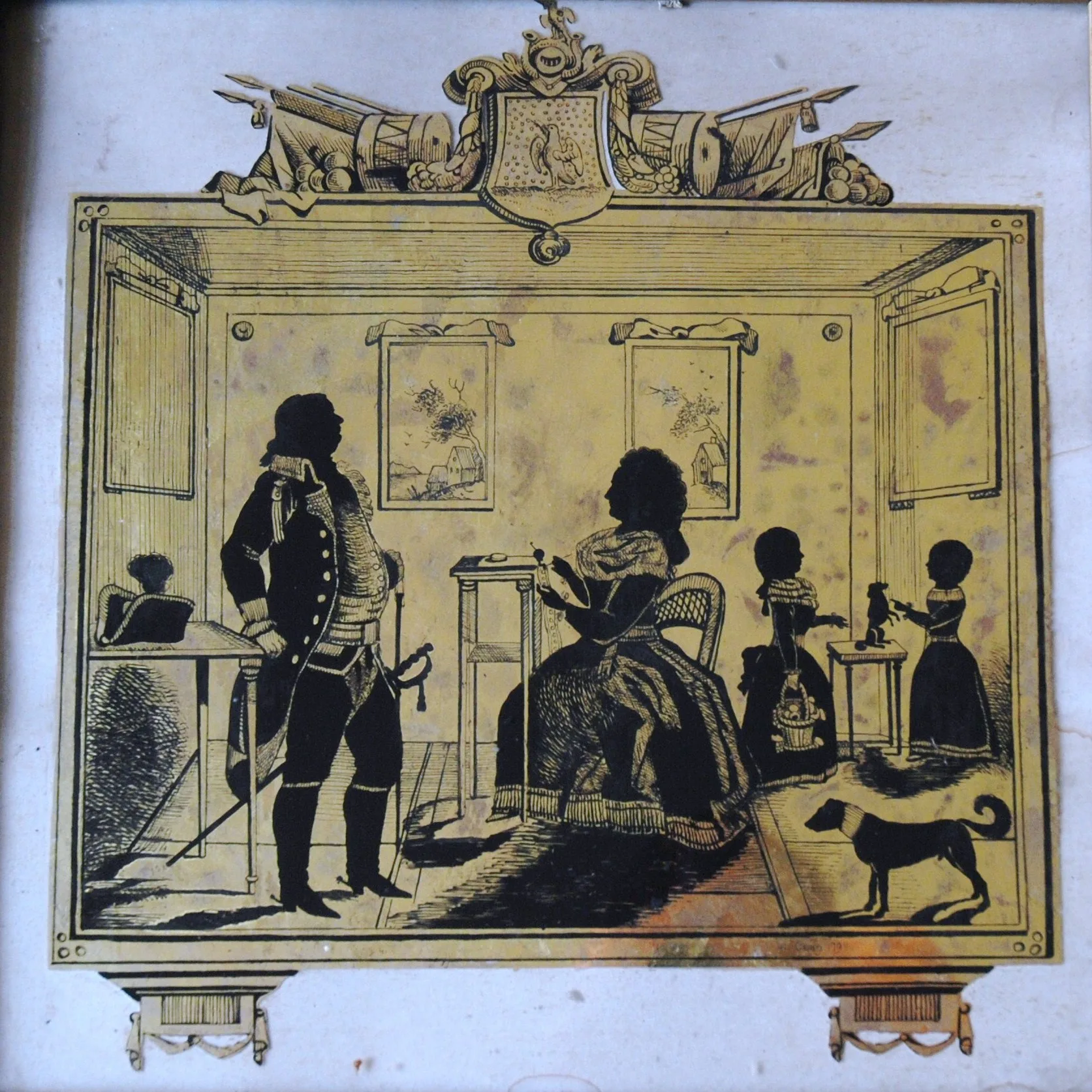
Verre églomisé is worked from the back of the glass. Britannica describes it as glass engraved on the reverse and covered with unfired paint or, usually, gold or silver leaf. A design is engraved through the leaf, coloured pigment is applied so that it shows through the engraved areas, and the back is protected by a further layer of glass or foil. The name comes from Jean-Baptiste Glomy, a French picture framer who died in 1786 and used the process for glass mounts. The technique dates from late antiquity and was revived in Italy between the 14th and 16th centuries, and in France, England and the United States in the 18th century.
Back-painting also survives in pub mirrors. At the Bunch of Grapes, 207 Brompton Road in Knightsbridge, a pub put up in 1844 that keeps substantial parts of a late Victorian refitting, the left-hand lobby has back-painted mirrors of 1890 showing grapes on a vine above flowers. They are signed by W. James of Kentish Town. CAMRA's heritage entry for the pub also records extensive etched glass, including a "Bottles & Jug" window, five snob screens decorated with birds and grapes and cast-iron columns with gold-painted capitals.
BREWERS' MIRRORS AND THE 1890S PUB BOOM
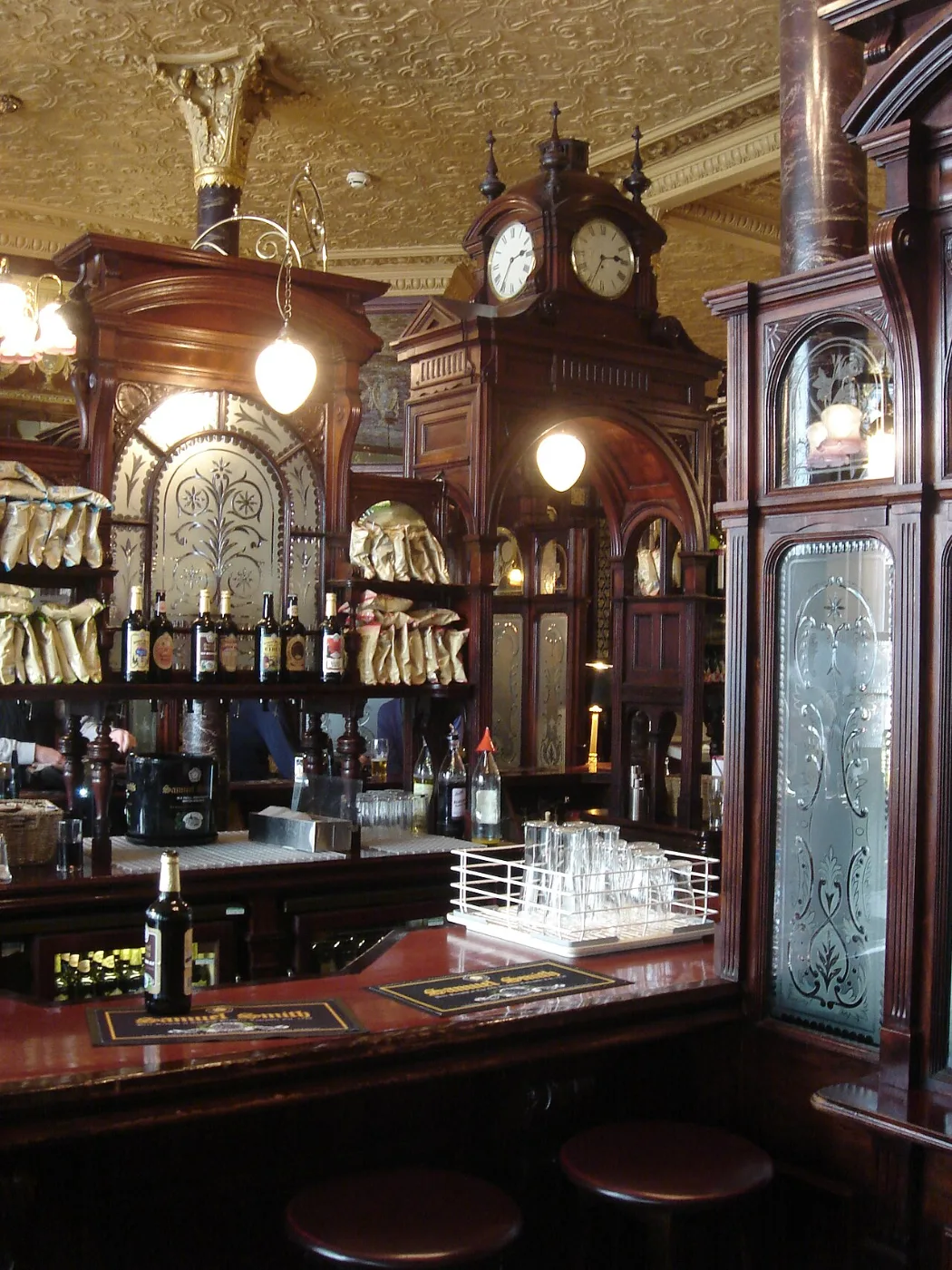
Historic England dates the remodelling of the Prince Alfred in Maida Vale to around 1898, at the height of the London "pub boom". Its listing describes extravagant spending on new pubs and on the remodelling of existing ones, as breweries and publicans competed for market control within strict control of licence distribution. Brewery advertising could appear on the glass itself. At the Argyll Arms, 18 Argyll Street, a building of 1868 refitted around 1895 for the proprietor E. Bratt to designs by Robert Sawyer, the first of three snugs has an enormous "Bass on Draught" mirror behind its curved bar counter.
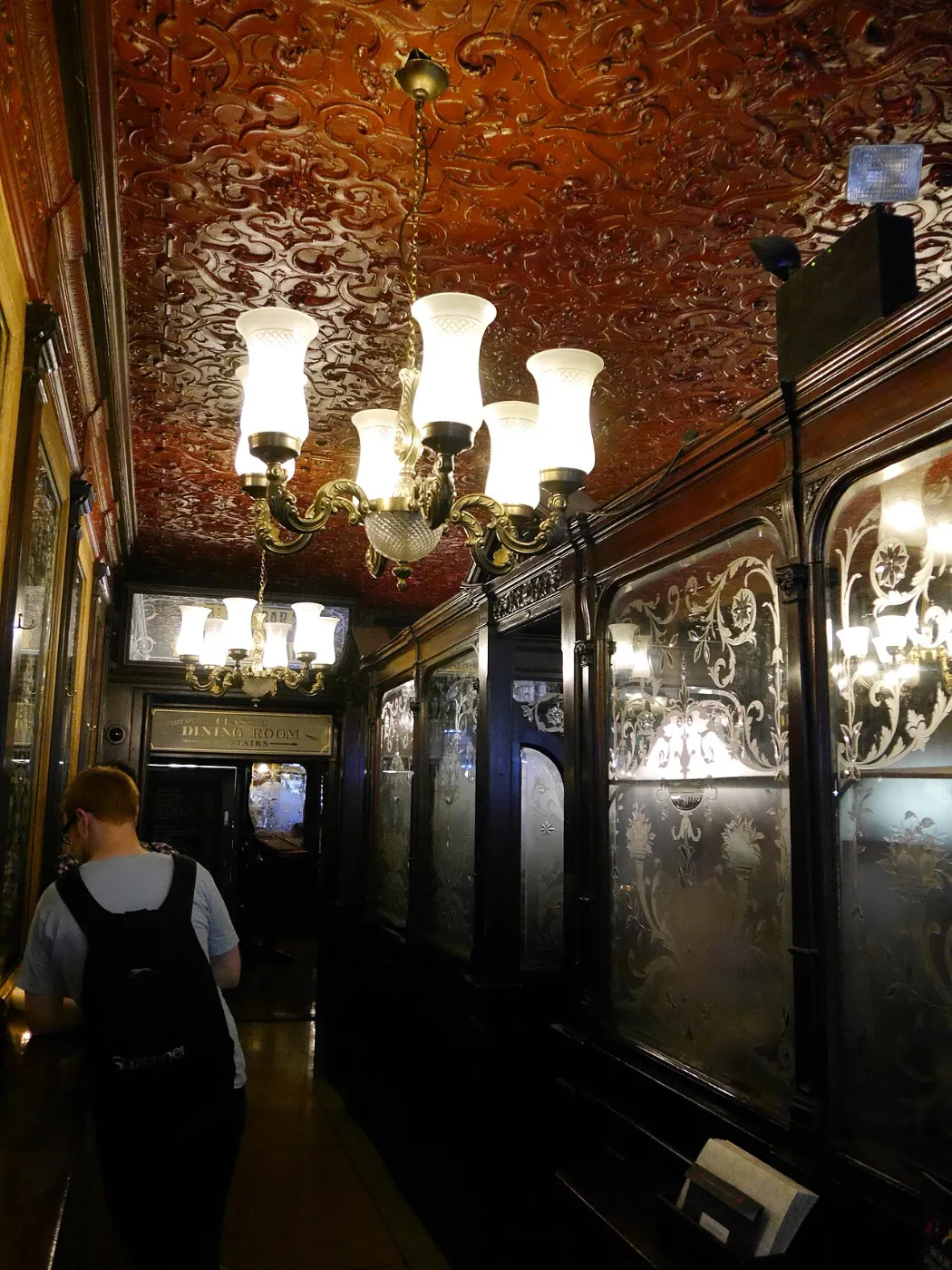
The rest of the Argyll Arms' fittings of about 1895 show the range of glass in one scheme. The corridor is lined with large brilliant-cut mirrors in marble and mahogany surrounds, separated by pilasters, which reflect the screens and glass opposite. The snugs are formed by carved mahogany partitions with acid-etched panels, and the glazed partition of the third snug reaches the ceiling. The rear saloon has etched and cut mirrored panels on three walls, and the small manager's office behind the servery is glazed with etched panels all round. The pub is listed Grade II* and rated three stars by CAMRA as an interior of outstanding national historic importance.
WHERE TO SEE CUT MIRRORS AND SNOB SCREENS IN LONDON

At the Red Lion, 2 Duke of York Street, built in 1821 and re-fronted in 1871 to designs by the architect W. H. Rawlings, the walls carry etched and diamond-cut mirrors in mahogany frames above fielded panels. More mirrors fill the bar back, in mahogany surrounds carved with Corinthian pilasters and keystones, and the former private bar at the rear is lined with them in arched surrounds. Historic England records that the internal fittings may be later than 1871, and that the mirrors are thought to be the work of Walter Gibbs and Sons of Blackfriars, spelt Walter Gibb and Sons elsewhere in the same listing.
Glass also decided who could see whom. At the Lamb, 94 Lamb's Conduit Street in Bloomsbury, a double range of snob screens stands on either side of the counter. CAMRA describes these frosted panels as popular in the 1890s for hiding customers from drinkers in other rooms, with hinges that let staff check on customers without disturbing their privacy. Some of the Lamb's screens are original and others belong to a later restoration, and its partitions were removed in a 1958 refurbishment. At the Prince Alfred, Historic England records counter-top snob screens with rotating etched glass panels.
The Salisbury, 90 St Martin's Lane, was rebuilt in 1892 and refitted around 1898. Its main bar has decorative etched mirror panels rising to the ceiling, lit by Art Nouveau copper candelabra in the form of draped female figures. CAMRA notes that only the mirror on the left near the door is original; the others are modern additions or replacements, and the etching on the long-wall mirrors dates from the last third of the 20th century. Scottish & Newcastle restored the pub in 1999, and CAMRA rates its interior three stars.
VICTORIAN PUB INTERIORS AT GORDON RAMSAY PUB & BAR

The interior design of Gordon Ramsay Pub & Bar at The Londoner Macao was completed in 2023. Its design cue is the London Bridge to Greenwich railway viaduct of the 1830s, whose 878 brick arches now house many shops, restaurants, bars and pubs. The history of that line is told in the London and Greenwich Railway and its viaduct of 878 arches. In the venue, steel, timber, metal and cast iron are layered into brickwork and vaults, and the dining room sits under arched brick vaults.
The interior combines scalloped ceilings and dark green enamel cast iron columns with Victorian pub cabinetry, panelling and mouldings. In the London pubs above, the Red Lion's mirrors sit in mahogany frames above fielded panels, the Argyll Arms' snugs are formed by carved mahogany partitions, the Prince Alfred's ornate timber bar screens have etched glass in their upper parts, and the Bunch of Grapes has cast-iron columns with gold-painted capitals. The history of that material in building is traced in cast iron architecture from the Iron Bridge to Victorian London.
SOURCES
- The Building Conservation Directory Brilliant Glass: Brilliant Cut and Acid Etched Glass Decoration, by Rodney Bender
- Encyclopaedia Britannica Hydrofluoric acid
- Encyclopaedia Britannica Verre églomisé
- United States Patent Office (via Google Patents) US108408A: Improvement in cutting and engraving stone, metal, glass, &c.
- Historic England The Red Lion Public House (List Entry 1066873)
- Historic England Prince Alfred Public House (List Entry 1066328)
- CAMRA Argyll Arms, Soho
- CAMRA Pub Heritage Bunch of Grapes, Knightsbridge
- CAMRA The Lamb, Bloomsbury
- CAMRA The Salisbury, Charing Cross