DEEP BUTTONING, COIL SPRINGS AND THE NAME OF AN EARL

A Chesterfield sofa is a sofa whose arms and back are all the same height, in the definition given by Oxford Learner's Dictionaries. The name belonged to a coat before it belonged to furniture: Merriam-Webster dates the first known use of the word, for an overcoat, to 1852, while the University of Toronto's Dialects of Ontario database lists 1900 as the Oxford English Dictionary year for the sofa. The form combines two upholstery techniques recorded in the V&A's furniture collection, coil springs and buttoning, and National Trust houses hold catalogued examples made from about 1890 to the 1950s. In Canadian English the word came to mean any sofa.
WHAT IS A CHESTERFIELD SOFA?
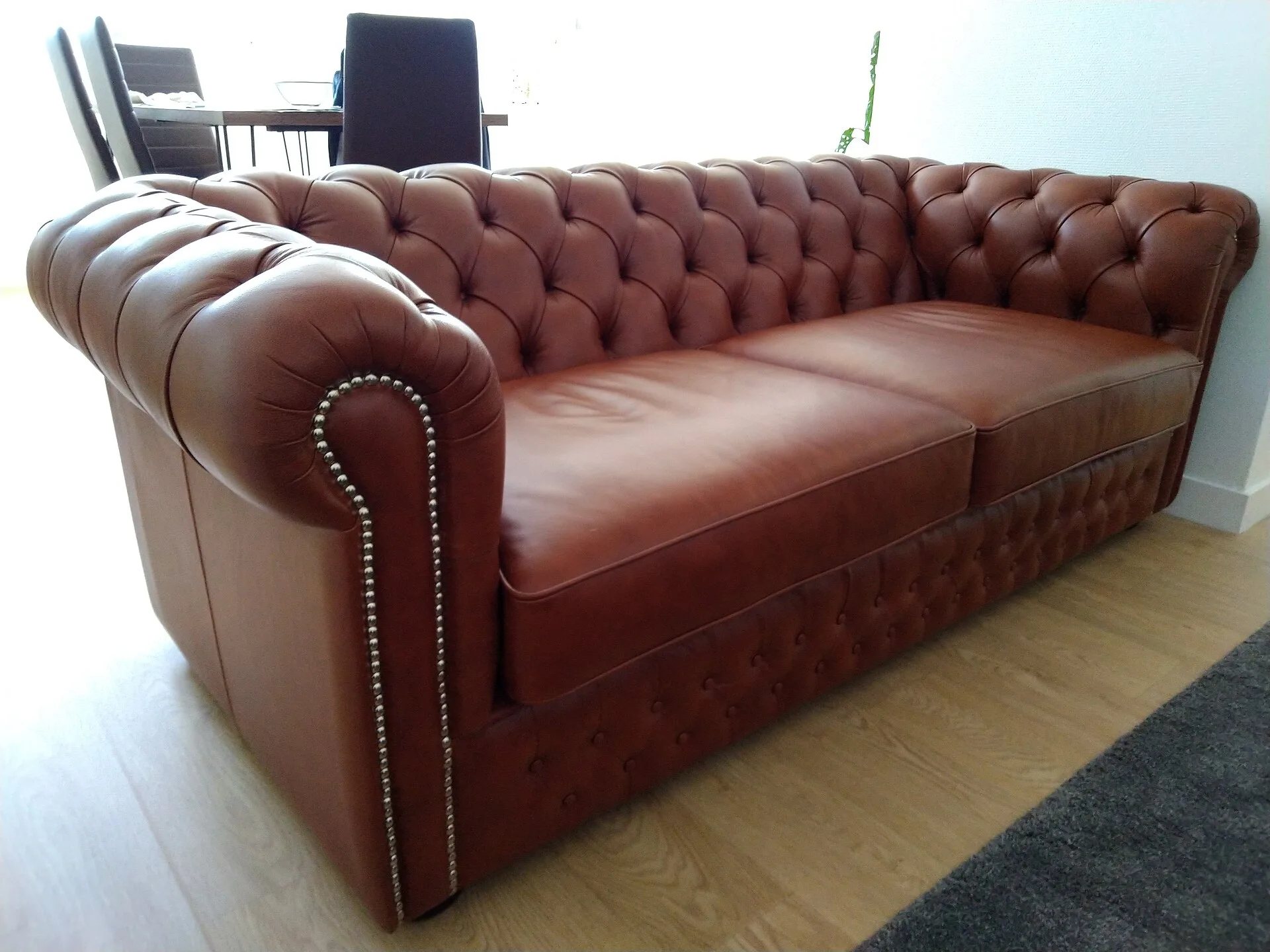
Dictionaries define the Chesterfield sofa by its proportions rather than its covering. Oxford Learner's Dictionaries describes it as a type of sofa with arms and a back that are all the same height. The Oxford English Dictionary definition quoted in the University of Toronto database describes a stuffed-over couch or sofa with a back and two ends, one of which is sometimes made adjustable. Merriam-Webster defines it as a davenport usually with upright armrests, and its children's dictionary as a sofa with arms. None of these definitions specifies leather, buttoning or springs.
The National Trust catalogues a sofa at Lanhydrock in Cornwall as a button-back Chesterfield sofa made in England around 1890. It is upholstered in red leather and stands on ring-turned walnut feet with brass castors, and it measures 70 cm high, 188 cm wide and 84 cm deep. The Trust records that its provenance is not known for certain: the sofa is listed in the house inventory of 1979, and was probably acquired when Lanhydrock passed to the National Trust in 1953.
A later example at Mount Stewart in County Down shows the same form in fabric. The National Trust describes it as a coil-sprung chesterfield sofa, British, made around the 1950s by the manufacturer Archibald Kendrick and Sons Limited. Its upright back is flanked by out-turned armrests, and it stands on six stained beech bun feet mounted on shepherd castors. The buttoned sofa is upholstered in glazed floral cotton with decorative trims, and a later loose cover of yellow damask with multicoloured fringing matches the drawing room curtains at Mount Stewart. It measures 78.8 by 233.8 by 92.1 cm and was given to the National Trust by Lady Mairi Bury in 1976.
WHERE DID THE CHESTERFIELD SOFA GET ITS NAME?

The word chesterfield named a coat before a sofa. Merriam-Webster's first sense is a single-breasted or double-breasted semifitted overcoat with a velvet collar, and it gives 1852 as the first known use of the word, with no separate date for the furniture sense. Oxford Learner's Dictionaries places the origin of the word in the mid-19th century, originally relating to a type of overcoat. The Oxford English Dictionary year listed for the sofa in the University of Toronto database is 1900, 48 years after the date Merriam-Webster gives for the coat.
Both dictionaries name a 19th-century nobleman as the source. Merriam-Webster's etymology reads "from a 19th century Earl of Chesterfield", and Oxford Learner's Dictionaries says the word is named after a 19th-century Earl of Chesterfield, adding that Chesterfield is a town in Derbyshire. That dating rules out Philip Dormer Stanhope, 4th Earl of Chesterfield, whom Merriam-Webster's biographical entry lists as an English statesman and author who lived from 1694 to 1773. The Victoria and Albert Museum is more specific about the coat: it states that the style was named after the 6th Earl of Chesterfield, a leader of fashion during the 1830s, and became popular in about 1840.
The V&A's example was made in 1895 by the tailor S. Nelson of Hanover Street, London, and the date is written beside the client's name. It is a single-breasted overcoat of woollen cloth, machine sewn and hand finished, with a short centre back vent, four buttons and a velvet collar. A small ticket pocket on the outside right breast was, according to the museum, a feature introduced in the late 1850s. The V&A records that the Chesterfield remained the most fashionable style of overcoat in the 1890s, and lists three varieties: a long version reaching the calf, a sac-back, and a loose caped version with an elbow-length cape but no sleeves.
HOW DID COIL SPRINGS CHANGE VICTORIAN UPHOLSTERY?

Metal springs reached British seating in stages. A V&A record for a settee states that spiral metal springs were first used at the very end of the 18th century, in specialist furniture such as the chamber horse, a seat that allowed indoor exercise. The label of a V&A chair made around 1845 dates the development of sprung upholstery to the 1820s, when the manufacture of iron springs became cheaper. According to the settee record, springs were used in ordinary domestic seating only from the 1830s, were immediately popular, and by 1850 almost every drawing-room chair or settee was sprung.
The walnut chair of about 1845 retains its original upholstery in very good condition. Six copper-coated steel coil springs are stitched to the webbing, some of which has been replaced, and compressed under a tacked cover. The V&A states that the springs gave the chair extra resilience, increased the depth of the upholstery and reduced the quantity of horsehair needed, although a layer of stitched horsehair stuffing was still used above them. The seat and back are covered in Berlin woolwork and wool velvet. Berlin woolwork, named because its first printed patterns and dyed wools came from Berlin from 1804, was the most popular embroidery technique in Britain between 1830 and the 1870s. The museum records that the chair was made for the sitting room or parlour of a middle-class or upper-class Victorian household.
The settee, made in England between about 1845 and 1860, shows the structure beneath a sprung seat. The seat rests on an open mesh of jute and cotton webbing in a black and white twill weave, without a base cloth, and its edges are stitched. The back is deeply stuffed but has no stitched edge. The frame, of carved beech and walnut, is now ebonised but was probably finished originally to imitate rosewood, and all four legs stand on castors with brass brackets and white stoneware wheels.
HOW IS DEEP BUTTONING MADE?

An oak chair made in England between 1860 and 1880, now in the V&A, records the buttoning technique on its gallery label. The grid pattern on its upholstery was created by buttoning: each button was knotted to a tight twine loop threaded right through to the base cloth. The museum states that the technique evolved from 18th-century methods of using quilting to hold down stuffing. On this chair, however, most of the horsehair is secured by hidden stitching rather than by the buttons. The under upholstery combines original horsehair with replaced kapok, and the leather top cover with its buttons and banding is also a replacement.
The settee of about 1845 to 1860 shows how curators read buttoning from what survives: its record states that the structural upholstery might be original, or that the back may originally have been buttoned. The V&A describes the oak chair's concave back as of the type found on Regency library chairs. The museum identifies Gothic Revival inlaid and incised geometric motifs and chevron bands on its turned, carved and part-ebonised frame, and its label refers to Charles Lock Eastlake, whose Hints on Household Taste was first published in 1868. The chair came from the collection of Charles and Lavinia Handley-Read and is displayed in Room 133 at V&A South Kensington.
WHAT DOES CHESTERFIELD MEAN IN CANADIAN ENGLISH?

Oxford Learner's Dictionaries gives a second, Canadian English sense of chesterfield: any type of sofa. The University of Toronto's Dialects of Ontario database records the word in interviews with Ontario speakers. In 1975 interviews in Belleville, a 76-year-old man describes lying on the chesterfield, and a woman recalls a big chesterfield in the middle of a living room with red linoleum. In 2004 interviews in Toronto, speakers aged 34 to 78 give chesterfield as their name for the item, one recalls a chesterfield shop on Yonge Street just above College, and an interviewer remarks that the term is apparently used only in Canada.
Survey figures show the word already dividing generations in the 1970s. According to McGill News, the Survey of Canadian English, carried out in 1972 by researchers from the University of Victoria, collected responses from more than 14,000 grade nine students and their parents. In that survey 83 per cent of parents used the word chesterfield, against 66 per cent of their teenage children. Charles Boberg, associate professor of linguistics at McGill University, began a new online survey inspired by the 50th anniversary of the 1972 study and kept its question on what to call the sofa. In February 2024, McGill News reported that the new survey was still collecting responses.
PROHIBITION BAR AT MANDARIN ORIENTAL SHENZHEN
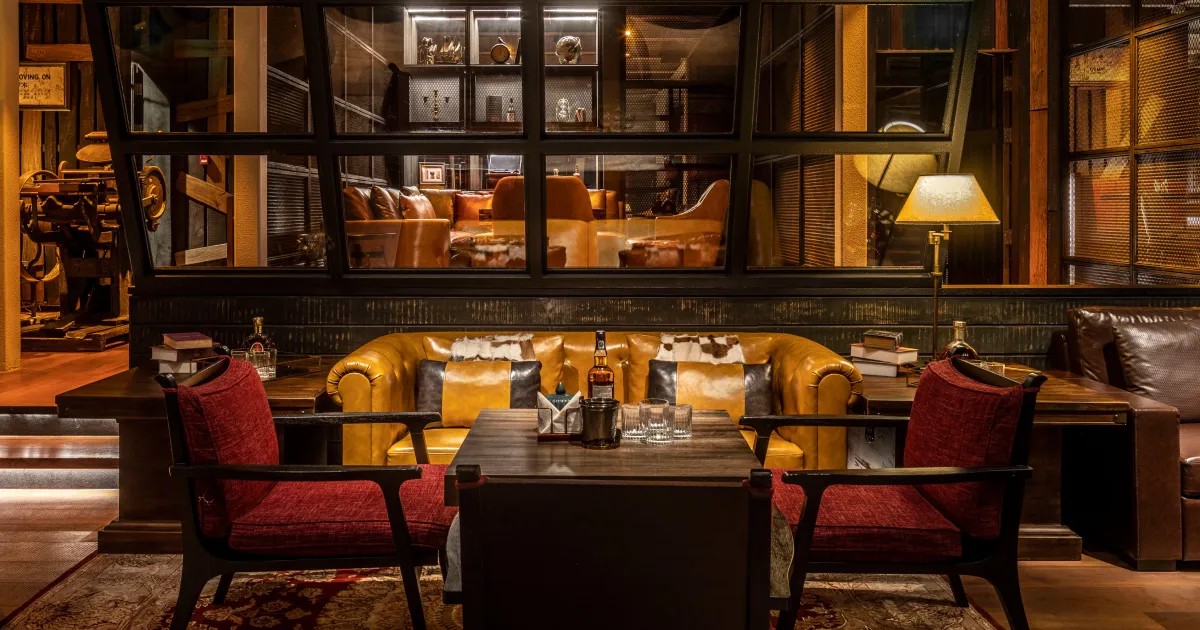
Silverfox Studios completed Prohibition Bar, The MO Bar on the 79th floor of Mandarin Oriental Shenzhen, in 2022. The semi-hidden bar is designed to recreate the intrigue of the Prohibition era, the period of the American speakeasy covered in our history of the 13-year alcohol ban. Guests reach it in two stages: a separate lift from L78, then a long corridor. The corridor is a storage-style passage with crates, exposed ductwork and aged hand-painted liquor adverts, the medium described in our article on ghost signs.
The bar itself has a long bar counter with a DJ booth and a cocktail station, and the interior is finished in distressed timber with steel beams. The lounge is furnished with Chesterfields, alongside iron screens and skyline views from the 79th floor. In the Oxford Learner's Dictionaries definition, a chesterfield is a sofa with arms and a back of the same height; the National Trust's catalogued examples at Lanhydrock and Mount Stewart date from about 1890 and the 1950s.
SOURCES
- Oxford Learner's Dictionaries chesterfield noun
- Merriam-Webster Chesterfield Definition and Meaning
- University of Toronto Dialects of Ontario: Chesterfield
- McGill News Taking stock of the state of English in Canada
- Victoria and Albert Museum Chesterfield overcoat, S. Nelson, 1895
- Victoria and Albert Museum Chair, England, ca. 1845
- Victoria and Albert Museum Settee, England, ca. 1845 to 1860
- Victoria and Albert Museum Chair, England, 1860 to 1880
- National Trust Collections Chesterfield, Lanhydrock, NT 882698
- National Trust Collections Chesterfield, Mount Stewart, NT 1220694