WHAT IS IKEBANA? FROM BUDDHIST ALTAR OFFERINGS IN KYOTO TO RIKKA, SHOKA, MORIBANA AND THE SOGETSU SCHOOL

Ikebana is the Japanese art of flower arrangement, also called kado, the way of the flower. It grew out of the flowers placed before Buddhist statues after Buddhism reached Japan in the 6th century and developed into an independent art in Kyoto in the 15th century. Arrangements use seasonal plants, dried branches, stones and moss in containers of ceramic, glass, wood, bamboo or metal. Its main styles followed one another: rikka for temples and warrior residences, chabana and nageire for the tea room, shoka for the home, moribana for the shallow dishes of the Meiji period, and the free work of the Sogetsu school, founded in 1927.
WHERE DID IKEBANA COME FROM?
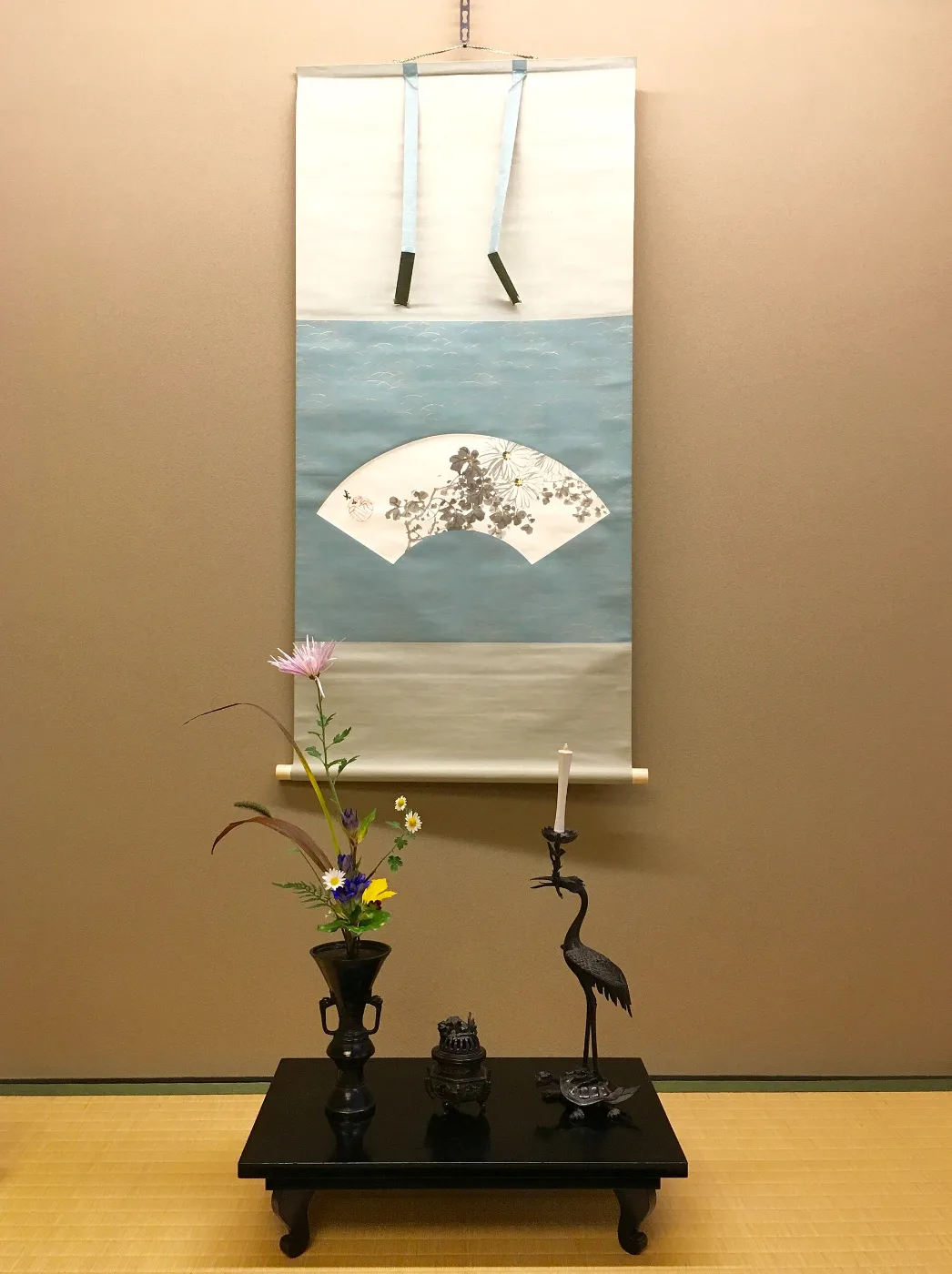
Britannica traces ikebana to Chinese Buddhist missionaries, who brought to Japan in the 6th century a formalised ritual of offering flowers to the Buddha. The Japan Tourism Agency gives the same starting point: flowers in vases were offered before Buddhist statues, and the practice later became an independent art. These altar offerings are called kuge. In the Kamakura and Nanbokucho periods a three-piece altar set, the mitsugusoku, made up of flower vase, incense burner and candle holder, became common, and the tatebana, or standing flowers, set three flowers in a tall metal vessel. A Buddhist floral offering already appears in the Heian-period Choju Jinbutsu Giga handscroll, owned by Kozanji temple in Kyoto.
The Ikenobo school, in its published history, names two further roots alongside Buddhist practice. The first is the appreciation of flowers in poetry: the Manyoshu and Kokinwakashu anthologies contain many flower poems, and from the Heian period the word for flower came to mean the cherry blossom. Sutra titles such as the Kegon-kyo and Hokke-kyo also carry the character for flower. The second is the yorishiro, an object that summons a divine spirit. Evergreen trees were treated as yorishiro, and the pine-bough kadomatsu set out for the New Year is one surviving form, a custom covered in our article on the pine tree in Japanese culture.
IKENOBO AND THE ROKKAKUDO TEMPLE IN KYOTO
Ikebana's oldest school is tied to Rokkakudo, formally Shiunzan Chohoji, a six-sided temple in central Kyoto. In the temple's founding tradition, as Ikenobo tells it, Prince Shotoku found the site while looking for timber to build Shitennoji in Osaka, built a hexagonal hall after the Buddha appeared to him in a dream, and enshrined an amulet of Nyoirin Kannon there. Ono no Imoko, who served Shotoku, is said to have become a priest and lived at the temple, and Britannica repeats the tradition that he founded the Ikenobo school in the early 7th century. The school's name comes from the same account: priests who made floral offerings at the altar each morning and evening lived in a hut, bo, beside a pond, ike, north of the temple.
The written record begins in 1462, when the Hekizan nichiroku, the diary of a monk at Tofukuji in Kyoto, notes that a warrior invited Senkei Ikenobo, a Rokkakudo priest, to arrange flowers. JAANUS, Columbia University's dictionary of Japanese art, dates the arrangement to 25 February 1462 and records a golden vase. Senno Ikenobo, whom the Japan Tourism Agency dates to 1482 to 1543, codified rules for arranging, which the agency treats as the start of ikebana as practised today. His Ikenobo Senno Kuden, in a copy handed down in 1537, tells the arranger to observe the inner essence of plants and express their natural form, and Nippon.com adds that he wanted details such as a withered stem or a twisted branch. Successive Ikenobo headmasters have served as Rokkakudo's head priests.
WHAT IS RIKKA?
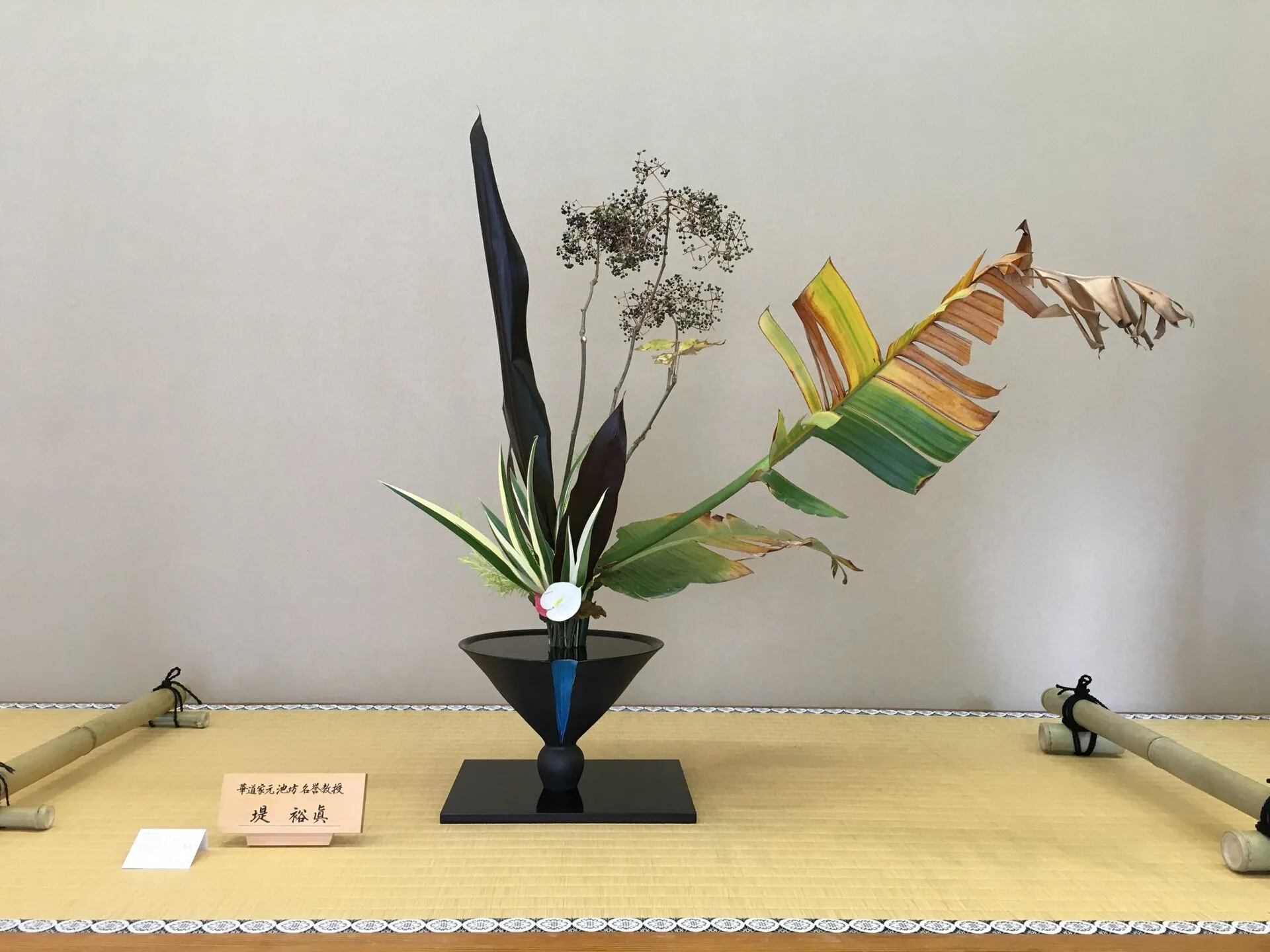
Before rikka, standing flowers, took shape, arrangements formed part of zashiki kazari, the display of art objects in rooms built in the shoin style, which was refined by the doboshu, attendants to the shogun. These rooms used the oshiita display board, precursor of the tokonoma alcove, and chigaidana staggered shelves. Upright tatehana were built from a main branch, the shin, with lower plants called shitakusa. The Ikenobo Sen'ei Kadensho, handed down in 1545, includes a skeletal drawing of a style of seven yakueda, or principal branches, an early form of rikka. JAANUS names rikka's seven branches as ryo, gaku, ro, shi, bi, yo and in. JAANUS describes the asymmetrical whole as an evocation of Mount Sumeru, the centre of Buddhist cosmology.
Senko Ikenobo I built a large sunanomono rikka in 1594 for Hideyoshi Toyotomi's visit to the residence of Toshiie Maeda, and in 1599 a hundred of his disciples held an exhibition at Daiunin in Kyoto. Senko Ikenobo II instructed at the rikka gatherings Emperor Gomizuno-o held in Kyoto, and his 91 drawings made from 1628 to 1635 are an Important Cultural Property. JAANUS calls the 17th century rikka's golden age, when the style spread from priests and aristocrats to the samurai class, and counts 29 rikka styles developed by Ikenobo masters up to Senko III, active from 1708 to 1734. In 1692 Ikenobo disciples made rikka 9 metres tall for the ceremony marking the restoration of the Great Buddha at Todaiji in Nara.
CHABANA, NAGEIRE AND SHOKA: THE LIGHTER STYLES
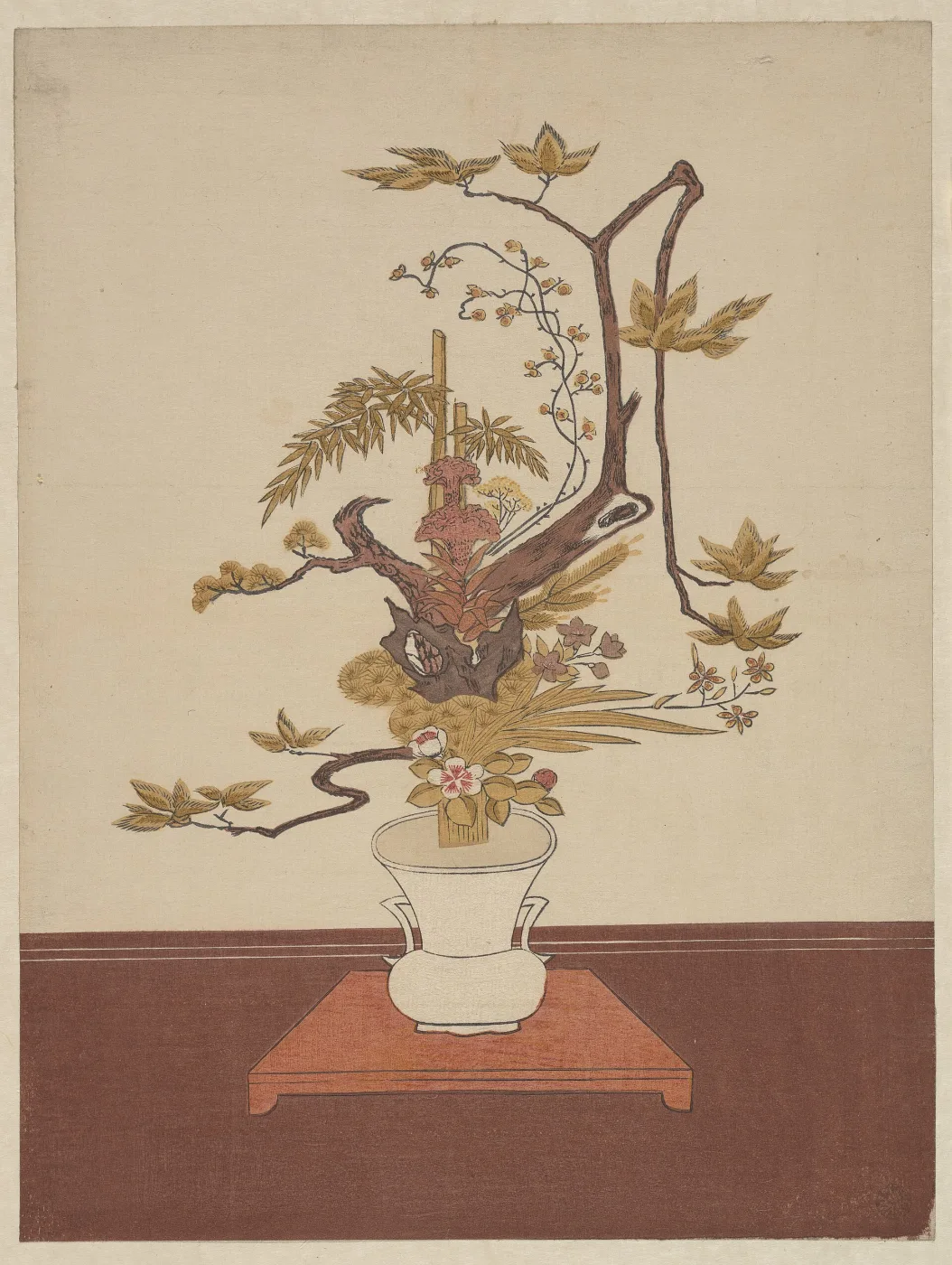
Sen'ei Ikenobo already favoured ikeru hana, looser arrangements, as well as the standing tateru hana. In the late 16th century the tea master Sen no Rikyu, 1522 to 1591, gave the tea ceremony its refined form, and the flowers used in it became chabana, tea flowers. Nippon.com reports that he wanted them arranged "as they do in a field." JAANUS links chabana to nageire, meaning "to throw into", an austere style also called heika that often uses a single flower. The Japan Tourism Agency notes that a simple arrangement became a standard feature of the tea room, and that tea masters especially favoured ikebana.
Shoka emerged at the end of the 17th century, combining simplified rikka forms with nageire. It uses three branches set in an asymmetric triangle, named shin, soe and tai. Lighter nageirebana for a small room or a tea room drew interest, and the Kodai Shoka Zukan, edited by Senyo Ikenobo and revised in 1697, shows them, and in the mid-18th century nageirebana was formalised as shoka. The Ikenobo history records an introductory shoka course and the admission of women as disciples, and Nipponia magazine notes that from the end of the 18th century ikebana spread to ordinary people, many of them women. The Soka Hyakki of 1820 holds 100 shoka drawings by the Shijo school painters Keibun Matsumura and Seiki Yokoyama.
HOW IS IKEBANA DISPLAYED IN THE TOKONOMA?
The tokonoma is the display alcove that grew out of the oshiita board of shoin rooms. Nippon.com notes that early arrangements decorated the tokonoma of aristocratic residences built in the shoin-zukuri style, and JAANUS describes the alcove as the standard place for domestic arrangements. The Art Institute of Chicago records that Edo-period woodblock prints showed floral displays in homes and public gathering places, many of them set in the tokonoma, and that interest in botany ran through every level of Edo society alongside flower arranging.
The Japan Tourism Agency describes the finished arrangement being placed in the tokonoma, usually beside a hanging scroll or where it can be seen on entering the room. The agency lists ikebana's principles as seasonality, asymmetry and the beauty of negative space, with stems placed so the eye also moves to the gaps between them. Materials are chosen to express the current season and include new buds, full blooms and plants beginning to wither. Nippon.com defines ikebana by the positioning of flowers, stems and other materials in relation to the container and the surrounding space, and notes that arrangements now decorate banquet halls, traditional inns, corporate boardrooms, department stores and city offices.
WHAT IS MORIBANA, AND WHAT IS A KENZAN?
After the capital moved to Tokyo, Ikenobo took part in the Kyoto Expo from 1872. Sensho Ikenobo was appointed ikebana teacher at the Kyoto Prefectural Women's School in 1879, an Ikenobo office opened in Tokyo in 1889, and Sensho devised shofutai, a simpler and more teachable form of shoka, set out in the 1904 textbook Hana no Shiori. The Ikenobo history records that nageire and moribana emerged in response to Western influence, and the school classed them as oyobana, applications of rikka and shoka.
Moribana, meaning piled-up flowers, is arranged in a wide, flat container called a suiban. Nippon.com credits the style to the Ohara school, founded in the late 19th century by Unshin Ohara, and the Cleveland Museum of Art gives the founding year as 1895. Cleveland describes moribana as a cluster-style arrangement in a round, flat container that brought Western flowers into ikebana, balanced on a scalene triangle of three main lines called subject, secondary and object. Nippon.com counts Ohara with Ikenobo and Sogetsu as the three predominant schools.
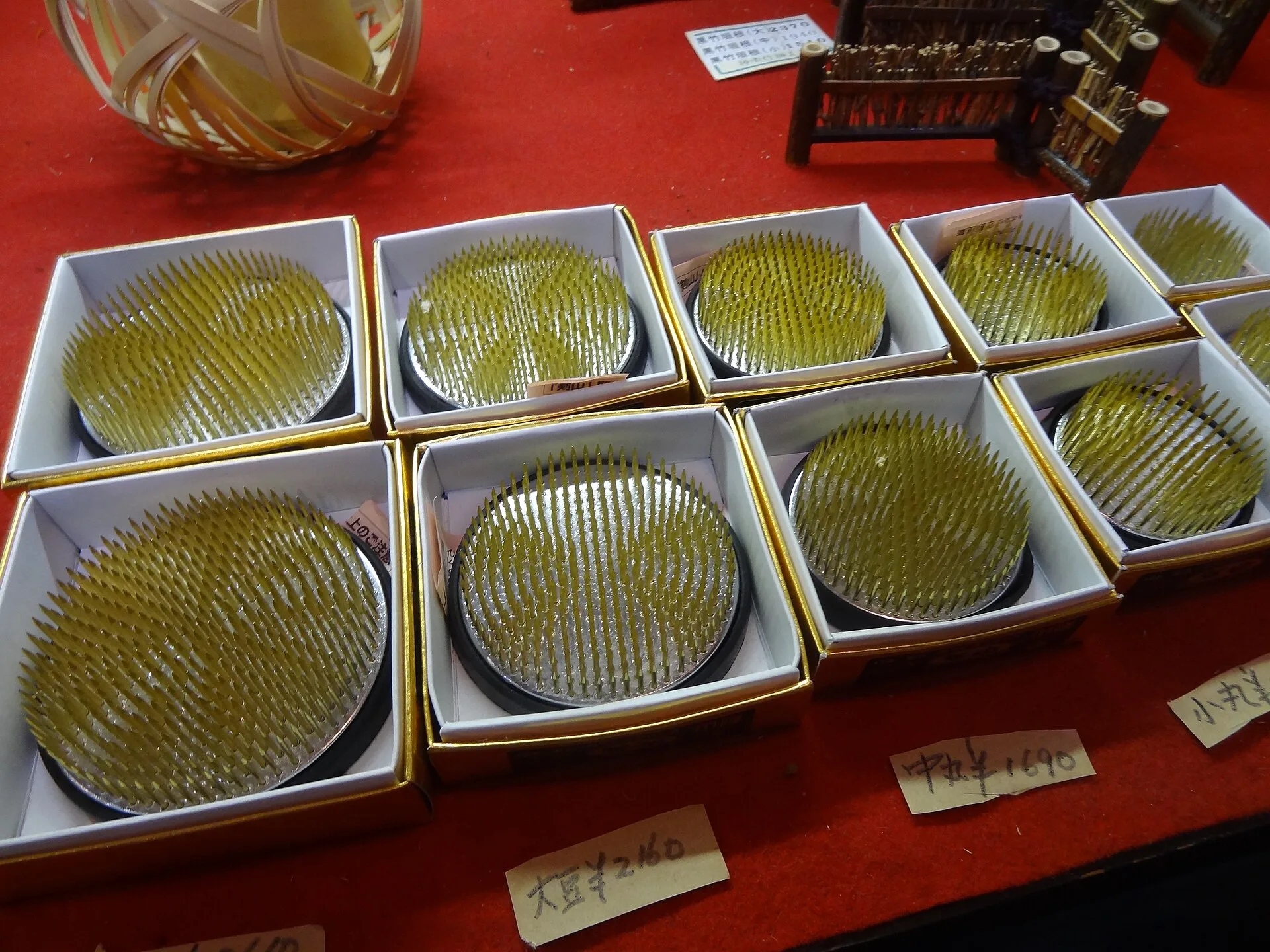
The low moribana dish relied on a holder. The kenzan is a heavy metal base set with many needle-like prongs, made round, square, rectangular or oval, onto which stems are pushed so that they stand upright. Nipponia magazine records that kenzan were made in large quantities from the early 20th century after advances in metalworking, with well-known makers in Tsubame and Sanjo in Niigata Prefecture, and that they suit low, wide containers. Before the kenzan, arrangers cut notches in sticks or fixed small wooden braces inside the vessel. Nippon.com names the kenzan and hanabasami, flower-cutting scissors, as the basic tools.
SOGETSU, SOFU TESHIGAHARA AND THE 20TH CENTURY
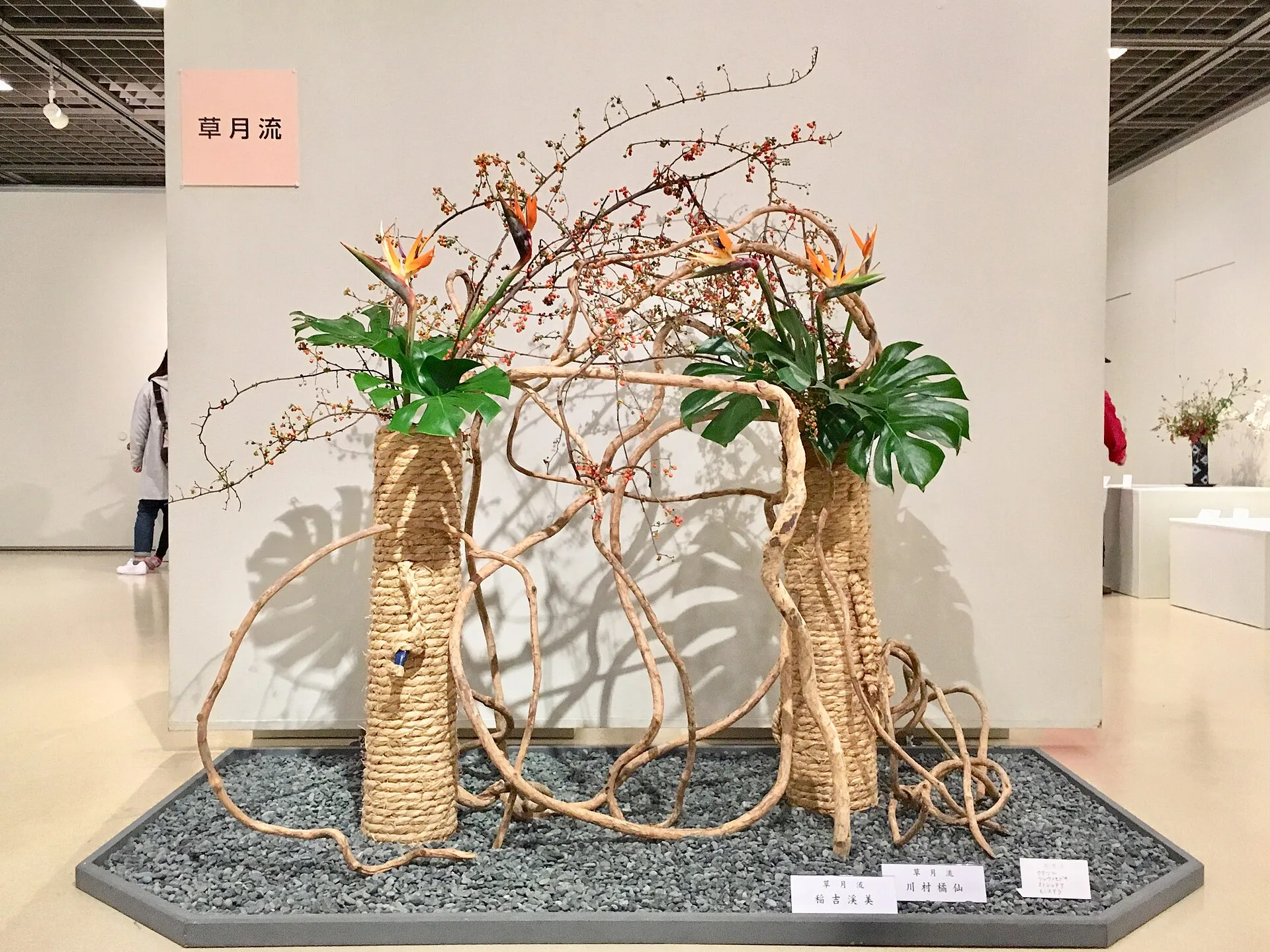
Sofu Teshigahara was born in 1900 in Sakai, Osaka, the eldest son of the ikebana artist Hisaji Teshigahara, and founded the Sogetsu school in 1927 after parting ways with his father. Nippon.com describes Sogetsu as valuing individual expression over set styles. The first Sogetsu exhibition was held in 1928 at the Senbikiya fruit parlour in Ginza, and from November 1929 NHK radio broadcast a programme titled "Nageire and Moribana Anyone Can Do." At the 7th Sogetsu exhibition, held in 1932 at Josui Kaikan in Hitotsubashi, Tokyo, Sofu introduced an admission fee and experimented with sogoka, integrated flower arrangement.
Sofu's 1951 solo exhibition at Mita presented what he called objet ikebana. After he died in 1979 his eldest daughter, Kasumi, became the second iemoto, or headmaster; Hiroshi Teshigahara became the third in 1980 and made sculptural works in bamboo, and his second daughter, Akane, became the fourth in 2001. At Ikenobo, after the Second World War, nageire and moribana became known together as jiyuka, free style, and in 1977 the school completed its headquarters beside Rokkakudo, including the Ikebana History Museum. The Ikenobo Ikebana Spring Exhibition is held there every April.
RIN AT MANDARIN ORIENTAL SHENZHEN
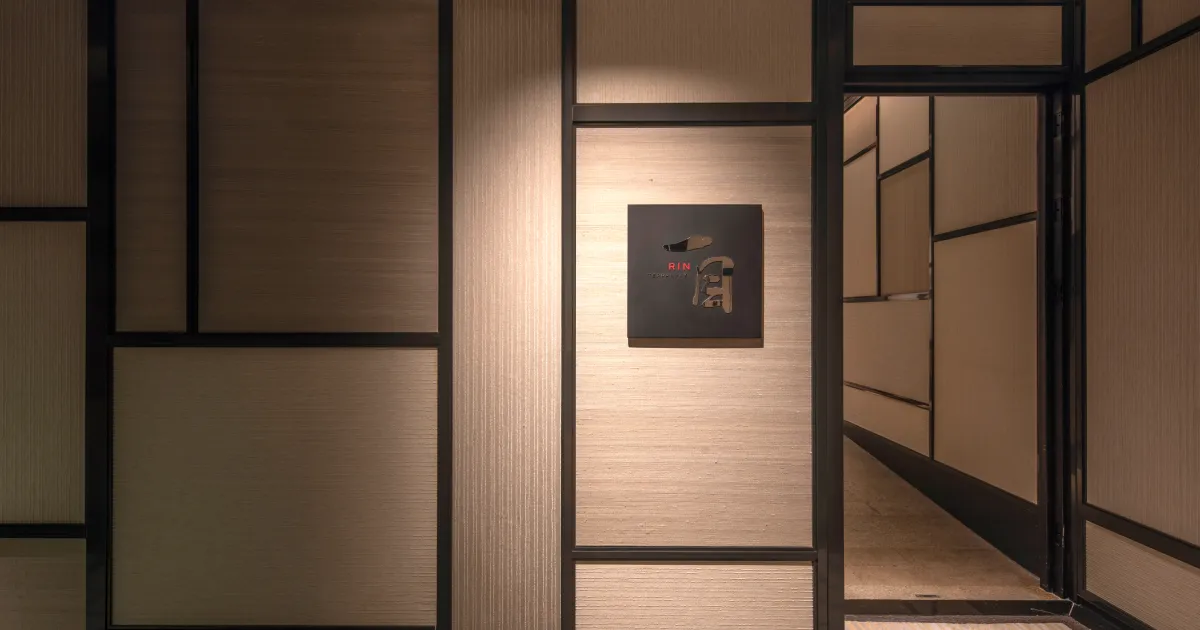
RIN is the signature Japanese restaurant at Mandarin Oriental Shenzhen, completed in 2022, with chef Masanobu Hoshina. It is reservation-only and every room is private. Guests enter from a Sake Lounge through low doors into three rooms named Corten Steel, Pine and Concrete. The Ikenobo history names three elements from which ikebana took form: flowers appreciated in poetry, offerings on the Buddhist altar and the yorishiro, objects believed to summon a divine spirit, among which it counts evergreen trees and the pine boughs of the New Year kadomatsu.
The restaurant serves teppanyaki. Ingredients are prepared raw in front of guests, the cooking equipment sits under the counter, and the sightline runs past the chef to the city. Ikebana is also practised as a performance in front of an audience. In the live demonstrations described by the Japan Tourism Agency, masters of the Ikenobo or Saga Goryu schools first sit and carefully lay out their tools, then inspect the materials and plan the composition before they start working on the arrangement.
SOURCES
- Ikenobo History of Ikenobo
- Ikenobo Ikenobo and the Rokkakudo Temple: Birthplace of ikebana
- Columbia University, JAANUS ikebana
- Encyclopaedia Britannica Ikebana
- Nippon.com Ikebana: Japanese Flower Arrangement
- Japan Tourism Agency Ikebana (Tablet Text)
- Art Institute of Chicago The Arranged Flower: Ikebana and Flora in Japanese Prints
- Cleveland Museum of Art The Art of Ikebana
- Web Japan, Nipponia Kenzan
- Sogetsu History of Sogetsu