COURSE BY COURSE, FROM DELMONICO'S TO CANTONESE BANQUETS

Wine pairing is the practice of choosing a wine to suit a dish, or a sequence of wines to follow the courses of a meal. Its conventions come from formal European and American dining, where stewards and butlers assigned wines to the oysters, soup, fish, roasts and dessert, and from a body of sensory rules about how sugar, acid, salt and umami in food change the taste of wine. The Oxford Companion to Wine, edited by Jancis Robinson, records how differently the subject is viewed: some treat it as intricate and detailed, some as a set of conventions tied to national culture, and some as a pursuit taken too seriously by food enthusiasts. The same principles are now taught in wine school syllabuses and applied by sommeliers in Hong Kong and Singapore to Cantonese banquet dishes and to wines from China's own vineyards.
WHERE DID WINE PAIRING COME FROM?
In France, the Oxford Companion notes, wine has long been treated simply as part of gastronomie, and few French people would describe a wine without suggesting the dishes it should be served with. The country traditionally looked to its chefs for expertise in tasting and selecting wine. According to the Companion, it was only in the late 1980s that wine began to be viewed in France as a distinct subject in its own right. The Companion's own entry on food and wine matching sets out general rules on how food changes the taste of wine and gives a short list of particularly successful combinations, both of which are covered below.
In New York, Charles Ranhofer, described on the title page of The Epicurean as former chef of Delmonico's and honorary president of the Société Culinaire Philanthropique of New York, set out the duties in a treatise that includes Delmonico's bills of fare from 1862 to 1894. In his system the host chose the finer wines when ordering the menu, the steward told the butler which wine went with each course, and the steward was responsible for seeing that the wines were served at a proper temperature. In restaurants this work later passed to the sommelier.
HOW WERE WINES MATCHED TO COURSES IN THE 19TH CENTURY?
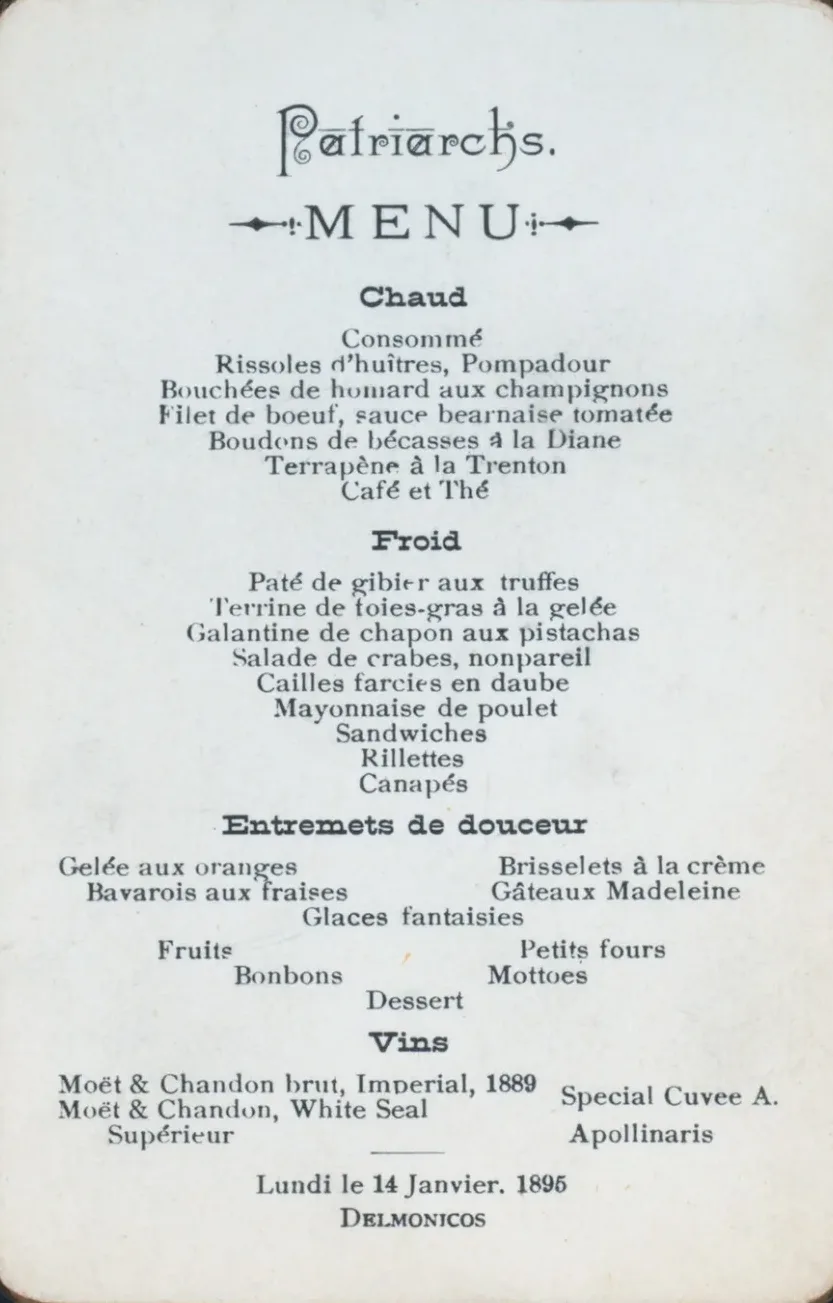
Ranhofer's section on the service of wines and cordials divides a dinner into three services. In the first, Sauterne, Barsac, Graves and Chablis accompany the oysters, and Madeira or sherry follows the soup. Rhine wines, among them Johannisberger, Hochheimer, Liebfraumilch and Steinberger, come with the fish. Wines including Moulin-à-Vent, Mâcon, Clos de Vougeot and Beaune go with the removes, and Bordeaux from Saint-Émilion, the Médoc and Saint-Julien with the entrées. The second service pairs the roasts with Burgundies such as Pommard, Nuits and Chambertin, and the hot desserts with Bordeaux including Château Margaux and Léoville. The third service brings dessert with Burgundy and Champagnes, Roederer among them, followed by wine liquors such as Muscatel, Malaga and Alicante.
Ranhofer also fixed serving temperatures. All white wines were to be served cold and sherry cool, Burgundy between 50 and 55 degrees Fahrenheit, Bordeaux between 55 and 60 degrees depending on its growth, and Champagne cold or iced. British practice followed a similar order. Writing for The Wine Society, which dates from 1874, food writer Felicity Cloake describes Victorian and Edwardian grand dinners that opened with hors d'oeuvres and soups always paired with sherry or Madeira. Fish usually came with Sauternes, Chablis, Graves or sherry, and the meal ended with salad, dessert, fruit, cheese and savouries accompanied by claret, port and sherry. Ranhofer places red Bordeaux and Burgundy with the entrées and roasts, while Cloake's account lists claret with the closing courses, alongside port and sherry.
WHERE DID THE CLASSIC FOOD AND WINE MATCHES COME FROM?

The Oxford Companion gives a short list of particularly successful combinations. It pairs Riesling with smoked salmon or other smoked fish, and Riesling, including medium-sweet styles, with onion tart. Chablis goes with oysters, and cru Beaujolais with charcuterie, especially rosette de Lyon. Red Bordeaux is matched with lamb and red Burgundy with feathered game. The list ends with Sauternes served with Roquefort or another blue cheese. The entry cross-refers to the Companion's separate guidance on the order in which wines should be served, discussed further below.
Two of these pairings can be traced in the nineteenth-century sources. Ranhofer's first service already places Chablis beside the oysters, together with Sauterne, Barsac and Graves, so that sweet white Bordeaux and dry Chablis were served with the same opening shellfish course at Delmonico's. Sauternes also appears in Cloake's account of Victorian and Edwardian dinners as a wine for the fish course, beside Chablis and Graves. In the Companion's modern list the sweet wine has moved to the end of the meal, with blue cheese, while Chablis keeps its place with oysters. The Companion's guidance on the order of wines notes that serving the sweet course before the cheese can cause problems for the wines.
WHAT ARE THE RULES OF WINE PAIRING TODAY?
In the specification for its Level 2 Award in Wines, the Wine & Spirit Education Trust (WSET) teaches wine pairing as a set of interactions. The components in food that affect wine are listed as sweetness, umami, acid, salt, flavour intensity, fat and chilli heat. The components in wine that are affected by food are listed as sweetness, acidity, bitterness from tannin and oak, fruitiness and alcohol. Students are assessed on whether they can identify the principal food and wine interactions, a learning outcome that accounts for four of the 50 multiple-choice questions in the examination. Bitterness appears only on the wine side of the list, as a quality of tannin and oak rather than of food.
The Oxford Companion sets out a parallel group of general rules. White wines generally, although not universally, taste more acid than red wines, which is why they suit simple fish dishes that would otherwise call for an acidic seasoning such as lemon juice or vinegar. Sweet foods, including less obvious ones such as tomatoes and balsamic vinegar, make a wine seem more sour, bitter and astringent, and also less sweet, stronger and less fruity. Very acidic dishes, such as those dressed with vinegar or citrus juice, work the other way: they reduce how sour a wine tastes, so that it seems richer and mellower, and a wine with any sweetness tastes sweeter still.
HOW ARE WINES ORDERED WITH A TASTING MENU?
When several wines follow the courses of a tasting menu, their order follows conventions recorded in the Oxford Companion. Dry wines come before sweet, ordinary before fine, and generally young before old. Wines are served in order of increasing sweetness because a sweet wine can make a dry wine that follows it taste acidic and unpleasant, and the Companion notes that this matches the usual sequence of dishes. Older wines are usually more complex than young ones, so serving the oldest last tends to flatter all the wines. The Companion also records exceptions: robust young wines can overwhelm a delicate old one, and because alcohol levels have tended to rise, some argue for moving from weaker old wines to stronger young ones.
The length of the meal is a further factor. After a generous meal, the Companion notes, palates tired by many younger wines may miss the subtleties of a fine old wine served at the end. Sommeliers working with Chinese banquet dishes have applied the course-by-course approach within a single dish. For poon choi, the layered Lunar New Year dish, Billy Yeung of One Harbour Road at Grand Hyatt Hong Kong told the MICHELIN Guide in 2024 that he pairs each layer with a different wine: a Neuchâtel white or a Mosel sparkling wine for the chicken and shrimp on top, a red from the Rhône or Ningxia for the middle, and a Santorini Vin Santo or a natural Georgian white for the bottom. His reason was that a single wine can make the meal dull.
WINE PAIRING WITH CANTONESE FOOD

In a 2021 MICHELIN Guide feature on wine pairing with Cantonese dishes, Hong Kong sommeliers returned repeatedly to Champagne and high-acid whites. Alex Yim, head sommelier of VEA, matched Brut Champagne with umami-rich and soy-based dishes, saying its minerality suits the saltiness of food cooked with soy sauce and its bubbles cleanse the palate. Benson Yan, head sommelier of Tin Lung Heen, said Champagne would almost never go wrong with Cantonese food. His own choices included German Riesling Kabinett with barbecued pork glazed with osmanthus honey, where the wine's mild sweetness echoes the honey and its acidity cuts the fat, and French Sauternes with baked egg custard tart.
Francois Ferrand of Tate named the texture of the main ingredient, the temperature and the sweetness of the dish as his deciding factors, and paired steamed mouth grouper with soy sauce and scallion with Chablis Premier Cru. Maxime Duval of One Harbour Road chose a 2018 Chablis from Domaine Patte Loup for sweet and sour pork, using its acidity to balance the sweetness of the sauce. The 2024 Lunar New Year guide added drinks from outside the European wine canon. Andrew Lam, head sommelier at Mandarin Oriental, Hong Kong, suggested a full-bodied Jun-shu-style sake for poon choi because of its shared umami and high level of amino acids, and Billy Yeung proposed a semi-dry Chinese Huadiao or a Spanish fino sherry for abalone in oyster sauce.
MATCHING DISHES WITH CHINESE REGIONAL WINES

Regional wine pairing matches a dish with a wine from the same place, so that food and wine express the same sense of place. Joe Yang Chao Bin, head sommelier of Jin Ting Wan at Marina Bay Sands in Singapore, received the MICHELIN Guide Singapore 2026 Sommelier Award. His list covers wines from six Chinese regions, Ningxia, Hebei, Shandong, Yunnan, Shanxi and Xinjiang, presented alongside Burgundy, Bordeaux and Champagne. Executive chef Albert Li's Angus short rib with preserved vegetable, wrapped in straw leaves, is served with the Skyline of Gobi Selection Marselan from Yanqi in Xinjiang.
For a seasonal menu built around Yunnan wild mushrooms, Yang chose wines from the province's high-altitude vineyards, and the MICHELIN Guide reports that he also tested whether the shared origin produced a convincing match on the palate. In its words, provenance alone is not enough. Yang joins tastings with the kitchen to understand the ingredients, sauces, techniques and intensity of each dish before choosing wines. Earlier, as head sommelier at City of Dreams, he told the MICHELIN Guide that a fruit-forward red such as a Marselan from Ningxia or Xinjiang would suit poon choi, its low tannins leaving the umami of the seafood intact and its acidity cutting the oiliness of roast pork.
WINE CABINETS AND A CHEF'S TABLE AT OPUS, SHENZHEN

Silverfox Studios designed Opus, a restaurant at Mandarin Oriental Shenzhen that was completed in 2022. The interior is assembled from a defined set of elements and materials. Geometric screens of metal and lattice are set within the restaurant, the seating is split between red leather banquettes and blue chairs, and globe pendants provide the light fittings. Brass panelling appears in the dining room and again at the chef's table, so the same material runs through both the main room and the counter.
The chef's table is set at a counter with a stainless hood, and the area includes glass wine cabinets, brass panelling and city views. In the sources above, wine service is organised as a sequence: Ranhofer's steward assigned a wine to each course and kept it at its proper temperature, and the Oxford Companion orders wines from dry to sweet and from young to old. At Opus, the glass wine cabinets are part of the chef's table area, together with the counter and its stainless hood.
SOURCES
- Oxford Companion to Wine (ckbk) Food and wine matching
- Oxford Companion to Wine (ckbk) Food and wine matching: some general rules
- Oxford Companion to Wine (ckbk) Food and wine matching: some particularly successful combinations
- Oxford Companion to Wine (ckbk) Order of wines to be served
- Internet Archive Charles Ranhofer, The Epicurean
- The Wine Society A taste of history
- Wine & Spirit Education Trust Specification: WSET Level 2 Award in Wines
- MICHELIN Guide Ask A Sommelier: How To Pick The Perfect Wine For A Cantonese Meal
- MICHELIN Guide Lunar New Year Food and Wine Pairing Guide
- MICHELIN Guide Joe Yang Is on a Mission to Change the Way We See Chinese Wine