CELLAR GARDENS, THE HOFBRÄUHAUS, OKTOBERFEST TENTS AND THE BOWERY

In Munich, brewers' summer cellars, a royal ordinance of 1812 and the opening of the court brewery to the public in 1828 shaped the beer hall and the beer garden as they are known today, with long shared tables, litre steins and live music. The Hofbräuhaus am Platzl, rebuilt in 1896 to 1897, became the best-known example, and the beer tents of Oktoberfest took the same format to several thousand seats per tent. German immigrants carried the beer hall and the beer garden to American cities in the 19th century. In New York, the Atlantic Garden on the Bowery opened in 1858 with room for up to a thousand patrons, and the format continues in American beer gardens founded in the 19th and early 20th centuries and in licensed Hofbräuhaus taverns abroad.
WHERE DID THE BAVARIAN BEER GARDEN COME FROM?
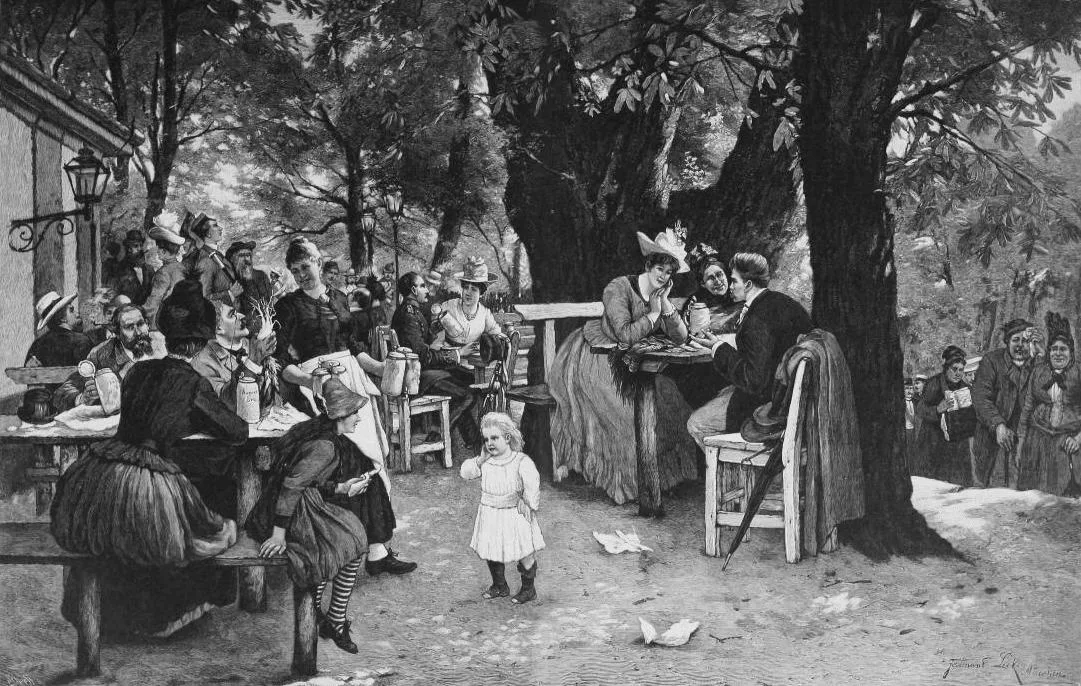
The beer garden began as a storage problem. Bavarian brewing rules of 1539 allowed beer to be brewed only between autumn and spring, because boiling in summer brought a risk of fire, according to the City of Munich's official Oktoberfest site. The State of Bavaria Office in Montreal gives the permitted season as September to April. To keep beer cool into the summer, brewers dug cellar vaults, especially in the hills around Munich. The Montreal office notes that these stone-covered storage rooms were not enough on their own to protect the beer from summer heat.
The city's account names the brewer Joseph Pschorr, husband of Maria-Theresia Hacker, as one of those who dug large underground cellars to keep beer cool through the summer. The cellars were typically cut into the high banks of the Isar, and brewers planted chestnut trees above them for shade. Chestnuts grew quickly and their shallow roots did not damage the vaults below. The cellar gardens that resulted were concentrated on the Schwanthalerhöhe, west of the Isar, and in Haidhausen and the Au on the east bank. The shaded gardens of present-day Munich descend from these brewery storage sites, according to the State of Bavaria Office in Montreal.
THE 1812 ORDINANCE AND THE RIGHT TO BRING FOOD
Once brewers had cool cellars with shade above them, they began selling beer directly from their summer storage. This led to a long dispute with neighbouring inns, which were losing customers to the cellars. In 1812 King Maximilian I Joseph of Bavaria settled the matter with what the City of Munich calls the Beer Garden Ordinance. It allowed Munich's brewers to sell beer at the place where it was made or stored, but it forbade them to sell food. Guests therefore brought their own snacks to the cellar gardens, and the arrangement has continued in Bavaria for more than two centuries.
The custom is known as the Brotzeitrecht, or right to snack, and its bicentenary was celebrated in 2012. Under it, guests may bring their own food to a beer garden as long as they buy their drinks there. The State of Bavaria Office in Montreal states that the custom began in Munich but is now found across Bavaria, and that Munich has 110 official beer gardens. Oktoberfest follows the same custom. Every large festival tent has its own beer garden, where seats cannot be reserved and visitors may bring their own snacks but not drinks of any kind, which must be bought from the host.
HOW DID THE HOFBRÄUHAUS BECOME A PUBLIC BEER HALL?

The Hofbräuhaus was founded on 27 September 1589 by Duke Wilhelm V of Bavaria to supply beer to his court, which had been buying costly beer from outside. Hofbräu München states that the first brewhouse was built at the Alter Hof from 1589 to 1591, and that brown beer and wheat beer were brewed there. In 1607 brewing moved to the site on the Platzl where the Hofbräuhaus stands today, and for almost three centuries it was a case of beer brewed where it is served. In 1828 King Ludwig I issued a decree allowing food and drink to be served to the general public, which began the building's life as a tavern.
In 1844 Ludwig I lowered the price of a Maß of Hofbräuhaus beer from 6½ kreuzer to 5 kreuzer, and in 1852 the Bavarian state took ownership, giving the house its official name, Staatliches Hofbräuhaus am Platzl. The brewery registered "HB" as a trademark in 1879 to counter imitators. Brewing on the Platzl ended on 22 May 1896, when production moved to Haidhausen, and later, in 1988, to Riem. Food and drink were served throughout the rebuilding. The new Schwemme opened on 9 February 1897, and the Neo-Renaissance building, designed by Max Littmann and described by the city as a beer palace, opened in September 1897.
INSIDE THE HOFBRÄUHAUS: LONG TABLES, THE MASS AND THE STAMMTISCH
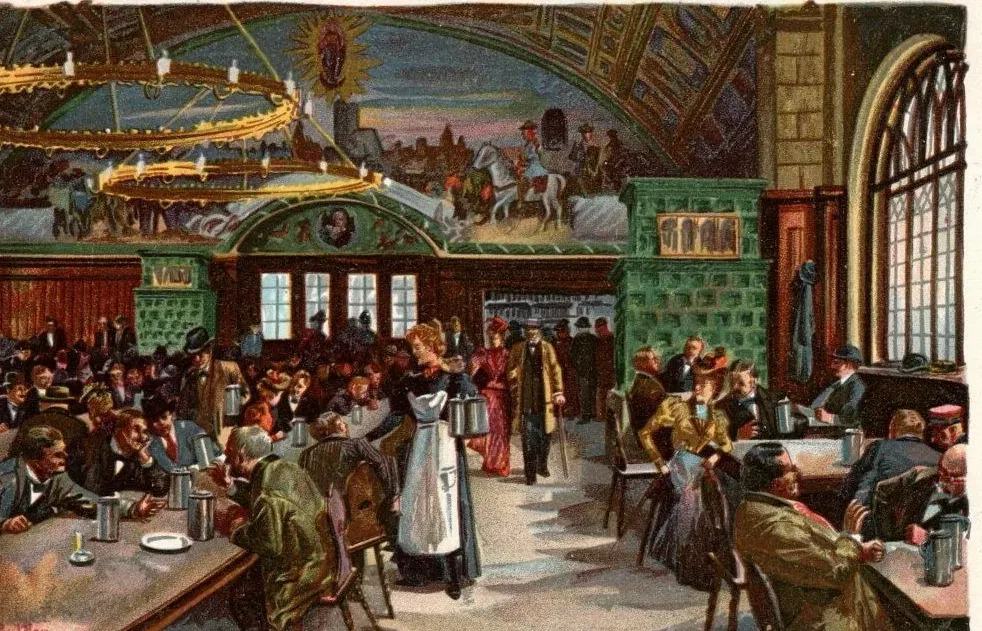
The Hofbräuhaus is organised as a series of halls of different sizes. The ground-floor Schwemme is the beer hall proper, with about 1,000 seats at long wooden tables. On the upper floors, the Festsaal has a vaulted ceiling nine metres high and room for about 1,500 people. The Wappensaal, Münchner Zimmer, Erkerzimmer and Bräustüberl add more than 1,000 further seats, and in summer the Wirtsgarten courtyard, with its Lion Fountain, serves as the house beer garden. Bands play in the Schwemme every day, and the City of Munich notes that the music pauses only on Good Friday and All Saints' Day.
The standard measure is the Maß, a litre of beer served in a stein known as a Maßkrug. In 1823 a beer penny was levied on every Maß sold to help pay for rebuilding the National Theatre. The Stammtisch, the regulars' table, is the beer hall's other fixed institution: more than 125 regular groups meet at the Hofbräuhaus, around 3,500 people in total. Regulars keep their personal litre steins in a mug vault of 616 compartments, which are reserved for them and cannot be bought. The best-known regular is fictional: the angel Aloisius from Ludwig Thoma's story of 1911.
HOW OKTOBERFEST TURNED BEER STALLS INTO BEER HALLS

Oktoberfest began with the marriage of Crown Prince Ludwig, the future Ludwig I, to Princess Therese of Saxe-Hildburghausen on 12 October 1810. The celebrations lasted five days and ended with a horse race on the meadows outside Munich, which were named the Theresienwiese in the bride's honour. Repeating the race the following year produced the first Oktoberfest, and in 1811 an agricultural fair was added. Britannica dates the first booths serving food and drink to 1818, the year a merry-go-round and two swings were also set up. The small beer booths multiplied quickly, and from 1896 innkeepers and breweries put up the first large beer tents, which in time formed a street of their own, the Wirtsbudenstraße.
By the late 20th century, Britannica notes, the booths had become large plywood beer halls with interior balconies and bandstands, and each Munich brewer erects one of these temporary halls, with seating for about 6,000 people. The Hofbräu festival tent, introduced in 1972, is 82 metres long and 62 metres wide, with space for about 10,000 visitors. On the opening day, at 12 noon, the Mayor of Munich taps the first barrel in the Schottenhamel tent and the cry "O'zapft is!" marks the start of the serving of beer. Since records began in 1980, the City of Munich has counted between 5 and 7 million visitors each year, and Britannica puts total beer consumption at more than 75,800 hectolitres.
GERMAN BEER HALLS AND BEER GARDENS IN 19TH-CENTURY NEW YORK
German immigrants who arrived in the United States in the 19th century brought brewing traditions with them, and many had experience of brewing on an industrial scale. Writing in Wine Enthusiast, Kara Newman notes that they introduced many Americans to lager and that beer gardens and beer halls developed in American cities from the 1840s to the 1870s, with music, games and other entertainment; many resembled amusement parks. Newman adds that beer halls and gardens of the late 1800s and early 1900s also served as community centres and as places where children were looked after.
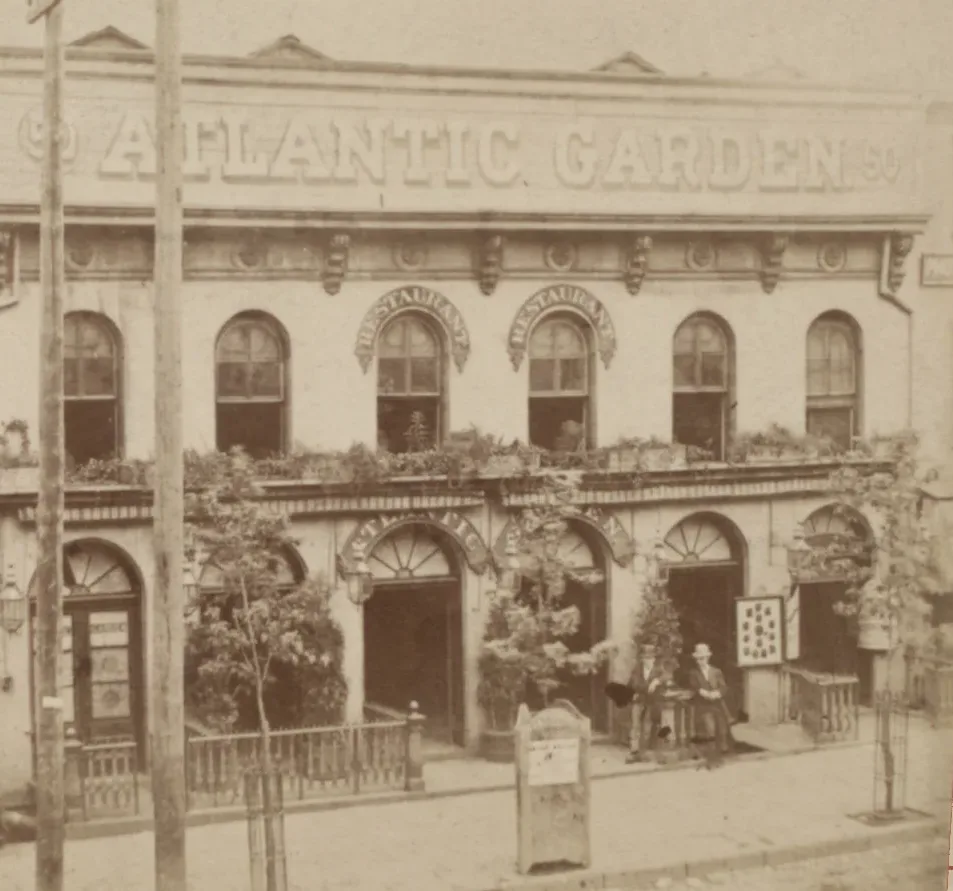
In New York, the Atlantic Garden was established on the Bowery in Manhattan by William Kramer in 1858. The Vault at Pfaff's, a Lehigh University archive of antebellum New York, records it as a massive beer garden for up to a thousand patrons. It served food and beer, staged musical and theatrical productions, and catered to German immigrants while remaining open to New Yorkers of all backgrounds. Wine Enthusiast describes it as the city's largest beer garden and lists a restaurant, several bars, a shooting gallery, billiard tables, bowling alleys and an orchestra. Newman notes that beer gardens of this kind were family friendly and encouraged families to stay, while saloons appealed mostly to working men.
THE BEER HALL REVIVAL TODAY
The Munich brewery has exported the beer hall format itself. Hofbräu München lists a Hofbräuhaus opened in Newport, Kentucky, in 2003 as a small brewery in the style of the original, and in the same year the first Hofbräuhaus in China opened in Jiangyin, in the Yangtze Delta. A replica opened in Las Vegas in 2004, and, according to the brewery, numerous other Hofbräuhäuser followed. In Germany, the first Hofbräu Wirtshaus opened in Hamburg in 2005, and the brewery states that numerous establishments in Germany and Austria followed.
In the United States, several older beer gardens still operate. Bohemian Hall and Beer Garden in Astoria, Queens, was founded in 1919 by the Bohemian Citizens' Benevolent Society and is still run by a Czech and Slovak community group. Wine Enthusiast also lists Mecklenburg Gardens in Cincinnati, founded in 1865, and Scholz Garten in Austin, Texas, opened in 1866, which the magazine describes as the oldest beer garden in America. Newman links the recent resurgence to craft breweries, farmers' markets and artisan food halls, and notes that new beer gardens often welcome children and pets and offer live music and lawn games.
BROADWAY AT EMIRATES PALACE, ABU DHABI

Broadway at Emirates Palace in Abu Dhabi is a brasserie and brewery bar, with interiors completed in 2023. Its concept is a 1920s New York theatre-district warehouse brewery, and its beer is brewed on site. The Hofbräuhaus on the Platzl brewed and served its beer on the same site from 1607 until brewing moved to Haidhausen in 1896, while New York's 19th-century German beer gardens, such as the Atlantic Garden on the Bowery, combined beer with music and theatrical productions for audiences of up to a thousand.
The design draws on New York in the 1920s. The brick walls are painted with faded 1920s advertising, known as ghost art, and the lettering combines a 1920s typeface with neon Broadway signage. The Cellar is a lounge with a brick vaulted ceiling and theatre ghost art. In Munich, the brewers' cellar gardens grew above vaulted storage rooms that brewers cut into the hills and the banks of the Isar to keep their beer cool through the summer, with chestnut trees planted above for shade.
SOURCES
- City of Munich (muenchen.de) From brewhouse to landmark: arguably the most famous tavern in the world
- Oktoberfest.de, City of Munich The beer gardens at the Wiesn and in Munich
- State of Bavaria Office in Montreal Der Biergarten
- City of Munich Press release 03/2023: A foray through the history of the Wiesn
- City of Munich (muenchen.de) Oktoberfest in Munich: program, tents, map and more
- Encyclopaedia Britannica Oktoberfest
- Hofbräuhaus München History
- Hofbräu München HB tradition
- Lehigh University, The Vault at Pfaff's Atlantic Garden
- Wine Enthusiast The history of America's beer gardens includes urban expansion and immigrant innovation