FROM SERVICE À LA FRANÇAISE AND KAISEKI TO NOUVELLE CUISINE, ELBULLI AND THE 50-COURSE MENU
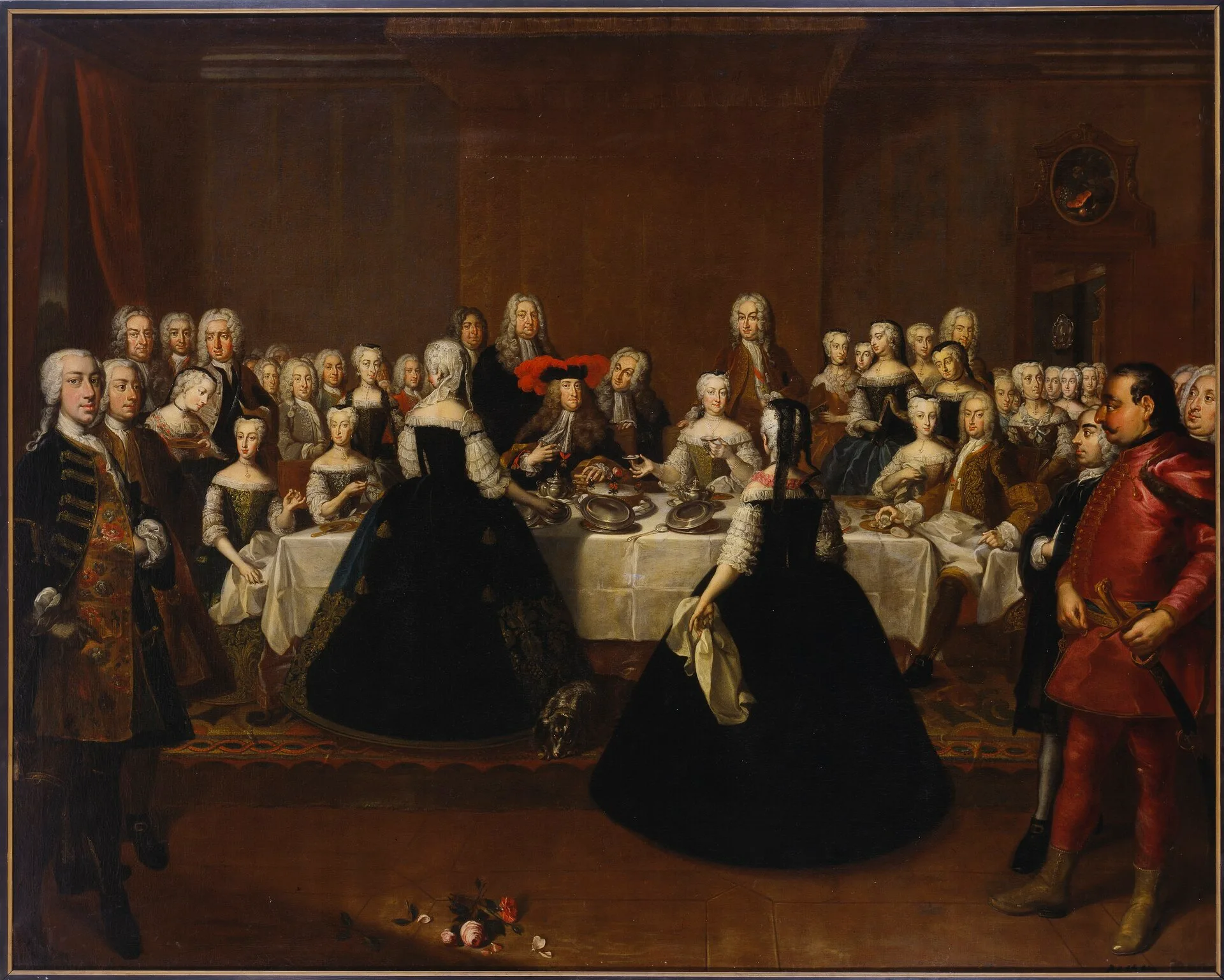
A tasting menu, or menu dégustation, is a meal whose original purpose, according to the SCMP's Post Magazine, is to give the diner a glimpse of a chef's skills, and the magazine traces the concept to French gastronomy. It rests on the 19th-century change from service à la française, with every dish of a course on the table at once, to service à la russe, with each course served in turn. Japan's kaiseki followed its own set sequence. Ferran Adrià's elBulli often served dinners of 47 courses, and Alchemist in Copenhagen now serves 50 courses over four to six hours.
WHAT WAS SERVICE À LA FRANÇAISE?
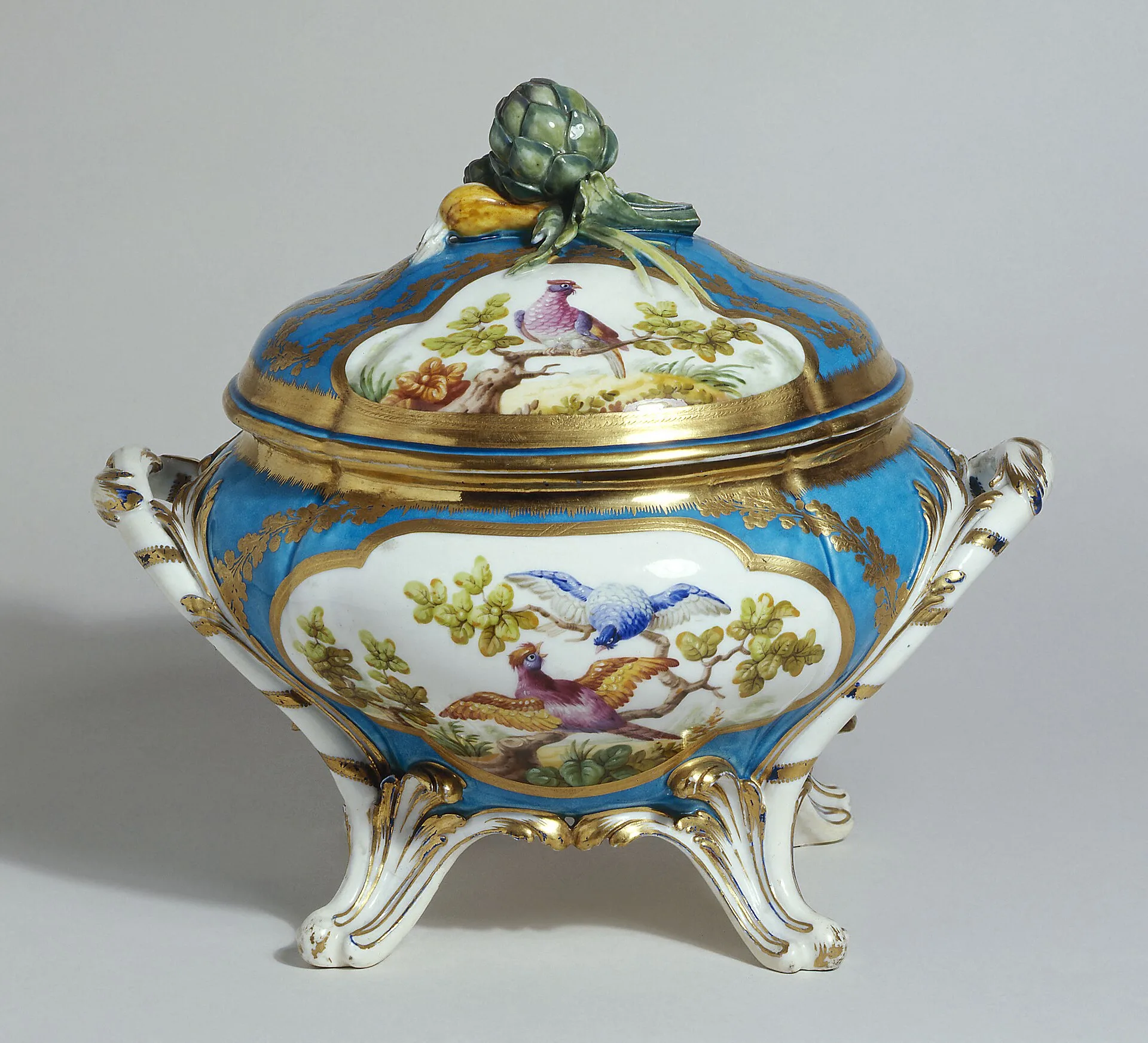
Before the multi-course meal was served one plate at a time, European formal dinners followed service à la française. The Metropolitan Museum of Art describes it as a custom codified in 17th-century France that remained the fashionable style across Europe until the early 19th century. The table held many serving dishes in a decorative arrangement, diners helped themselves from the dishes nearest them, and servants reset the whole table for each course. The first course usually included a soup or a stew, and its tureen was the most prominent piece on the table. Other dishes were grouped symmetrically around it. By the 1770s a large service frequently contained two round tureens, called pots à oille after the Spanish stew olla podrida, and two oval ones, called terrines.
Carnegie Museums of Pittsburgh credits the court of Louis XIV at Versailles with setting the formal dining customs of 18th-century Europe through this style. At each course every dish was placed on the table at once in a set position. French feasts attended by the king might run to eight courses including dessert, while the most formal English dinners had three. In The Experienced English Housekeeper of 1769, Elizabeth Raffald set out a bill of fare of 25 dishes to each course, with a dessert of the same number, and in 1767 the York Courant reported that Sir William Lowther offered 180 dishes at Flatt Hall. Servants passed bread, oil and vinegar, but serving food to diners was considered extremely bad form.
HOW SERVICE À LA RUSSE CREATED THE SEQUENCE OF COURSES
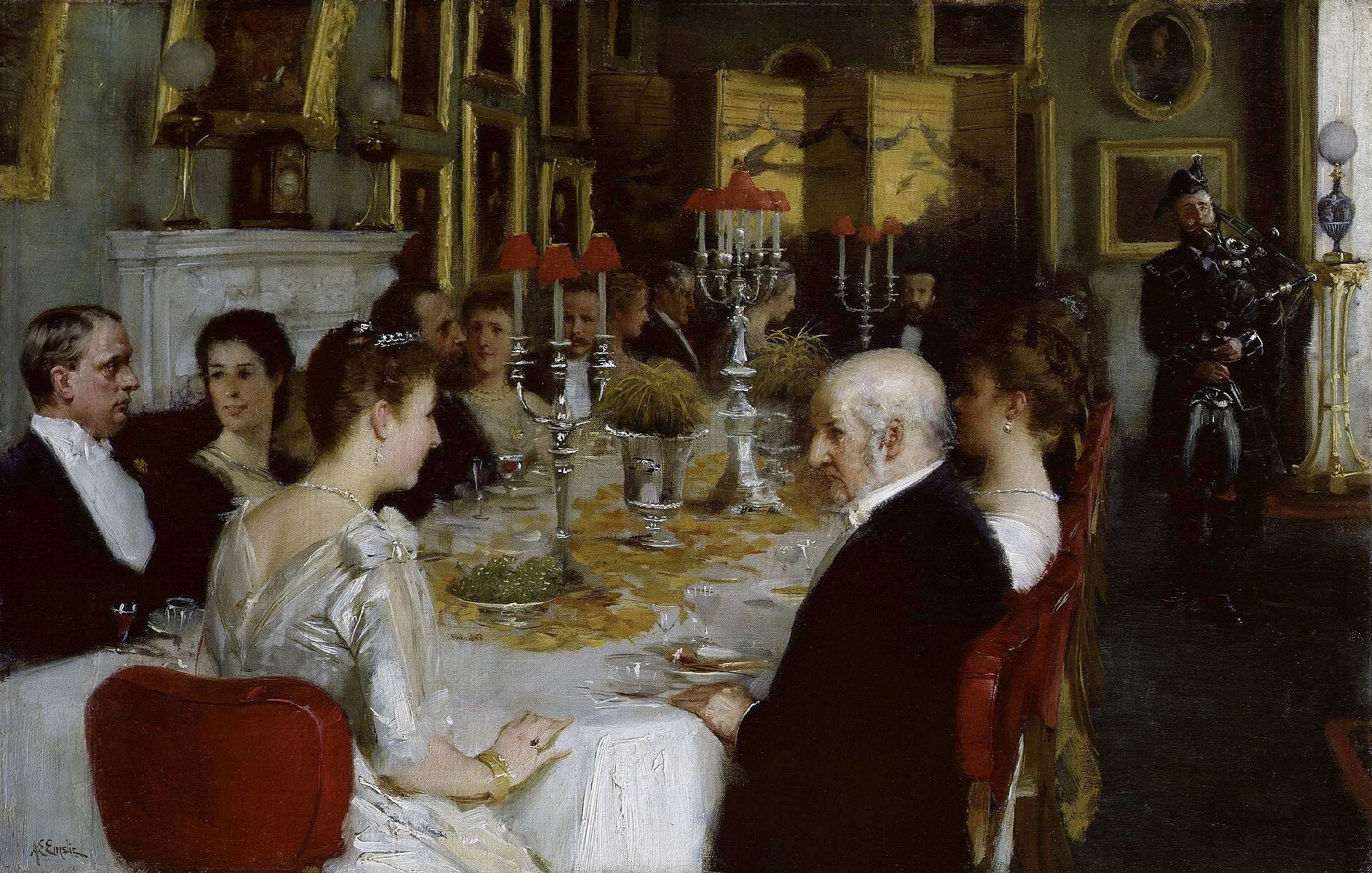
The Met records that service à la russe replaced service à la française in the early 19th century. The Victoria and Albert Museum dates its adoption by Victorian society to the 1860s. Under the new method each course was served individually to guests by servants, rather than food being set out in dishes from which diners helped themselves. The V&A notes that the change altered the look of the table: silver entrée dishes and ceramic tureens gave way to floral displays in glass vases and ceramic fruit stands.
The place setting took on greater importance and occupied more of the table. The V&A cites The Habits of Good Society, a guide of about 1859, which describes a setting of two large knives, a silver fork and a fish fork, a tablespoon for soup, three large forks, and a glass each for sherry, hock and champagne. The museum also notes that the 1892 catalogue of the cutlers James Dixon & Sons listed 28 cutlery designs. Its own example is a silver King's pattern tablespoon made by Charles Boyton in London in 1893 to 1894.
ESCOFFIER AND THE PLATED COURSE
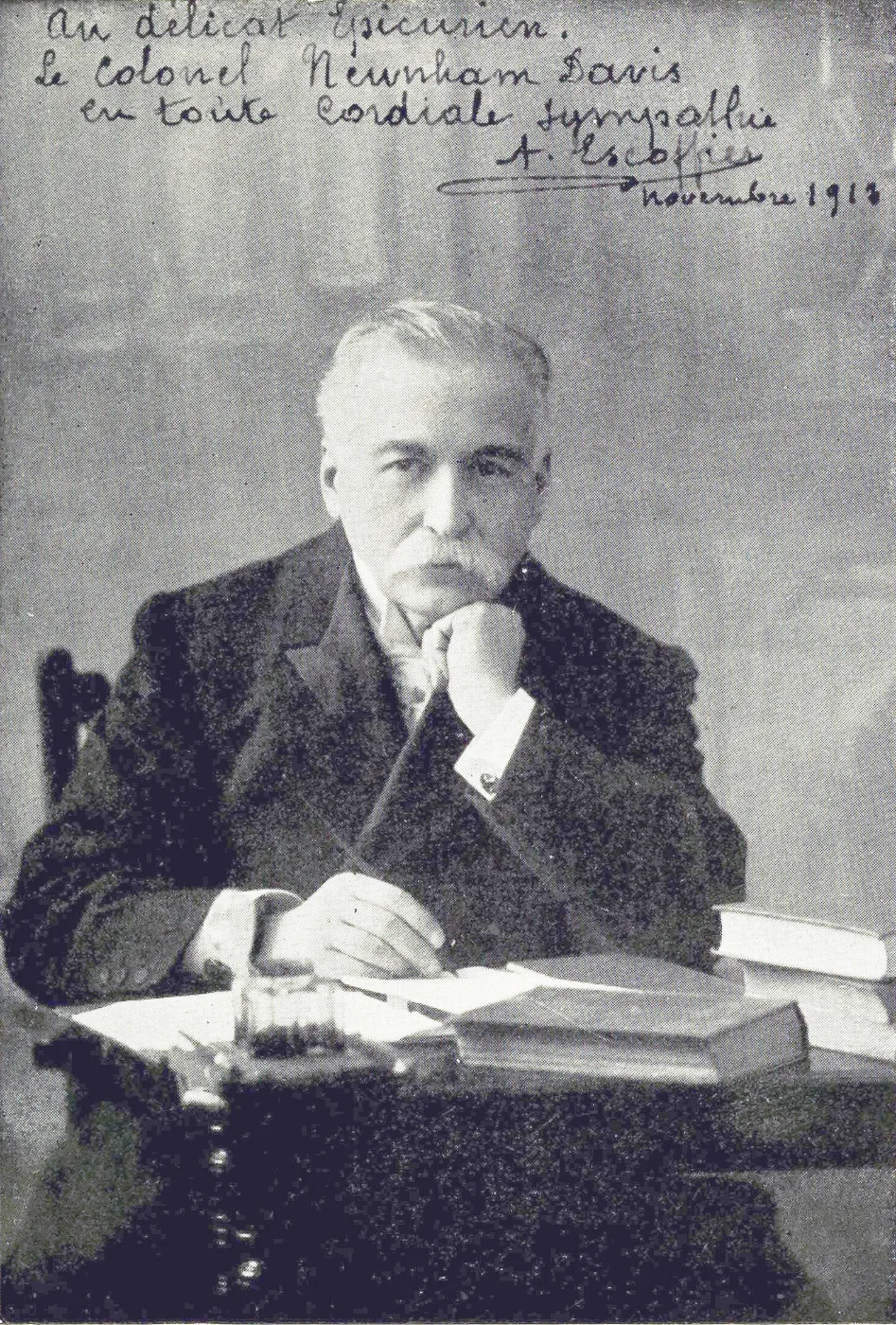
Auguste Escoffier was born on 28 October 1846 at Villeneuve-Loubet in France. Britannica, which calls him "the king of chefs and the chef of kings", records that he directed the kitchens of the Savoy Hotel in London from 1890 to 1898 and then those of the Carlton Hotel in London. His published works include Le Guide culinaire, Le Livre des menus and Ma Cuisine, and he died in Monte Carlo, Monaco, on 12 February 1935, aged 88. The Wellcome Collection holds a second edition of Le Guide culinaire, subtitled aide-mémoire de cuisine pratique, published in Paris by Colin in 1907 and written with the collaboration of Philéas Gilbert and Émile Fétu.
In Escoffier's dining rooms, according to Britannica, empty plates were set before each diner, and waiters then served and carved food at the table. Under nouvelle cuisine, which Britannica dates to France in the 1960s and 1970s, dishes were instead plated in the kitchen by chefs, and the waiter simply set the prepared plate down in front of each diner. Nouvelle cuisine also discarded outright some long-held traditions of Escoffier's grande cuisine, such as sauces made with meat extracts and thickened with a flour-based roux. Britannica notes that the ten principles championed by Gault and Millau all concerned technical aspects of cooking.
KAISEKI: JAPAN'S SEASONAL MULTI-COURSE MEAL
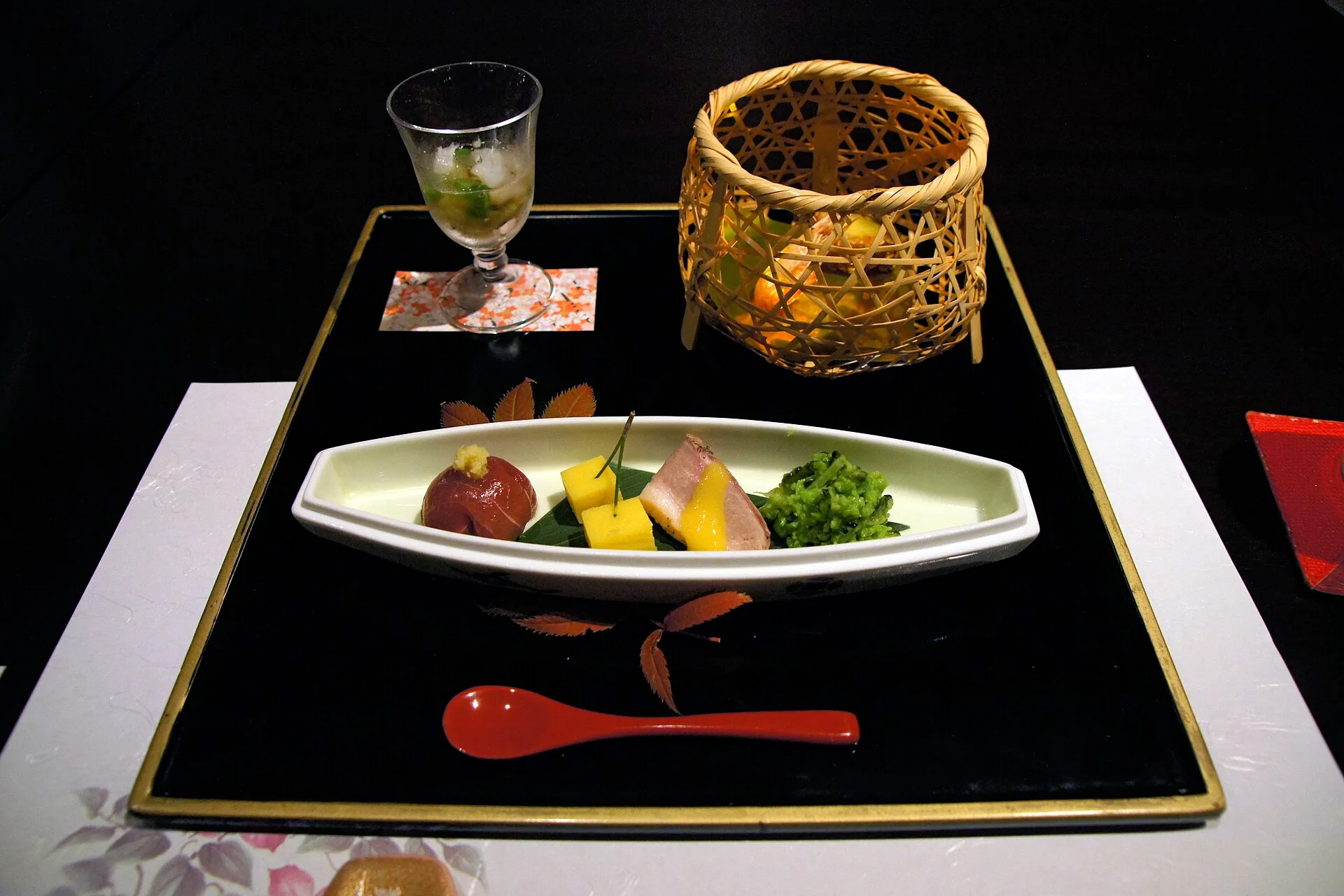
Japan developed its own fixed sequence of courses. The MICHELIN Guide explains that the word kaiseki is written in two ways. The first, 懐石, comes from chakaiseki, the meal of the formal tea ceremony practised from the 16th century: a simple multi-course meal served before matcha. Kaiseki literally means stones in the bosom, which the guide explains as a reference to stones that monks folded into their robes, close to their bellies, to keep hunger at bay. The second, 会席, combines the characters for a gathering and for seating. It describes a more elaborate meal accompanied by sake and ending with a simple tea service. In chakaiseki the chef may hand a shared platter to each guest in turn, while the sake-led form gives each guest an individual plate.
A kaiseki meal traditionally runs to nine courses, although versions range from six to 15. The MICHELIN Guide lists the usual order as sakizuke, a first course that is usually pickled; hassun, the seasonal course served on wooden platters about eight inches across; suimono, a dashi soup; tsukuri, or sashimi; yakimono, a grilled dish; takiawase, simmered vegetables usually with some meat; shokuji, rice with miso soup and pickles; and mizugashi or mizumono, sweets or fruit. In traditional chakaiseki the hassun carried two elements representing the mountains and the sea, while modern versions often have four to six items.
WHERE DID THE TASTING MENU COME FROM? FRANCE, JAPAN AND NOUVELLE CUISINE
The SCMP's Post Magazine reports suggestions that the degustation has links to the royal courts of France, and cites a sample menu of 1662 that lists three services of no fewer than 15 separate dishes. In a public lecture abstract published by the University of Hawaiʻi at Mānoa Library, the Pomona College historian Samuel H. Yamashita records that Japanese chefs began to appear in the kitchens of nouvelle cuisine chefs in France for further training in the 1970s, and that Paul Bocuse, Alain Chapel and Joël Robuchon visited Japan to teach and sample its cuisine, some of them opening restaurants there. He describes a "Japanese turn" in American fine dining from 1980 to 2017, when chefs in Los Angeles, New York and the Bay Area adopted the Japanese tasting-menu format along with Japanese ingredients and techniques.
The spread of nouvelle cuisine through French fine dining was measured in a study by the Northwestern University sociologist Hayagreeva Rao and colleagues, published in 2003, which followed about 600 French chefs holding one or more Michelin stars from 1970 to 1997. In 1970, 36 per cent of the chefs had one nouvelle cuisine signature dish and 48 per cent had none. By 1997 only 6 per cent had none, and 70 per cent were predominantly nouvelle cuisine. The authors concluded that nouvelle cuisine was a social movement rather than a passing culinary trend.
ELBULLI AND THE TASTING MENU OF 40 COURSES AND MORE

elBulli stood in an isolated seaside cove at Roses, on the far north-eastern tip of Spain. The World, the public radio programme, reported in 2011 that the restaurant held three Michelin stars, seated 50, opened only for dinner and only for six months of the year, and received more than a million reservation requests a year. Ferran Adrià had run its kitchen for 24 years and often served dinners of 47 courses, with dishes sprayed, syringed or painted onto the plate. Dishes included a foam mojito served with popcorn that had been powdered and reconstituted as kernels, and a tempura of rose petals. The average bill was $388 a head, excluding drinks, tax and tips.
elBulli served its last dinner in 2011, a party for loyal clients and the families of staff at which guests chose from a list of 50 dishes, including clam meringue, olive spheres and a hot and cold gin fizz. Adrià planned to reopen the site in 2014 as a culinary foundation that would act as a food laboratory and post new recipes online every day. The World reported that four of the world's top five chefs had trained at elBulli, among them René Redzepi of Denmark and Grant Achatz of Chicago. Former elBulli staff opened Disfrutar in Barcelona in 2015, and the SCMP's Post Magazine describes it as known for tasting menus of at least 19 courses.
Alchemist in Copenhagen serves a meal of 50 courses that normally lasts four to six hours, according to the same magazine. Its chef, Rasmus Munk, told the SCMP that his guests expect a lengthy menu, that being overwhelmed is built into the restaurant's "50 impression" concept, and that the sensory overload this can cause is part of the idea. Pete Wells, writing as restaurant critic of The New York Times more than a decade before the SCMP article, held that a tasting menu can bring a succession of delights that no shorter meal could contain, but that the diner may at other times "feel as much like a victim as a guest". The SCMP adds palate fatigue and the lukewarm temperatures of such meals to the complaints.
OPUS AT MANDARIN ORIENTAL SHENZHEN

Opus is a restaurant at Mandarin Oriental Shenzhen, completed by Silverfox Studios in 2022. Its dining room combines geometric metal and lattice screens with red leather banquettes, blue chairs, brass panelling and globe pendants, and it has city views. The room also has glass wine cabinets. Under service à la russe, the V&A notes, the individual place setting took on greater importance, and the setting described in The Habits of Good Society of about 1859 gave sherry, hock and champagne a glass each.
Opus also has a chef's table counter with a stainless hood. The place where a dish is finished moved in stages. Under service à la française, servants set every dish of a course on the table at once. Under service à la russe, they brought each course to each guest in turn. In Escoffier's dining rooms, waiters still carved and served food at the table. Under nouvelle cuisine, the chef assembled each plate in the kitchen, and the waiter only set it down in front of the diner.
SOURCES
- The Metropolitan Museum of Art Stand, Sèvres Manufactory, ca. 1777 to 1785
- Carnegie Museums of Pittsburgh At Table: High Style in the 18th Century
- Victoria and Albert Museum Tablespoon, Charles Boyton, London, 1893 to 1894
- Britannica Auguste Escoffier
- Wellcome Collection Le Guide culinaire, aide-mémoire de cuisine pratique, second edition, 1907
- MICHELIN Guide Kaiseki 懐石 or kaiseki 会席?
- Britannica Nouvelle cuisine: Impact
- University of Hawaiʻi at Mānoa Library Samuel H. Yamashita, The Japanese Turn in Fine Dining in the United States, 1980 to 2017: Abstract
- The World (PRI) World's most famous restaurant closes
- South China Morning Post Are tasting menus worth it?