HOW A CANTONESE HABIT OF TEA WITH SMALL DISHES BECAME ONE OF CHINA'S BEST-KNOWN WAYS TO EAT

Dim sum and yum cha describe two parts of one meal. Dim sum is the food: a broad range of small steamed and fried dishes of probable Cantonese origin. Yum cha, which literally means 'drink tea', is the occasion: going out to drink tea and share those dishes, traditionally at breakfast or lunch. The modern custom grew out of the teahouses of Guangzhou, where the city's first large teahouse opened during the reign of the Guangxu Emperor, which began in 1875, and it reached Hong Kong through businesses such as Lin Heung, which opened three Hong Kong branches in 1918. Britannica records dim sum in the Chinatowns of New York and San Francisco by the 1920s. In May 2026 the custom also gained legal standing, when Guangzhou brought into force regulations dedicated to protecting and passing on the city's morning tea culture.
WHAT DIM SUM AND YUM CHA MEAN
Britannica defines dim sum as a collective term for a broad assortment of small dishes of probable Cantonese origin, and gives the Mandarin form of the word as dianxin. It divides the range into steamed and fried dishes, each with dozens of varieties. Steamed dumplings and buns are traditionally served in bamboo baskets, fried items include the spring roll, and small side dishes include pork spareribs and chicken feet. The Hong Kong Tourism Board puts the number of dim sum dishes at more than 1,000. The idea is older than the restaurant meal: the Michelin Guide traces dim sum to Tang dynasty China and notes that the Qing writer Zhangsi Gu described it simply as a snack.
Yum cha refers to the whole outing rather than the food: sitting down with tea and ordering a series of small dishes to share. Britannica describes the brunch in Guangzhou as a high point of the week, with dim sum served to diners in no hurry, and notes that the custom spread from the city to Hong Kong and to Chinese communities in and outside China. Guangzhou's municipal government records that major teahouses serve morning, afternoon and evening tea, and that morning tea, typically from 4am to 11am, is the most popular. Xu Jinhui, executive chef of the China Hotel in Guangzhou, who has worked in the trade for more than 30 years, gives the traditional sequence of a meal as tea first, then steamed items, then fried dishes and finally sweets.
WHERE YUM CHA CAME FROM: THE TEAHOUSES OF GUANGZHOU
Guangzhou's municipal government describes the city as the centre of China's tea trade, with tea its favourite drink for centuries. Before the Qing dynasty, it says, the city's teahouses were mostly low buildings with modest equipment and a limited range of services. That changed during the reign of the Guangxu Emperor, when the Sanyuan building opened in the Shisanhang, the 'thirteen firms' district that was then the city's business centre, as Guangzhou's first teahouse of real standing. It was a richly furnished three-storey building nicknamed the High Teahouse, and locals began to describe going for morning tea as going to the High Teahouse.
Other teahouses followed, among them the Taotao, Luyu, Tianran, Yixiang and Furu. Tao Tao Ju was founded in 1880, the sixth year of the Guangxu reign, by the businessman Huang Chengbo near today's Dishifu Road in Liwan district, and was first named Pu Tao Ju after his wife. It closed after his death, reopened in 1927 under the teahouse entrepreneur Tan Jienan, and took its present name from a signboard a new shareholder bought from another teahouse. In the late Qing and early Republican period it was known for tea brewed with mountain spring water in Yixing teapots, and China's Ministry of Commerce named it a time-honoured brand in 2006. The regulations that took effect in Guangzhou on 1 May 2026, which China Daily describes as the country's first legislation dedicated specifically to yum cha, set standards for traditional on-site preparation, require disclosure of production methods and set a 24-hour window for freshly made dim sum.
HOW YUM CHA MOVED TO HONG KONG
Lin Heung shows the link between the two cities. The SCMP reports that the business began as the Guangzhou Cake Shop, opened in Guangdong in 1889, and that three branches opened around Hong Kong in 1918. The last of them, on Wellington Street in Central, moved there in 1996 from Queen's Road Central. The SCMP describes a crowded, noisy room in which dim sum trolleys rolled between tightly packed tables, and a menu that kept dishes becoming rare in newer restaurants, such as pork liver siu mai, steamed sausage rolls and beef balls wrapped in caul fat.
The Michelin Guide credits Lin Heung and Luk Yu with making Cantonese dim sum a symbol of local dining culture, each serving a different stratum of society. Lin Heung was known for street favourites such as pork liver siu mai and dai bao, the large steamed bun, while Luk Yu served more refined dishes, including fried Chiu Chow dumplings with broth and steamed pork ribs in Chu Hou bean paste. Later restaurants changed the format. Tim Ho Wan, founded by Mak Kwai-pui, built a business on quick service and low prices for dim sum of hotel standard, and expanded overseas.
THE CLASSIC DIM SUM DISHES: HAR GOW, SIU MAI AND CHAR SIU BAO

Har gow, the steamed shrimp dumpling, is the dish the Michelin Guide calls the best-known dim sum internationally. Standards for its pleated wrapper vary by source: the Hong Kong Tourism Board specifies at least seven pleats, the Michelin Guide says a good har gow looks like a half moon with 12 or 13 folds, and China Daily's 2026 report from Guangzhou gives 13 as the classic number. Chef Lai-Yin Wong of Cuisine Cuisine at The Mira explains that the water starch in the dough makes it sticky and hard to cut with a mould, so skilled cooks flatten each skin with a single strike of a cleaver. The Michelin Guide gives the ideal filling as 30 per cent raw shrimp and 20 per cent cooked shrimp, with fatty pork. Wong and Lee Man Sing of Mott 32 both estimate that mastering har gow and siu mai takes one to two years.
Siu mai is a steamed dumpling with a cup-shaped wrapper around a filling of pork, shrimp and vegetables; the Hong Kong Tourism Board describes its yellow skin and a topping of fish roe or diced carrot. Char siu bao, the barbecued pork bun, comes steamed, with a soft, fluffy dough, or baked as char siu so, with a crunchy exterior. Other staples include cheung fun, steamed rice noodle rolls filled with shrimp, barbecued pork or beef and served with sweet soy sauce, and lo mai gai, sticky rice with chicken, mushrooms and Chinese sausage steamed in a lotus leaf. The tourism board also lists the egg tart, or dan taat, a custard tart with a shortcrust or puff pastry base, and notes that Hong Kong serves both the traditional Cantonese version and a caramelised Portuguese-style tart inspired by Macao.
FROM TRAYS AND TROLLEYS TO ORDER SHEETS

The way dim sum reaches the table has changed several times. Choi Sai-kwai, who opened Hoi Lin Restaurant on the outskirts of Kowloon Walled City in 1959, told the SCMP's Young Post that staff originally carried one or two bamboo steamers at a time, which was heavy work. Restaurants then introduced trays with straps worn over the shoulders so that waiters could carry more. The trolley came last: it eased the waiters' work and let customers see the food before choosing. Britannica notes that the speed of this kind of service made dim sum well suited to people with only a short break for a meal. The older system ran at volume. Lai-Yin Wong has recalled dim sum restaurants producing 600 plates of pork ribs from 30 large steamers in a single morning.
Trolleys are now rare. Young Post reports that they are hard to repair and that modern restaurants prefer ordering by QR code. Hoi Lin, which moved to Fuk Loi Estate in 1992, still makes its dim sum by hand, starting at 2am each day, and one long-standing customer told the paper that ticking dishes on an order form removes the personal contact that trolley service provided. Britannica lists rolling trolleys, conveyor belts and printed cards on which diners tick their choices as the formats now in use.
YUM CHA ETIQUETTE: ONE BOWL, TWO PIECES AND THE FINGER TAP
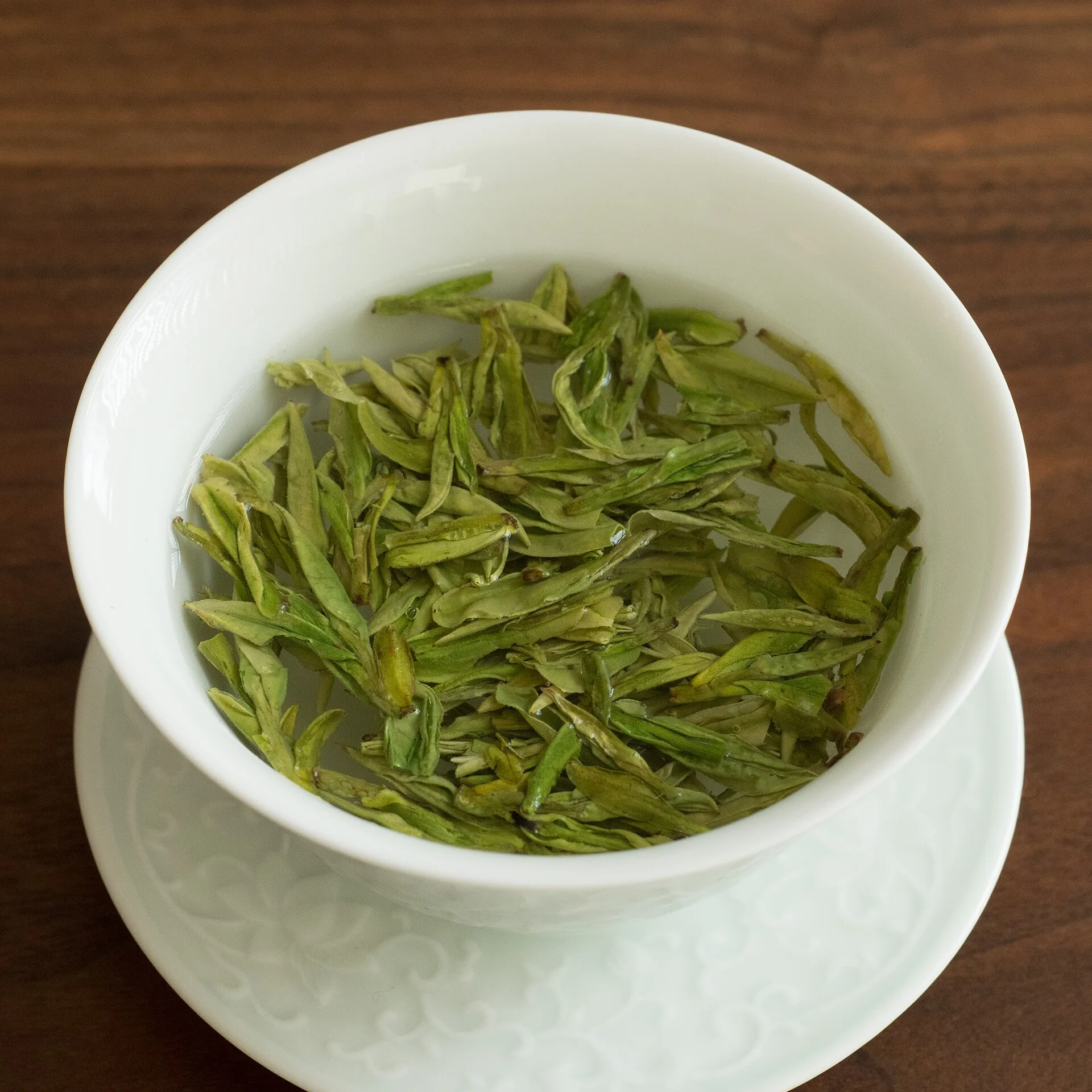
The Cantonese phrase 一盅兩件, one bowl and two pieces, describes the basic yum cha order. China's Ministry of Culture and Tourism defines it as a bowl of tea served with two portions of dim sum, the minimal standard from which morning tea began, and notes that tea has since taken a secondary role as the range of dim sum has grown. China Daily uses the same formula when it describes Guangzhou's morning meal as one pot of tea and two dim sum dishes. At Lin Heung, the SCMP reported, tea was served in gai wan, small handleless lidded cups that take some skill to pour from and drink, refilled from large steel teapots. The ministry lists the finger-tapping gesture and the protocol for refilling water among the customs visitors can learn.
The finger tap is a silent thank you to whoever pours the tea: the diner taps the table lightly with the index and middle fingers. The usual explanation is a story about the Qianlong Emperor of the Qing dynasty travelling incognito among commoners, which China Daily presents as a story rather than history. In the version published by Beijing's official tourism website, the emperor visits a teahouse in Xiguan, Guangzhou, during a southern tour, and copies the waiter by pouring tea for his servant. Court rules required the servant to kneel and touch his forehead to the ground, which would have revealed the emperor's identity, so he bent his index and middle fingers and tapped the table beside the cup instead. The same page says the gesture was first made with the knuckles of a loosely closed fist before it became a tap of the fingertips.
DIM SUM IN AN OPEN KITCHEN AT BAZAAR, MANDARIN ORIENTAL SHENZHEN

Bazaar is a restaurant at Mandarin Oriental Shenzhen, designed by Silverfox Studios and completed in 2022, with open kitchen stations, a bakery and a bar lounge. Dim sum is made at an open preparation station, where bamboo steamers sit under a cylindrical stainless steel hood. Bamboo steamers were carried on the strapped trays of Hong Kong waiters and on the trolleys that replaced them, and steamed dishes are traditionally served in bamboo baskets. Steaming is the method behind most of the classic dishes, including har gow, siu mai and the steamed version of char siu bao.
The rest of the restaurant is built around timber post-and-beam structures and a slatted timber ceiling. A raw bar and grill seating sit beside the open kitchen under a steel frame with large gear-wheel forms, and the dining room is furnished with rattan armchairs and has views across the city.
SOURCES
- Britannica Dim sum
- Guangzhou Municipal Government Enjoying Morning Tea
- China Daily, via Baiyun District Government Yum cha: Greeting the day the Guangdong way
- Huacheng, Guangzhou Daily Time-honored restaurants to enjoy dim sum in GZ (I): Tao Tao Ju
- Ministry of Culture and Tourism of China, Travel China Yum Cha: 'One Bowl with Two Pieces' and the Art of Lingnan Slow Living
- South China Morning Post Hong Kong dim sum parlour Lin Heung Tea House closes after 104 years
- Young Post, South China Morning Post Hong Kong's Hoi Lin Restaurant serves handmade dim sum since 1959
- MICHELIN Guide The Evolution of Hong Kong's Yum Cha Culture
- Hong Kong Tourism Board 6 Must-Order Dim Sum for Beginners
- Visit Beijing, official tourism website of Beijing Cantonese Legend of Knocking to Express Thanks When Drinking Tea