FROM COAL SHOPS AND WINE COUNTERS TO BISTRONOMIE

The bistro meaning most dictionaries give today is a small, moderately priced restaurant, but the French word began with a person rather than a place. In the 19th century a bistro was the man who kept a wine shop or cabaret, and only later the room where he served. The Paris bistro grew out of the city's 19th century wine merchants and the coal and drinks shops run by migrants from the Auvergne, who added simple food to widen their custom. Its fixtures became a recognisable set, from the counter known as the zinc to the tables and chairs that French dictionaries still call de bistrot. A century later, professionally trained chefs including Yves Camdeborde used the same format for more ambitious cooking at moderate prices, and a new word, bistronomie, followed.
WHAT IS THE BISTRO MEANING IN FRENCH?
The Dictionnaire de l'Académie française, in its ninth edition, lists the word as bistro but recommends the spelling bistrot, and marks it as popular usage. It gives two senses. The first, now dated, is the owner or manager of a drinking establishment, café or cabaret. The second is the establishment itself: a place to drink, an estaminet, or a small popular restaurant. The Académie also records the phrases table de bistrot and chaise de bistrot for furniture typical of these places in the early 20th century, and the adjective in style bistrot. The Ville de Paris notes the same order of meanings: the word first named the proprietor, with bistrote for a woman, and only then the premises.
The word is recent. The Ville de Paris dates its first known written appearance to 1884, in the abbé Moreau's Souvenirs de la Roquette, which glosses it as marchand de vin, a wine merchant. The Académie dates the word to the 19th century and suggests two possible sources, the Poitevin dialect word bistraud, a little servant, or bistrouille, while calling the origin uncertain. Writing in Saveur in 2010, Beth Kracklauer describes bistrouille as a northern French term for a mixture of coffee and eau-de-vie and treats it as the more credible etymology. In English, Merriam-Webster dates its first known use in the restaurant sense to 1919, defining a bistro as a small or unpretentious restaurant, and also as a small bar or tavern.
BISTRO MEANING AND ORIGIN: THE COSSACK LEGEND AND OTHER STORIES
The best known explanation for the word is a story about Russian soldiers. The Fondation Napoléon, in the period glossary on its website, gives two versions. In the first, set in 1812, French hussars in Russian roadside taverns heard Cossack drinkers calling out bistra, Russian for "quick", as they hurried to finish their drinks, and brought the word home, where it became bistro and then bistrot. In the second, set in Paris in March 1814, Cossacks impatient to be served in Parisian bars shouted the same word at the staff. Saveur's account places the cry of "Bystro! Bystro!" in Paris in 1815 and presents it as a popular legend.
Dictionaries do not support it. The Ville de Paris calls the Cossack etymology fanciful, and its own dating explains why: the first written use of bistro is from 1884, seven decades after Russian troops were in the city, and that first use meant a wine merchant rather than a place for fast service. Montmartre has a competing claim. According to the Ville de Paris, local tradition holds that the word was born at La Mère Catherine on the place du Tertre, a restaurant founded in 1793, a story the city also describes as fanciful. Both the Académie française and the Ville de Paris treat the true origin of the word as uncertain.
HOW AUVERGNATS AND THE CAFÉS-CHARBONS SHAPED THE PARIS BISTRO

The bistro's growth followed the growth of Paris. Saveur notes that between 1800 and 1900 the city's population rose from about 500,000 to 2.5 million, as railways made the journey from remote regions easier and a late industrial revolution concentrated work in the capital. Many of the new Parisians lived without kitchens, and the bistro became the place where they ate home-style food. According to the Ville de Paris, migrants from the Auvergne, known as bougnats, left the poor land of the Massif Central during the Industrial Revolution. They worked first as water carriers and rag pickers, then moved into trading wood, scrap metal, coal delivered to homes, and drinks.
The shops that combined coal with drink were called cafés-charbons. To widen their custom, the Ville de Paris records, their owners gradually began offering light food. Saveur describes the Auvergnats, many of them coal deliverers, as widely credited with launching the bistro by adding cheap, hearty dishes such as stews to their coal shops, and notes that migrants from the Périgord and Lyon opened bistros serving the dishes of their own regions. The first owners were not trained cooks. They served plats ménagers, housewife's dishes learned at home, and many bistros were family businesses in which recipes were refined over generations.
BISTRO VS BRASSERIE VS RESTAURANT: WHAT IS THE DIFFERENCE?
The Ville de Paris distinguishes the bistro from both the restaurant and the brasserie. A bistro is open at any hour, serves drinks and quick food that can be eaten at the bar, and offers small typical dishes. The brasserie came from a different migration and a different drink. Saveur notes that Alsatians who moved to Paris after the Franco-Prussian War of 1870 to 1871 opened brasseries, where beer was the main drink, a history set out in what is a brasserie. The bistro, whose first recorded meaning was a wine merchant, was built around wine.
The bistro also sits above the bar-tabac, which in Saveur's description serves wine or coffee but whose menu usually stops at sandwiches and croissants. At the other end of the scale, some bistros became destinations. Saveur names Aux Lyonnais, opened in 1890, L'Ami Louis, from the 1920s, Allard, opened in 1931, and Chez Georges, opened in 1964, as bistros that drew customers from well beyond their neighbourhoods. The MICHELIN Guide lists Benoit, at 20 rue Saint-Martin in the 4th arrondissement, as a genuine Parisian bistro that keeps its period Belle Époque interior. Its listing describes woodwork, copper pots, mirrors and velvet banquettes, with the letter B monogrammed on everything down to the plates.
THE ZINC, THE BISTRO CHAIR AND THE ARDOISE
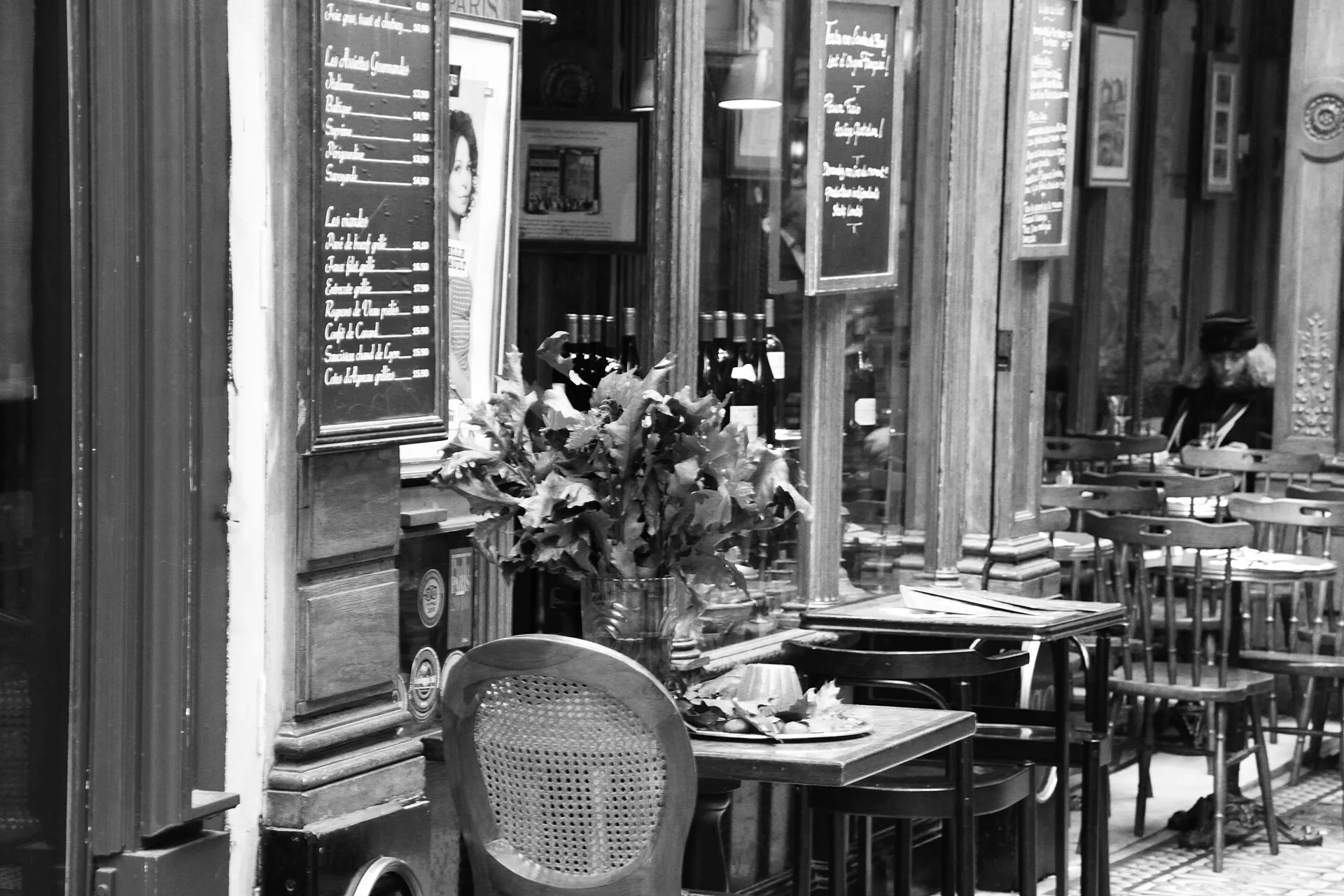
Every bistro has a counter, and in Paris it is usually called the zinc. Saveur notes that bistros themselves are often referred to as a comptoir or a zinc, after the counter or bar that is a fixture in them, and that a few still have zinc surfaces. The Ville de Paris goes further and states that the counter was never actually made of zinc but of tin, or simply of wood, sometimes covered in formica. In 1930 Marcel Nectoux opened a workshop making bistro counters on the rue de Charonne in Paris, and the Ville de Paris reports that the skill has passed through three generations of the family.
The chair the Ville de Paris singles out in its feature on bistros is the bentwood No. 14, designed by the German-Austrian cabinetmaker and industrialist Michael Thonet. The Ville de Paris notes that it has been made for more than 160 years, that it was designed as a kit of six parts, two nuts and ten screws, and that more than 50 million originals are said to have been sold, not counting copies. The third fixture is the ardoise. Larousse defines the word first as slate, then as a board of slate or another material on which writing can easily be wiped away, and in familiar French as a running account of goods or drinks taken on credit at a shop or café.
WHAT DOES A BISTRO SERVE? CLASSIC BISTRO DISHES
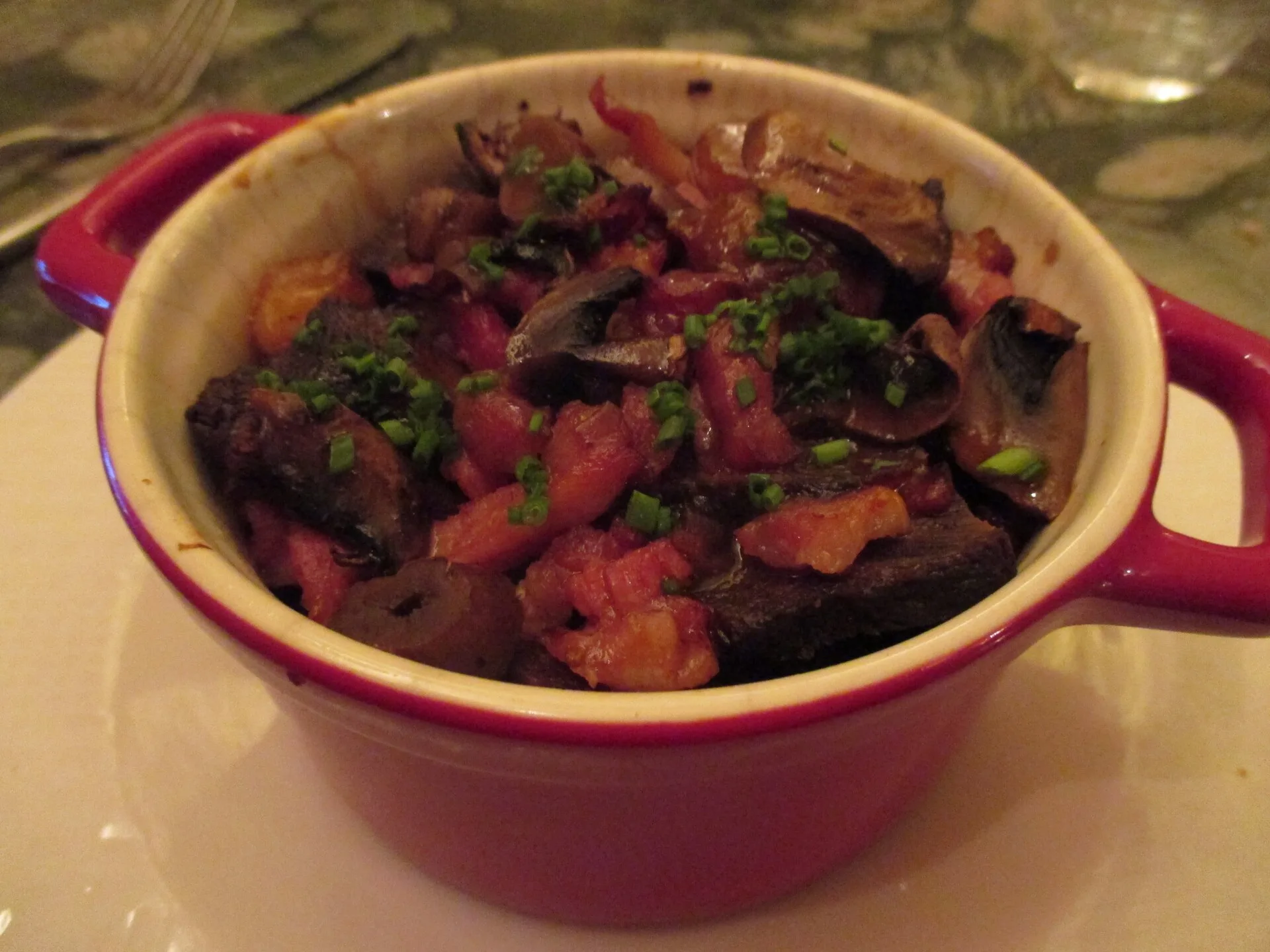
Bistro cooking was built on cheap ingredients made tender. Saveur describes braising as central to the bistro kitchen because it softened cheap cuts of meat, and offal as a way of adding flavour at little cost. Its examples of regional dishes brought to Paris include a Provençal daube and a Lyonnais queue de boeuf mijotée, a slow-cooked oxtail stew, while roast chicken and lamb became standard. The Ville de Paris lists the dishes it considers typical of the bistro today: œufs mayonnaise, steak tartare, bavette, blanquette de veau, croque-monsieur, île flottante and crème brûlée.
The same repertoire runs through the city's best known addresses. At Le Mesturet, a bistro near the Bourse that has existed since 1883, owner Alain Fontaine serves dishes including blanquette de veau, civet de cerf and brandade de morue, according to the Ville de Paris. The MICHELIN Guide lists pâté en croûte, calf's head with ravigote sauce, cassoulet and millefeuille at Benoit. Price is part of the definition. In 2018 The National, carrying an Associated Press report from Le Mesturet, quoted Fontaine as saying that the real Parisian bistro offers homemade food at accessible prices, with a coffee for €1 and the plat du jour, the day's special, with a glass of wine for €12.
BISTRONOMIE: YVES CAMDEBORDE AND THE NEW PARIS BISTRO
The modern revival began in 1992, when Yves Camdeborde opened La Régalade in the 14th arrondissement. Writing in Saveur in 2010, Alexander Lobrano records that Camdeborde had cooked at the Hôtel de Crillon under Christian Constant, and that at La Régalade he drew on the cooking of the Béarn in southwest France, with dishes such as a help-yourself terrine de campagne, red mullet on polenta and duck hearts with oyster mushrooms. Other Constant alumni opened their own bistros, among them Thierry Breton at Chez Michel and Christophe Beaufront at L'Avant Goût. Constant told Lobrano that what set the movement apart was that its chefs were professionally trained.
The new bistros opened in neighbourhoods where rents were low, and their reasonably priced menus suited the economic downturn of the 1990s. Lobrano compares them with casual restaurants opening at the same time in London's East End and in Brooklyn. Guy Savoy, who opened several new-generation bistros in the 1980s and 1990s including Le Bistrot de l'Étoile and Les Bouquinistes, told Saveur that a second generation of modern bistro chefs called its cooking la bistronomie. The traditional bistro, meanwhile, has become rarer. Alain Fontaine told the Ville de Paris that bistros now make up 14 percent of the capital's restaurants, against nearly 50 percent thirty years earlier. In 2018 he became president of an association seeking UNESCO intangible cultural heritage status for the bistros and terraces of Paris.
CHALKBOARD MENUS AND MARBLE AT THE BAY, MANDARIN ORIENTAL JUMEIRA DUBAI

The Bay at Mandarin Oriental Jumeira, Dubai, is a Silverfox Studios project completed in 2019. Its food is set out along a marble buffet counter and a series of white marble stations, and the stations carry chalkboard menus, the same object Larousse defines under ardoise: a board of slate or another material on which writing can easily be wiped away and rewritten. A timber-topped bread and pastry island stands under pendant lights, and white brick sits over a geometric tiled floor.
Seating includes green banquettes, a type of seat that the MICHELIN Guide also lists, in velvet, among the period fittings of Benoit in Paris. Overhead at The Bay is a beamed timber ceiling, and the space has steel-framed glazing. The room also has a marble-fronted bar facing the beach terrace and the sea. In Paris the bar counter is the fixture that, according to Saveur, gave bistros the names comptoir and zinc, and that the Ville de Paris says was made of tin or wood rather than zinc. At The Bay the bar is fronted in marble.
SOURCES
- Ville de Paris « Les bistrots sont les vraies lumières de Paris, où l'on peut venir sans distinction de classe »
- Ville de Paris La tradition bistrotière à l'honneur avec Alain Fontaine
- Académie française Dictionnaire de l'Académie française, 9e édition: bistro, bistrot
- Larousse Ardoise
- Fondation Napoléon Bistro (Period glossary)
- Saveur A Parisian Tradition: How the Bistro Got Its Name
- Saveur The New Bistro
- MICHELIN Guide Benoit
- Merriam-Webster Bistro
- The National Paris bistros and cafes seek Unesco status as intangible cultural gems