SASSOON HOUSE, THE PALACE HOTEL AND SHANGHAI'S HOTEL TOWERS TO 1934
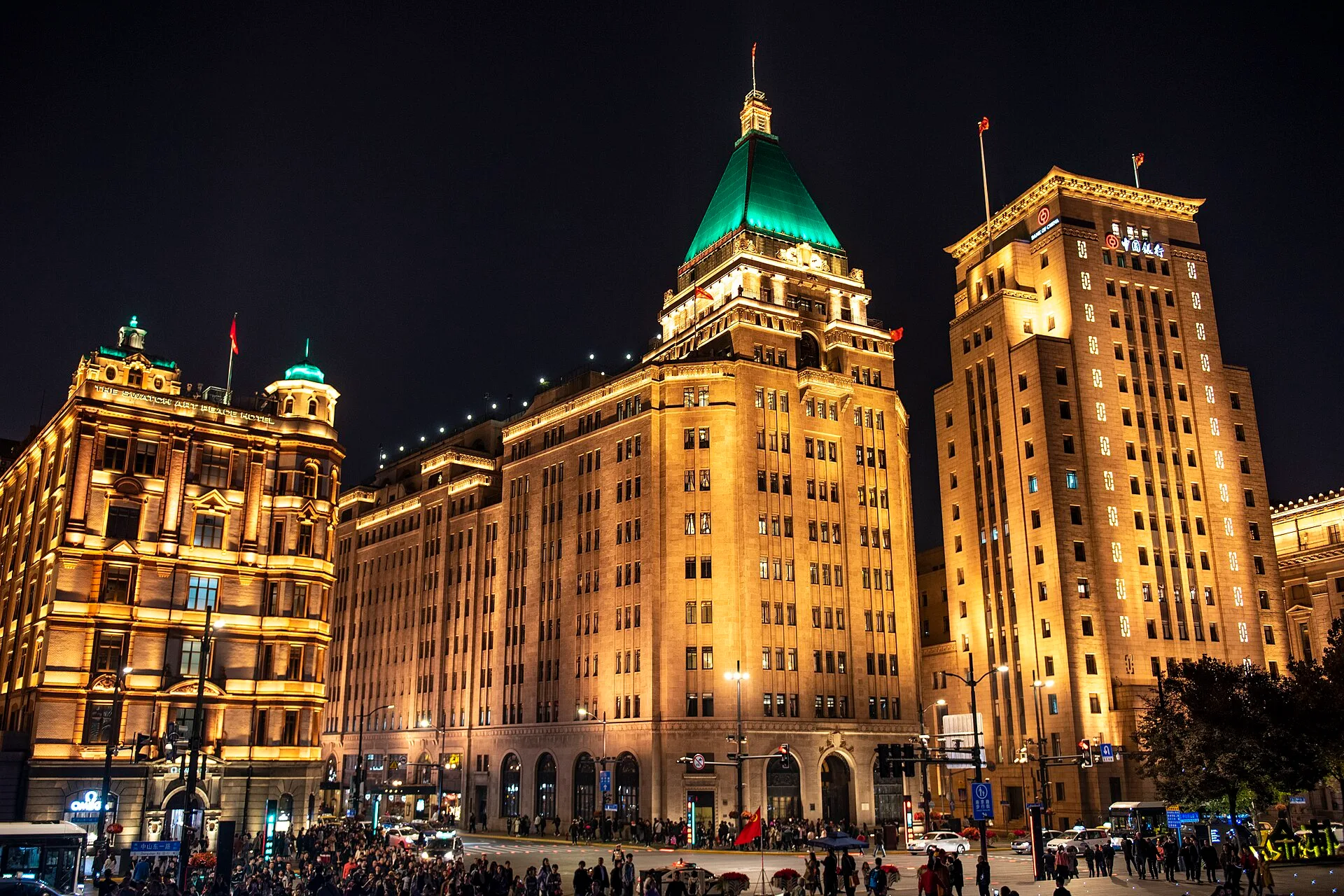
The Peace Hotel Shanghai stands at the corner of the Bund and Nanjing Road and is made up of two buildings, one on each side of Nanjing Road. The north building is Sassoon House, built from 1926 to 1929 for Victor Sassoon to designs by Palmer and Turner, which opened as the Cathay Hotel. The south building is the former Palace Hotel, completed in 1908. Both belong to a run of Western-style hotels built in Shanghai between 1846 and 1934, from the Astor House near the Waibaidu Bridge to Broadway Mansions and Laszlo Hudec's Park Hotel. The Cathay became known for its Art Deco interiors and its jazz bar, and after a three-year restoration the north building reopened in 2010 as the Fairmont Peace Hotel.
WHERE DID SHANGHAI'S FIRST WESTERN HOTEL OPEN
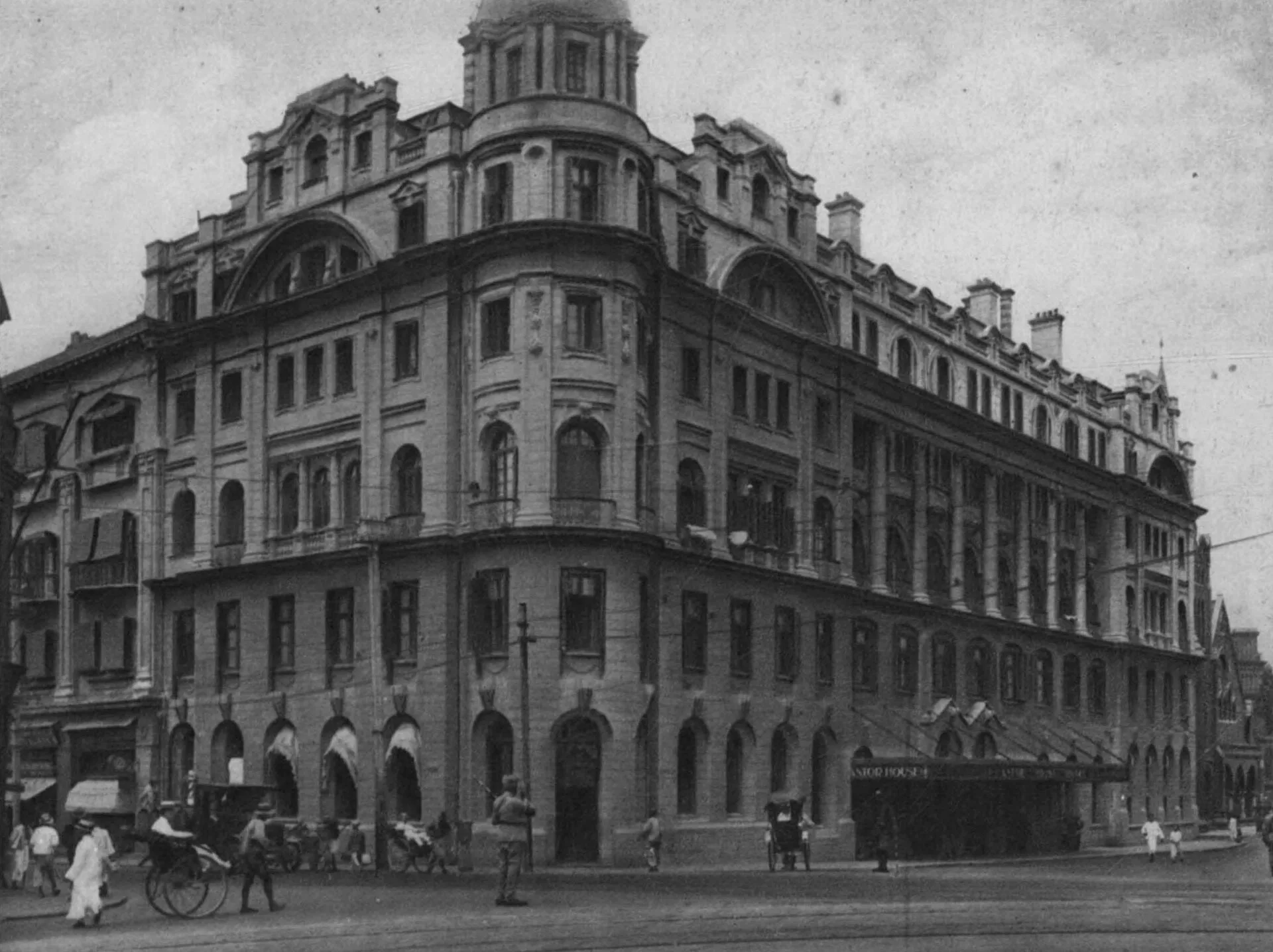
The oldest of the hotels around the Bund is the Astor House. The Information Office of Shanghai Municipality records that it opened in 1846 as Richard's Hotel, founded by the Richard family on the Bund near today's Jinling Road East, and describes it as the first Western hotel in China. In 1857 it moved to its present site on Huangpu Road near the Waibaidu Bridge. It was rebuilt in 1912 in a neo-classical Baroque style, and the information office counts it among the most lavish hotels in the city and in the Far East in the early 20th century. The city government listed it as heritage architecture in 1999.
The Shanghai International Service Portal, run by the city, describes the present building as six storeys high in a British neo-classical Victorian Baroque style, with arched windows on the ground floor, projecting balconies and Ionic columns between the third and fourth floors. Its plan is V-shaped, and the central hall keeps its original Victorian Gothic Revival style. Both city sources link the hotel with Shanghai's first electric light and first telephone service. The portal adds the city's first screening of a sound film, and the information office adds the first ballroom. When the hotel stopped taking guests in January 2018 for renovation, it had 116 rooms, a banquet hall and a cafe bar.
HOW THE PALACE HOTEL BECAME PART OF THE PEACE HOTEL SHANGHAI
The site of the Peace Hotel's south building was first occupied by the Central Hotel, founded in 1903 in a three-storey English-style brick building. Marilyn Shea's picture guide to the historic buildings of the Bund, published by the University of Maine at Farmington, records that a six-storey Renaissance-style building replaced it between 1906 and 1908, when the hotel was renamed the Palace Hotel. The new building was a brick and wood structure. Its Baroque towers carried a pavilion and a roof garden until a fire destroyed them in 1914. The guide calls the Palace the finest hotel in Shanghai in its early years.
The Palace Hotel had stood at the Bund end of Nanjing Road for almost two decades when construction of Sassoon House began on the opposite corner in 1926. The two hotels were later brought under one name. The Shea guide records that in 1965 the Palace Hotel became the South Wing of the Peace Hotel, and that the two buildings continue to operate together under that name. The Irish Times described the arrangement in 2004 as a hotel in two parts: the north building, which had been the Cathay, and the south building, which had been the Palace Hotel. The Peace Hotel name dates from 1956, when, according to the same report, the former Cathay reopened under it.
WHO DESIGNED SASSOON HOUSE AND THE CATHAY HOTEL
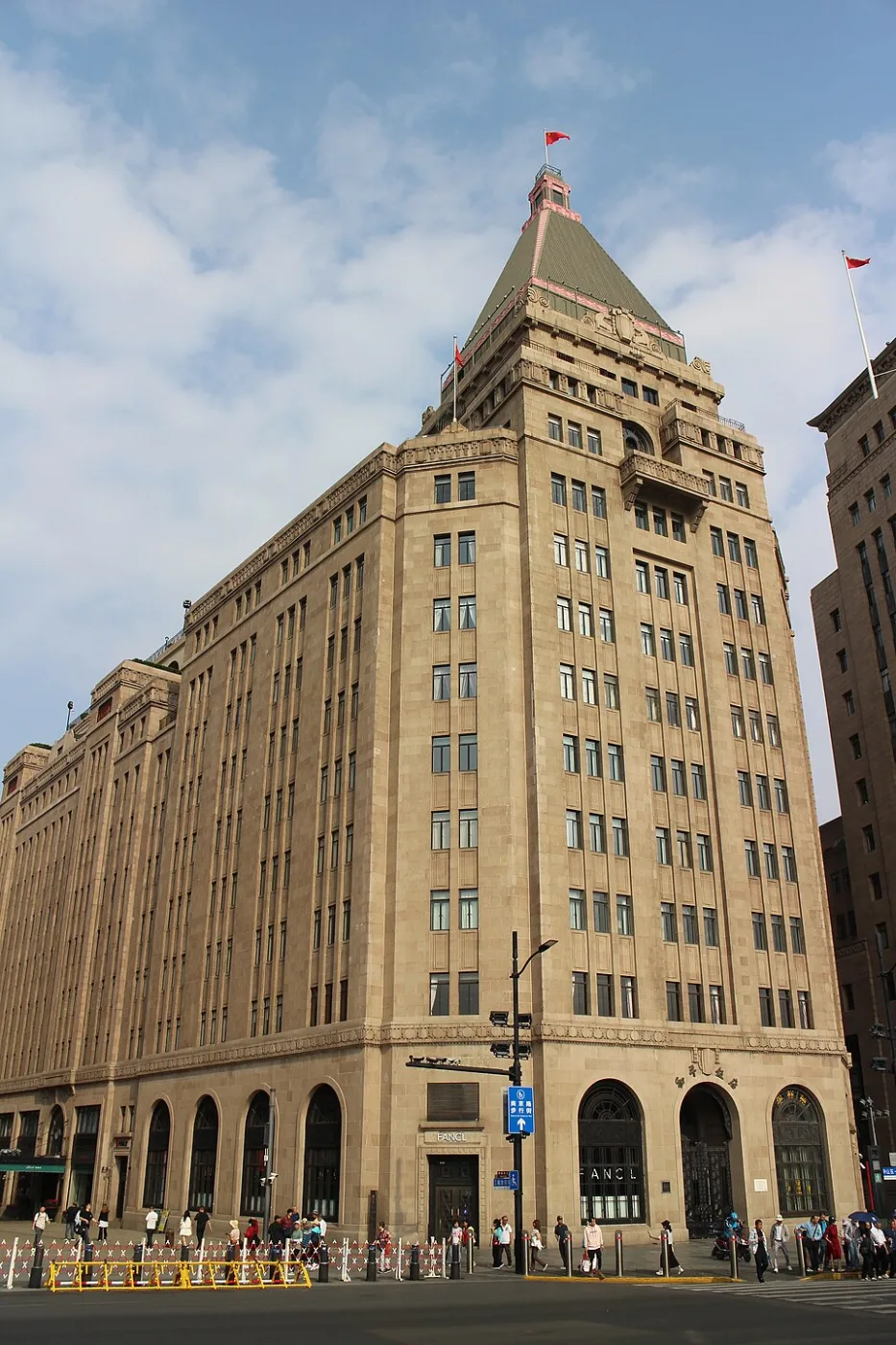
Sassoon House was designed by Palmer and Turner for Victor Sassoon, and construction ran from 1926 to 1929. The firm had already built several of the banks and offices along the Huangpu waterfront. The Shea guide credits it with the Hong Kong and Shanghai Bank building of 1923, which it calls one of the best Palmer and Turner buildings, the Yokohama Specie Bank of 1923 to 1924 and the Customs House of 1927, whose clock tower reaches 90 metres. Sassoon House was a mixed building rather than a hotel alone. It held the Cathay Hotel, several dining rooms, three or four floors of offices and a penthouse for Sassoon himself.
The structure is reinforced concrete. According to the Shea guide, the main building is thirteen storeys tall, with its lower floors faced in granite and terracotta tile used from the ninth floor upwards, and it is topped by a copper pyramid roof 10 metres high. The Irish Times called it a Chicago-style building and described its copper-green, pyramid-shaped top above a granite tower. Sassoon had a private balcony beneath the copper roof and held parties on the top floor. The Fairmont Peace Hotel now names the 10th-floor penthouse where he lived the Sassoon Suite, and states that its ninth-floor Cathay Room was formerly his private banquet hall.
WHAT WERE THE CATHAY HOTEL'S ART DECO INTERIORS LIKE
The Cathay opened in 1929, which the Irish Times places in the Jazz Age, and the paper describes it as having been the most luxurious hotel in the world at its opening. It records an Art Deco scheme with revolving doors, copper chandeliers and Italian marble floors, and Hospitality Design lists the copper-sheathed roof, white Italian marble floors and Lalique glass artwork among the building's original landmark features. The Irish Times also noted details still in place in 2004: Tudor-panelled stairwells, clocks in the lobby showing the time in New York, Moscow, Tokyo and Hawaii, and a lift labelled in the British manner, with G for the ground floor rather than 1.
The hotel's best-known rooms were its suites decorated in national styles. The Shea guide sets out their placing: German, Indian, Spanish and Japanese rooms on the fifth floor, French, Italian and American rooms on the sixth, and an English room on the seventh. The Irish Times listed nine National Deluxe Suites preserved in 1930s style, adding a Chinese room to that set, and the Fairmont Peace Hotel still lists nine suites themed on Chinese, French, American, English, Japanese, German, Spanish, Italian and Indian styles. Among the early guests, the Irish Times reports, Noël Coward finished his play Private Lives in the penthouse suite in 1930, and George Bernard Shaw and Charlie Chaplin also stayed.
HOW DID JAZZ COME TO THE PEACE HOTEL SHANGHAI
Jazz was associated with the Cathay from its first decade. The South China Morning Post (SCMP) reports that in the 1930s the hotel's bar became so well known for jazz that it was called The Jazz Bar, at a time when American musicians were being hired to play in Shanghai's nightclubs. Both the Irish Times and the hotel record that the bar was once called the Horse and Hound. The hotel still operates it as the Jazz Bar, and Hospitality Design described it at the 2010 reopening as a Shanghai institution since the 1930s.
The present resident group, the Old Jazz Band, has been a fixture at the Peace Hotel since 1980, according to the SCMP. The paper reported six members aged from 63 to 97, with an average age of 82, playing at the hotel bar 365 nights a year in a style they call soft jazz with a Shanghainese flavour. It notes that Guinness World Records once recognised the group as the oldest jazz band in the world. In 2004 the Irish Times had put the band's average age at 75 and described its music as old-time jazz. The hotel lists nightly performances by the Old Jazz Band and states that the group holds a Guinness World Record.
WHICH HOTEL TOWERS DID SHANGHAI COMPLETE IN 1934
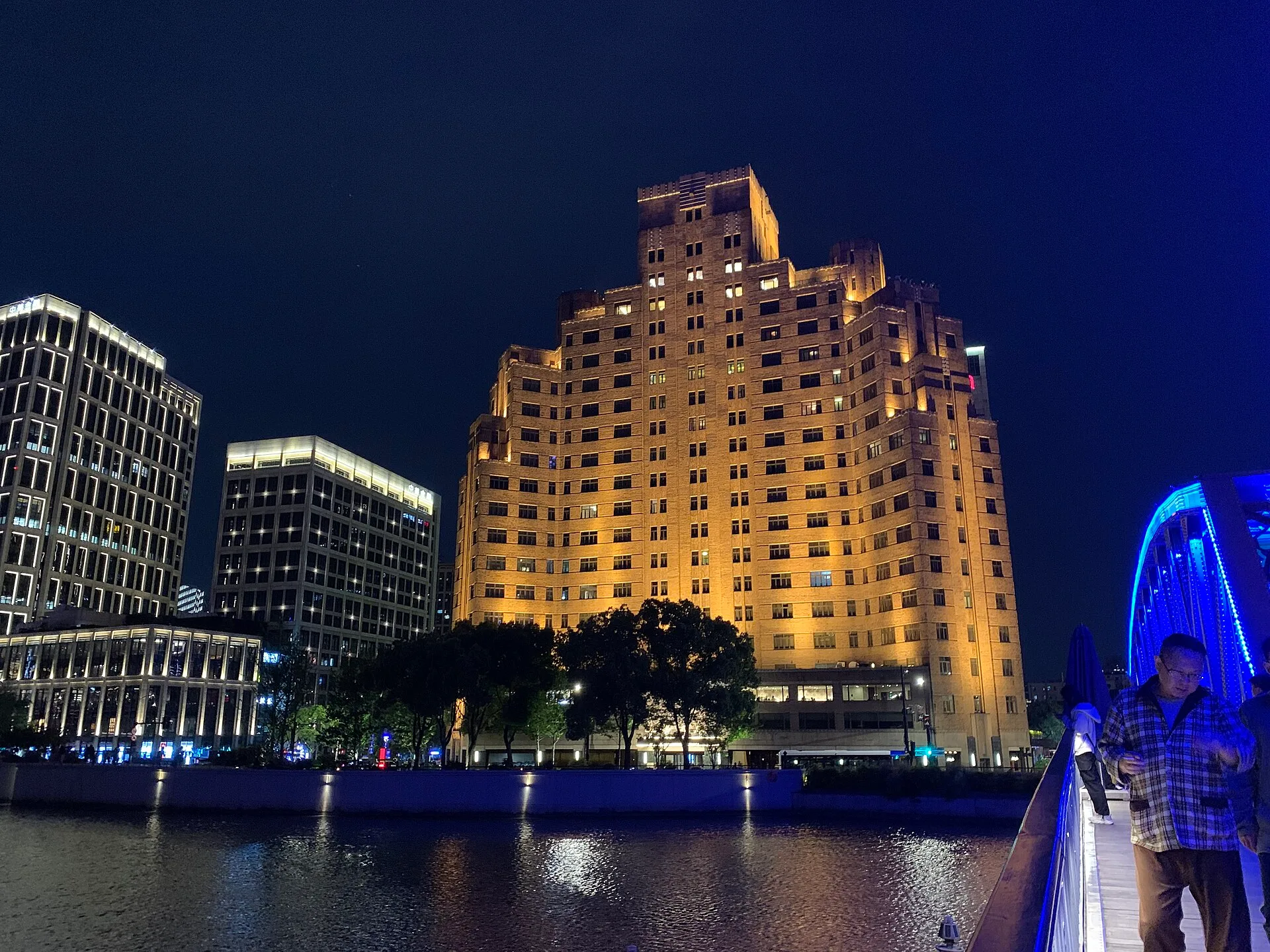
Two more towers were finished in 1934. Broadway Mansions was begun in 1930 and completed in 1934. The Shea guide describes its style as modern cubist, emphasised by red granite facings on the lower floors and brown terracotta above, and records that it was designed as luxury apartments and later used as a hotel, with balconies giving some of the best views of the Bund. The same year brought the Park Hotel on Nanjing Road West, designed by Laszlo Hudec, whose name the Slovak foreign ministry gives as Ladislav Hudec. The ministry records that he was born in Banská Bystrica, graduated in architecture from the Budapest University of Technology and Economics in 1914 and lived in Shanghai from 1918 to 1947.
The Park Hotel was built from 1931 to 1934 as an Art Deco tower of 22 storeys, almost 84 metres tall. The Slovak ministry describes it as Asia's first skyscraper and the tallest building in Asia until 1963, and in Shanghai until 1983. Lenore Hietkamp's 1998 thesis at the University of Victoria, based on Hudec's own archive held there, notes that for almost fifty years it was called the tallest building in the Far East. Hietkamp relates the design to Hudec's Austro-Hungarian background and his exposure to architecture in America and Germany, and records that the building came to be owned by Chinese businessmen. The hotel states that it stands opposite People's Park and serves as the reference point for Shanghai's coordinate system.
HOW WAS THE PEACE HOTEL SHANGHAI RESTORED IN 2010
The north building reopened as the Fairmont Peace Hotel after a three-year restoration, which Hospitality Design reported on 29 July 2010. The work was led by the design firm HBA, which worked with designers, architects and historians to recreate the building's Art Deco character. The guestrooms were given Art Deco motifs and 1930s-style furnishings, alongside modern fittings that included two high-definition televisions and an espresso machine in each room, and the Nine Nations Suites were kept. A new presidential suite was created in the 10th-floor penthouse where Sassoon had lived.
Hospitality Design counted six restaurants, bars and lounges in the reopened hotel. Among them were the Jazz Bar, the Dragon Phoenix Chinese restaurant, the Cathay Room with its ninth-floor terrace over the Bund, and the Peace Hall, where the sprung wooden dance floor remained. A new extension added a sky-lit swimming pool and a Willow Stream Spa. The Fairmont Peace Hotel now also runs a Peace Museum, which traces the legacy of the former Cathay Hotel from 1929 to the present day.
THOMPSON SHANGHAI EXPO ON THE FORMER EXPO 2010 SITE

Thompson Shanghai Expo opened in October 2025 as Thompson's first hotel in Asia Pacific. It has 254 rooms and stands on the former site of Expo 2010 Shanghai, facing the Huangpu, and Silverfox Studios worked on its full scope. The design avoids literal pavilion imagery. It is organised instead as buildings within buildings: each public room and each guestroom type is its own structure, with its own ceiling and its own materials. At the Cathay Hotel of 1929, the suites were each decorated in the style of a different country, and the 2010 restoration kept them as the Nine Nations Suites.
The hotel's all-day dining restaurant, the Fishermen's Pavilion, occupies levels 19 and 20. It is set as penthouse pavilions facing the river and the Expo grounds. On the Bund, the top floors of Sassoon House held Victor Sassoon's penthouse on the 10th floor and his private banquet hall on the ninth, now the Cathay Room with its terrace over the Bund. Across Nanjing Road, the Baroque towers of the Palace Hotel carried a pavilion and a roof garden until the fire of 1914.
SOURCES
- Information Office of Shanghai Municipality Historic Astor hotel to shut for facelift
- Shanghai International Service Portal Shanghai's historic hotels: Where legacy meets modern hospitality
- University of Maine at Farmington, Marilyn Shea The Bund: Picture Guide to Historic Buildings
- The Irish Times The Peace Hotel that has seen war and revolution
- South China Morning Post World's oldest jazz band in Shanghai a rare constant amid China's breakneck modernisation
- Hospitality Design Fairmont Peace Hotel Opens in Shanghai
- Fairmont Peace Hotel Fairmont Peace Hotel, Shanghai
- Ministry of Foreign and European Affairs of the Slovak Republic Ladislav Hudec: the Slovak who changed Shanghai
- University of Victoria, Lenore Hietkamp The Park Hotel, Shanghai (1931-1934) and its architect, Laszlo Hudec (1893-1958)
- Radisson Hotels Park Hotel Shanghai