FROM A STOCKHOLM GYMNASTICS SCHOOL TO THE SPA TREATMENT ROOM

Swedish massage is the name used in the United States for a sequence of strokes known by French terms: effleurage, petrissage, friction, tapotement and vibration. The name ties it to Per Henrik Ling (1776 to 1839), who founded the Royal Central Institute of Gymnastics in Stockholm in 1813. Physiotherapy historians and the massage trade press credit the stroke system itself to the Amsterdam practitioner Johan Georg Mezger, who took his medical doctorate at Leiden in 1868, and in Sweden the same technique is called classic massage. The history runs from a state gymnastics school for army officers to a medical faculty in the Netherlands, a hotel practice in Amsterdam and the professional societies of Britain and the United States.
WHO WAS PER HENRIK LING?

Ling, whose first name is also spelled Pehr, was born in 1776 and died in 1839. Before he moved to Stockholm he was fencing master at Lund University, and in 1813 he also taught at the Karlberg Military Academy. An 1888 account by the gymnast Hartvig Nissen describes him as a former fencing master who took up the study of movement after using gentle percussion on rheumatism in his own arm. Gymnastics gained importance in Sweden with the introduction of general conscription in 1812. On 29 January 1813 Ling petitioned for a state-funded gymnastics institution in Stockholm, and a royal letter of 5 May 1813 authorised it.
Ling's Swedish gymnastics had four branches. Aesthetic gymnastics resembled ballet and pantomime, military gymnastics was based mainly on fencing, educational gymnastics was the form now recognised simply as gymnastics, and medical gymnastics resembled what is now called physical therapy. Nissen's account sets out the working method. Ling used five basic positions, standing, kneeling, sitting, lying and hanging, which he said could be combined into nearly 12,000 positions. Movements were grouped as active or passive, and combined into "duplex" movements in which the operator and the person being treated resisted each other.
THE ROYAL CENTRAL INSTITUTE OF GYMNASTICS IN STOCKHOLM

The institute's first regulations were issued in 1814 and never printed, and it was placed under the ecclesiastical administration. In 1815 it was given the building known as Styckgjutaregården, on Beridarebangatan and Hamngatan in Stockholm. From 1813 to 1863 its training covered pedagogical, military and medical gymnastics, and it also offered paid medical treatment. The standard male student was a young army officer on a one-year instructor course. After Ling's death, Lars Gabriel Branting led the institute from 1839 to 1862 with a strong focus on its physiotherapy side, and Ling's son Hjalmar, a teacher there, organised educational gymnastics into what became known as the Swedish gymnastics system during the 1860s.
New regulations dated 2 January 1864 gave the institute its own board and director, and three departments, pedagogical, military and medical, each led by a senior teacher, with two-year courses. The same regulations allowed the board to decide on admitting women, and female students were accepted from the 1860s. In 1887 the departments were replaced by three one-year courses for instructors, gymnastics teachers and physiotherapists, and women's courses began every other year, becoming annual from 1900. According to the school's own history, foreign visits and course participation were very frequent, and Swedes who held the institute's examination settled in other countries.
WHO INVENTED SWEDISH MASSAGE? JOHAN GEORG MEZGER
Johan Georg Mezger, also written Johann, was the son of a butcher in Amsterdam. The Zeeuws Archief gives his year of birth as 1838, while the University of Amsterdam's Album Academicum records 22 August 1839. According to the International Physiotherapy History Association's chairman, Glenn Ruscoe, he worked in his father's trade, took up gymnastics and experimented with massage to improve gymnastic performance. The orthopaedic consultant Dr J.L. Dusseau introduced him to medical education. The Album Academicum records him studying medicine at the Athenaeum Illustre in Amsterdam from 1864 and taking his doctorate at Leiden on 15 September 1868. His final-year dissertation examined friction treatment for sprained ankles.
The vocabulary of Swedish massage comes from Mezger's practice. The trade title MASSAGE Magazine credits him with organising the techniques and adopting the French terms effleurage, petrissage and tapotement. Ruscoe's account gives the naming to two Swedish physicians, Berghmann and Helleday, who used the terms effleurage, friction, petrissage and tapotement for four movements after their clinical time with Mezger. The Encyclopaedia Britannica defines effleurage as light or hard stroking, petrissage as compression that includes kneading, squeezing and friction, and tapotement as percussion in which the sides of the hands strike the surface of the skin in rapid succession. Physicians sent assistants to learn his technique for clinics across Europe.
MEZGER AT THE AMSTEL HOTEL AND IN DOMBURG
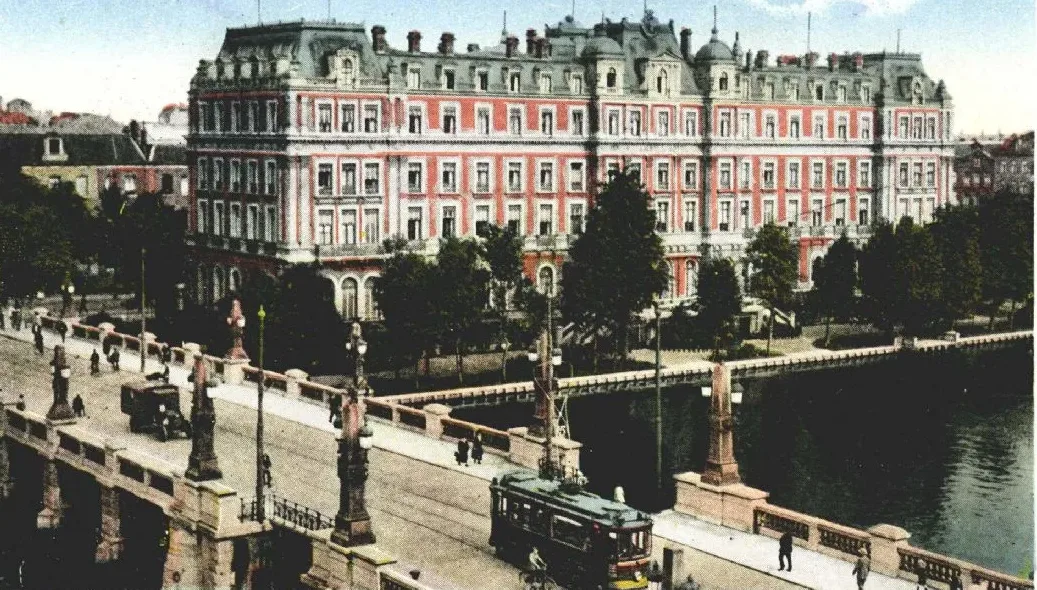
Within two years of graduating, Mezger opened a private clinic at the Amstel Hotel in Amsterdam, and the Zeeuws Archief records that he practised at the hotel in winter. His reputation for gouden duimen, golden thumbs, made him internationally known, and the press followed his movements. When he considered spending his winters working in Wiesbaden, admirers in Amsterdam sent petitions and gifts asking him to stay. His patients included emperors, empresses, kings and queens, and in 1892 he was taken to St Petersburg to treat the Empress of Russia. The Zeeuws Archief holds a collection of portrait photographs that patients gave him in thanks.
Mezger married Petronella Borsius of Middelburg, and from then on spent his summers in Domburg, on Walcheren in Zeeland. In 1886 to 1887 he had Villa Irma built near Domburg, on land in Oostkapelle that is now part of the municipality of Veere, and he lived and worked there during the summer months. In later years he also practised in Paris during the winter. He died in Paris on 3 March 1909 at the age of 70 and was buried in Oostkapelle.
SWEDISH MOVEMENTS AND MASSAGE IN AMERICA AND BRITAIN
Ling's system reached the United States before Mezger's terms did. In June 1856 Charles Fayette Taylor finished his medical lectures at the University of Vermont in Burlington and sailed to London to study Ling's Swedish system. There Georgii, a Swede trained at the Stockholm institute, refused to teach him, and he paid Dr Roth a guinea an hour for 60 hours of instruction instead. Taylor returned to New York in December 1856 and began practising the movement cure, and published his Theory and Practice of the Movement Cure in 1860 or 1861. Hartvig Nissen, director of the Swedish Health Institution in Washington, D.C., and instructor in gymnastics at Johns Hopkins University, addressed the Clinical Society of Maryland on "The Swedish Movement and Massage Treatment", printed in Baltimore in 1888. He defined massage as kneading, pressing, stroking, rubbing, tapping, hacking and percussing applied to the muscles, and he objected to the passive and duplex movements of Ling's system being called massage.
In Britain, nine nurses and midwives formed a council of trained masseuses in 1894, launched in February 1895 as the Society of Trained Masseuses, and the society's chronology credits Rosalind Paget and Lucy Robinson with forming it. It was incorporated in 1900, introduced an examination in Swedish remedial exercise in 1910 and one for its teachers in July 1911. In 1920 it received a Royal Charter as the Chartered Society of Massage and Medical Gymnastics, and a conjoint examination in massage and Swedish remedial exercises became the minimum qualification for membership in 1927. The society took the name Chartered Society of Physiotherapy in 1943. Its archive at the Wellcome Collection holds papers on Olive Guthrie-Smith and the Swedish Institute, later St Mary's Hospital School of Physiotherapy, from 1904 to 1939.
WHY IS IT CALLED SWEDISH MASSAGE?
Ruscoe's history of Mezger states that Ling founded the Swedish system of exercise while Mezger's massage was separate work. Because physicians combined Mezger's massage with active movements of the kind Ling taught, Mezger's practice came to be labelled Swedish massage, and Ruscoe describes Mezger as the father of so-called Swedish massage. MASSAGE Magazine answers its own question, whether Swedish massage is truly Swedish, with a no, and notes that what is called Swedish massage in the United States is called classic massage in Sweden. The older attribution persists in the Encyclopaedia Britannica, whose introduction to its entry on massage describes Ling as a doctor in Stockholm who devised a system of massage.
The National Archives of Sweden's description of the institute lists its teaching as pedagogical, military and medical gymnastics, and later as courses for instructors, teachers and physiotherapists, and does not list massage as a subject. The medical side later left the institute altogether. Under a statute in force from 1934 to 1959, physiotherapy moved largely to the medical sector, at the Karolinska Institute and Seraphim Hospital, and military gymnastics moved to the Swedish Army Physical Training School. From the 1958 to 1959 budget year, physiotherapy training was formally transferred to Karolinska Institutet. The institute was renamed GIH, now the Swedish School of Sport and Health Sciences, in 1966.
HOW IS A SWEDISH MASSAGE STRUCTURED TODAY?
A Swedish massage today is built from five strokes. MASSAGE Magazine describes effleurage as long, sweeping or gliding strokes, often used at the start and end of a session; petrissage as a kneading technique of rhythmic compressing and lifting of soft tissue; friction as deeper, firm pressure that generates heat; tapotement as hammering, slapping, cupping, hacking and tapping; and vibration as the therapist pressing or placing the hands on a specific part of the body. Four of the five names are the ones Ruscoe associates with Mezger's clinic. The English words in Nissen's 1888 definition, kneading, pressing, stroking, rubbing, tapping and hacking, cover the same range of movements under different names.
MASSAGE Magazine also sets out the order of a session. The therapist starts with a lighter touch, particularly with a client receiving a first massage from them, and uses effleurage to warm the muscles and map their layout. As the session ends, the therapist may return to gentle, sweeping effleurage. Massage oil or lotion is used throughout to protect the skin from friction. Spa bathing has its own history, traced in our history of wellness tourism and the modern hotel spa.
TREATMENT ROOMS AT THE SPA, MANDARIN ORIENTAL JUMEIRA, DUBAI

Mezger's clinic at the Amstel Hotel, opened within two years of his 1868 doctorate, put massage inside a hotel. The Spa at Mandarin Oriental Jumeira, Dubai, completed in 2019, was designed by Silverfox Studios around a concept named DesertScape, which takes its forms from curved, ridged dunes. The formation of such dunes is covered in how sand dunes form in the desert landscapes of Arabia. The spa has nine treatment rooms with full-height windows facing the beach and the Gulf. Alongside them are a VIP suite and a hammam suite. The hammam's own history is traced in the hammam, from Roman thermae to the Ottoman world.
Beyond the treatment rooms, the spa includes a vitality room. At its centre is a circular pool finished in dark mosaic, a material whose history is set out in mosaic tile, from Greek pebble floors and Roman baths to modern pools. The walls of the vitality room are curved and clad in stratified marble, and the ceiling above is rippled and lit from a cove. Throughout the marble surfaces, the grain of the stone runs continuously from one piece to the next. Seating takes the form of cocoon pods upholstered in linen.
SOURCES
- National Archives of Sweden (Riksarkivet) Kungliga Gymnastiska Centralinstitutet (KGCI), archive description
- GIH, The Swedish School of Sport and Health Sciences Essay on the history of GIH
- US National Library of Medicine, Digital Collections Hartvig Nissen, The Swedish Movement and Massage Treatment (1888)
- history.physio (Glenn Ruscoe, International Physiotherapy History Association) Johann Mezger and the Modern Science of Massage
- history.physio (Glenn Ruscoe, International Physiotherapy History Association) America's first Physical Therapist
- University of Amsterdam, Album Academicum J.G. Mezger
- Zeeuws Archief Dr. Mezger, held van de elite en van Domburg
- Wellcome Collection Chartered Society of Physiotherapy archive
- Encyclopaedia Britannica Massage
- MASSAGE Magazine Swedish massage history