THE JAPANESE METHOD OF MENDING BROKEN CERAMICS WITH URUSHI LACQUER AND POWDERED GOLD
Kintsugi is the Japanese method of repairing broken or chipped ceramics with urushi lacquer and finishing the joins with powdered gold, silver or platinum, so that the repair stays visible instead of being hidden. Mending pots with lacquer is far older; what Japanese craftsmen added was the metal finish. The technique developed alongside chanoyu, the tea ceremony, during the Muromachi period (1336 to 1573), and gold lacquer repairs became closely associated with tea wares. The best known origin story involves the shogun Ashikaga Yoshimasa and a cracked Chinese celadon bowl now in the Tokyo National Museum. Since the 2000s kintsugi has spread to the general public, and in March 2024 the word entered the Oxford English Dictionary.
WHAT IS KINTSUGI? GOLDEN JOINERY, KINTSUKUROI AND KESHIKI
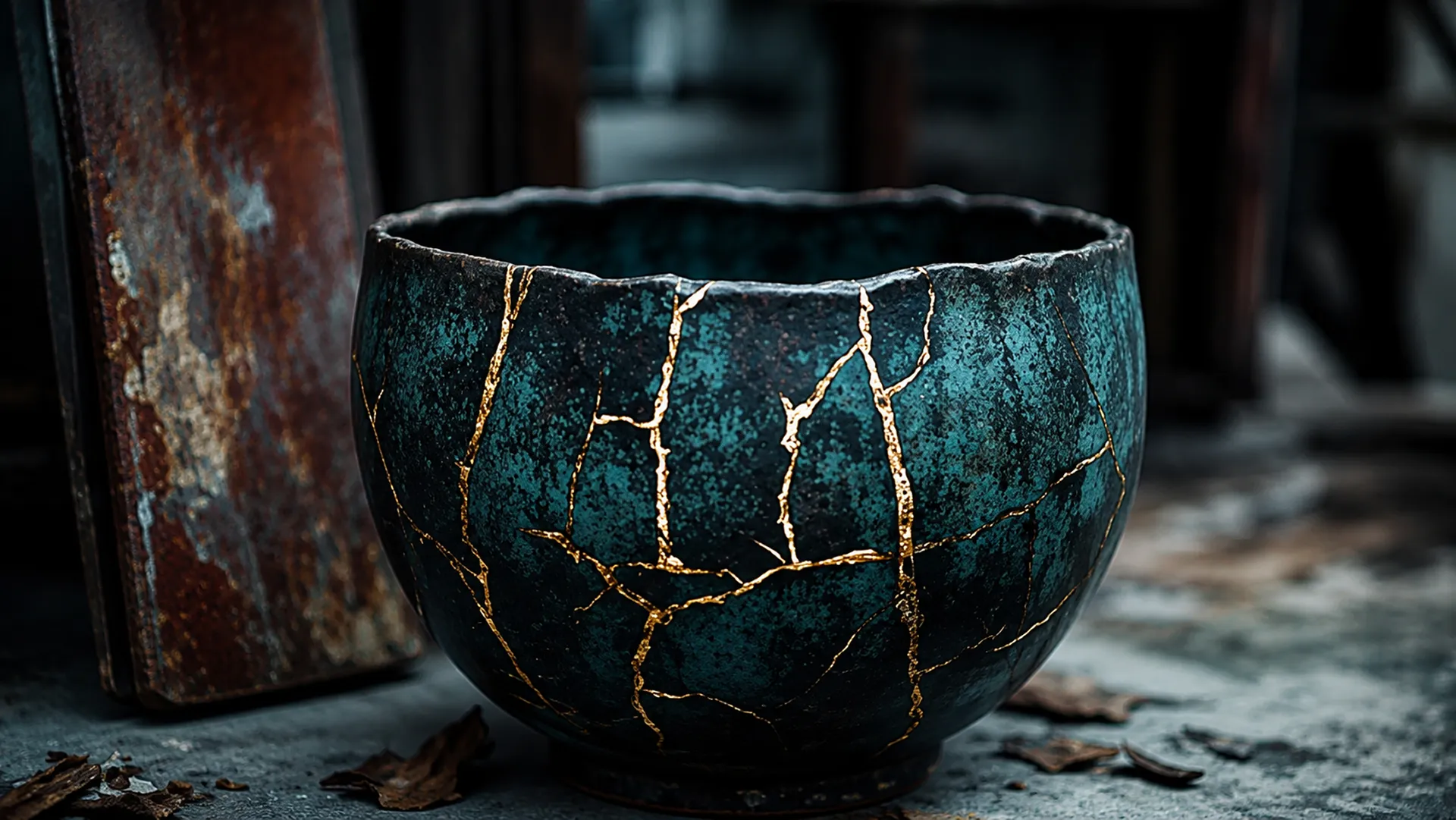
Britannica translates kintsugi as golden joinery and lists kintsukuroi as another name for the practice. Broken pieces are bonded with lacquer and the seams covered with metal powder, usually gold or silver and sometimes platinum, so that the line of the break becomes part of the surface. Although the technique is Japanese, it has been applied to Chinese and Korean ceramics as well as Japanese ones. Britannica cites a Korean celadon cup of the Goryeo period, now in the Cleveland Museum of Art, that was mended in this way.
Japan Up Close records that people admired the gold lines across a repaired vessel and called them keshiki, meaning scenery. Before kintsugi, according to Web Japan, broken fragments were held together by kasugaidome, a technique using thick metal staples, and for a long time ordinary household items were mended instead with yakitsugi, which fused the pieces with lead glass. The Metropolitan Museum of Art makes the same point about China: Chinese repairs of the period typically used metal staples, while repair with gold lacquer is specific to Japan.
WHERE DID KINTSUGI COME FROM? THE STORY OF YOSHIMASA'S BOWL
The adhesive came first. The sap of the lacquer tree, which grows in both Japan and China, works as a glue, and vessels were repaired with lacquer in Japan during the Jōmon period (about 13,000 to 300 BC) and in China at around the same time. The Smithsonian notes that decorating such repairs with gold began in Japan only several centuries ago, and that the origins of kintsugi are unknown. Both the Smithsonian and Britannica connect its spread to the tea ceremony: Britannica places it after the 15th century, the Smithsonian in the late 16th century.
The popular origin story, repeated by Britannica and presented by Japan Up Close as one theory, is set in the late 15th century. The shogun Ashikaga Yoshimasa sent a damaged Chinese tea bowl, a favourite of his, back to China for repair, and it returned held together with metal staples. In Britannica's telling, Yoshimasa disliked the result and had Japanese craftspeople develop a better looking method; Japan Up Close says only that the staples may have prompted the search for one. Britannica states plainly that the accuracy of the story is uncertain.
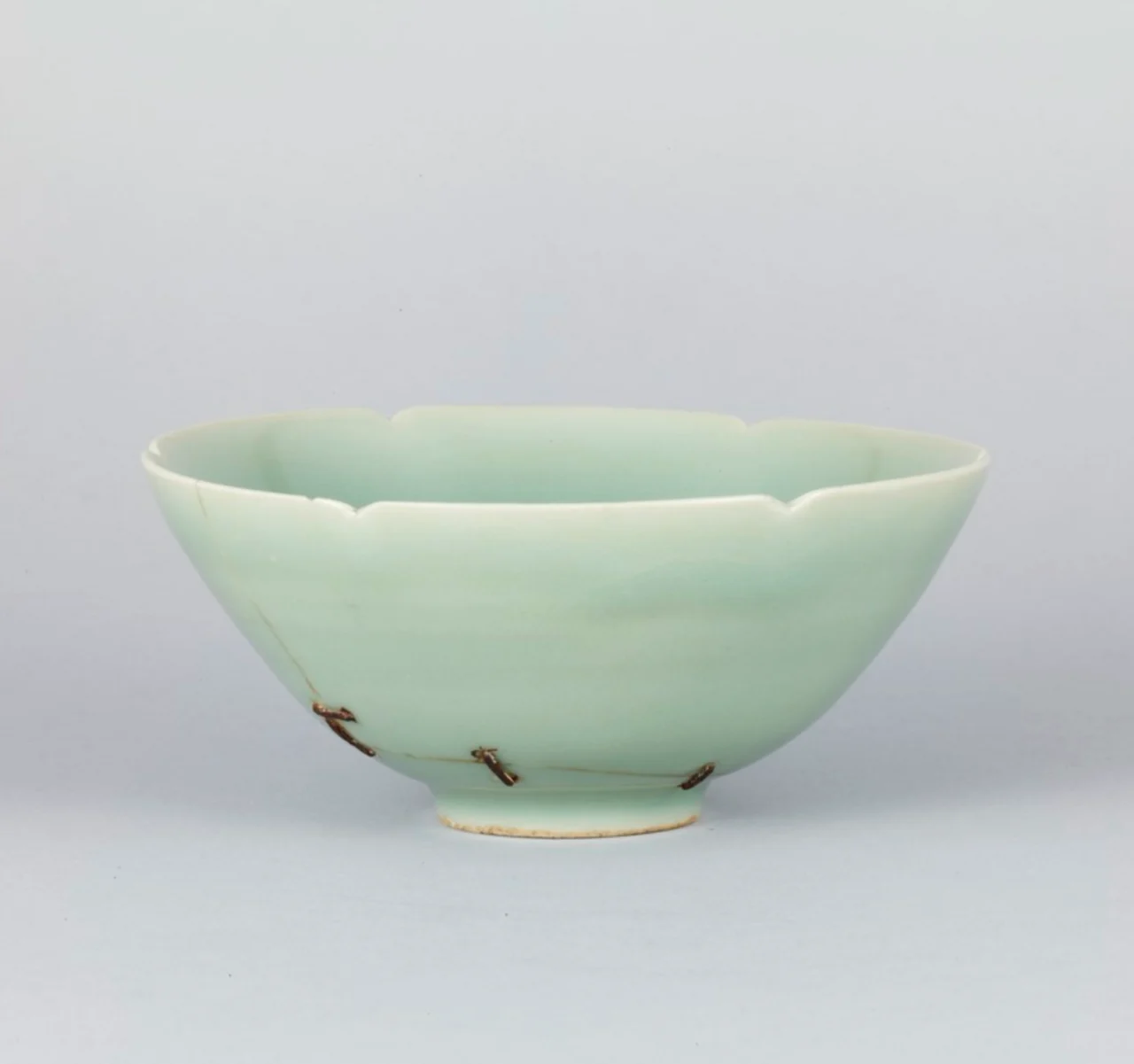
The Tokyo National Museum holds a 13th century Longquan celadon bowl from Southern Song China, an Important Cultural Property named Bakōhan after a large clamp said to resemble a locust. The museum's account rests on the Bakōhan Saōki, written in 1727 by the Confucian scholar Itō Tōgai. According to this record, the bowl cracked at the base while it belonged to Yoshimasa (who ruled from 1449 to 1473), and he sent it to China to be exchanged for one of equal quality. None could be found, so it came back with the crack bound by a large clamp, which made it even more prized. The museum regards this part of the record as credible. Its entry describes the metal clamp and does not mention gold; the link to kintsugi comes from later retellings.
KINTSUGI AND THE JAPANESE TEA CEREMONY
The Met notes that Japan valued Chinese celadons from the 14th century, when the Ashikaga shoguns built their collections. Ceramics were valuable and used mainly by the upper classes, so owners had good reason to repair a broken chawan (tea bowl) rather than replace it, and Web Japan records that guests at tea gatherings came to appreciate the irregular patterns that the damage left behind. When the Freer Gallery of Art in Washington mounted its exhibition Golden Seams in 2008, it described gold lacquer repairs as closely associated with the tea ceramics used in chanoyu.
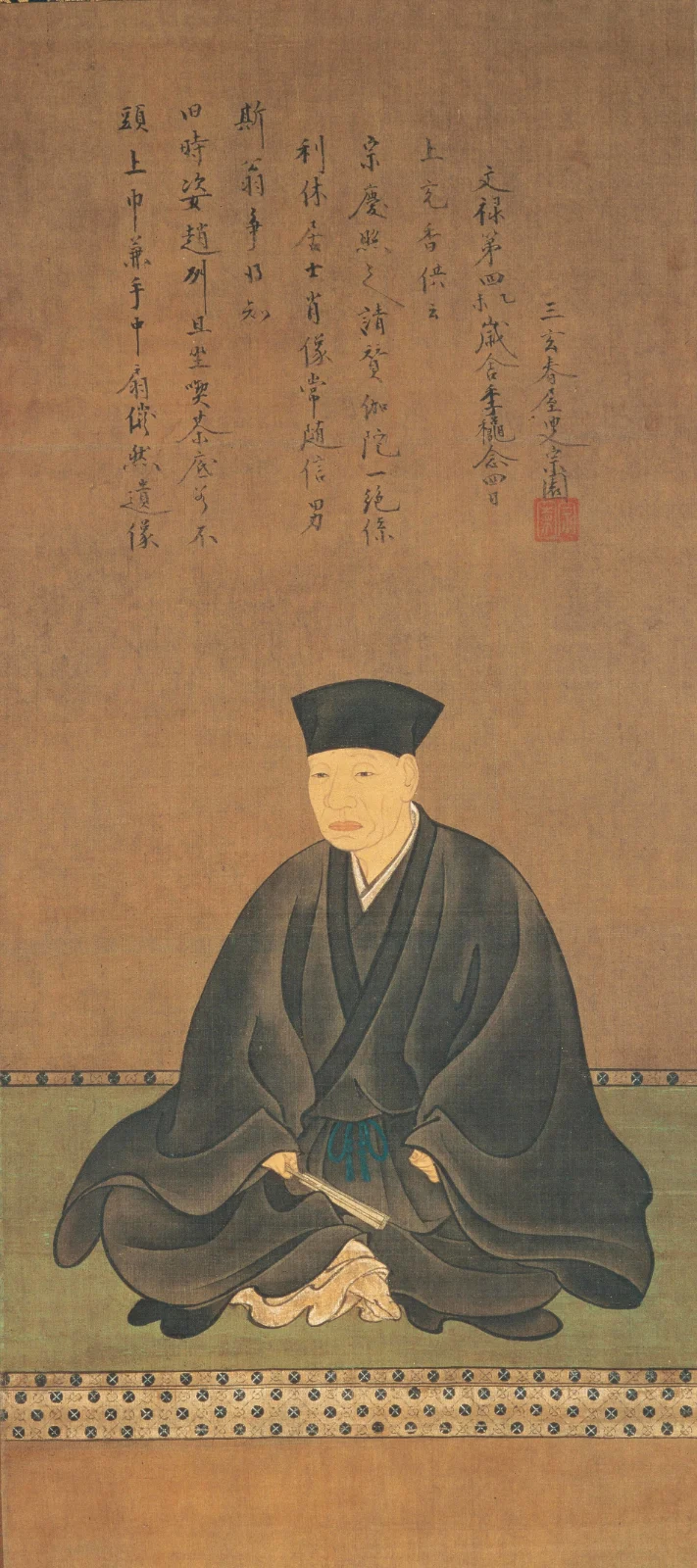
The Herbert F. Johnson Museum of Art at Cornell University, in a 2008 exhibition of mended Japanese ceramics, credited the tea masters Takeno Jōō (1502 to 1555) and Sen no Rikyū (1522 to 1591) with developing the ideals of wabi and sabi, and quoted Rikyū: “tea jars that have been repaired with lacquer become all the more fit for use”. Mended antiques, particularly those once owned by earlier practitioners, tied a gathering to the tradition before it, and a fine repair could add prestige to both the object and its owner. Web Japan dates the perfection of the classical technique to the Edo period (1603 to 1868) and notes that some pieces repaired more than 200 years ago are still intact.
HOW IS KINTSUGI DONE? URUSHI, MUGI URUSHI AND GOLD POWDER
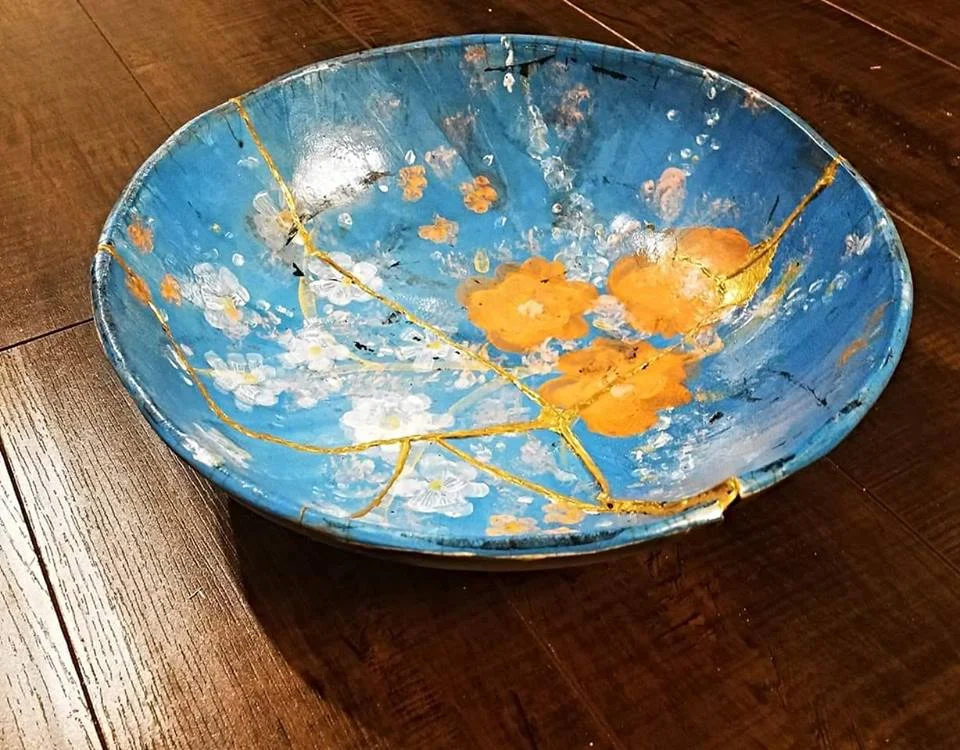
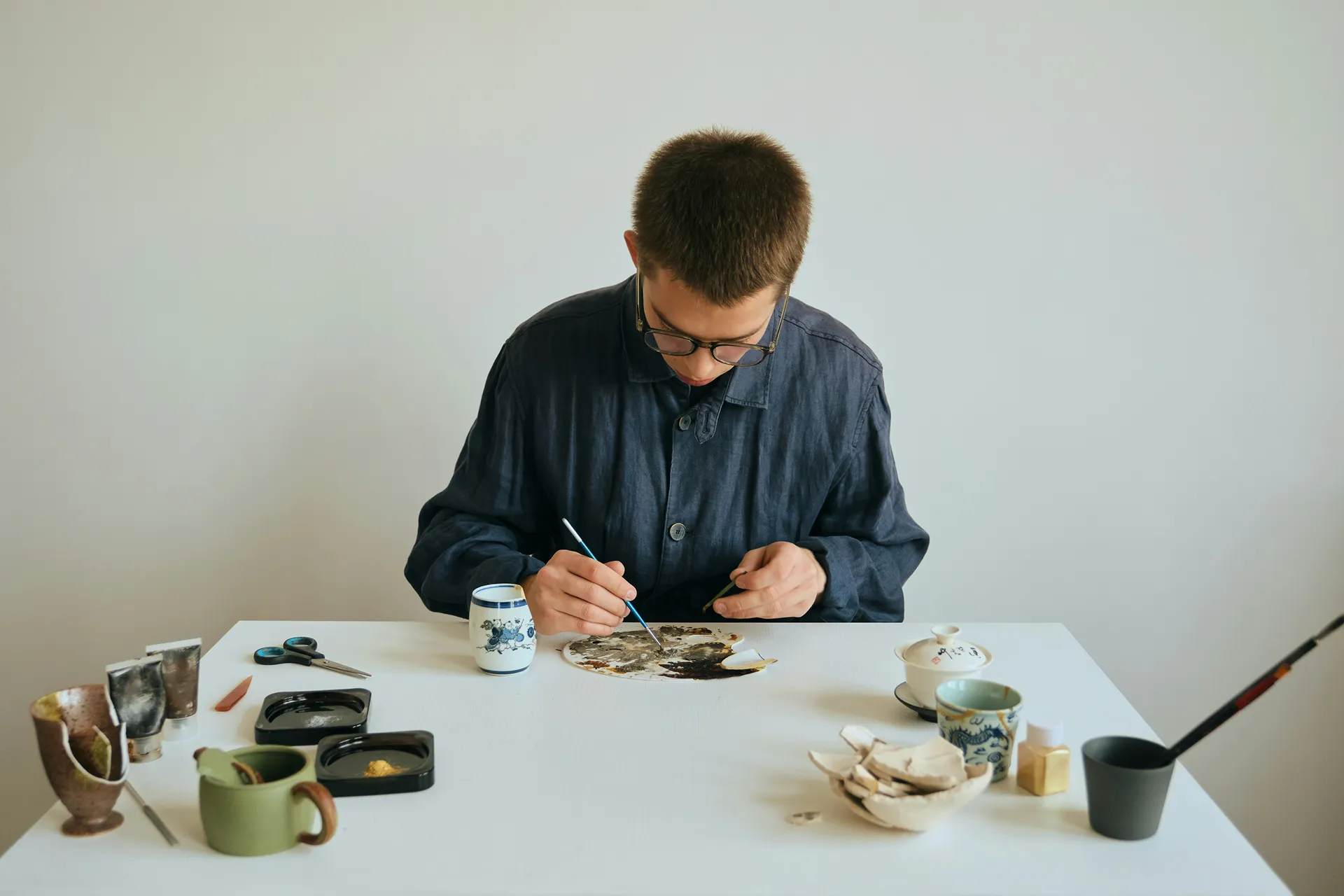
Traditional kintsugi uses urushi, the sap of the lacquer tree, the same raw material behind Chinese lacquerware, as both the glue and the ground for the gold. Cured urushi is glossy, durable and water resistant, but Britannica notes that it needs high humidity to harden and irritates the skin while wet. For the adhesive, the lacquer is mixed with rice glue (nori urushi) or flour (mugi urushi). Chips and small missing fragments are filled with sabi urushi, a putty that Britannica describes as urushi mixed with clay powder and Nippon.com as raw lacquer kneaded with powdered stone and water.
The pieces are joined with the adhesive and left to harden for one to three months. Excess lacquer is then ground away, for example with charcoal. A thin line of coloured urushi, usually red and occasionally black, is painted along each fracture, and metal powder is sprinkled over it so that it adheres to the lacquer, a step Britannica compares to the Japanese lacquer technique maki-e. Where a rim, foot or handle is missing, the form is rebuilt with cloth or successive layers of lacquer, in a method similar to kanshitsu, and then finished in the same way as a crack.
KINTSUGI IN MUSEUM COLLECTIONS
The Metropolitan Museum of Art in New York holds a Chinese tea bowl that shows the other half of the Bakōhan story. Made at the Longquan kilns in the 13th century under the Southern Song dynasty, it is a stoneware bowl 12.7 centimetres across, with the pale bluish green celadon glaze typical of those kilns, and its cracks are mended with gold lacquer. Because the technique is specific to Japan, the Met reads the repair as evidence that the bowl was used and valued there, noting that Chinese repairs of the period typically used metal staples. The bowls in Tokyo and New York record the two methods of repair.
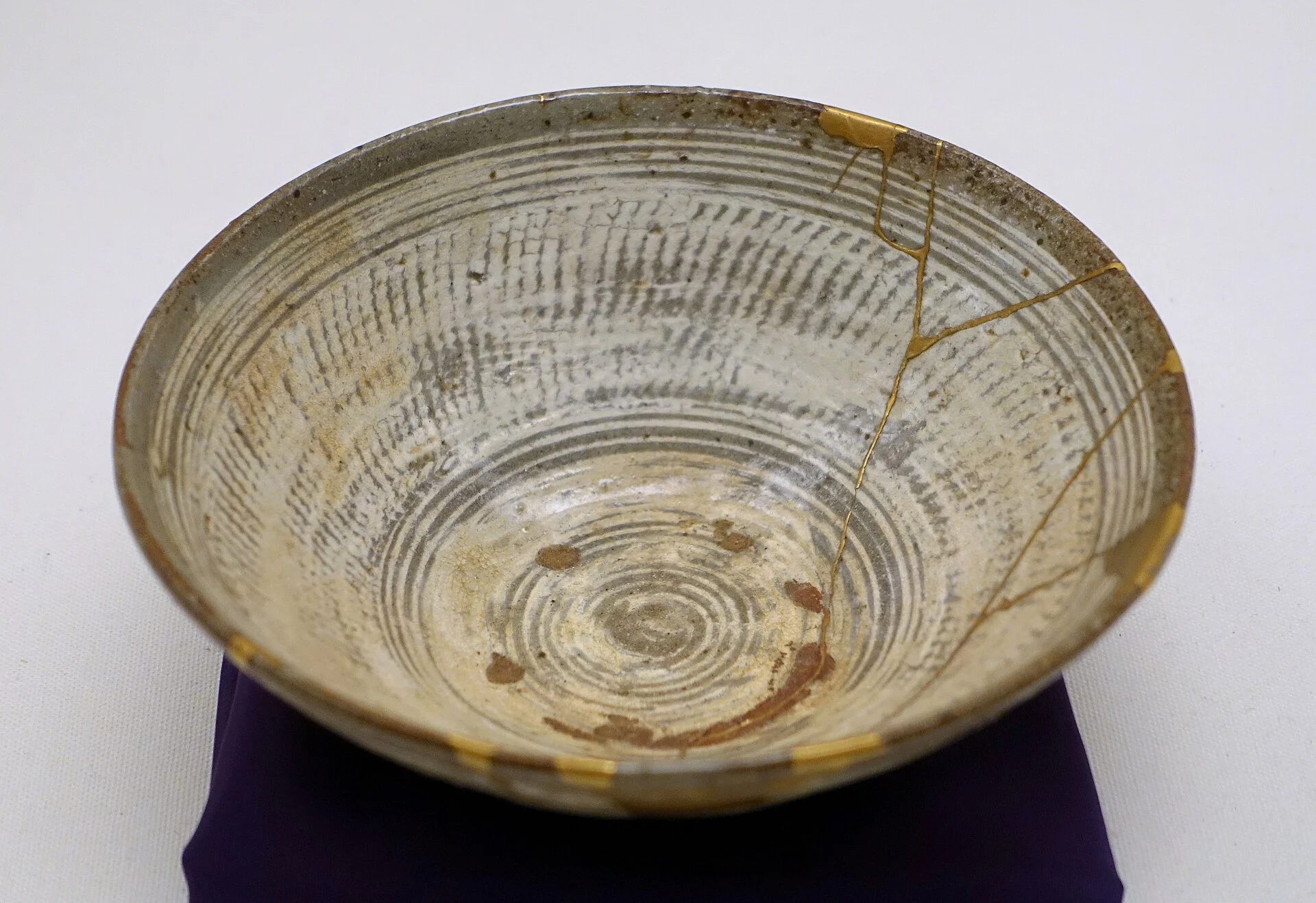
In Washington, the Freer Gallery of Art, part of the Smithsonian's National Museum of Asian Art, holds a 17th century tea bowl of Satsuma ware from Kagoshima prefecture (F1904.323). It is stoneware with a clear crackled glaze, stained by ink, and its breaks are mended with gold lacquer. The Freer brought such objects together in Golden Seams: The Japanese Art of Mending Ceramics, shown in Gallery 6A from 8 November 2008 to 29 November 2009, with 13 mended ceramics from China, Vietnam, Korea and Japan. Earlier in 2008, the Johnson Museum at Cornell showed a private collection of mended tea wares organised by the Museum of Lacquer Art in Münster, Germany.
WABI-SABI, MUSHIN AND YOBITSUGI
Kintsugi is now routinely explained through wabi-sabi. Britannica defines wabi as beauty in simplicity and sabi as appreciation of the old and weathered, and describes wabi-sabi as a philosophy that draws value from imperfection and impermanence. In its account, kintsugi is often linked to wabi-sabi because it highlights breaks rather than concealing them, extends an object's life and displays its history. The Johnson Museum glosses the two words differently, wabi as poverty and humility and sabi as seclusion, ageing, patina and decay, and adds mushin, or no mind, which it explains as nonattachment and acceptance of circumstances. Japan Up Close also presents kintsugi in terms of wabi-sabi.
Variants of the technique take the idea further. In yobitsugi, described in a Japan Society event listing as one of the techniques within kintsugi, a broken vessel is completed with fragments from other objects, giving it a new character. In 2022 the group exhibition YOBITSUGI: Beyond Repair, at White Conduit Projects in London, invited artists from Japan and Britain to treat damage as a starting point. Britannica names other contemporary artists who work from kintsugi, including Tomomi Kamoshita, who joins ceramic fragments found on beaches, and Yee Sookyung, who builds abstract sculptures from discarded ceramic pieces. It also notes the use of kintsugi as a metaphor for resilience in wellness circles.
HOW KINTSUGI SPREAD BEYOND THE TEA ROOM
According to Web Japan, kintsugi reached the general public in Japan in the 2000s, helped by a beginner's guide, renewed interest in traditional crafts and growing concern about possessions and the environment in an age of mass consumption. Kits are sold online and classes have become popular. Japan Up Close adds that interest grew after the Great East Japan Earthquake of 2011, which destroyed many objects. Web Japan also describes a simplified method alongside the classical one: water resistant craft glue replaces urushi for the join, and the seam is traced with acrylic ceramic paint, which avoids the long curing time and the conditions that lacquer requires.
Classical practice continues through specialist restorers. Nippon.com profiles Suezaki Hiroki, born in Osaka in 1957, a lacquer restoration specialist since 1985 who has restored cultural properties for shrines, temples and museums. He opened a workshop in Kyoto in 2014, began offering classical kintsugi classes in Tokyo and Kyoto in 2015 and has taught around 250 students. In 2023 the Vatican Museums added his Bakōro, a lacquer piece on a ceramic core, to their collection, and in 2024 he began teaching a lacquer restoration course at a school in Venice. The same profile records that kintsugi was added to the Oxford English Dictionary in March 2024.
GOLD, FIRE AND JAPANESE HERITAGE AT STRAWFIRE
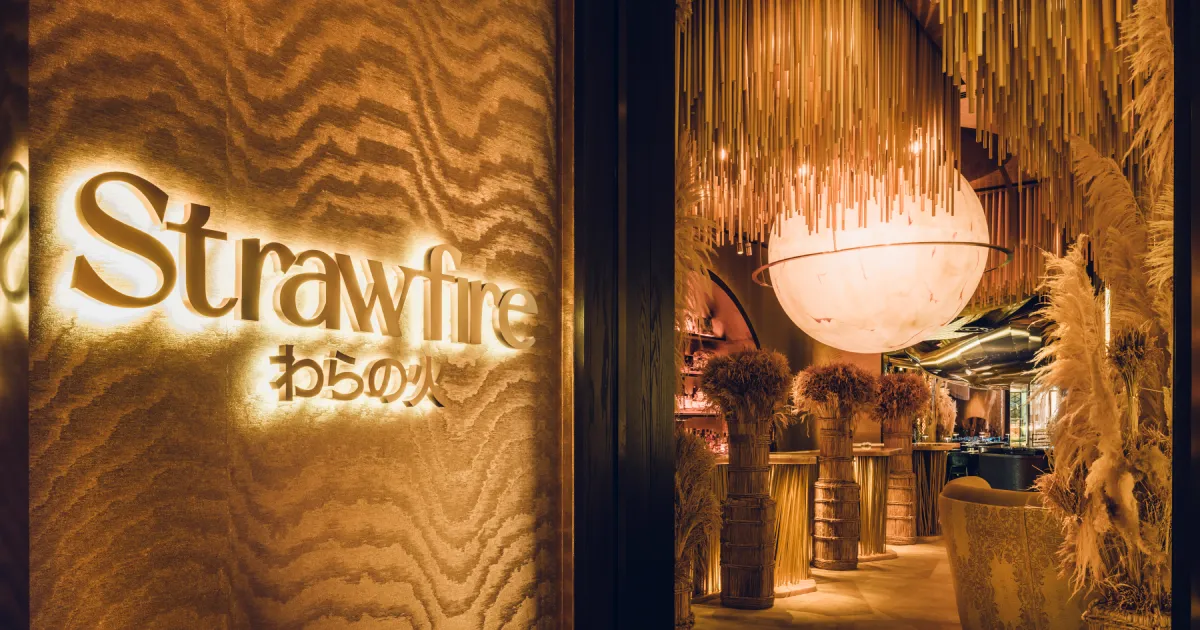
Strawfire, at Emirates Palace Mandarin Oriental in Abu Dhabi, is a Japanese restaurant by the chef Ross Shonhan, designed by Silverfox Studios and completed in 2024. Its concept draws on rice straw, wara, in rural Japan and on warayaki, a grilling method in which burning straw sears meat and fish. The design follows three themes: straw, fire and Japanese heritage. Straw is expressed in cream, gold and mustard tones and fire in orange, gold and rust, so gold is the one colour common to both palettes. Straw bales up to 2 metres tall stand in the booths, and a back-illuminated kumiko screen shows the shadows of the chefs. In a kintsugi repair, gold is a surface applied over a hand-worked base, dusted onto lines of lacquer that follow the shape of a break. At Strawfire, the warayaki counter sits beneath a hand-beaten brass hood fronted with faceted gold tiles.
SOURCES
- Britannica Kintsugi: History, Pottery and Facts
- Tokyo National Museum (ColBase) Celadon porcelain bowl, named Bakōhan
- The Metropolitan Museum of Art Tea bowl, China, Southern Song dynasty, with gold lacquer repairs
- Smithsonian Institution The Beauty of Broken Objects
- Smithsonian Institution Golden Seams: The Japanese Art of Mending Ceramics
- Herbert F. Johnson Museum of Art, Cornell University The Aesthetics of Mended Japanese Ceramics
- Web Japan, Ministry of Foreign Affairs of Japan Kintsugi: Creating New Value From Broken Items
- Japan Up Close Golden Cracks: The Traditional Japanese Art of Kintsugi
- Nippon.com Kintsugi and the Art of Embracing Imperfection: Suezaki Hiroki's Vision for Artisan Renewal
- Embassy of Japan in the UK Japan Society: YOBITSUGI, Beyond Repair