THE CALDAS DA RAINHA FAIENCE FACTORY FROM 1884 TO TODAY

Bordallo Pinheiro is the name of a faience factory in Caldas da Rainha, a town on Portugal's west coast, and of the artist who founded it with his brother in 1884. Rafael Bordalo Pinheiro (1846 to 1905) had no workshop training in pottery, yet within a few years the factory was producing relief-moulded faience modelled as cabbages, lobsters, frogs and snakes, in a style that followed the nineteenth-century revival of the French potter Bernard Palissy. The factory went through financial crises, an auction in 1908 and several changes of name and ownership before Grupo Visabeira acquired the company in 2009.
WHO WAS RAFAEL BORDALO PINHEIRO
Rafael Bordalo Pinheiro was born in Lisbon on 21 March 1846 and died there on 23 January 1905, according to Infopedia, the Porto Editora encyclopedia, which describes him as a caricaturist, illustrator, ceramist, comic-strip author, editor, decorator and costume designer. He came from a family of artists, and his brother Columbano Bordalo Pinheiro was a painter. He attended the Conservatório from 1860 and in 1861 enrolled in civil architecture drawing at the Academy of Fine Arts, where he also studied historical drawing, although his attendance was irregular. Paulo Henriques, in an essay published by the Museu Bordalo Pinheiro, notes that he came to ceramics by an erudite path rather than through workshop experience.
His early career was in illustrated journalism. In 1875 he went to Rio de Janeiro at the invitation of the newspaper O Mosquito, contributing until 1877, and then ran his own illustrated titles there before returning to Lisbon in 1879. The Metropolitan Museum of Art records that he built a successful career in Rio before founding the ceramics factory in Caldas da Rainha with his brother. Infopedia gives the original spelling of his name as Raphael Bordallo Pinheiro. Infopedia and the Lisbon museum write Bordalo with one l, while the factory's brand keeps the older double l of Bordallo.
WHERE CALDAS DA RAINHA CERAMICS COME FROM

Caldas da Rainha joined the UNESCO Creative Cities Network in 2019 in the field of Crafts and Folk Art. UNESCO describes the town as an important centre for ceramic production with about 500 years of ceramic heritage. The historian João B. Serra, in a 1988 study of the Bordalo Pinheiro factory published in the journal Análise Social, notes that all the common ware made in Caldas and the surrounding region was in red or yellow clay. From the middle of the nineteenth century, he writes, the town's reputation rested on decorative rather than utilitarian ware, enriched by relief ornament and an original range of glazes.
Two names stand behind that reputation. From the 1820s, the figure Henriques calls the mythical Dona Maria dos Cacos made and sold monochrome glazed clay figures of people and animals that served as jugs, toothpick holders and candlesticks. Manuel Cipriano Gomes, known as Mafra (1811 to 1905), was a large manufacturer who was made a purveyor to the Royal Household by King Fernando in 1870, and the Museu Bordalo Pinheiro describes him as Bordalo Pinheiro's immediate predecessor. Both are represented in the museum's ceramics collection alongside Rafael and his son. Serra also cites an 1881 inquiry which found that Caldas lacked workers who understood the scientific basis of preparing clay bodies and glazes.
HOW THE BORDALLO PINHEIRO FACTORY WAS FOUNDED
The company's articles of incorporation were recognised in October 1883 and the public deed was signed on 9 August 1884, according to the Museu Bordalo Pinheiro. Feliciano Bordalo Pinheiro took charge of management and Rafael of technical and artistic matters; Serra records that Rafael was given the artistic direction for twenty years. The stated purpose was to explore the ceramics industry, in particular faience. In mid-October 1884 the two brothers left for France, Belgium and England to study manufacturing processes and buy machinery.
Production was built up in stages. The factory made bricks, glazed roof tiles and wall tiles from 1884, used for its own technical and commercial premises, then decorative faience from mid-1885 and tableware from 1888. The Escola de Desenho Industrial Rainha D. Leonor was created in Caldas in 1884 and became an industrial school in 1887, the year a protocol linked it to the factory, which undertook to train up to 150 students. In 1888 the factory employed 83 people: 63 men, 3 women and 17 children. Sales began in Lisbon with an exhibition in February 1886 and a shop on the Avenida da Liberdade from June 1886.
BERNARD PALISSY AND THE PALISSY STYLE
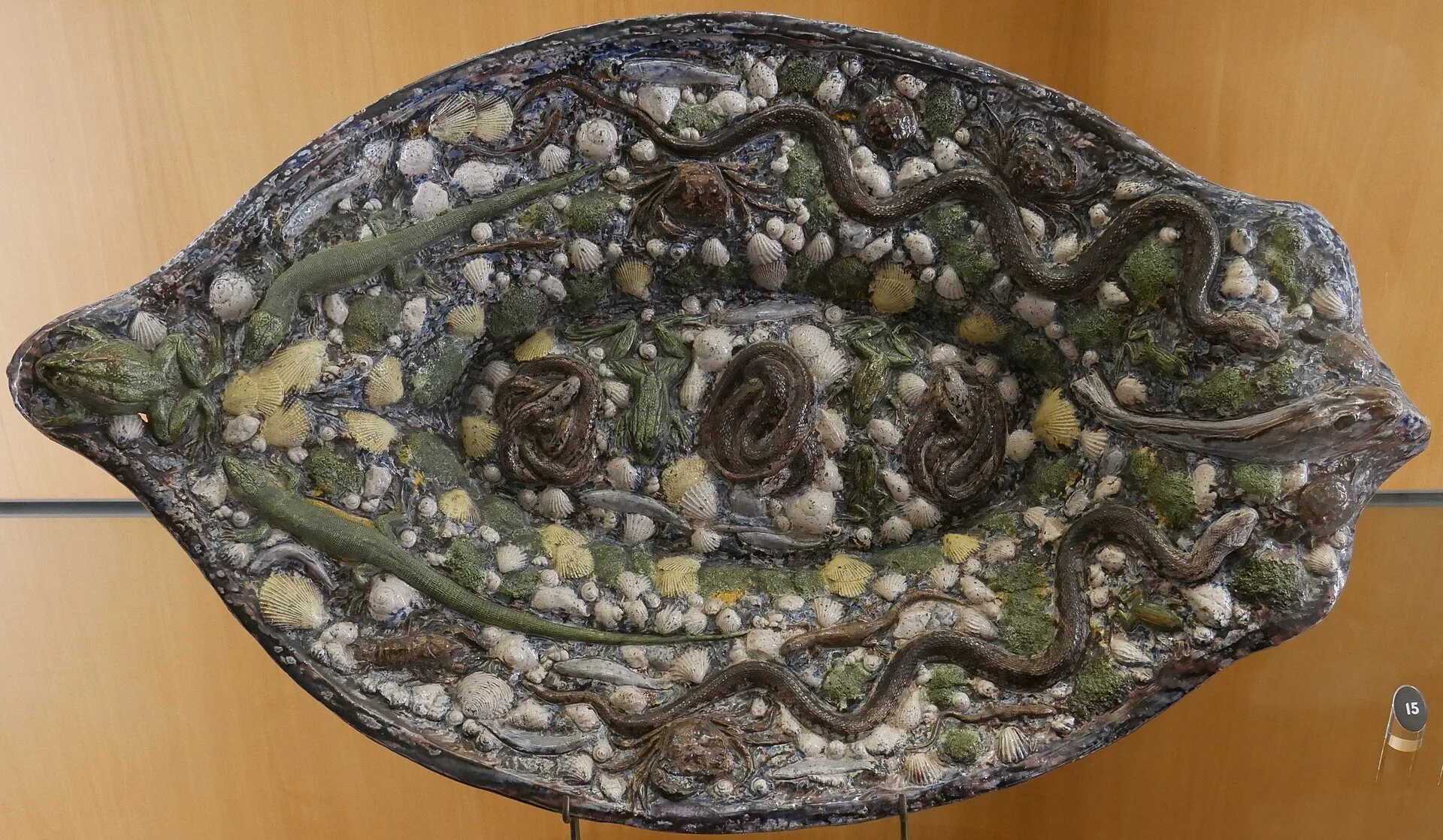
Bernard Palissy was born in 1509 at St. Avit, near Lacapelle Biron in France, and died in Paris in 1590. Britannica describes his rustic ware as earthenware covered with coloured lead glazes and decorated with plants and animals, mostly in the form of oval or circular dishes, ewers and sauceboats. He probably did not use the potter's wheel: his best-known pieces were pressed into a mould and finished by modelling or by applied ornament moulded in relief. In 1565 he was appointed inventor of rustic pottery to the king and the queen mother, and in 1570, with his sons, he built a pottery grotto for Catherine de Médicis in the Tuileries garden.
Palissy's moulds were used again in the seventeenth century at Avon near Fontainebleau and at Manerbe in Calvados, and Britannica records copies made between 1840 and 1870 by Avisseau of Tours and Georges Pull of Paris. Henriques places the Caldas factory within this revival: Palissy's writings were republished in Paris in 1844, and the revived models were shown to great acclaim in the French section of the Great Exhibition in London in 1851. He describes the factory's first decorative pieces as generally following the Palissy style, with modelled relief in balanced volumes and a naturalistic, imitative finish, glazed either with a uniform coloured enamel or by a dripping technique.
WHAT BORDALLO PINHEIRO MADE: CABBAGES, LOBSTERS AND FROGS
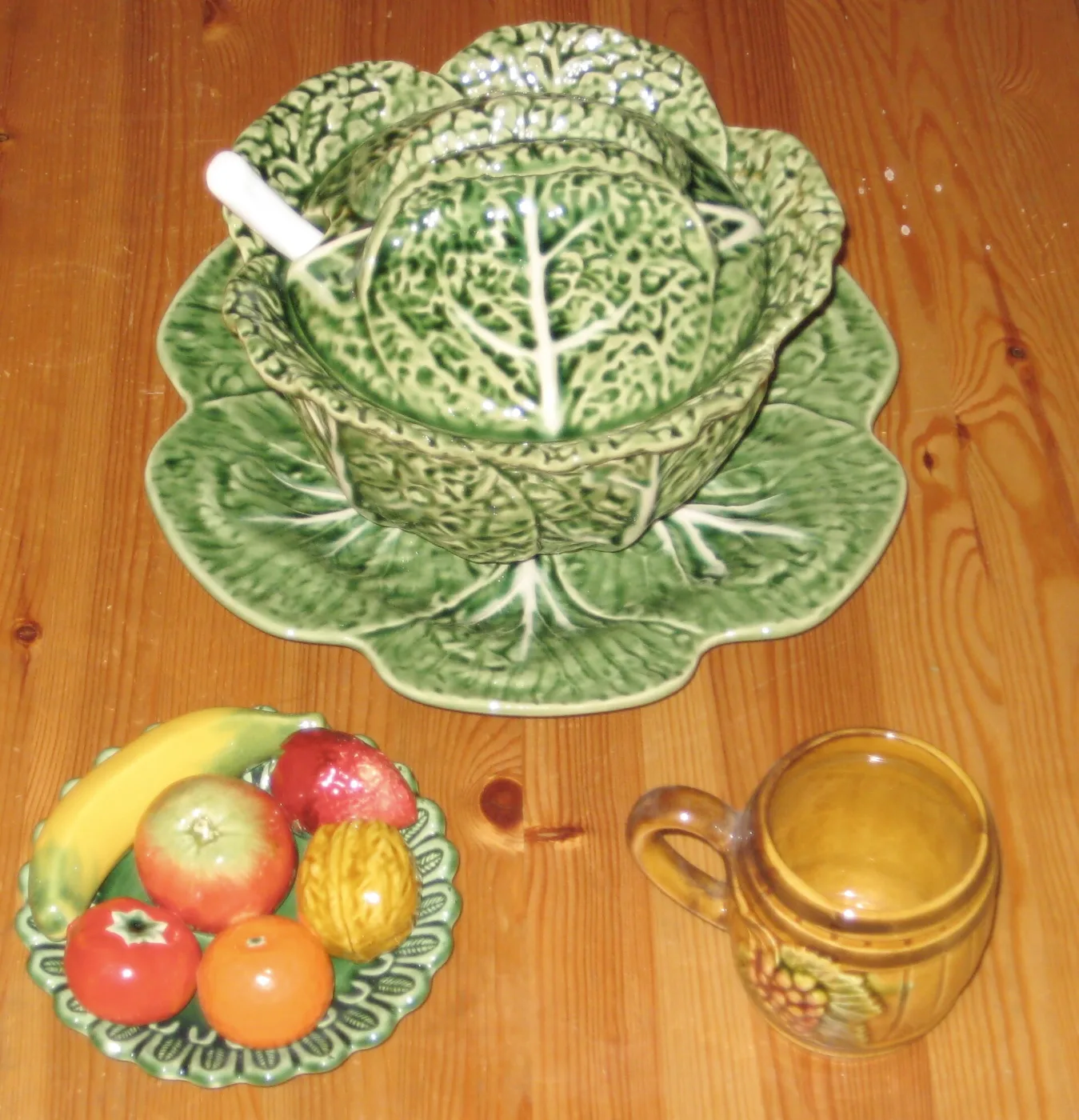
Henriques groups the subjects of the naturalistic ware into three sets. Vegetables included cabbage, cucumbers, peppers, turnips, tomatoes, garlic and potatoes. Animals presented as food included lobsters, mussels, oysters, grouper, bream and sea bass. Live animals included ducks, frogs, beetles, bees, snakes and lizards. In its reworkings of traditional Portuguese pottery forms, the factory also used isolated applied decoration such as small frogs or branches with flowers or fruit. Alongside this ware it made dinner services in powdered stone, decorated with printed motifs alluding to Portuguese references or painted in a style close to Art Nouveau, and tiles, its own branch of Portuguese azulejos, in revivalist, naturalistic and Art Nouveau patterns.
The Metropolitan Museum of Art holds a round glazed earthenware plate with a lobster, dated 1889 and measuring 45.1 centimetres, given in 2020 in celebration of the museum's 150th anniversary; its catalogue entry suggests that the plate heralds the surreal works of Salvador Dalí. In 1891 Bordalo Pinheiro designed tile scenes with frogs, storks, snakes and birds for the Tabacaria Mónaco. A vase with lobsters created in 1904 by Rafael and his son Manuel Gustavo is in the permanent collection of the Museu de Cerâmica in Caldas da Rainha, and Grupo Visabeira reissued it in 2024 for the brand's 140th anniversary. AFP reports that his swallow figures, the andorinhas, appear in many Portuguese homes as symbols of family and home.
EXHIBITIONS, LARGE PIECES AND THE 1891 CRISIS
At the 1889 Paris World's Fair, where Bordalo Pinheiro designed the decoration of the Portuguese pavilion, his ceramics enjoyed what Henriques calls remarkable success, and the French state made him a member of the Legion of Honour. Serra adds that many of the orders taken in Paris went unfilled for lack of funds. In 1892 the factory produced neo-Manueline decoration for the Portuguese pavilion at the Colombian Exhibition in Madrid. The Talha Manuelina, about 2.40 metres tall, was known as the Talha dos Operários because the workers asked for it so they could share the proceeds of its sale; King Carlos acquired it in 1893.
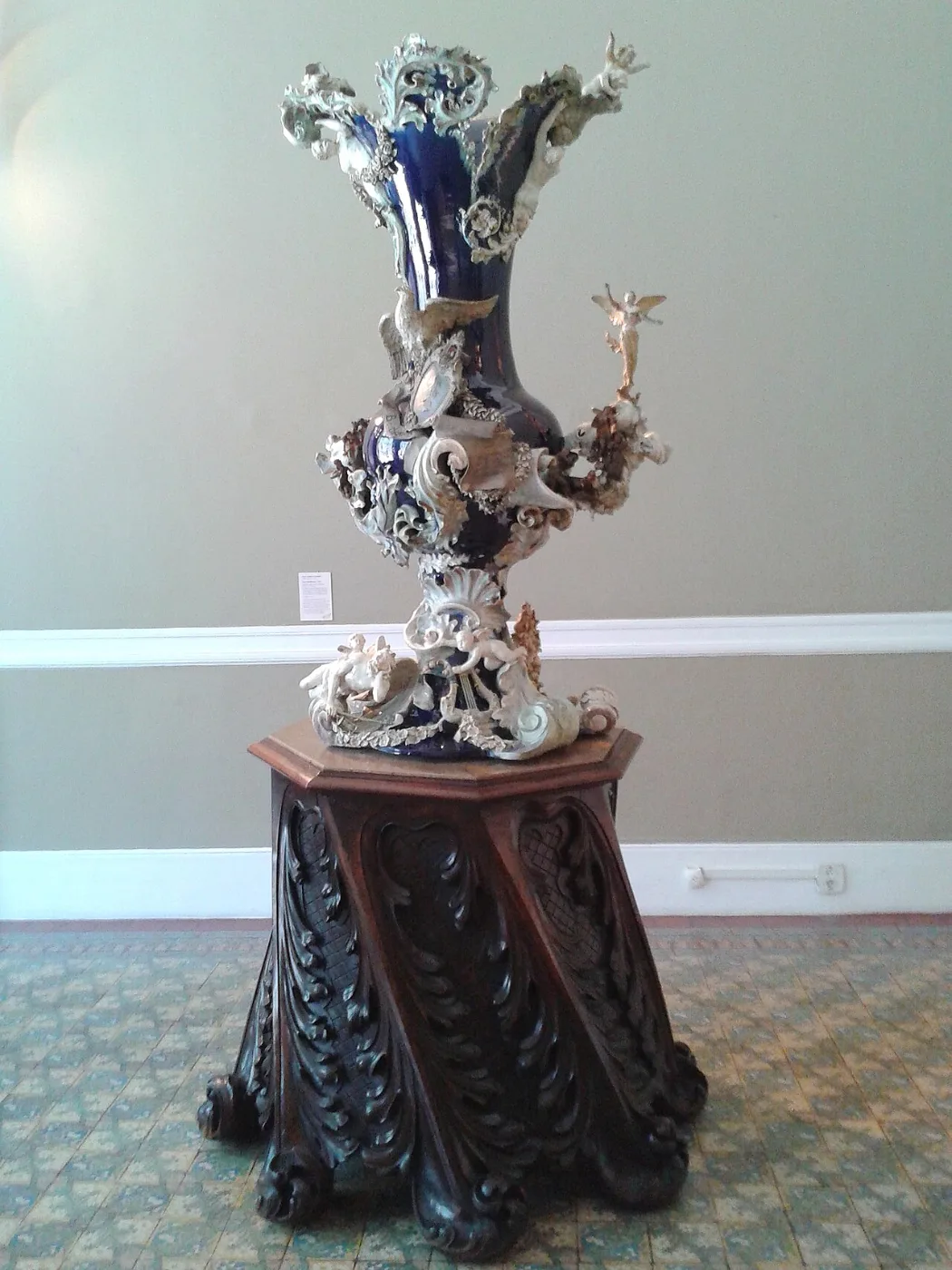
The Beethoven jug was produced between 1896 and 1898, originally for Carlos Relvas. Refused because of its size, it was exhibited at the Teatro D. Amélia in Lisbon in late 1898 priced at 5 contos and found no buyer; Rafael later took it to Brazil and gave it to the Brazilian head of state. AFP reports that it stands outside the National Museum of Fine Arts in Rio de Janeiro. The financial crisis of 1891 ended the utilitarian sector: of the roughly 150 workers employed in August 1888, about 40 remained, and the factory turned to decorative tiles and artistic faience. In the early 1900s it produced the ceramic decoration for the Panificadora de Campo de Ourique, a bakery in Lisbon.
WHAT HAPPENED TO BORDALLO PINHEIRO AFTER 1905

After Rafael's death, his son Manuel Gustavo Bordalo Pinheiro (1867 to 1920) took charge of the factory between 1906 and 1908. Serra records that the Banco de Portugal enforced the company's debt, and in January 1908 the factory was auctioned and bought for 7 contos by Manuel Godinho Leal, a landowner from the Alentejo. Manuel Gustavo then set up a new workshop, registered as the Fábrica Bordalo Pinheiro and inaugurated on 5 November 1908, which kept producing his father's models. In 1924 the family lost control of the company, which became Faianças Artísticas Bordalo Pinheiro, with new shareholders from Caldas.
In Lisbon, the Museu Bordalo Pinheiro grew from the collection of Arthur Ernesto Santa Cruz Magalhães (1864 to 1928), a poet, pamphleteer, critic and humorist. In 1913 the architect Álvaro Augusto Machado was commissioned to design a villa at Campo Grande to house it, and the museum opened in 1916. Its bequest to the city was completed in 1924, and it reopened in 1926 with ceramics and a library added. Its ceramics collection holds around 1,000 pieces of artistic and everyday faience from the Caldas factory, from unique works to mass-produced models.
Grupo Visabeira acquired the Caldas company in 2009. AFP reported in 2018 that the firm's outlook had been bleak before the purchase, that the factory had moved from its original central site to the outskirts of the town, and that the old site was by then a museum and shop. The workforce stood at 180 at the time of the purchase and was being expanded to 255, and sales had tripled since 2009. The artist Joana Vasconcelos ordered pieces while the firm was in difficulty and later became one of its guest designers. Grupo Visabeira states that the factory still uses much of its centuries-old technique to reproduce the historic models.
PORTUGUESE CERAMICS AND THE DINING ROOM AT TASCA
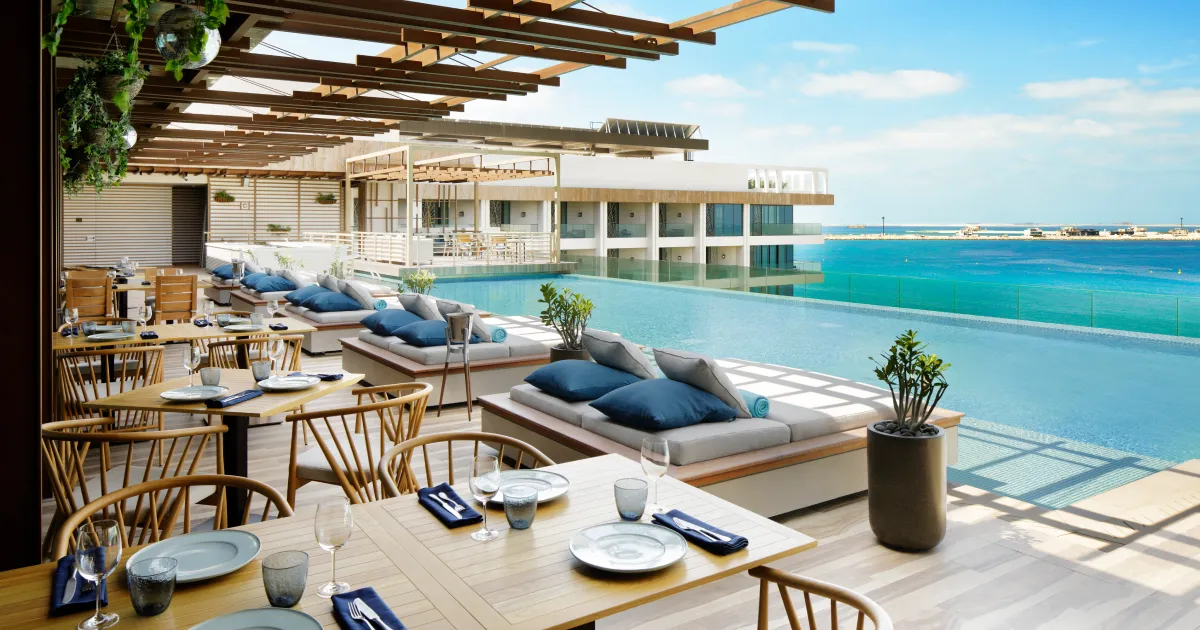
Most Bordallo Pinheiro pieces are still made by hand, with only a few pressed mechanically, and AFP put exports at about half of production in 2018. Grupo Visabeira lists France, Italy, Spain, the United Kingdom, the Netherlands, Sweden, the United States and Japan as the brand's main international markets. In Dubai, Tasca at Mandarin Oriental Jumeira is a contemporary Portuguese restaurant by chef José Avillez, completed in 2019 with a terrace and a bar. The restaurant holds One MICHELIN Star, and its rooftop terrace overlooks the Arabian Gulf.
Inside, timber tables sit beneath a slatted ceiling, and the bar is fitted with marble counters. Turquoise glassware and blue cushions bring colour into the room, and ceramics are displayed on illuminated shelving. In Caldas da Rainha, where the Bordallo Pinheiro factory was founded, UNESCO counts two large industrial ceramic units and around 17 craft workshops still in operation, working in a tradition the organisation dates back about 500 years. The town's ceramics, according to UNESCO, shape its education, economy and culture.
SOURCES
- Museu Bordalo Pinheiro A National Ceramics Factory
- Museu Bordalo Pinheiro The origins
- Museu Bordalo Pinheiro Ceramics
- Análise Social João B. Serra, Arte e indústria na transição para o século XX: a fábrica dos Bordalos (1988)
- The Metropolitan Museum of Art Round plate with lobster
- Infopedia Rafael Bordalo Pinheiro
- Britannica Bernard Palissy
- UNESCO Caldas da Rainha, Creative Cities Network
- AFP via Malay Mail New lease of life for Portugal's booming ceramics bastion
- Grupo Visabeira Bordallo Pinheiro, Peça do Ano (press release, February 2024)