A SOUTHWARK MARKET OF CHARTERS, TRUSTEES, IRON HALLS AND RAILWAY ARCHES

Borough Market history runs from produce sold at the southern end of London Bridge to a charitable food market of iron halls and railway arches in Southwark. The London Museum records grain, fish, vegetables and cattle being sold in Southwark by 1014, and the market has traded on its present site, a plot once known as The Triangle, since an Act of Parliament moved it off the street in the 1750s. Its buildings include market halls designed by Henry Rose in 1851, an entrance of 1932 and a cast iron portico brought from Covent Garden in 2004, all set among railway viaducts, the newest of them built for the Thameslink Programme. For most of the 19th and 20th centuries Borough was a wholesale fruit and vegetable market; it turned to retail food from the late 1990s.
WHERE DID BOROUGH MARKET COME FROM?
Borough Market presents its past as 1,000 years of history, a figure based on early records of trade in Southwark rather than on a founding date. According to the London Museum, records show grain, fish, vegetables and cattle being sold in Southwark, which it calls London's oldest suburb, by 1014. The historian Stephen Halliday, writing in History Today, cites a document of 1276 that complained of the market becoming a nuisance by spreading onto the south side of London Bridge. The London Museum dates the first formal mention of a fruit and vegetable market to the same year, when the trade moved to the High Street, and the archive record of the Borough Market Trustees describes the move as one from London Bridge to the King's Highway, now Borough High Street.
Borough Market's own timeline records a City of London ban in the 1270s that stopped citizens buying food in Southwark and barred traders from setting up on the bridge. Separate markets operated in the area until the 15th century, when, according to the London Museum, they merged. An annual three-day fair began around the same time, and Southwark Fair, held each September, became one of the most riotous events in London. By the 16th century the street was so congested that women selling produce from baskets were not permitted to sit down and had to carry their wares without a break.
THE CHARTERS AND THE 1756 BOROUGH MARKET ACT

Control of the market passed to the City in 1550, when Edward VI granted a charter conferring market rights on the Lord Mayor and citizens. Borough Market's timeline records that the City, which had fought for control for centuries, extended trading from two days a week to four. In 1671 a charter of Charles II fixed the limits of the market, which Halliday describes as running from the southern end of London Bridge to St Margaret's Hill, near the present Guy's Hospital, and to the site of the former Tabard Inn in Talbot Yard. In 1676 a fire destroyed the market house, the administrative centre of the market, which had also kept the grain dry.
By 1754 the stalls were obstructing the growing traffic on Borough High Street, and a bill went before Parliament to stop the market trading on the grounds that it "obstructs much trade and commerce". The resulting Borough Market Act, dated 1756 by Halliday and the London Museum and 1755 in the trustees' archive record, abolished the street market and gave the parish of St Saviour, Southwark, now Southwark Cathedral, the right to hold a market on a new site. Southwark residents raised £6,000, which the London Museum puts at over £1 million today, to buy a plot south of St Saviour's known as The Triangle. It remains the centre of the market.
WHO RUNS BOROUGH MARKET? THE TRUSTEES
The Act placed the new market in the hands of the parish. According to the archive record of the Borough Market Trustees on AIM25, the churchwardens, overseers of the poor and inhabitants of St Saviour's were empowered to buy land and became trustees of the market. The same Act established 120 commissioners, gave the trustees the right to hold a market and levy tolls, and directed that the profits of the market be used to reduce the parish rates. The London Museum quotes the 1756 Act's description of the site as an estate "for the use and benefit of the parish forever", and notes that the charitable trust it created still manages the market.
Later legislation shaped the trust further. The AIM25 record notes that the number of trustees was limited to 21 in 1907, and that later Acts allowed the trustees to issue bye-laws and barred any other market within 1,000 yards. The site was enlarged in 1862 and again in 1932, when Three Crown Square was closed, and the record gives its area as four acres. Halliday describes a board of 16 trustees who are required to live in the vicinity of the market. Borough Market today describes itself as a charity run by a board of volunteer trustees, responsible for making sure the market benefits shoppers, traders and neighbours.
BOROUGH MARKET HISTORY IN IRON AND GLASS, 1851 TO 1932

The oldest market buildings date from 1851, when halls designed by Henry Rose were added. Halliday notes that Rose had earlier redesigned the nave of St Saviour's, and that further work followed in 1863 to 1864 by Edward Habershon. He attributes the Gothic character of the halls and their elaborate wrought ironwork to both architects being chiefly associated with church design. The London Museum describes Rose's structures as glass and iron and notes that they are still standing. They appear in an 1872 wood engraving of the market by Gustave Doré and François Pannemaker held in its collection.
Southwark Council's 2006 conservation area appraisal for Borough High Street describes the market as an assembly of canopies and open sided sheds arranged around an internal street that meets Stoney Street roughly opposite Park Street, with light curved steel trusses supporting a glazed roof on cast iron columns. The appraisal records the 1932 addition of the entrance to the market among the buildings sweeping into Southwark Street, and places the monumental portal to Borough Market at Nos. 6 to 8 Southwark Street, in the centre of the block between Stoney Street and Bedale Street. Halliday describes this Southwark Street entrance of 1932 as Art Deco, and the London Museum also dates the Art Deco entrance to the 1930s.
HOW THE RAILWAY VIADUCT CROSSED BOROUGH MARKET

The railway companies wanted access to produce from Kent and Sussex, but, as Halliday explains, the 1756 Act did not allow the market to give up land for tracks. Under an arrangement of 1860, the companies received a "flying" leasehold to build a viaduct over the market, which continued to trade beneath the arches, and the trustees receive compensation whenever the viaduct is widened. Borough Market's timeline dates the viaduct's arrival to 1862, the year the trustees' archive record links to the South Eastern Railway extension to Cannon Street and Charing Cross, and Southwark Council dates the link between London Bridge and Cannon Street stations to 1866. The railways made Borough a major wholesale centre for fruit and vegetables.
The most recent widening came with Network Rail's Thameslink Programme. A new Borough Viaduct, 507 metres long and running above the market area, was built to double the number of tracks leaving the western end of London Bridge station and give Thameslink two dedicated tracks. Over the bank holiday weekend of 30 April to 1 May 2011, a 72 metre bridge weighing 1,200 tonnes was moved into place over Borough High Street at about 7 millimetres per second. Network Rail noted that in places the new viaduct stands no more than 16 centimetres from existing buildings, and that it runs between listed buildings.
During construction part of the market moved to a temporary site within its grounds, the Jubilee Market. The architects Jestico + Whiles, in a project the practice dates to 2013, record that the 19th century cast iron roofs over the historic market hall were dismantled, restored and reconfigured to fit the geometry of the new viaduct. The temporary structure of tubular steel and ETFE roofing became a permanent expansion of the market, and a new glazed market hall was built beneath the viaduct on the Borough High Street corner, with glazed roofs printed with a leaf pattern.
THE FLORAL HALL PORTICO FROM COVENT GARDEN
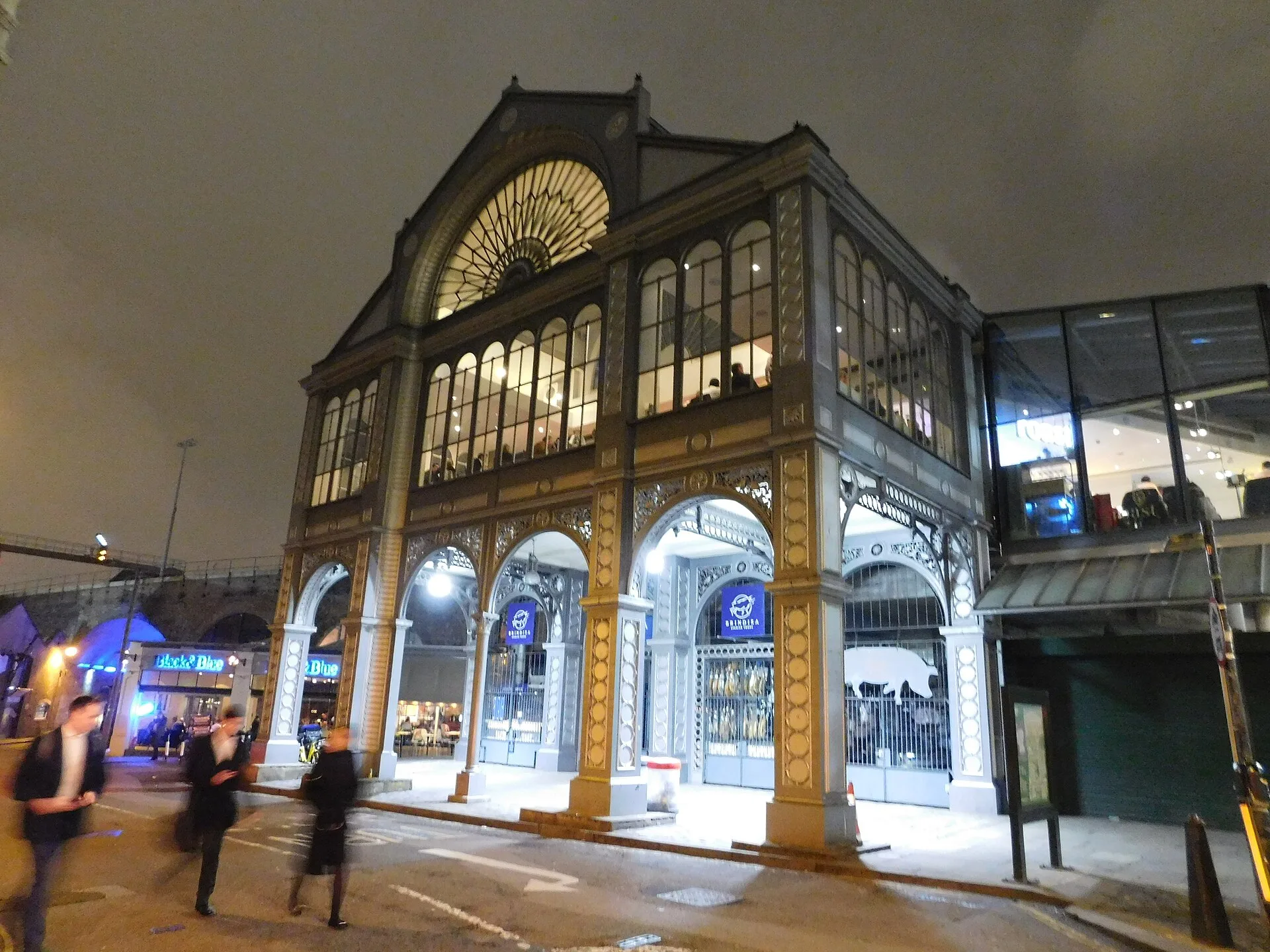
The Floral Hall was built in 1858 to 1859 beside the present Royal Opera House, the third theatre on the Covent Garden site, which Edward Middleton Barry designed and which opened in 1858. Historic England describes the hall as a glass and iron frame structure intended to serve as a concert hall annexe and winter garden, and attributes the portico to Barry. The theatre became the Royal Opera House in 1892, and the roof of the Floral Hall had to be rebuilt after fire damage in 1956.
During a large extension programme at Covent Garden, the southern portico of the Floral Hall was taken down in the early 1990s and put into store. It was then re-erected as a frontage to Borough Market, opened in 2004, and Southwark Council's appraisal places the re-erected cast iron elements in Stoney Street. The portico was listed at Grade II on 14 April 2008. Historic England's entry describes a cast iron and glass structure of two storeys, three bays wide, with a ground floor arcade, tall round headed windows and a large radial fanlight with sunburst glazing on the first floor, painted silver, and a replacement steel pediment of about 2003.
WHEN DID BOROUGH MARKET BECOME A RETAIL FOOD MARKET?
In 1930 an offer of sponsorship from Charlie Chaplin turned the traders' annual sports day into a national news story. Borough Market's timeline records that in the 1950s the market remained at the heart of the fruit and vegetable trade, until the growth of supermarkets in the 1980s and 1990s threatened its future. Encouraged by the success of the Food Lovers' Fair in November 1998, Borough began to reinvent itself as a retail market for high quality food. Southwark Council's appraisal dates the opening of the specialist foods retail market, trading on Fridays and Saturdays, to 1999.
The London Museum notes that since the 1990s traders have focused on selling to the public rather than to businesses, while some specialist food retailers have also built wholesale operations supplying restaurants and other businesses. Halliday recorded a wholesale market trading on weekdays from 2am to 8am alongside a retail market open on Thursdays, Fridays and Saturdays from 9am to 5pm. In 2021, in response to customer demand, the market opened on Sundays for the first time in its recent history.
GORDON RAMSAY PUB & BAR AND LONDON'S RAILWAY ARCHES

The interior design studio Silverfox Studios completed Gordon Ramsay Pub & Bar at The Londoner Macao in 2023. Its design cue is the London Bridge to Greenwich railway viaduct of the 1830s, a line of 878 brick arches, many of which now hold shops, restaurants, bars and pubs. At Borough Market, traders have worked beneath railway arches since a viaduct crossed the site in 1862, and the Thameslink Programme added the 507 metre Borough Viaduct above the market area in the 2010s.
The interior layers steel, timber, metal and cast iron into brickwork and vaults. The dining room sits under arched brick vaults with scalloped ceilings, and the room combines dark green enamel cast iron columns with Victorian pub cabinetry, panelling and mouldings. At Borough Market, cast iron columns carry the glazed roof of the market halls first built to the design of Henry Rose in 1851, and the Floral Hall portico re-erected there in 2004 is also of cast iron and glass.
SOURCES
- History Today Underneath the Arches: Celebrating Borough Market
- Borough Market History
- London Museum Borough Market: London's oldest food trading hub
- AIM25 Borough Market Trustees
- Southwark Council Borough High Street Conservation Area Appraisal
- Historic England Resited Floral Hall portico at Borough Market
- Network Rail New landmark bridge launched into place
- Jestico + Whiles Borough Market