HOW SUDIRMAN, THAMRIN, KUNINGAN AND SEMANGGI BECAME JAKARTA'S BUSINESS DISTRICT, FROM THE 1962 ASIAN GAMES TO THE MRT

Jakarta's Golden Triangle, segitiga emas in Indonesian, is the name commonly used for the city's central business district, an imaginary triangle formed by Jalan Jenderal Sudirman, Jalan Gatot Subroto and Jalan H.R. Rasuna Said. Property developers' version of the district in the 1980s also took in Jalan M.H. Thamrin. Its roads and buildings came in stages. Contingents at the 1962 Asian Games were driven along a revamped Sudirman and Thamrin, Rasuna Said was completed in 1979, and the Sudirman Central Business District (SCBD) was launched in 1993. The Semanggi Interchange opened in 2017, the first MRT line reached Bundaran HI in March 2019, and in 2022 the 382.9 m Autograph Tower on Jalan Thamrin was completed as Indonesia's tallest building.
WHAT IS JAKARTA'S GOLDEN TRIANGLE?
A 2023 master's thesis on the Kuningan area, held by the library of the Institut Teknologi Bandung (ITB), describes Segitiga Emas Jakarta as the term popularly used for the city's central business district, formed by three main roads: Jalan Jenderal Sudirman, Jalan Gatot Subroto and Jalan Rasuna Said. Jakarta's spatial plan to 2030 calls the same location Segitiga Emas Setiabudi and designates it an integrated international commercial zone built on a superblock concept. The thesis also describes the area as a diplomatic enclave. Property developers began promoting the district in the 1980s, defining it as Thamrin, Sudirman, Gatot Subroto (Semanggi) and Rasuna Said, and the term segitiga emas became popular in the property market in the 1990s.
Encyclopaedia Britannica places Jakarta at the centre of roughly one fourth of Indonesia's trade and services and two thirds of its banking and financial sectors. Industrial development and new housing are usually built on the outskirts, while commerce and banking remain concentrated in the city centre, where land is expensive and rents are high. The subdistrict of Karet Kuningan covers 1.79 km², or 20.23% of the Setiabudi district, and is enclosed by Jalan Prof. Dr. Satrio, Jalan Jenderal Sudirman and Jalan Rasuna Said, according to the ITB thesis. The thesis notes that Jalan K.H. Mas Mansyur, which runs from Tanah Abang to Karet, had already been built by the 1960s.
HOW DID THE 1962 ASIAN GAMES SHAPE THAMRIN AND SUDIRMAN?

Jalan Jenderal Sudirman began as a link road. The ITB thesis records that after the satellite town of Kebayoran Baru was completed in the 1950s, building continued with connecting roads such as Jalan Jenderal Sudirman and then Jalan Gatot Subroto. Jakarta hosted the 1962 Asian Games. A 2015 Jakarta Post feature on the 187-postcard collection of Scott Merrillees, published as Jakarta: Portraits of a Capital 1950 to 1980, records that Games contingents were driven along the revamped Jalan Jenderal Sudirman and Jalan Thamrin. The route passed statues of a young man and a young woman waving from the top of a tall pedestal, and the athletes competed at the brand new Gelora Bung Karno sports complex. In 1971, the thesis notes, Sudirman was still empty, with no significant development apart from the Gelora Bung Karno stadium complex.
Hotel Indonesia opened on 5 August 1962. Its architects were the American Abel Sorensen and his wife, Wendy Becker, and the 406-room hotel stood on 25,082 m² of land in a T plan: the 15-storey Ramayana Wing formed the top of the T and the eight-storey Ganesha Wing its stem. The Jakarta Post describes it as a social centre of Jakarta in the 1960s and much of the 1970s. The Sarinah Building was the country's first modern shopping centre, according to the South China Morning Post. The final postcards in Merrillees's collection record midday traffic on Jalan Thamrin and Jalan Hayam Wuruk, which the Jakarta Post calls the embryos of today's infamous congestion. Britannica lists traffic congestion as a major problem for the city.
HOW DID KUNINGAN AND RASUNA SAID COMPLETE THE GOLDEN TRIANGLE?

Kuningan, on the triangle's eastern side, was an informal settlement lying between four planned residential centres: Menteng, Tebet, Bendungan Hilir and Kebayoran Baru. The ITB thesis records that it was known as kampung susu sapi, the dairy-cow village, and that batik making had developed there since 1910. The Kuningan Project began in 1970, a permanent bridge from Menteng to Kuningan replaced a temporary one, and the area's public roads were first paved in 1975. Jalan Rasuna Said, which became the eastern boundary of the Golden Triangle, was built from the 1970s, completed in 1979 and in operation in the 1980s. Its construction completed the imaginary triangle with Sudirman and Gatot Subroto.
Major multinational companies and embassies moved their offices to Kuningan, and its eastern side developed into a complex of foreign embassies. In 1993 Artha Graha launched SCBD as a business centre for financial companies. Jalan Prof. Dr. Satrio was projected as a shopping belt along the lines of Orchard Road in Singapore, and from 1997 nine large developers obtained permits to build on it, among them PT Danamon, PT Jakarta Setiabudi Internasional, Jakarta Land and PT Putra Surya Perkasa. On the Rasuna Said corridor, Pasar Festival and the Sumantri sports hall were developed in 1995. Superblocks followed from the 2000s, and foreign embassy offices became concentrated in the area. ITC Kuningan was completed in 2003, and Mall Ambassador, by the same developer, Sinar Mas Land, in 2005. In the Rasuna Epicentrum development, Universitas Bakrie opened in 2005 beside Pasar Festival, and Epicentrum Walk followed in 2009. Kuningan City and Kota Kasablanka were operating by 2012, and Ciputra World by 2013, according to the ITB thesis.
HOW WAS THE SEMANGGI INTERCHANGE BUILT?
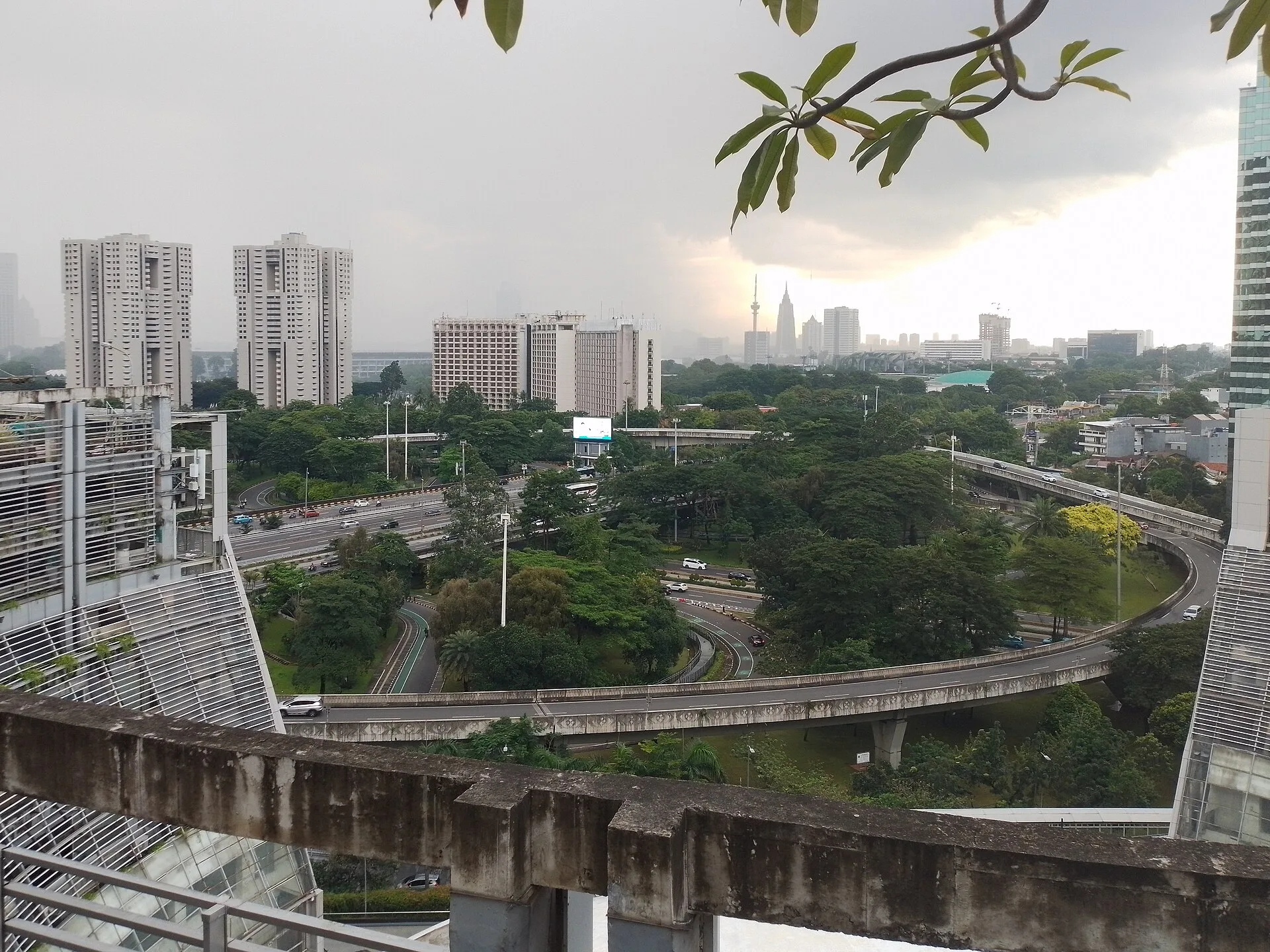
Semanggi is the local word for cloverleaf, and the Jakarta Post describes the Semanggi Interchange as an expansion of the city's iconic Semanggi cloverleaf. The interchange had its soft launch at 8.20 pm on Friday 28 July 2017. It runs for 1.8 km on two ramps. The first, 796 m long, links Slipi in West Jakarta with Blok M in South Jakarta. The second, 826 m long, links Cawang in East Jakarta with the Hotel Indonesia traffic circle in Central Jakarta. The interchange was expected to reduce congestion in the area by 30%. Leftover funds were set aside to repair the pavements along Jalan Sudirman up to Bendungan Hilir and along Jalan Gatot Subroto from the Kartika Chandra Hotel to Taman Ria Senayan.
The state-owned contractor PT Wijaya Karya built the interchange in 15 months and finished two months ahead of schedule. It cost Rp360 billion (US$27.1 million), against an original budget of Rp579 billion, and was built without city funds: it was fully financed by Mitra Panca Persada, a subsidiary of the Japanese property firm Mori Building Company. Load tests showed it could bear up to 480 tonnes. The structure is designed with a traditional Betawi motif called gigi balang and with cloverleafs, and thousands of LED lamps on it change colour and pattern every few seconds.
HOW DID JAKARTA'S GOLDEN TRIANGLE SKYLINE GROW?
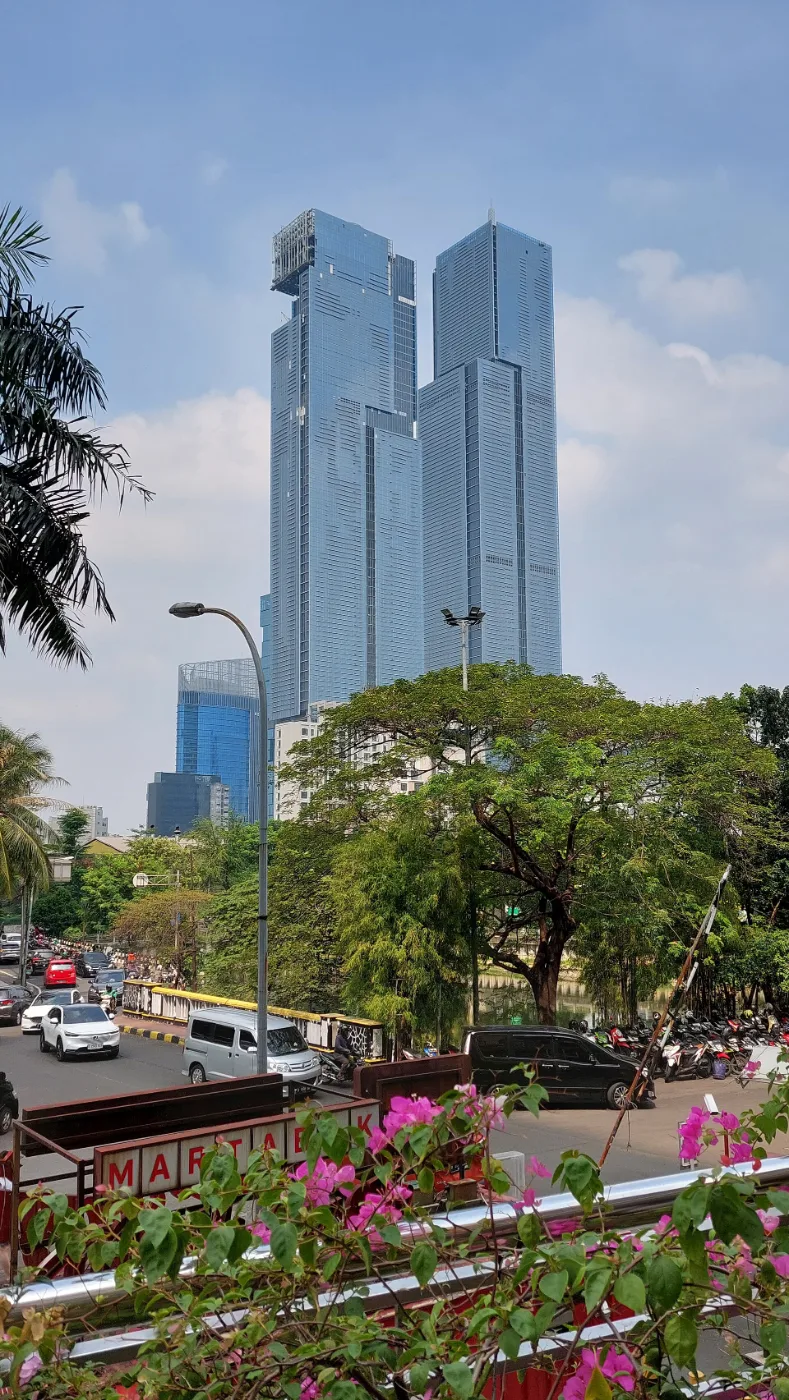
The Council on Tall Buildings and Urban Habitat (CTBUH) lists Wisma 46, completed in 1996 at 261.9 m, as Jakarta's first building of 150 m or more. In Kuningan, Gama Tower, also called Menara Rasuna and Cemindo Tower, stands at Jalan H.R. Rasuna Said Kav. C22. CTBUH records it as 285.5 m tall, with 64 floors above ground and four below, built from 2011 to 2016 for hotel and office use, designed by PT Sekawan DesignInc Arsitek and developed by PT Wahana Nusantara. The Westin Jakarta was introduced in August 2016 between the 50th and 69th floors of the tower, with up to 272 rooms. The Jakarta Post reported that it was dubbed the city's tallest hotel.
CTBUH records the Autograph Tower, also called Thamrin Nine Tower 1 and Waldorf Astoria Jakarta, as 382.9 m tall, with 75 floors above ground, six below and an occupied height of 322.6 m. Construction started in 2014 and was completed in 2022. The architect was Kohn Pedersen Fox Associates, the structural engineers were Meinhardt and Wiratman, and the developer was PT Putra Gaya Wahana. The tower has a concrete and steel composite structure and holds a hotel and offices. CTBUH ranks it first in Jakarta and Indonesia, 37th in Asia and 55th in the world, and describes the Thamrin Nine complex as highly visible along Jalan Thamrin.
WHAT IS BUNDARAN HI, AND WHEN DID THE MRT REACH IT?

Bundaran HI is the Hotel Indonesia Roundabout, with the Welcome Monument and its two giant waving figures at its centre, according to the South China Morning Post. CTBUH places the Thamrin Nine complex near the Bundaran HI Monument. Hotel Indonesia was redeveloped in the 2000s. The property was leased to the Djarum Indonesia Group for 50 years, renovation began in 2004, and the building reopened as Hotel Indonesia Kempinski in 2009. The developer had to preserve the original structure and facade but was given a free hand to redesign the interior. Nearby, the Grand Hyatt Jakarta is part of the Plaza Indonesia mixed-use complex.
The first phase of MRT Jakarta was inaugurated at Bundaran HI Station on Sunday 24 March 2019. It covers 13 stations along a 15.7 km route from Lebak Bulus Station in South Jakarta to the Hotel Indonesia traffic circle in Central Jakarta, passing through Senayan and Dukuh Atas. Free trial rides ran until 31 March and commercial service began on 1 April, with eight trains running from 5.30 am to 10.30 pm in the first month, later to rise to 16 trains running from 5 am to midnight. A 7.8 km second phase was planned to continue from the traffic circle to Kota Station in West Jakarta.
HENSHIN AT THE WESTIN JAKARTA

Henshin, a Nikkei restaurant and rooftop bar at The Westin Jakarta, opened in 2017 on floors 67 to 69. Silverfox Studios designed all three of Henshin's floors and its arrival tunnel. The Westin Jakarta, with up to 272 rooms, occupies the 50th to 69th floors of the mixed-use Gama Tower, so Henshin's three floors are the top three of the hotel. The name henshin means transformation. The restaurant's chef, Hajime Kasuga, is a third-generation Japanese Peruvian, and the menu follows the Nikkei tradition.
On level 69, the uppermost of the three floors, a large bingata pattern spans the ceiling. The interior also uses translucent, blue-lit forms shaped as sake barrels. Gama Tower stands on Jalan H.R. Rasuna Said in Kuningan, the road that completed the Golden Triangle's eastern side in 1979. CTBUH records the tower, also called Menara Rasuna and Cemindo Tower, as 285.5 m tall, built for hotel and office use and completed in 2016, the year The Westin Jakarta was introduced on its upper floors.
SOURCES
- Institut Teknologi Bandung Ahmad Zuhdi, Gambaran Umum Kawasan Kuningan (master's thesis, chapter 4), 2023
- Encyclopaedia Britannica Jakarta: Economy
- The Jakarta Post Yuliasri Perdani, Sukarno's vision of a modern capital, 2015
- South China Morning Post Inside Indonesia's first five-star hotel, in Jakarta, and its part in building a nation
- The Jakarta Post Callistasia Wijaya, Semanggi Interchange opens to motorists, 2017
- Council on Tall Buildings and Urban Habitat The Skyscraper Center: Jakarta
- Council on Tall Buildings and Urban Habitat The Skyscraper Center: Gama Tower
- The Jakarta Post Jakarta's tallest hotel set to attract business travelers, 2016
- Council on Tall Buildings and Urban Habitat The Skyscraper Center: Autograph Tower
- The Jakarta Post MRT Jakarta officially rolls out, 2019