BEFORE OIL, DUBAI'S COAST LIVED ON FISHING, TRADE AND THE SUMMER PEARL DIVE
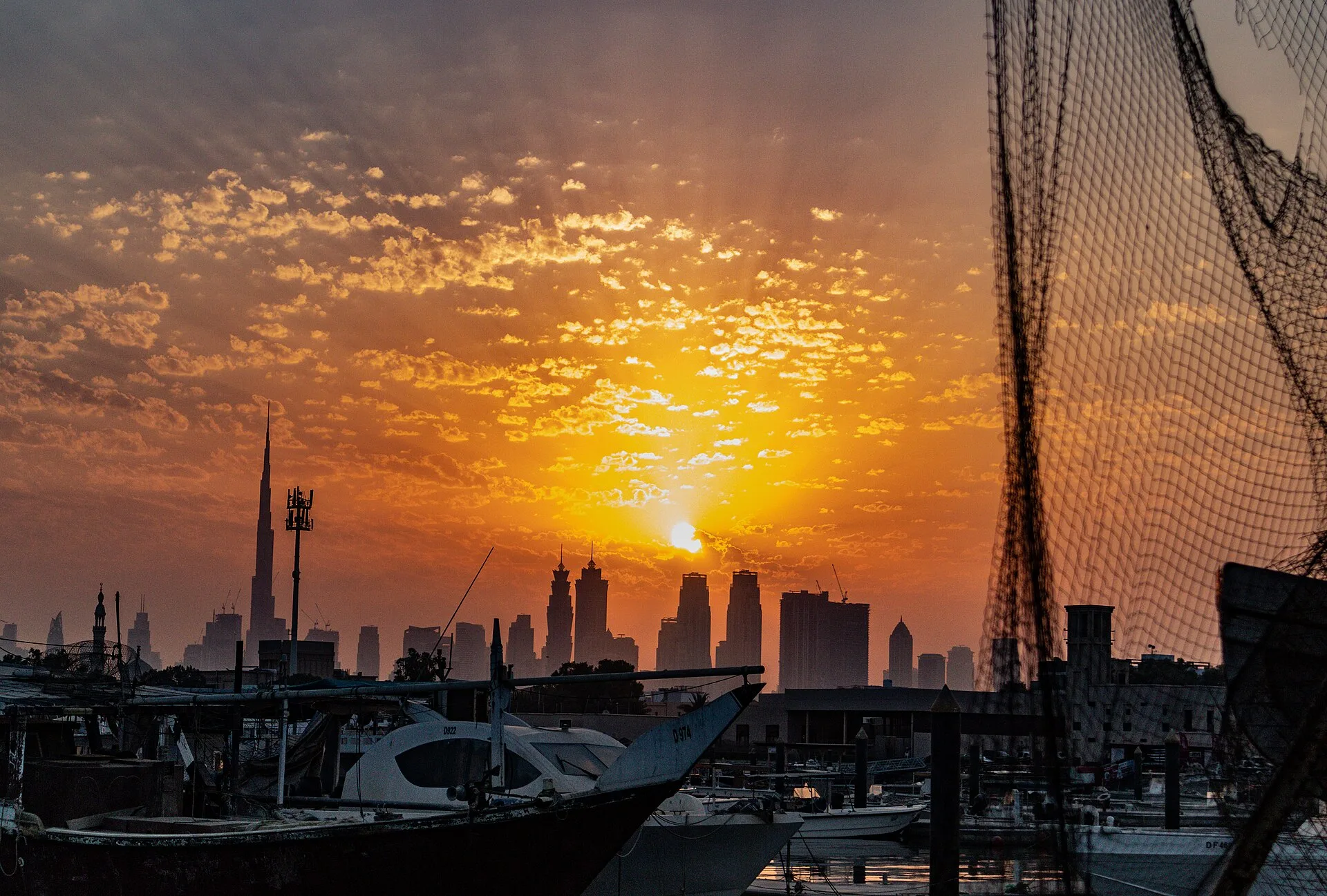
For most of its recorded history, the coast where Jumeirah now stands supported fishing, trade and pearl diving. About a thousand years ago a trading settlement of the Abbasid period stood here, with a market, a caravanserai and houses. In 1908 a British gazetteer recorded Jumairah as a village of 45 palm-branch huts whose people were all fishermen, three miles from a town of about 10,000 that sent some 335 boats to the pearl banks. Pearling dominated the economy of the Gulf until the 1930s, when Japanese cultured pearls and the Depression brought it down, and oil later replaced it. The history of Jumeirah and old Dubai before the towers is largely the history of Dubai pearl diving: who financed the boats, how the summer season worked, what the divers carried and why the trade ended within a generation.
JUMEIRAH'S ABBASID TRADING SETTLEMENT
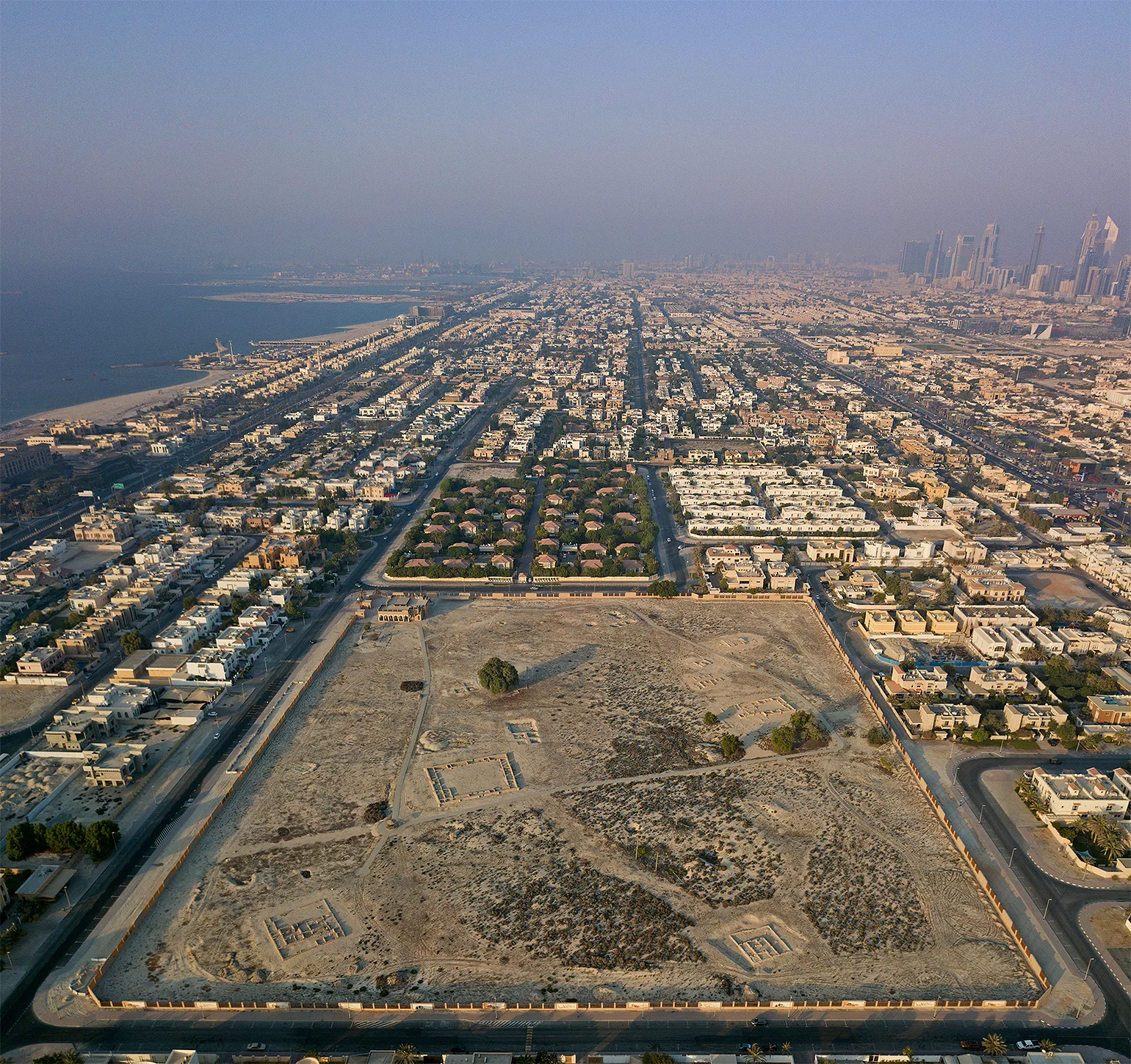
The oldest known settlement on this stretch of coast is the Jumeirah Archaeological Site, about 80,000 square metres of ground in the district of Jumeirah 2. Gulf News reported in 2008 that a team from the American University of Beirut explored the site in 1969, that an Iraqi archaeological team uncovered its first buildings and artefacts in 1974, and that Dubai's tourism department had been excavating it since 1993. Nine structures survive. Seven had been identified by then, including a souq, a workshop later converted into a mosque, a caravanserai and a large residence believed to be the ruler's house. Finds include coins of the Abbasid era, pottery from southern Iraq, and terracotta and stonework from China. The archaeologist Hussain Qandil believed the town extended from the beach inland towards the area of Al Safa Park.
A 2024 study by Karol Juchniewicz and Agnieszka Lic of the Polish Academy of Sciences, published in the journal Études et Travaux, calls Jumeirah a key site for understanding the Abbasid period in eastern Arabia but one that remains severely understudied. Their analysis of the carved stucco that decorated its buildings suggests the main occupation was Abbasid, with a possible earlier phase before or in the early ninth century. An earlier reading of the site survives in the title of a 1975 paper cited in the study: An Ancient Caravan Station in Dubai.
OLD DUBAI IN 1908: WHAT LORIMER'S GAZETTEER RECORDED
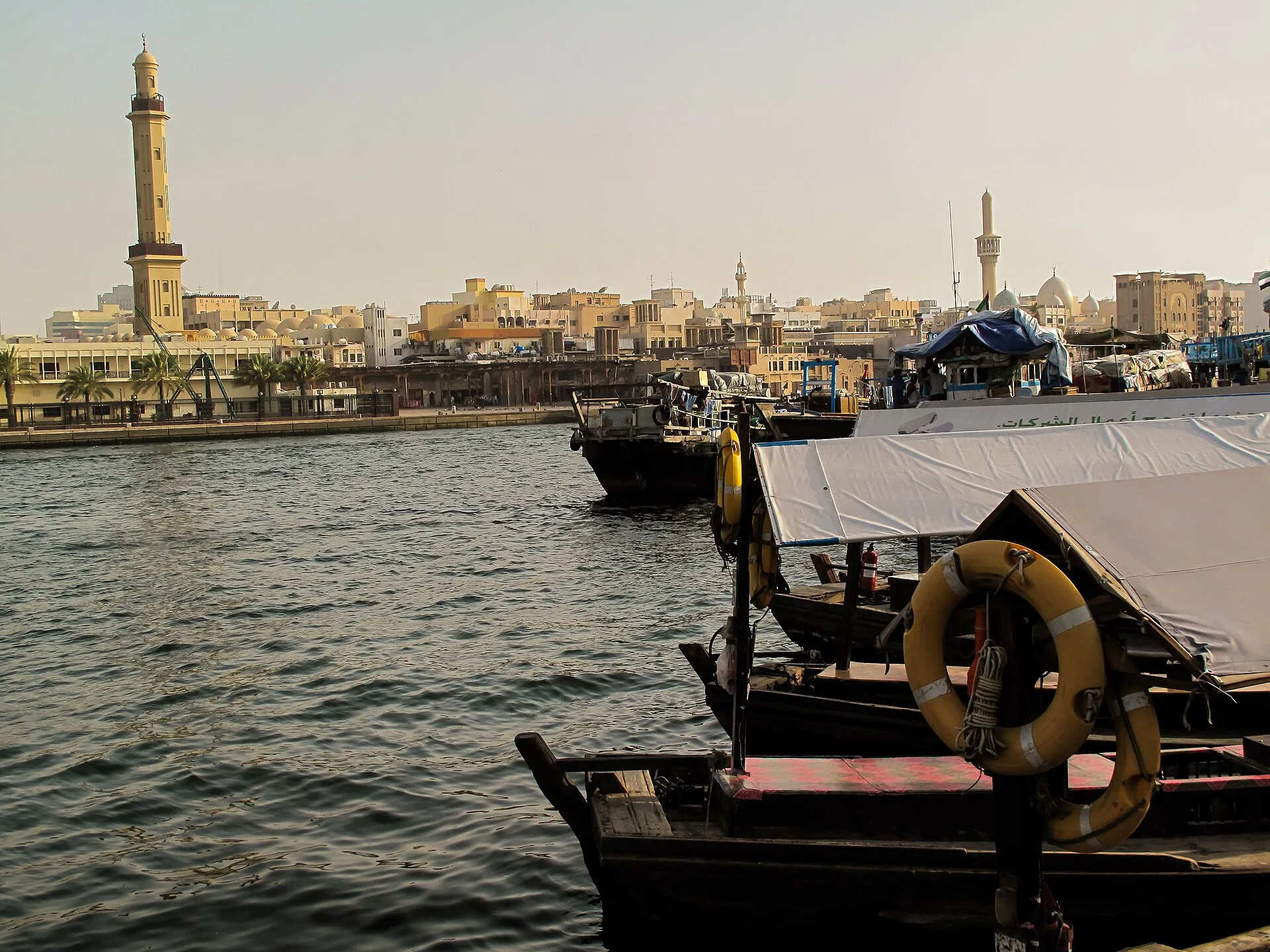
The most detailed early description of Dubai and Jumeirah is in J.G. Lorimer's Gazetteer of the Persian Gulf, whose geographical volume was published in 1908 and is now digitised by the Qatar Digital Library. Lorimer describes Dubai as an independent principality between Sharjah and Abu Dhabi, with Jabal Ali, 220 feet high, as the only hill on the coast. Jumairah appears as a coastal village about 3 miles south-west of the town, with 45 huts built of date-palm branches. Its inhabitants, from the Bani Yas, the Manasir and mixed tribes, were all fishermen and kept 5 camels, 60 donkeys, 45 cattle and 200 sheep and goats. The principality's revenues, about $51,400 a year, came largely from the pearl fisheries.
Dubai town stood on both sides of a creek with a shallow, difficult entrance. Deira, the principal quarter, had about 1,600 houses and a bazaar of 350 shops; Shindagha, nearer the sea, about 250 houses; and Dubai proper about 200 houses, 50 shops and the principal mosque. Ferries linked the two banks. The population was about 10,000. Lorimer counted about 335 pearl boats, 50 fishing boats and 20 seagoing vessels, with 10 to 12 boats built in the town each year. The nearest pearl bank lay about 20 miles out to sea, and about 20 more Hindus came to the town for each pearling season, in addition to the 67 who lived there. Dubai had no customs, and Lorimer described its trade as considerable and expanding rapidly.
HOW THE GULF PEARL ECONOMY WORKED
UNESCO, in its listing of Bahrain's pearling heritage, dates the Gulf pearling tradition from about the 2nd century to the 1930s and describes the Gulf as the best-known source of pearls since ancient times. The trade dominated the region's economy and peaked at the end of the 19th and beginning of the 20th centuries. According to Gulf News, demand rose sharply in the 18th and 19th centuries and trade ties with Indian merchants grew alongside it; families settled permanently in coastal villages, particularly in Abu Dhabi and Dubai, while others moved to the coast each year from May to September for the season. Trade was conducted in Indian rupees.
Dr Mark Hobbs, Gulf history specialist at the British Library, describes an industry that ran on borrowed capital. Merchants, the tawawish, advanced money to boat captains, the nakhudas, and were repaid when pearls were delivered. The nakhudas owned or hired the boats, fed and clothed their crews and gave them advances at the start of each season. Lorimer's figures show the scale: he valued the industry at £625,933 in 1873 to 1874 and £1,076,793 in 1904 to 1905, and in 1905 Bahrain alone employed 917 boats and more than 17,500 men. Abu Dhabi had 410 pearl boats, Doha 350 and Dubai 335.
Other observers left their own figures. James Wellsted, writing in 1838, reported 3,500 boats at Bahrain at the height of the season and 700 more between Qatar and Oman. Lewis Pelly, in 1865, put the number at Bahrain at 1,500, yielding a profit of £400,000 a year. Paul Harrison estimated in 1924 that Bahrain's pearls from the 1913 season sold for about nine million US dollars. For the coast that became the UAE, Gulf News gives a peak of more than 1,200 pearling boats, each carrying almost 20 divers. The traveller William Palgrave recalled in 1877 that Sheikh Mohammed bin Thani of Qatar had told him: "We are all from the highest to the lowest slaves of one master, Pearl."
WHAT WAS LIFE LIKE FOR A DUBAI PEARL DIVER?
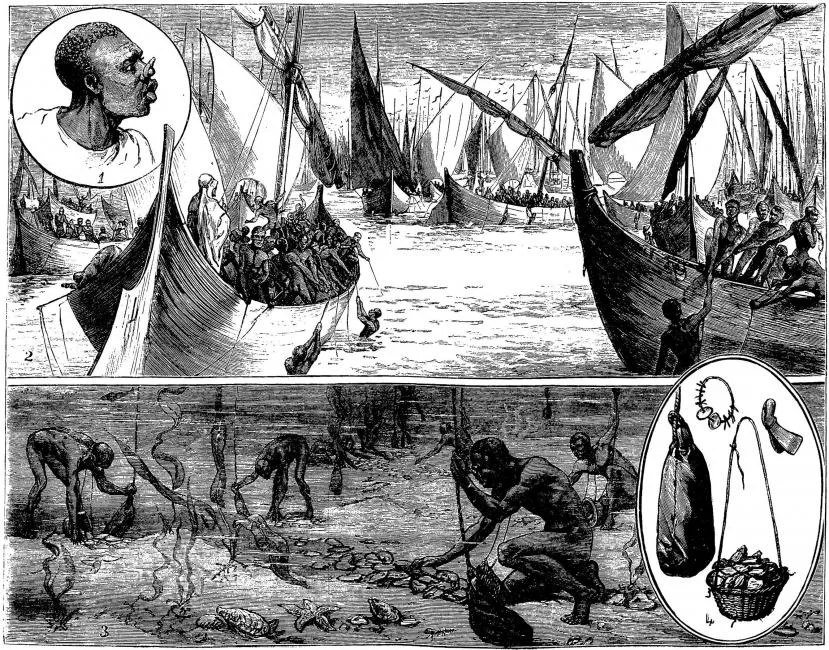
The main season, Ghous Al Kabir or the Big Dive, ran from 1 June to 30 September, with shorter one-month seasons in October and November, according to a Gulf News feature built on National Archives photographs. Khaleej Times, drawing on Dubai Museum and local heritage experts, gives the time at sea as four months and ten days. Crews left port to the song Al Nahham. A boy joined at about nine, prising open oyster shells with a knife, began diving at about twelve and stopped at around fifty. The working day lasted 12 to 14 hours, from before sunrise to sunset, in a pattern of five dives followed by a rest.
The equipment was minimal. A diver wore a nose clip and leather finger guards, carried a rope basket for the oysters and was taken down by a stone weighing about 5 kilograms. A second rope ran to the surface, and a crewman on deck hauled him up when he signalled through it. Khaleej Times puts the average depth at about 10 metres and records that divers on Dubai Creek boats made about 50 dives a day, each lasting roughly three minutes; Gulf News notes that some dives reached 40 metres. A diver earned between 200 and 300 rupees a year.
DEBT AND BONDED LABOUR ON THE PEARL BOATS
The advances that kept boats at sea also bound the men who worked them. Crews were made up of divers, sailors and pullers, who hauled the divers up from the seabed, and Hobbs notes that many of the lowest-ranked workers had been enslaved in Africa and the Asian subcontinent. In a second article for the Qatar Digital Library he explains that most divers were indentured labourers rather than chattel slaves: captains advanced them money for provisions, and sometimes for the winter, and from the mid-1920s these debts grew every year.
As the industry declined, more divers sought formal release. Requests for manumission peaked in the 1930s, and the statements often gave insufficient food and clothing as the reason. Most of the cases involving pearl divers came from the Trucial Coast, the area that is now the United Arab Emirates, where the end of pearling left many residents in deep poverty. By the mid to late 1930s, some divers were describing themselves as labourers for the oil companies.
WHY DID THE GULF PEARL INDUSTRY COLLAPSE?
The collapse came from several directions. Demand fell after the First World War. Mikimoto Kōkichi began developing cultured pearls in Japan in 1916, and cultured pearls, more plentiful than natural ones, sold for as little as a tenth of the price of Gulf pearls. After the 1929 crash, Hobbs writes, the industry suffered a disaster from which it never fully recovered, and the Depression was still affecting the region in the mid-1930s. UNESCO describes the end of the trade as sudden and catastrophic.
From the 1920s, pearling fleets shrank and towns lost people as workers left to find jobs elsewhere. Bahrain's population fell from around 100,000 to 90,000 between 1908 and 1941, and Doha's from 27,000 to 16,000 during the 1930s. In January 1936 the British Political Agent Percy Loch wrote of "a somewhat extraordinary state of affairs" caused by the financial depression and the fall in the value of pearls. By the early 1950s, according to Hobbs, large-scale oil production had largely ended traditional pearling in Gulf waters. Khaleej Times reports that pearl diving in the UAE has all but died out, while cultured pearls are now produced in Ras Al Khaimah.
THE BAY AT MANDARIN ORIENTAL JUMEIRA, DUBAI

The Bay at Mandarin Oriental Jumeira, Dubai, designed by Silverfox Studios and completed in 2019, has a marble buffet counter and white marble buffet stations with chalkboard menus, and a timber-topped bread and pastry island stands under pendant lights. White brick walls rise above a geometric tiled floor, and green banquettes sit under a beamed timber ceiling, with steel-framed glazing. A marble-fronted bar faces the beach terrace and the sea.
SOURCES
- UNESCO World Heritage Centre Pearling, Testimony of an Island Economy
- Qatar Digital Library, British Library Divers are a Pearl's Best Friend: Pearl Diving in the Gulf 1840s to 1930s
- Qatar Digital Library, British Library Twilight of Pearl Trade Sees 'Slave' Divers Seek Freedoms
- Qatar Digital Library Gazetteer of the Persian Gulf, Vol. II, J.G. Lorimer, 1908, p. 454 (Dibai and Jumairah)
- Qatar Digital Library Gazetteer of the Persian Gulf, Vol. II, J.G. Lorimer, 1908, p. 455 (Dibai Town)
- Études et Travaux, Polish Academy of Sciences Abbasid Jumeirah, Dubai: An Overview of the Site and Its Architectural Stucco Decoration
- Gulf News Jumeirah: Digging up the past
- Gulf News Year of the 50th: A look at UAE's pearl diving history
- Gulf News Diving deep into riches of a culture
- Khaleej Times 11 facts about pearl diving in the UAE