FROM A 149-METRE TRADE CENTRE BESIDE A SINGLE-LANE HIGHWAY IN 1979 TO EMIRATES TOWERS, THE METRO RED LINE AND THE MUSEUM OF THE FUTURE
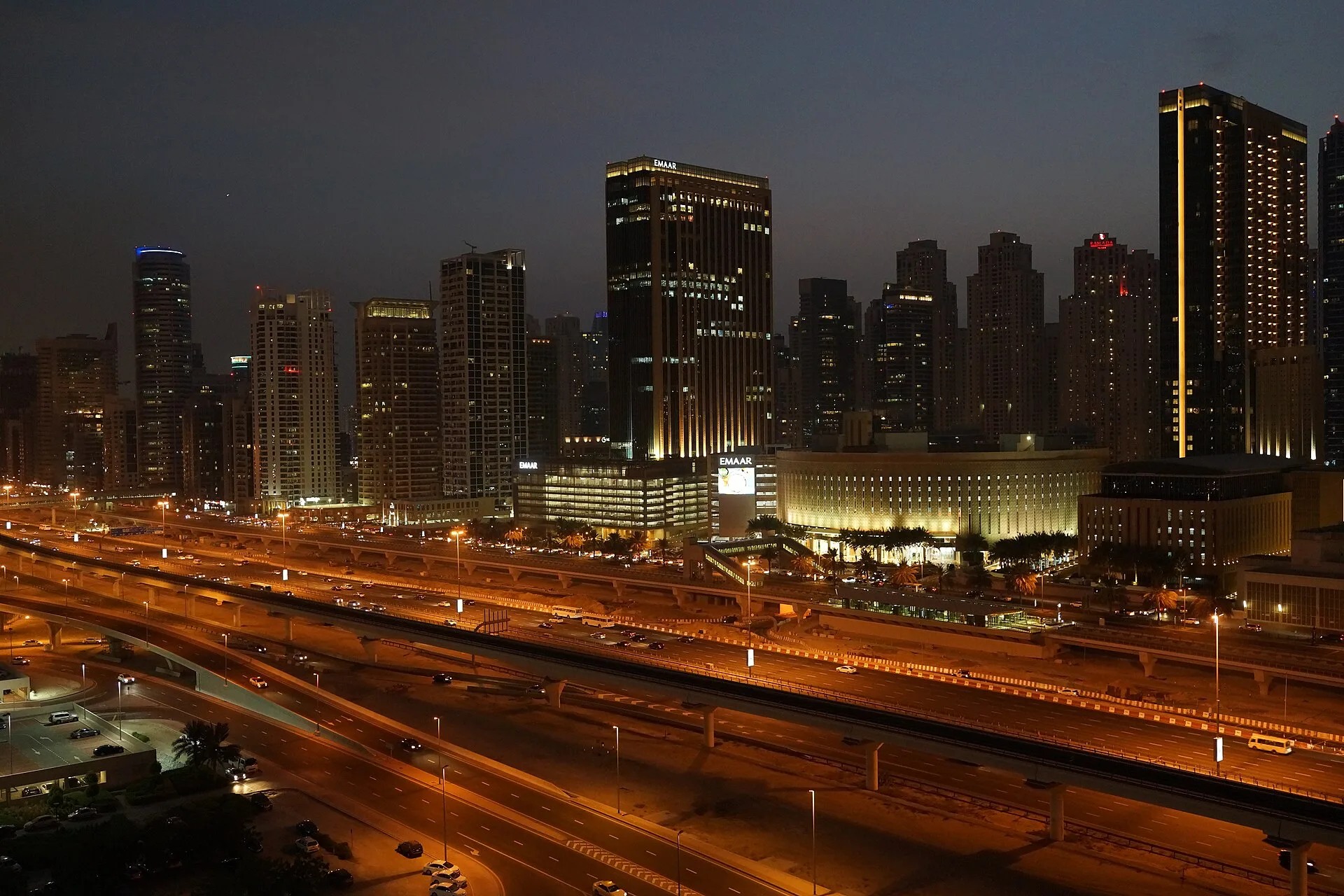
Sheikh Zayed Road is the Dubai section of the E11 highway, running about 55 kilometres from the Trade Centre Roundabout to the Abu Dhabi border. In 2007 Gulf News described it as home to most of the city's skyscrapers. It began as a narrow intercity road, built between 1971 and 1980, known in Dubai as Defence Road. The 39-storey Dubai World Trade Centre opened beside it in 1979, when the highway was a single lane. Nearly 30 kilometres were rebuilt between 1993 and 1998, and the towers that followed included Emirates Tower One in 2000 and the Rose Rayhaan by Rotana in 2007. The Dubai Metro Red Line began running along the road on 9 September 2009, and the Museum of the Future opened beside it in February 2022.
WHAT WAS SHEIKH ZAYED ROAD BEFORE THE TOWERS?
According to a 2011 history of the E11 in The National, the original road between Abu Dhabi and Dubai was proposed on 22 January 1968. Work began in 1971 and was completed by 1980, at a cost of Dh15 million, which government officials put at about Dh60 million in 2011 terms. Before the road, travel between the two towns in the late 1950s went by convoy with camels and carriages and could take up to seven days, while modified pickup trucks crossed the desert to Dubai in about seven hours.
The finished road was long and narrow, with no hard shoulders. Small cafeterias and restaurant shacks stood close to the traffic, heavy lorries used the route, and the right lane was pitted and congested. Speed bumps made of asphalt and covered in sand were hard to see. Travellers stopped at Seih al Shueib, the border point where passports were stamped, and the drive from Abu Dhabi island to the site of the future Burj Khalifa took a little over two hours. One resident interviewed by the paper recalled camels on the road in the late 1970s.
At the Dubai end, Gulf News describes the road in the early 1970s as a simple stretch of asphalt known as Defence Road, passing through desert with only a few warehouses and low-rise buildings. The Defence Roundabout on the road was later called the First Interchange. The Nasser Rashid Lootah building, built in 1974, stood beside it, and the former defence area lay on the other side of the road. Three kilometres away lay the Trade Centre Roundabout, which in 2007 still marked the start of the expressway.
WHEN WAS THE DUBAI WORLD TRADE CENTRE BUILT?
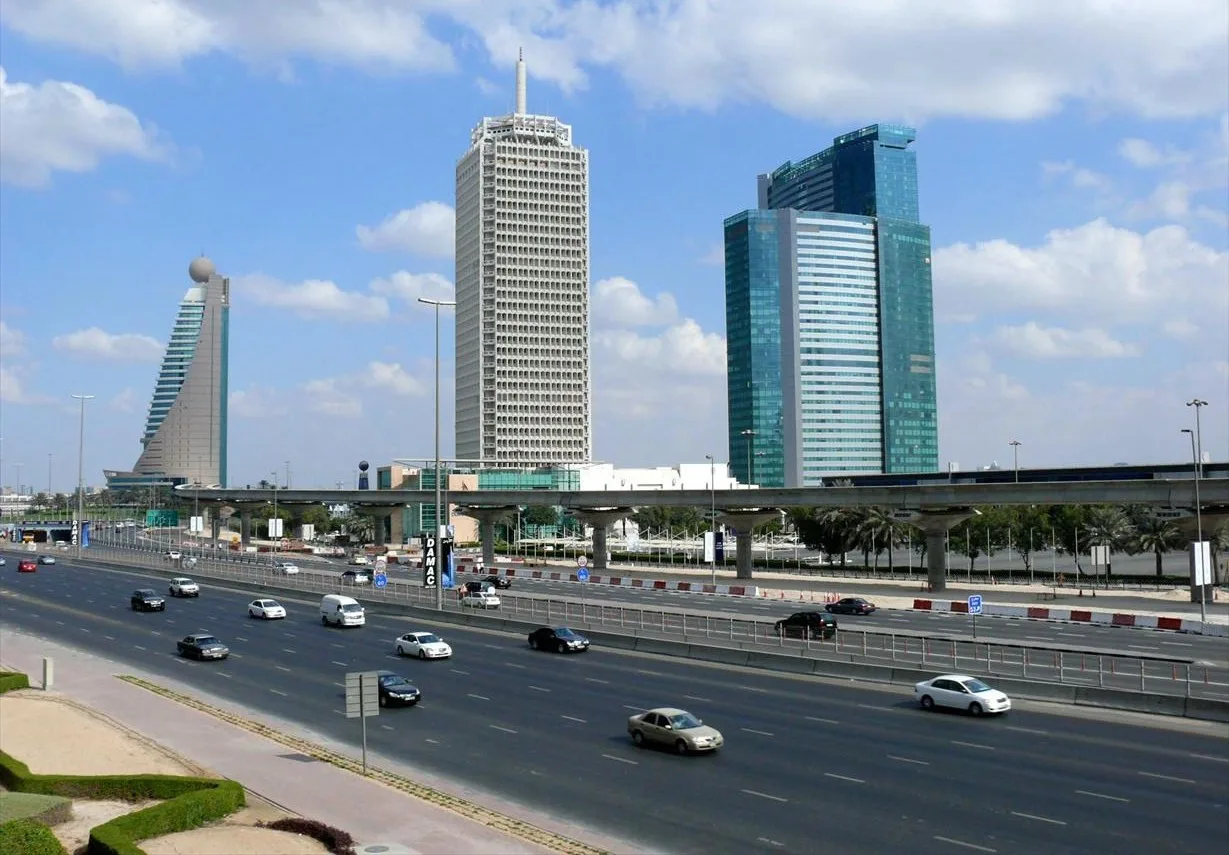
The Dubai World Trade Centre was designed by John Harris, a British architect trained at the Architectural Association in London, who had worked in Kuwait in 1952. Harris arrived in Dubai in the autumn of 1959, completed the city's first masterplan in May 1960 and delivered a second in 1971. He presented a first tower design in early 1974 and returned with the tower scheme that October. The Skyscraper Center database of the Council on Vertical Urbanism records construction starting in 1974; Gulf News dates the start to 1975. The tower was planned at 33 floors and raised to 39 after work had begun.
The Skyscraper Center lists the completed building at 149 metres and 39 floors, finished in 1979 as an office tower by John R. Harris and Partners. Gordon Heald, Harris's associate, moved to Dubai to oversee the project and worked on the detailed design. The concrete tower has a double facade with set-back windows, and Harris used Islamic arches in the window openings. The concrete was originally planned to be beige and was painted white in the 1980s. By September 1979 about a third of its rentable office space had been leased.
The architect Todd Reisz told Gulf News that it was “at the time the tallest tower in the Middle East”. It was sited on the Abu Dhabi highway while Dubai was growing in a linear pattern towards Abu Dhabi and Sharjah. A 2007 Gulf News account describes the trade centre being unveiled in 1979 on a patch of land beside a single-lane highway. Motorists unfamiliar with the new roundabout found merging difficult until Dubai Municipality and the police installed traffic lights. The tower now stands at the gateway to Sheikh Zayed Road.
HOW WAS SHEIKH ZAYED ROAD WIDENED AND REBUILT?
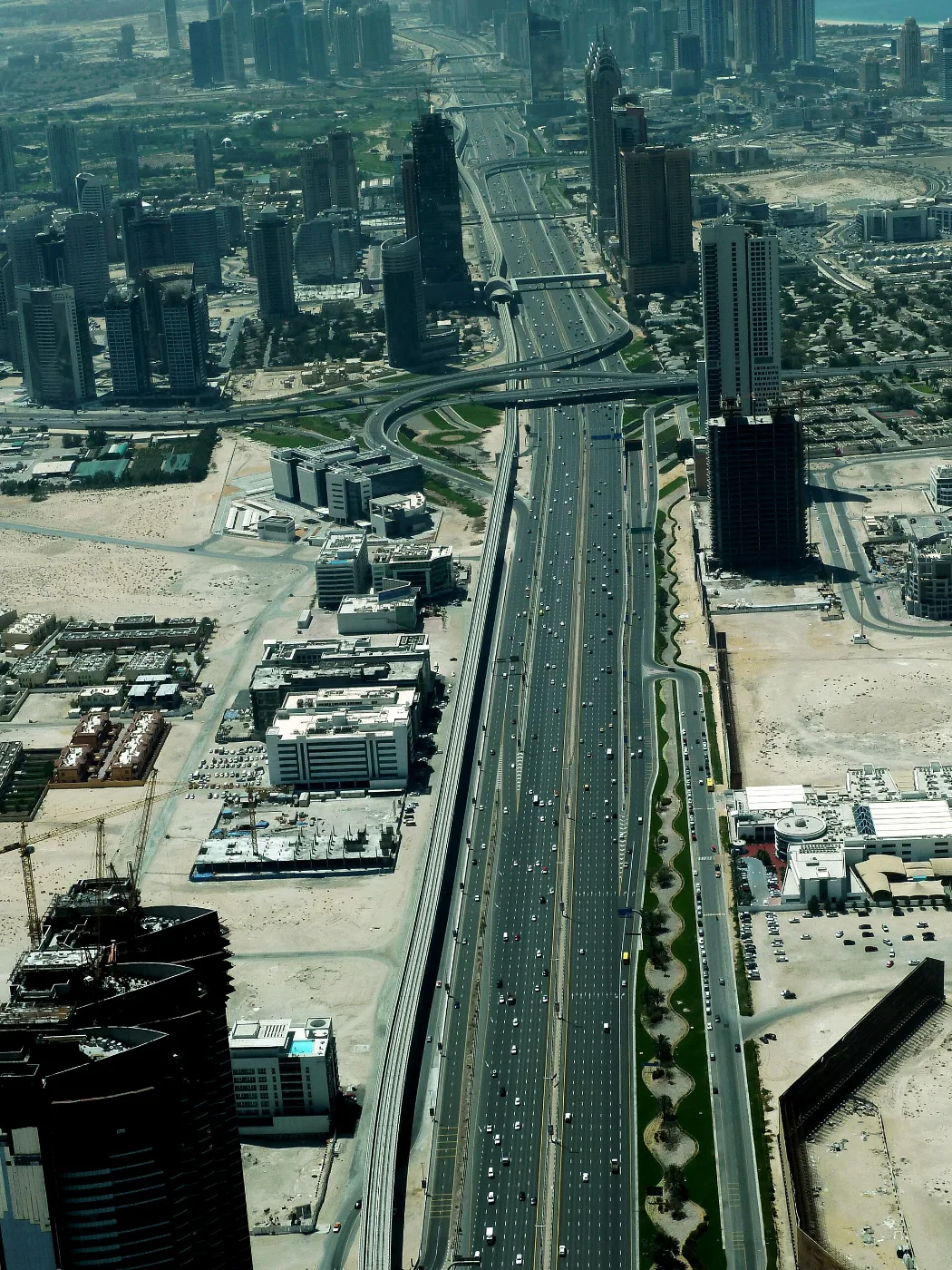
The National dates the start of a project to widen the road to four lanes to 1993, with eight exit bridges built for Dh110 million. Gulf News records that nearly 30 kilometres of the road were built between 1993 and 1998, and that the road, previously called Defence Road, runs 55 kilometres as an expressway from the Trade Centre Roundabout to the Abu Dhabi border. Drivers coming from Abu Dhabi know the same road as the E11. By 2011 it was an eight-lane road, and the drive from border to border took one hour.
Junctions on the rebuilt road were numbered as interchanges. The Defence Roundabout became the First Interchange, near the Toyota Building, and in 2007 the last roundabout on the road was the sixth interchange, at the entrance to Jebel Ali Village, The Gardens and Ibn Battuta Mall. Publishing a photograph of the Trade Centre Roundabout taken by Javed Nawab nearly 30 years earlier, Gulf News described the 3-kilometre stretch between the Trade Centre and Defence roundabouts as having changed dramatically, and noted that expatriates called it the Manhattan of Dubai because it is home to most of the city's skyscrapers.
As Dubai expanded through the 1980s and 1990s, the Defence Roundabout could no longer handle the traffic. The Roads and Transport Authority (RTA) replaced it with a three-tier junction costing $168 million, built between 2006 and 2011, with construction starting in the fourth quarter of 2006. Gulf News describes the project as part of turning Sheikh Zayed Road into a multi-level, signal-free network linking Downtown Dubai to Al Safa. The former defence area beside the interchange is where Burj Khalifa now rises.
WHICH TOWERS WENT UP ON SHEIKH ZAYED ROAD AROUND 2000?
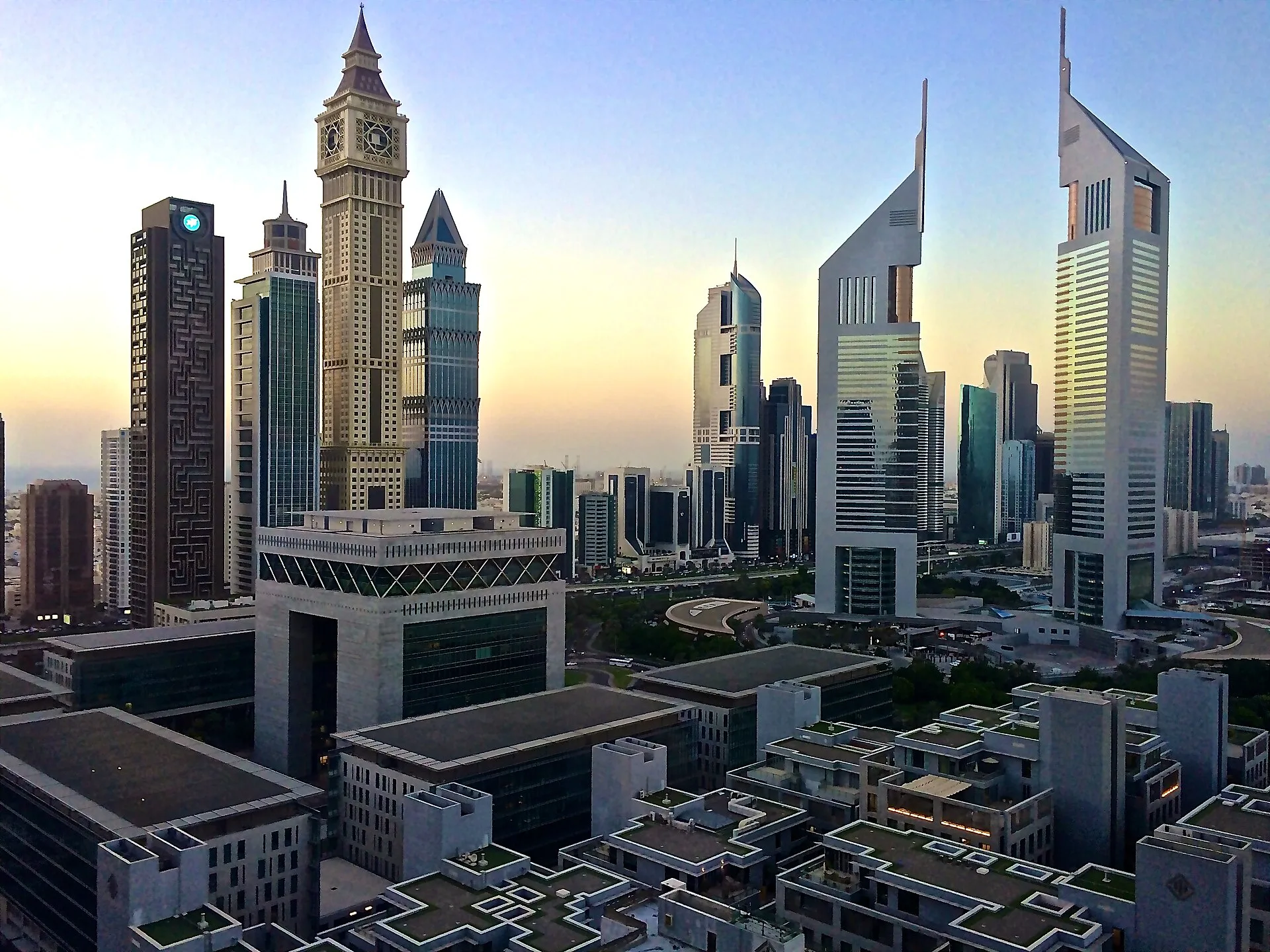
Emirates Tower One was completed in 2000. The Skyscraper Center lists it at 354.6 metres and 54 floors, an office building with a composite structure, designed by the architect Hazel Wong while at NORR Limited, which is also listed as architect of record. Structural design was by BG&E and Hyder Consulting, with peer review by Leslie E. Robertson Associates. The database describes the Emirates Towers as among the first skyscrapers along Sheikh Zayed Road in Dubai's financial centre, and notes that they are often cited as among the tallest skyscrapers designed by a woman at the time of completion. It currently ranks Tower One 14th in height in Dubai.
Both towers have equilateral, triangular footprints, which the Skyscraper Center says give the structures more stability against wind and earthquakes. A hybrid of steel and concrete allows large areas of column-free office space. The towers rise from a three-storey terraced podium of shops, restaurants and cafes, are clad in silver aluminium and reflective glass, and are flanked by rounded parking structures. Tower One has steel transfer floors at level nine, three further transfer floors and a tuned mass damper at its peak. The database notes that the road has seen a boom in construction since they were completed.
The Rose Rayhaan by Rotana followed in 2007. The Skyscraper Center lists it at 333 metres, with 71 floors above ground and one below, designed by Khatib & Alami, and describes it as a supertall hotel on Sheikh Zayed Road in Dubai's financial district. The original plans called for 380 metres, and the design was later modified to reduce the height. It currently ranks the tower 126th in height in the world, 25th in the Middle East and 20th in Dubai, six places behind Emirates Tower One.
WHEN DID THE DUBAI METRO RED LINE OPEN?
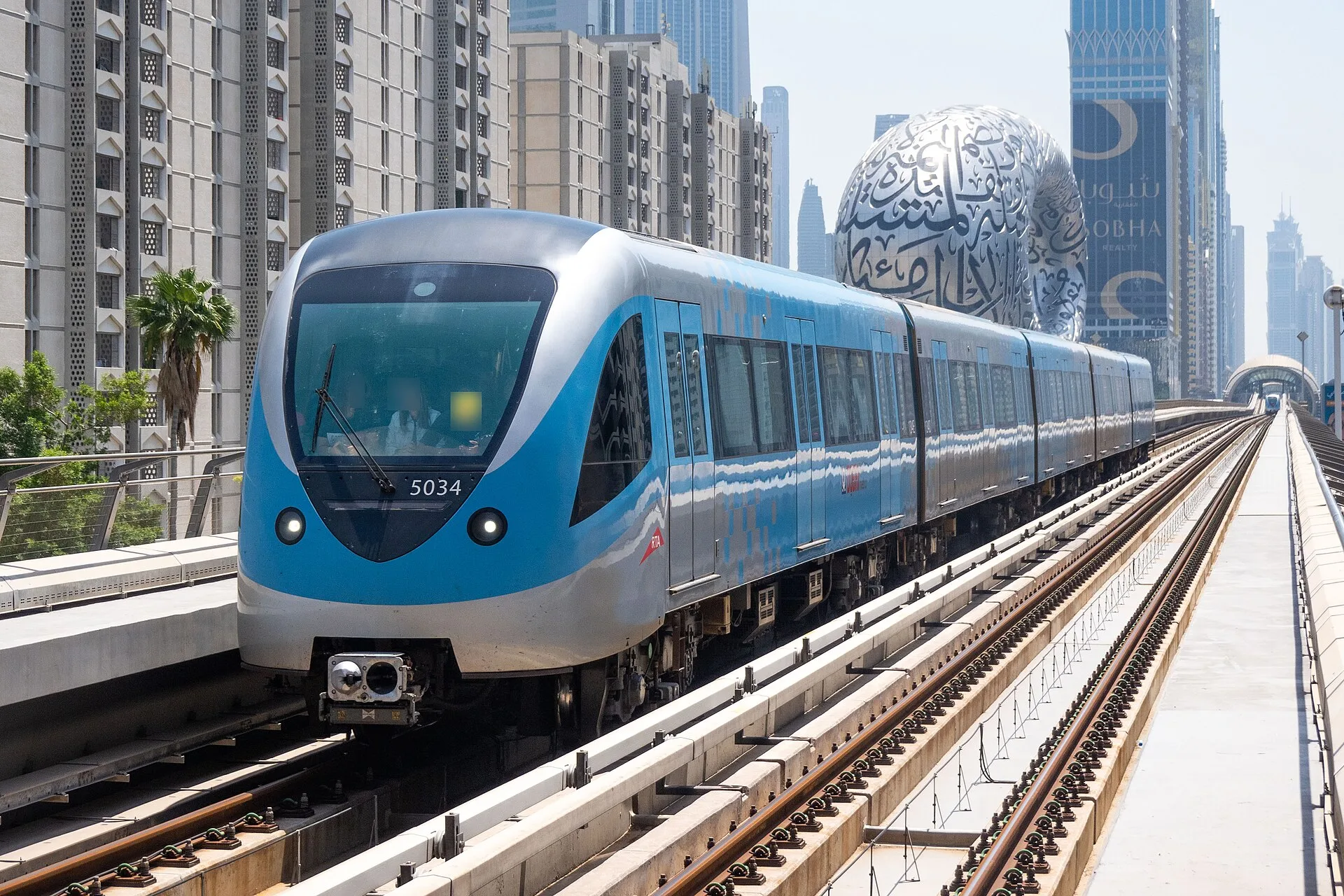
The contract for the Dubai Metro was signed in May 2005 between Dubai Municipality and Mitsubishi Heavy Industries, according to Gulf News. The National dates the start of construction to 2006. Trains were lifted onto the tracks in April 2008, and the 12.6 kilometres of underground track were among the most demanding parts of the project. In January 2009 a station was under construction on Sheikh Zayed Road, and the trial run of the Red Line also took place along the road.
Ten stations on one line opened on 9 September 2009, written 09/09/09, first for invited guests and then for the public over the following days. The National describes it as the first metro on the Arabian Peninsula, and the first train ran down Sheikh Zayed Road. Its trains are driverless. In 2020 Gulf News gave the Red Line as 52 kilometres long with 29 stations, 4 underground and 25 elevated, and described the system as the world's longest driverless automated railway.
Ridership rose from 39 million in 2010 to 69 million in 2011 and 109 million in 2012. By 2023 the network had carried more than 2 billion passengers, 1.34 billion of them on the Red Line. The Green Line, serving the areas around Dubai Creek, opened in September 2011, and the Red Line was later extended by 15 kilometres, 11.8 kilometres elevated and 3.2 underground, to the Expo 2020 site. In 2015 property within 1.5 kilometres of Red and Green Line stations rose in value by between 13 and 41 per cent.
WHEN DID THE MUSEUM OF THE FUTURE OPEN?

The Museum of the Future opened to the public on Monday 22 February 2022. Gulf News reports that the Dubai architecture firm Killa Design won the design competition for the museum in 2015, and that the UK firm BuroHappold Engineering, as lead consultant, turned the architect Shaun Killa's design into a building. The structure has seven floors and is given as 77 metres high, although the same Gulf News report also gives 78 metres. Its site is on Sheikh Zayed Road, where Metro trains pass it.
Work on the building started in June 2016. Its steel framework is a diagrid of 2,400 diagonally intersecting beams, completed in November 2018, and the interior has no columns. The facade is clad in 1,024 stainless steel panels, each individually moulded and manufactured, and Arabic calligraphy by the Emirati artist Mattar Bin Lahej covers the steel surface. The calligraphy also serves as the windows that bring daylight into the museum, and after dark the script is lit by 14 kilometres of LED lighting. The circular building sits on a green mound.
THE CLUB LOUNGE AT MANDARIN ORIENTAL JUMEIRA DUBAI

On Sheikh Zayed Road, 3 kilometres separate the Trade Centre Roundabout, where the 149-metre Dubai World Trade Centre opened in 1979, from the First Interchange, formerly the Defence Roundabout. Along the road, Emirates Tower One reached 354.6 metres in 2000 and the Rose Rayhaan by Rotana 333 metres in 2007. Burj Khalifa rises on the former defence area beside the First Interchange, and the Red Line has run along the road since 2009. The Club Lounge at Mandarin Oriental Jumeira Dubai was completed in 2019.
The lounge's window seating is made of rattan, with planters hanging above it, and looks out over the skyline and Burj Khalifa. Inside the lounge, the buffet combines white marble and timber and stands beneath a black steel frame. One lounge area pairs a cushioned banquette with a dark timber armchair and a large abstract painting. A second seating area has sofas, timber display shelving and a bar counter. Marble-topped tables are set beneath a cove-lit ceiling crossed by timber beams.
SOURCES
- Gulf News Dubai World Trade Centre: the making of an icon
- Council on Vertical Urbanism, Skyscraper Center World Trade Center, Dubai
- The National A trip down E11 memory lane
- Gulf News From empty roundabout to city hub
- Gulf News Dubai's First Interchange: Journey through time from Defence Roundabout
- Council on Vertical Urbanism, Skyscraper Center Emirates Tower One
- Council on Vertical Urbanism, Skyscraper Center Rose Rayhaan by Rotana
- Gulf News Dubai Metro turns 11 years old today
- The National Dubai Metro turns 16: How trains transformed a city
- Gulf News How the Museum of the Future in Dubai reimagines the future