HOW HOTEL BARS DEVELOPED IN NEW YORK, LONDON, SINGAPORE, PARIS AND MUMBAI, 1890S TO TODAY
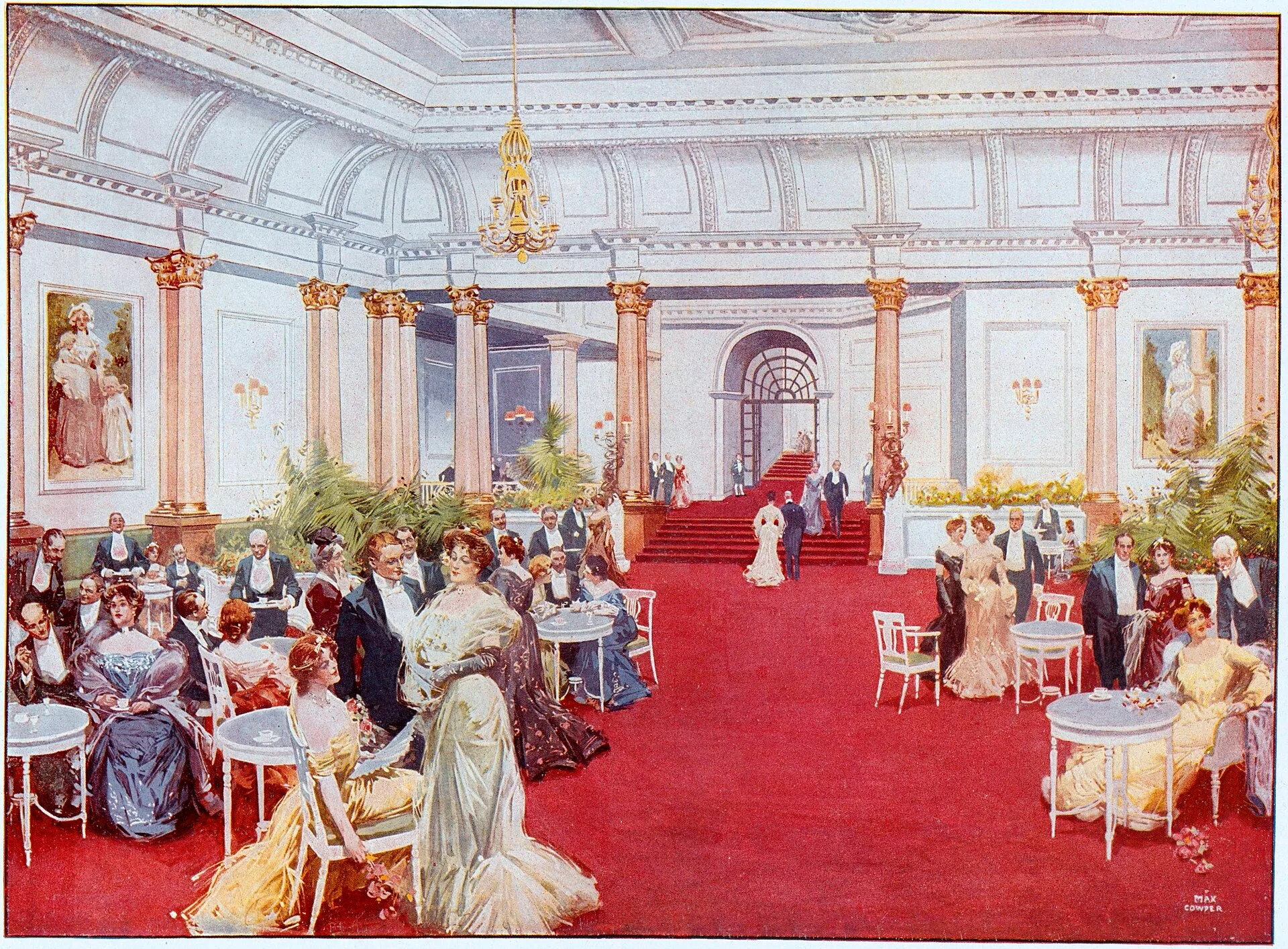
Hotel bars in New York became influential in the late 19th century, when the bars of the Waldorf, the Fifth Avenue Hotel and the Hoffman House each had a distinct clientele or character. London’s Savoy Hotel, opened in 1889, had an American Bar by 1903, named for the iced American style of its drinks. Raffles Hotel in Singapore credits its Long Bar with the first Singapore Sling in 1915, and US Prohibition from 1919 sent bartenders such as Harry Craddock to Europe, where he compiled The Savoy Cocktail Book in 1930. In New York, a Maxfield Parrish mural reached the St Regis in 1932 and Ludwig Bemelmans painted the bar at the Carlyle in the 1940s. In Mumbai, the Taj Mahal Palace describes its Harbour Bar as the city’s first licensed bar.
WHERE DID THE HOTEL BAR COME FROM? NEW YORK IN THE 1890S

The Oxford Companion to Spirits and Cocktails, edited by David Wondrich and Noah Rothbaum, describes the bar of the Waldorf in New York as one of the most influential in America and the world from the early 1890s. The Waldorf opened in 1893 at Fifth Avenue and Thirty-Third Street, at first without a stand-up bar, and the Astoria opened next door in 1897; the two hotels were later joined as the Waldorf-Astoria. Its bar drew industrialists and financiers, with J. P. Morgan a daily visitor, while Jim Grey’s bar at the Fifth Avenue Hotel drew politicians. The Hoffman House, another New York hotel, ran a bar that the same entry describes as showing strong German influence.
The Waldorf’s head bartenders were largely Irish-born or of Irish descent, and its bar book included a few Irish whiskey cocktails, which the Companion notes were a rarity at the time. That bar book was kept by Johnny Solan and preserved by the hotel’s press agent, Albert Stevens Crockett, who used it as the basis for two books, among them Old Waldorf Bar Days of 1931, and an unpublished manuscript. The recipes belonged to the American mixed-drink tradition traced in a separate article on Jerry Thomas and the origins of the cocktail. The Waldorf bar closed when Prohibition began in 1919.
WHY IS IT CALLED AN AMERICAN BAR? THE SAVOY IN LONDON

The Savoy opened in London in 1889, next to the Savoy Theatre, without a dedicated bar. A date of 1893 is often given for the opening of its American Bar, but the Oxford Companion entry by Anistatia Miller and Jared Brown rejects it. It cites a court case of 1900 in which the hotel was said to have no bar or counter for the sale of intoxicating liquors, and places the first mention of an American Bar at the Savoy in 1903. The bar was named for the style of drinks it served, which used ice in their preparation, and the hotel has rearranged, redecorated and rebuilt it many times since.
Ruth Burgess, known as Kitty, appears to have been the first bartender in charge, and by the end of 1903 she had been joined by Ada Coleman, known as Coley. Coleman created the Hanky Panky, a gin cocktail that remains her best-known drink, according to a CNN report on the bar. The Oxford Companion records that Rupert D’Oyly Carte retired both women on 17 December 1925, bowing to American patrons who felt it was inappropriate for women to work in barrooms. Their successor was Harry Craddock, an English bartender who had spent the previous years working in the United States.
HARRY CRADDOCK, PROHIBITION AND THE SAVOY COCKTAIL BOOK
The 18th Amendment brought Prohibition to the United States in 1919. Craddock had mixed drinks at the Hollenden Hotel in Cleveland, Ohio, and according to the Special Collections and Archives of California State University, Northridge, he returned to Britain so that he could keep working as a bartender. CSUN dates his arrival at the Savoy’s American Bar to 1920; the Oxford Companion says he was hired for the hotel’s dispensary bar in 1921 and later took charge of the American Bar, where he stayed until he resigned in 1939. The drinks of the dry years he left behind are covered in a separate article on Prohibition cocktails.
Craddock compiled The Savoy Cocktail Book, first published in 1930. It holds recipes for more than 700 cocktails, many framed by the Art Deco illustrations of Gilbert Rumbold, and includes drinks from bartenders Craddock knew in the United States and Britain alongside his own, such as the Corpse Reviver No. 2. Its advice to home bartenders includes the line "Never use the same ice twice". CNN credits Craddock with creating more than 250 drinks, names the White Lady as his signature drink and reports that the book served as the handbook for each head bartender who followed him until Erik Lorincz arrived in late 2010.
WHERE WAS THE SINGAPORE SLING INVENTED? THE RAFFLES LONG BAR
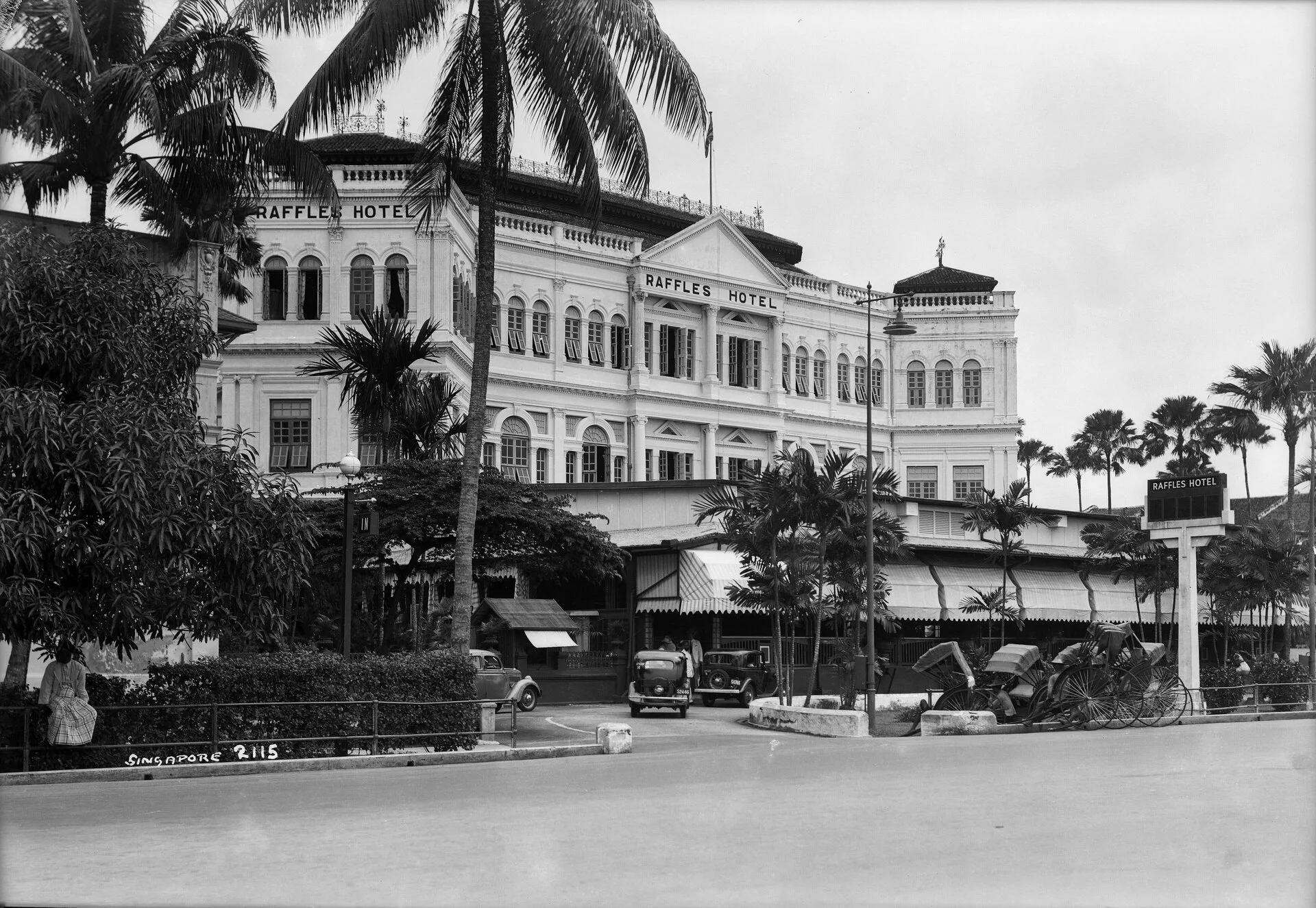
Raffles Hotel in Singapore states that the Singapore Sling was first mixed at its Long Bar in 1915 by a Raffles bartender, Ngiam Tong Boon. In the hotel’s account, Ngiam designed the drink to look like fruit juice, which made it acceptable for women to drink in public at the time. The Long Bar was then located along Cad’s Alley and was known as the rendezvous of planters. Raffles dates its custom of brushing peanut shells off the bar and onto the floor to the 1900s, when rubber and plantation owners from Malaya met there at weekends.
Infopedia, the reference service of Singapore’s National Library Board, gives the same date and creator. It describes Ngiam as a Hainanese bartender at Raffles Hotel at the turn of the century and says the Sling was originally created as a lady’s drink, hence its pink colour. Ngiam is also credited with the Million Dollar Cocktail, which gained fame after Somerset Maugham mentioned it in a short story. The Long Bar now occupies unit 02-01 of Raffles Arcade at 328 North Bridge Road, entered from the North Bridge Road side of the hotel.
WHO INVENTED THE BLOODY MARY? HARRY’S NEW YORK BAR AND THE KING COLE BAR
Harry’s New York Bar in Paris is not a hotel bar, but its history runs into one. According to the Oxford Companion entry by François Monti, the retired jockey Tod Sloan opened it as the New York Bar at 5 rue Daunou in 1911. Sloan sold his stake to another jockey, Milton Henry; Henry’s former wife, Nell, bought the bar back in 1920; and in 1923 the Scotsman Harry McElhone took it over and gave it his name. From the 1920s American tourists were told to give taxi drivers the address as "Sank Roo Doe Noo". The entry lists Ernest Hemingway, F. Scott Fitzgerald, George Gershwin and Jean-Paul Sartre among its patrons.
The bar claims the Bloody Mary, the Sidecar, the White Lady and the French 75. The Companion calls these claims mostly bogus and notes that they surfaced only after McElhone’s death in 1958; McElhone himself credited the Sidecar to Malachi McGarry of Buck’s Club in London in 1922. The Bloody Mary story continues in New York. The Boston Globe reports that Fernand Petiot first made the drink at Harry’s and became head bartender at the St Regis in 1934, where he added spices, salt, pepper and lemon. The name Bloody Mary was thought too vulgar for St Regis guests, so the hotel renamed it the Red Snapper.
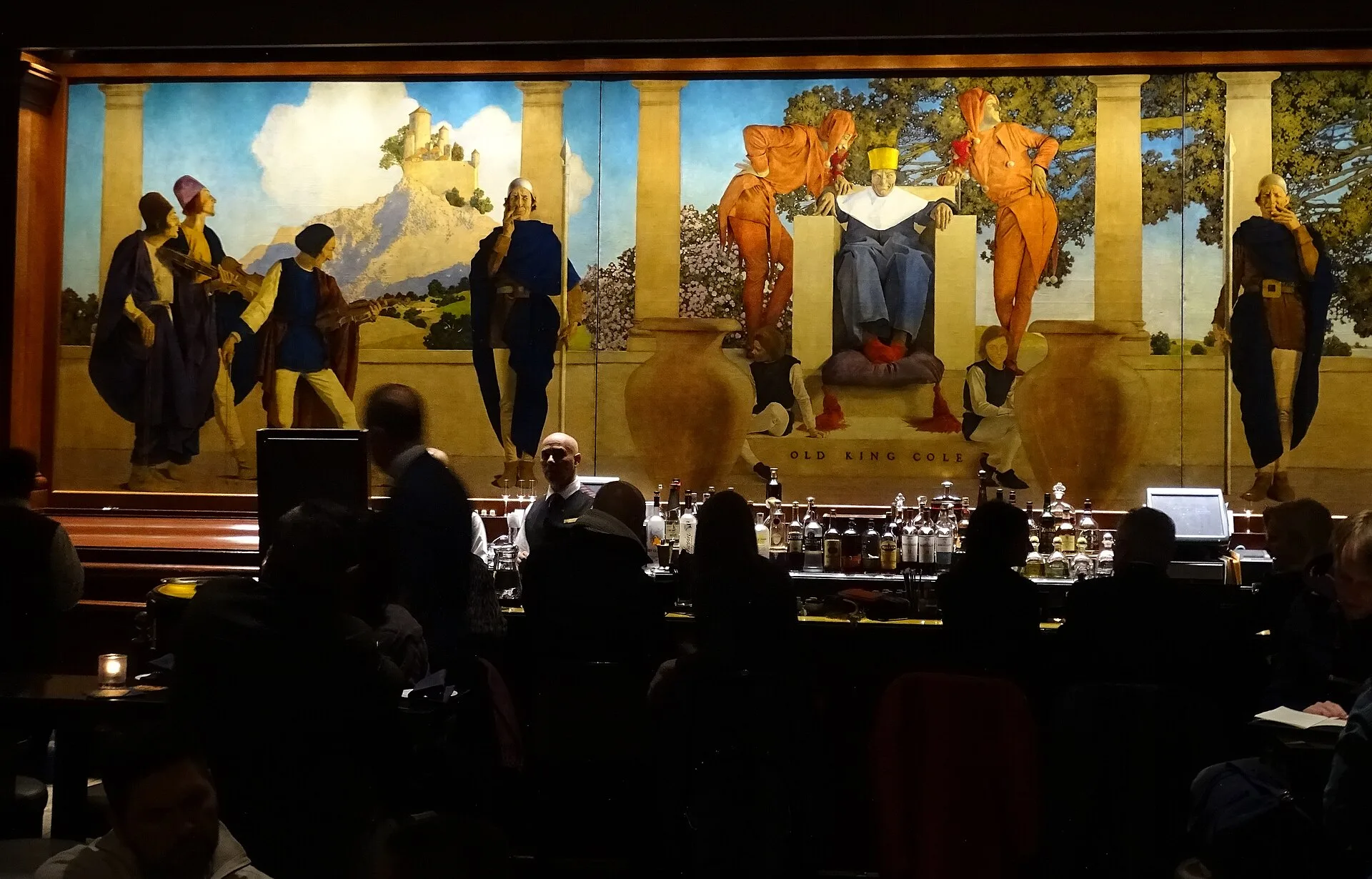
The mural behind the King Cole Bar had come from another hotel. In 1906 John Jacob Astor IV asked Maxfield Parrish to paint a mural of Old King Cole for the bar of the Knickerbocker Hotel, for a fee of 5,000 dollars. The Knickerbocker closed in 1920, and in 1932 the mural, about 30 feet or 9 metres long, was moved behind the bar of the St Regis, another Astor hotel. Urban lore holds that the king has Astor’s face, a story Parrish publicly denied. The Globe treats the St Regis claim to the Bloody Mary as a story rather than settled fact, and reports that the Red Snapper remains the signature cocktail of the King Cole Bar.
BEMELMANS BAR AND THE NEW YORK HOTEL BAR AFTER REPEAL

The Waldorf-Astoria bar reopened after Repeal in 1933 as a men-only barroom, according to the Oxford Companion. In 1959 the hotel moved the bar to its Lexington Avenue side, women were admitted soon after, and the bar lost its standing as a centre of mixology. Between those two dates, in 1947, the Carlyle hotel opened Bemelmans Bar. In the mid-1940s the Carlyle’s managing director commissioned Ludwig Bemelmans, the artist and author of the Madeline children’s books, to paint murals of the four seasons in Central Park.
The Carlyle’s own history describes Bemelmans’s whimsical illustrations as still covering the bar’s walls and repeats the rumour that Bemelmans and his family were paid for the murals with accommodation in the hotel for a year and a half. The same history notes that some of New York City’s greatest jazz pianists have played the bar’s piano since it opened. In 2002 the designer Thierry Despont restored the bar, keeping its Art Deco appearance, including a ceiling covered in 24-carat gold leaf.
WHAT IS A HOTEL BAR TODAY? FROM THE HARBOUR BAR TO THE SAVOY
In Mumbai, the Taj Mahal Palace was built in 1903 by Jamsetji N. Tata. The hotel’s factsheet, published by its operator IHCL, describes the Harbour Bar as the first licensed bar of the city. It presents the Harbour Bar as a lounge bar with warm interiors, intimate seating and mood lighting for drinks before and after dinner, serving fine malts, international wines and global tapas. Its signature cocktails include one named From the Harbour since 1933 and another called the Bombay Blazer.
In London, the Savoy’s American Bar took first place on The World’s 50 Best Bars list in 2017. The Oxford Companion lists its head bartenders since Craddock, among them Eddie Clarke from 1939, Joe Gilmore from 1954 to 1975 and Peter Dorelli from 1985 to 2000, followed by Salim Khoury, Erik Lorincz and, from 2018, Maxim Schulte. Shannon Tebay took the post in 2021, the first American to hold it, according to the entry. In Singapore, guests at the Long Bar are still invited to brush peanut shells from the bar onto the floor.
TRIDENT, NARIMAN POINT, MUMBAI

Trident, Nariman Point stands on Marine Drive in South Mumbai, facing the Arabian Sea. The 35-storey building opened on 7 April 1973 as the Oberoi-Sheraton and was the tallest building in South Asia until 1980. The seafront it faces is covered in a separate article on how Mumbai built Marine Drive. In the same city, the Taj Mahal Palace, built by Jamsetji N. Tata in 1903, seventy years before the Oberoi-Sheraton opened, describes its Harbour Bar as Mumbai’s first licensed bar.
The hotel was renamed Trident in 2008 under The Oberoi Group. Silverfox refurbished its arrival reception and lobby lounge, spaces whose history is covered in a separate article on the hotel lobby as a public living room, together with Ness Bar, the ballroom and the event spaces. The work was completed in 2025 under a "Luxury Lifestyle" concept. Ness Bar is on L1, with views over Marine Drive and the sea, the waterfront the building has faced since it opened as the Oberoi-Sheraton in 1973.
SOURCES
- The Oxford Companion to Spirits and Cocktails (via Spirits & Distilling) The Waldorf-Astoria
- The Oxford Companion to Spirits and Cocktails (via Spirits & Distilling) The Savoy Hotel’s American Bar
- The Oxford Companion to Spirits and Cocktails (via Spirits & Distilling) Harry’s New York Bar
- CNN The American Bar at London’s Savoy named world’s best bar
- California State University, Northridge, University Library The Savoy Cocktail Book
- Raffles Hotels & Resorts Iconic Long Bar at Raffles Singapore
- National Library Board Singapore Singapore Sling
- The Boston Globe The Bloody Mary at the St. Regis
- Rosewood Hotels & Resorts History of Bemelmans
- IHCL The Taj Mahal Palace, Mumbai factsheet