HANDMADE PAPER FROM MULBERRY BARK THAT HAS COVERED JAPANESE DOCUMENTS, SCREENS AND LANTERNS FOR 1,300 YEARS
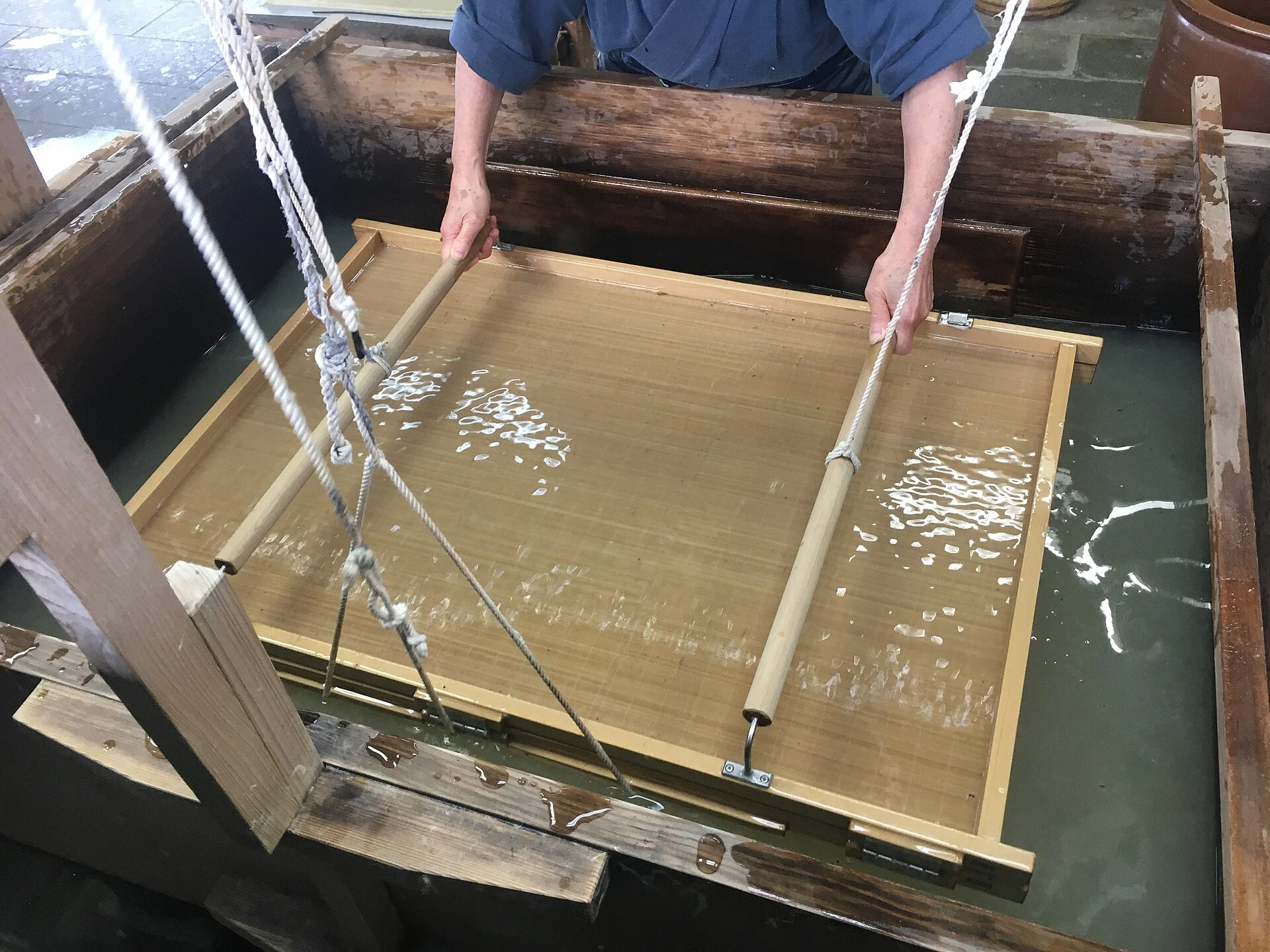
Washi is Japanese handmade paper made from the inner bark fibres of plants, most often kōzo (paper mulberry), mitsumata and gampi. The term means Japanese paper and came into use in the late 19th century, when Western-style paper, yōshi, entered Japan. Papermaking reached Japan from China in the early 7th century, and the oldest datable washi survives from 702. Sheets are formed by nagashizuki: a bamboo screen is dipped repeatedly into a vat of fibres suspended in water thickened with a plant mucilage called neri, and shaken until the sheet builds up. The result is light, strong and hard to tear. Washi has been used for records, sutras, prints and banknotes, and in buildings for shoji, the translucent sliding screens, and fusuma, the opaque sliding partitions. UNESCO inscribed washi on its Representative List of the Intangible Cultural Heritage of Humanity in 2014 and extended the listing in 2025.
WHERE DID WASHI COME FROM?

According to the Nihon shoki, the chronicle of Japan compiled in 720, papermaking reached Japan from China in 610. Nippon.com links its spread to Buddhism, since paper was needed to copy scriptures, and to Prince Shōtoku (574 to 622), the regent who promoted both. Early Japanese paper was made from hemp, and makers later turned to native shrubs such as kōzo, gampi and mitsumata, whose fibres were easier to process, according to the Japanese culture magazine niponica. JAANUS, the dictionary of Japanese architecture and art terms, records the oldest datable example as a census document of 702 in the Shōsōin, the imperial storehouse in Nara. Nippon.com notes that the Shōsōin also holds an early 8th-century family register written on paper from Mino, in present-day Gifu Prefecture.
JAANUS records that paper-making households increased rapidly from the 8th century, and that neri and nagashizuki, which produced thinner and finer paper, were developed between the late 8th and the 9th centuries. Niponica places the method in the Nara period (710 to 784) and Nippon.com in the Heian period (794 to 1185). The Heian period reportedly had 42 paper-making regions. Paper served for tax records and sutra copying, and courtiers wrote poetry on decorated sheets, of which JAANUS cites the early 12th-century Sanjūrokunin shū as an example. Regional specialities emerged in the Kamakura and Muromachi periods, and in the Edo period each district produced its own paper under local monopolies. Echizen, in modern Fukui Prefecture, became the source of hōsho, a paper that grew popular in the Edo period.
KOZO, MITSUMATA AND GAMPI: THE THREE WASHI FIBRES

Kōzo, the paper mulberry, is the most common washi fibre. According to the Robert C. Williams Museum of Papermaking at the Georgia Institute of Technology, it can be cultivated in wet or dry fields, and its bark takes two to three years to mature. It is harvested in late autumn or early winter, after the leaves fall. Kōzo fibres are about 10 millimetres long, against about 5 millimetres for gampi and mitsumata and about 1 millimetre for the wood pulp of modern paper, according to niponica. JAANUS notes that kōzo binds well and makes a very tough paper, and Nippon.com that its longer fibres make it more translucent than the other two. All three papers on the original 2014 UNESCO listing are made from kōzo.
Mitsumata grows on hillsides among Japanese cedar and cypress. Its short, soft fibres are absorbent and resistant to insects, and JAANUS describes its paper as very smooth and pliable. The Georgia Tech museum notes that the highest-quality mitsumata fibres are used for Japanese banknotes. Gampi is the most difficult of the three. It grows wild, has not been cultivated successfully and is harvested from February to May, when the plant is full of sap, so it is not steamed like the others. Its paper is semi-translucent, lustrous and resistant to damp and insects, and it crackles when handled. Because gampi is scarce and expensive, it is used mainly for calligraphy paper and for beating gold leaf.
HOW IS WASHI MADE? FROM BARK TO NAGASHIZUKI
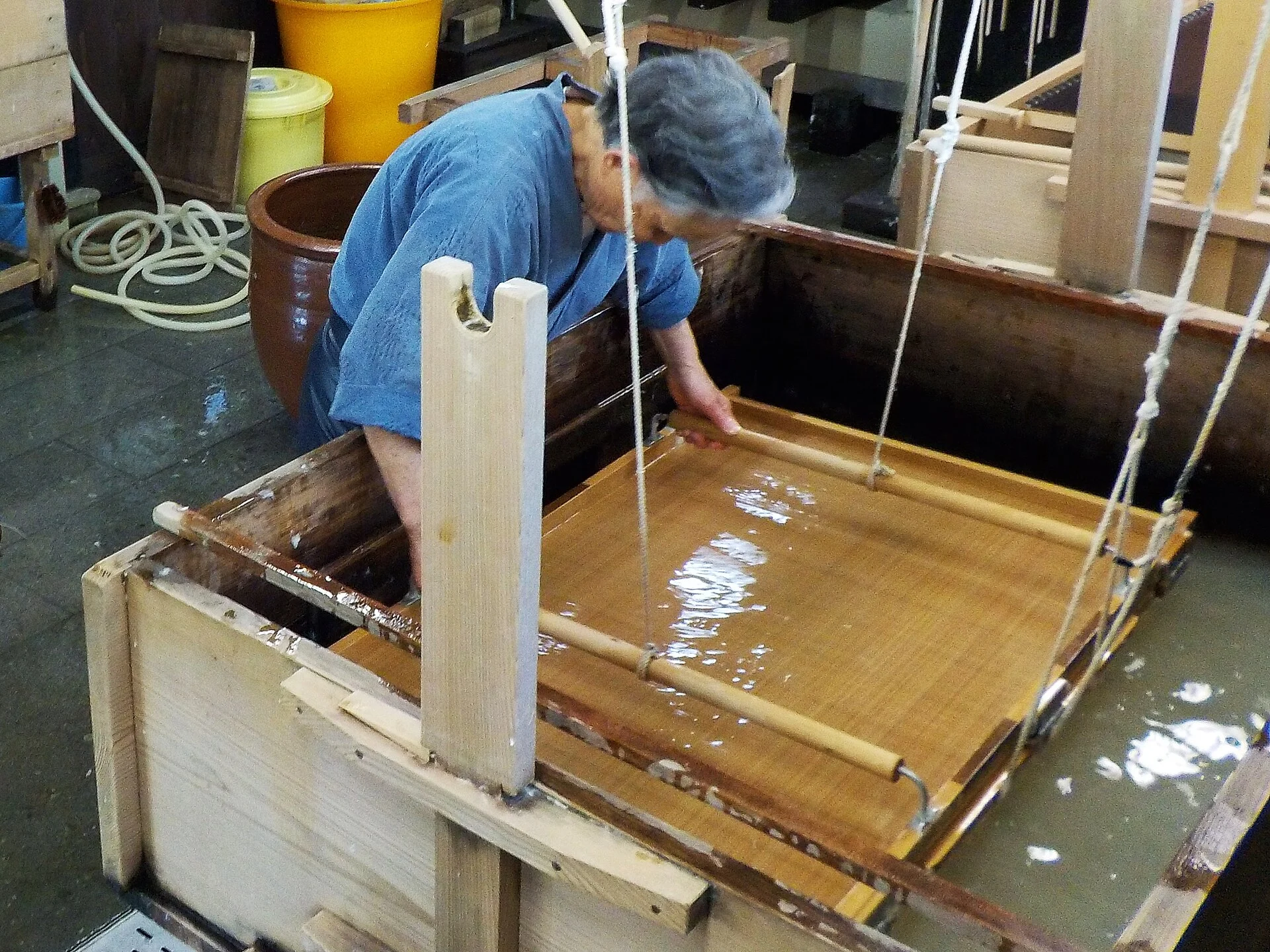
Washi is traditionally made in winter, after the farming year, when the cold keeps organic materials fresh and makes the fibres contract into a stronger sheet. Pure, cold water is essential, as minerals eventually mar the paper. The Georgia Tech museum describes the preparation of kōzo. Bundles are steamed for about two to two and a half hours, and the bark is stripped while soft and dried as kurokawa, or black bark. The inner white bark, shirokawa, is separated by treading it on flat stones in a running stream. It is soaked, boiled in alkali for about an hour, then rinsed in cold running water for up to two days. Specks are picked out by hand, a step called chiri-tori, and the fibres are beaten with wooden mallets until they resemble wet cotton.
Neri makes nagashizuki possible. Niponica identifies its source as tororoaoi and describes the method as interweaving long fibres in water mixed with neri to produce a tough, even sheet. Nippon.com describes the fibres being mixed with tororo aoi and sieved on a bamboo mat, the suki-su, set in a wooden frame, the suki-geta. JAANUS describes the mixture being shaken and thin layers scooped onto the screen repeatedly until the required thickness is reached; the sheets are then peeled off and dried in the sun, and the screen marks remain visible. Niponica contrasts this with tamezuki, the European method for short fibres, in which water drains only once and the paper tears more easily. Production is slow: at the Iwama Heizaburō workshop in Imadate, Fukui Prefecture, Nippon.com reports that a pair of workers makes 60 to 70 large ōban sheets a day.
MINO, ECHIZEN AND THE UNESCO WASHI LISTING

UNESCO first inscribed washi in November 2014, at the ninth session of its intergovernmental committee in Paris. The listing covers three papers and their communities: Sekishū-banshi in Misumi-chō, Hamada City, Shimane Prefecture; Hon-minoshi in Mino City, Gifu Prefecture; and Hosokawa-shi in Ogawa Town and Higashichichibu Village, Saitama Prefecture. All three are designated Important Intangible Cultural Properties in Japan, and the inscription replaced a 2009 UNESCO listing for Sekishū-banshi alone. UNESCO records that the paper is used for letters, books and home interiors, including paper screens and sliding doors, and that the skills pass down within families, through preservation associations and through local municipalities. Mino draws its water from the Nagara River, and niponica dates papermaking there to about 1,300 years ago.
Echizen City, in central Fukui Prefecture, is a leading producer of washi by quality, variety and output, and its hōsho and torinoko papers are designated Important Cultural Properties. Local legend, as recounted by Nippon.com, tells of a woman who appeared on the upper reaches of the Okamoto River and taught the villagers to make paper, as their valley had little farmland but clean water. She said only that she came from upstream, so they called her Kawakami Gozen, Lady Upstream, and enshrined her at Okamoto Shrine. The Meiji government issued Japan's first national banknotes on Echizen washi in 1868, and the 1712 encyclopaedia Wakan sansai zue called torinoko the king of papers.
In December 2025, at its twentieth session in New Delhi, the UNESCO committee approved a national extension of the washi listing. Its decision states that the new inscription incorporates and replaces the 2014 element and includes newly joining communities motivated by the original inscription. It notes that women make up most of the community members covered by the extension, and names the Association for the Preservation of Echizen Torinoko Ganpi Paper among the groups drafting safeguarding plans. Ganpi, in the association's name, is the gampi fibre that JAANUS describes as giving a semi-translucent paper with a shiny finish.
WASHI IN SHOJI, FUSUMA AND PAPER LANTERNS

Shoji consist of a wooden lattice covered with washi, which diffuses light into the interior, according to niponica. JAANUS calls the translucent screen akari shōji, as distinct from fusuma, the opaque sliding screen. Nippon.com notes that Mino has long been known for fine shoji paper, and niponica that Hon-minoshi is made only from kōzo and known for its white tone. Fusuma frames are covered with thick paper, the finest with silk or other cloth. Sliding versions developed around the end of the Heian or start of the Kamakura period; in the Muromachi period fusuma divided large spaces into smaller rooms, and they became essential in elite shoin-zukuri residences before spreading to farmhouses and merchant homes. JAANUS notes that rayon has since replaced washi for fusuma.
Washi also made lighting. Chōchin are collapsible lanterns of washi glued to bamboo hoops and lit by a candle inside; niponica dates their design to around the end of the 16th century. Coating washi with persimmon tannin or oil made it waterproof, which allowed its use for umbrellas. Nippon.com notes washi lanterns at yatai food stalls and in home light fittings, and records that Isamu Noguchi used washi in more than 200 Akari light designs. In Mino, the Mino-washi Akari Exhibition shows lanterns with washi shades for two days each October.
THE DECLINE OF HANDMADE WASHI AND ITS USES TODAY
Handmade washi declined in the Meiji period (1868 to 1912) as imported machine-made paper replaced it. JAANUS records that production peaked in 1901, when about 200,000 people were involved, and that by 1984 fewer than 500 households still made washi. Yanagi Muneyoshi helped revive interest in handmade paper, and JAANUS dates the designation of washi as an Important Cultural Asset to 1969. Most paper in Japan now comes from automated mills, and the Georgia Tech museum counts a few hundred families in rural villages that still make washi by hand.
Nippon.com describes washi as resistant to tearing and insects, and notes that ink on it stays legible after the paper is soaked and dried. Washi made without bleach does not yellow in sunlight, and Nippon.com cites its use in restoring frescoes in the Vatican. Rembrandt experimented with washi around 1650, and in the Edo period sturdy handmade paper carried ukiyo-e woodblock prints. Current uses listed by Nippon.com include folding fans, umbrellas, bookbinding, chiyogami printed with kimono-inspired patterns, and washi masking tape.
RIN: PRIVATE DINING ROOMS AT MANDARIN ORIENTAL SHENZHEN
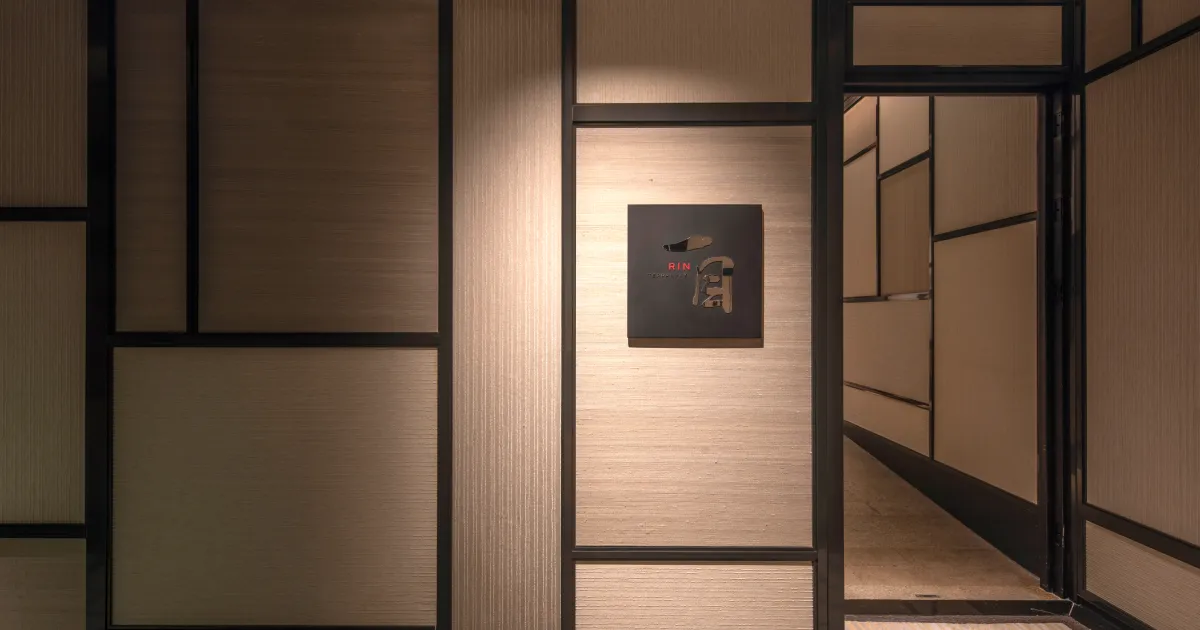
RIN is the signature Japanese restaurant at Mandarin Oriental Shenzhen, completed by Silverfox Studios in 2022 and led by chef Masanobu Hoshina. It takes reservations only, and every dining room is private. The restaurant serves teppanyaki, with ingredients prepared from raw in front of guests. Equipment sits under the counter so that the work surface stays clean, and the sightline runs past the chef to the city. Guests reach the three teppanyaki rooms, the Corten Steel Room, the Pine Room and the Concrete Room, from a Sake Lounge, entering each through a low door.
RIN's rooms are named after materials: weathering steel, pine and concrete. In the traditional Japanese interior, the material that divided and lit rooms was paper. Fusuma, wooden frames covered with thick paper, divided large spaces into smaller rooms from the Muromachi period and became essential in shoin-zukuri residences; until rayon replaced it, that paper was washi. Shoji, wooden lattices covered with washi, diffused daylight into the interior. The paper for both came from papermaking centres such as Mino, long known for its fine shoji paper, and Echizen, where torinoko was called the king of papers in 1712.
SOURCES
- UNESCO Intangible Cultural Heritage Decision 9.COM 10.22: Washi, craftsmanship of traditional Japanese hand-made paper
- UNESCO Intangible Cultural Heritage Decision 20.COM 7.B.51: extension of the washi inscription
- JAANUS, Columbia University Washi
- JAANUS, Columbia University Fusuma
- Robert C. Williams Museum of Papermaking, Georgia Institute of Technology Washi: Fibers and Harvesting
- Robert C. Williams Museum of Papermaking, Georgia Institute of Technology Washi Fiber Preparation
- Nippon.com The World of Washi: Paper that Lasts a Thousand Years
- Nippon.com Washi (Japanese Paper)
- Nippon.com Paper Places: Beautiful Fukui Shrines for the God of Washi
- Web Japan, niponica niponica no.18: Amazing Paper in Japan