HOW JORDAN'S BEDOUIN WOMEN WOVE THEIR TENTS, RUGS AND BAGS FROM GOAT HAIR AND WOOL ON LOOMS OF STICKS AND STONES

Bedouin weaving in Jordan is a women's craft. Bedouin women spun goat hair, sheep's wool and camel hair by hand and wove them on simple ground looms into the strips that made up their tents, and into the rugs, bags, cushion covers and camel trappings used inside and around them. Each tribe and region had its own materials, colours and pattern names, passed from mother to daughter without being written down. By the 1960s the household industry had largely died out, replaced by mass-produced goods. One of the best-known efforts to revive it is the Bani Hamida Women's Weaving Project, started in 1985 in the Mukawir area of Madaba governorate and run since 1998 by the Jordan River Foundation. More than 1,600 women from 13 villages have taken part in a project set up to bring back traditional Bedouin rug-making.
WHAT IS BEDOUIN WEAVING IN JORDAN?
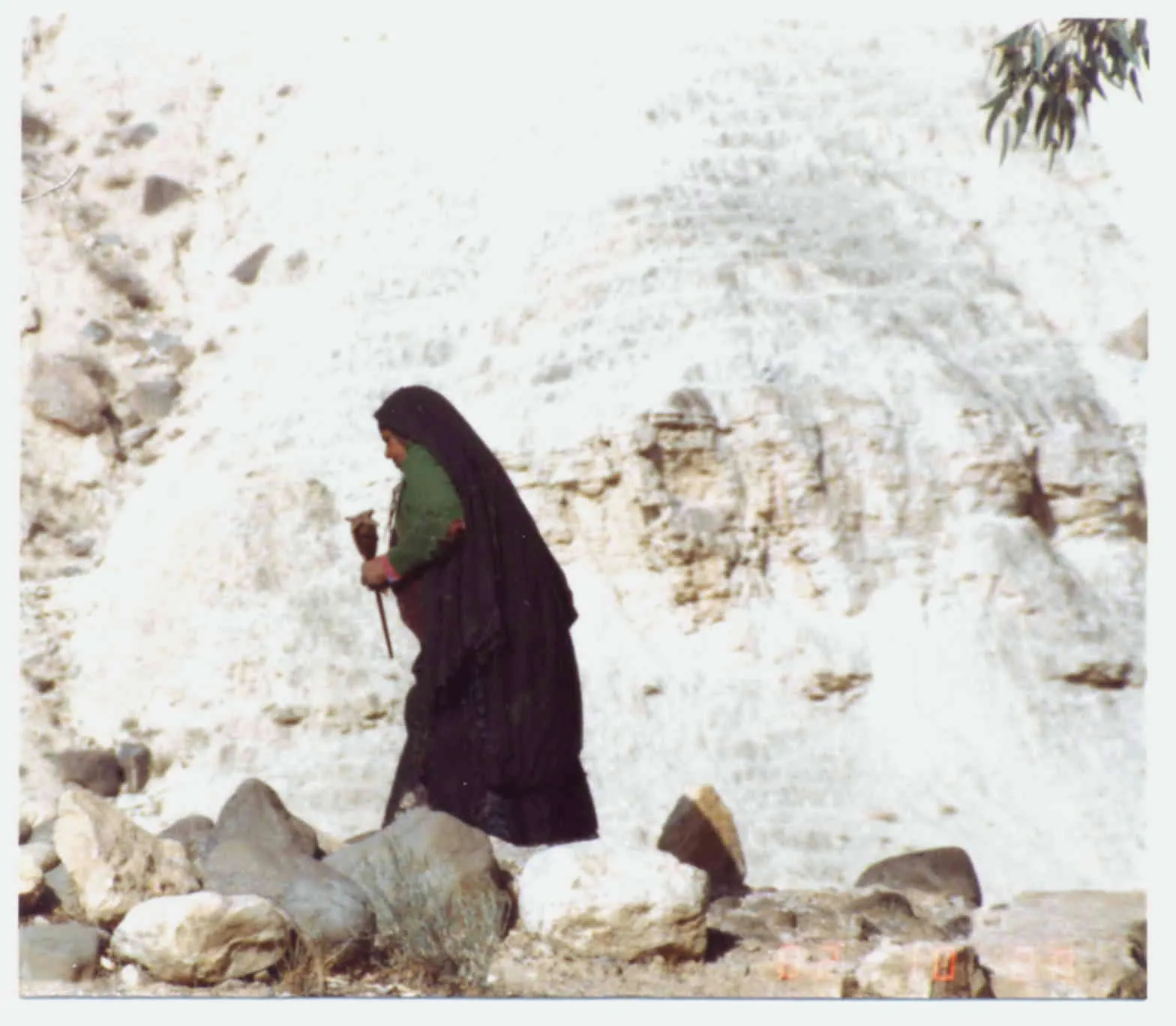
The Karak Resources Project, a multidisciplinary study of the Karak region of central Jordan coordinated by academics from Johnson University and Elon University, records that Bedouin women are still actively involved in weaving, while the craft is almost extinct among the village women of the Karak plateau. Bedouin women weave mainly for their own households. Their products include floor rugs, tent cloth, cushion covers, bags for grain and clothing, saddlebags for camels and donkeys, and cradles for carrying children. Because Bedouin families keep many goats, coarse goat hair is used for the heavy tent cloth and thick rugs. Village families, by contrast, mostly sell their sheep's wool and keep some back to stuff mattresses.
The raw materials across Jordan were mainly goat hair, sheep's wool and camel hair, according to the Amman carpet dealer and collector Khalil Naouri, interviewed by The National in 2023. Animals are washed and sheared in spring. Women then spin the fibre into yarn on a spindle, called a meghzal on the Karak plateau: a wooden staff with a small movable wheel and a hook, light enough that women are often seen spinning while they walk. Dyes came from plant and tree extracts and from crushed insects. Wool was costly in a region with few resources, and some weavers made yarn from old clothes, which can still be seen at the edges of some surviving pieces.
HOW IS A BEDOUIN RUG MADE ON A GROUND LOOM?

The Bedouin loom is built from sturdy sticks and stones. Two sticks are pinned to the ground with the warp yarn stretched between them, and a third stick across the middle separates the warp threads so the weft can pass through. The weaver sits cross-legged at one end, passes the weft back and forth on a stick, and moves along the rug as it grows. The Al Sadu Society in Kuwait, which documents the related al-Sadu weaving of the Gulf, describes these Bedouin textiles as narrow-loom weavings that are warp-faced, made mostly by women for tent dividers, cushions and pillows. The cloth is woven tight and strong so that rain, wind and sand stay out of the tent.
Weaving follows the farming year. On the Karak plateau it begins in late autumn, after the harvest and before the rains. A long rug about one metre wide and four metres long takes more than two months, and several women of the same family usually work on it together, so weaving is also a social occasion. UNESCO's description of al-Sadu in the United Arab Emirates, inscribed in 2011 on its list of intangible heritage in need of urgent safeguarding, records the same pattern of learning across the region: girls watch, then take on simple tasks such as sorting wool before moving on to the harder skills.
THE HOUSE OF HAIR: BEDOUIN TENTS AND THE TEXTILES INSIDE THEM

The Bedouin tent is called bait al-sha'ar, the "house of hair", after the goat-hair cloth it is made from. The cloth is woven in long, narrow strips on the ground loom, and the strips are sewn together to form the roof and outer walls. A 2017 exhibition at the Jordan Craft Centre, held with Tiraz, the Widad Kawar Home for Arab Dress, set up a real tent for visitors to sit in and showed how Bedouin women spun the yarn, built their looms and wove these strips themselves. Tent-making craftsmanship is one of the skills UNESCO lists in its description of the cultural space of the Bedu in Petra and Wadi Rum, proclaimed in 2005 and inscribed in 2008.
The textiles inside the tent each had a name and a job. The National lists the saha, an elaborate hanging that divided the men's side of the tent from the women's; the mafrash, a long rug laid on the tent floor; the iliga and the idl, bags with and without handles for storing dried food; the figeh, a small rug of the countryside; and the gafaya, a covering for a camel's hindquarters. Tiraz's own exhibition, which ran from November 2017 to April 2018, displayed a furnished tent with household items and camel trappings, and explained how tribal markings were turned into woven designs.
TRIBAL PATTERNS AND REGIONAL STYLES OF JORDANIAN WEAVING
Each region of Jordan produced different materials, patterns, colours and fringes. The Jordan Times, reporting on the 2017 Craft Centre exhibition, notes that rugs from Karak tend towards soft, muted colours, while those from Al Jafr in the south use bright, clear tones. Pattern names change from tribe to tribe: a motif one group calls hujub, or amulets, another calls rkamat, or waves, and a design known as "stairs" in one tribe is the "road to Jericho" in another. The patterns were memorised and handed down from mother to daughter rather than recorded. The Karak Resources Project records a preference among Bedouin weavers for dark colours, with deep reds, navy blues, greens, oranges and black as the traditional palette.
Naouri reads the weavings as a record of Jordan's tribes. When tribes formed alliances, he told The National, their weavings sometimes combined patterns that had belonged to each, so a rug can show relations, relative wealth and trade between areas. He describes the work of the Howeitat of the southern desert as rough, with weavers looking to the Negev for ideas, and says the Beni Hassan of the north-east developed a zigzag pattern and wove in deliberate flaws in the belief that perfection belongs to God alone. Near Syria's Hauran plain, weavers mixed imported Syrian cotton into wool rugs, and in Salt, techniques came from Hebron. Bedouin who settled around Petra took Nabataean motifs from Petra into their own work.
WHY JORDAN'S WEAVING TRADITION DECLINED
The National reports that the cottage industry, once practised in villages and desert homes across Jordan, was largely extinct by the 1960s as households switched to mass-produced goods. Naouri points to plastic rugs made in China, which he says cost about six dollars, as the replacement for handmade pieces. UNESCO describes the wider change behind this in southern Jordan: over the past fifty years more Bedu have settled, as education, housing, health care and sanitation made a settled life more attractive, and the skills built up over generations have eroded. It also warns that desert tourism and its demand for "authentic" Bedu culture could degrade that heritage further.
The same pressures appear elsewhere in Arabia. UNESCO's entry for al-Sadu in the Emirates says the practice declined sharply after the economic growth that followed the discovery of oil, as Bedouin families moved to cities and young women took work outside the home, leaving mostly older women as practitioners. In Jordan, documentation has been thin. When Naouri completed his book Hands and Hearts: Weavings from Jordan in 2013, after four years of research with ethnologists and historians, he told the Jordan Times he had struggled to find evidence on Bedouin crafts. From a collection of more than 1,000 pieces he chose 150, representing about 23 Jordanian tribes, for the book.
THE BANI HAMIDA WOMEN'S WEAVING PROJECT

The Bani Hamida project began in 1985, launched by Save the Children in the Mukawir area, an impoverished district of Madaba governorate. It became part of the Jordan River Foundation in 1998. The foundation says the project set out to revive the long-established tradition of Bedouin weaving, to support the local social fabric and to raise living standards, and that more than 1,600 women have benefited since it started. When King Abdullah II visited in September 2023, the Royal Hashemite Court reported that the project had worked with women across 13 villages and that participants had produced 420 items in 2022.
The project takes its name from the Bani Hamida area, and Bani Hamida weaving had a reputation of its own. Naouri told The National that Beni Hameideh weavers, as the paper spells the name, used the wool of newborn sheep, which he says feels like silk, and finished their pieces with wide tassels. The project's stated purpose, in the words of both the foundation and the Royal Court, is to revive weaving and traditional Bedouin rug-making. Naouri's proposal for Jordan goes further: a national museum with a working weaving studio on site, and rural centres where Bedouin women would be trained to keep weaving and earn an income from it.
W AMMAN AND THE LANDSCAPES OF JORDAN

W Amman opened in April 2018 as the W brand's first hotel in Jordan, and Silverfox Studios designed the full interiors of the 40-storey hotel. The design draws on two of the country's landscapes: the rose-toned rock formations and canyon of Petra, and Amman's limestone hillside city. Petra is also one of the places where, according to Naouri, Bedouin weavers took Nabataean motifs into their own patterns.
The arrival sequence, called the "Canyon Walk", recalls the Siq at Petra, with angled planes and lines of light leading guests to the lifts and lobby. Movement through the rest of the hotel is planned as a "Journey of Discoveries", shaped around canyons and shards, and the faceted, shard-like façade carries the same idea to the outside of the building.
SOURCES
- Karak Resources Project Bedouin Weaving
- The National Jordan's abandoned weaving tradition holds history in its fibres
- Jordan Times Visitors experience bedouins' daily life at weaving exhibition
- Jordan Times Collector on a mission to keep bedouin art of weaving alive
- Tiraz Centre Woven: The Art of Traditional Weavings in Jordan
- Al Sadu Society The Techniques of Bedouin Weaving
- UNESCO Intangible Cultural Heritage Al Sadu, traditional weaving skills in the United Arab Emirates
- UNESCO Intangible Cultural Heritage Cultural space of the Bedu in Petra and Wadi Rum
- Jordan River Foundation Bani Hamida Weaving Project
- Royal Hashemite Court King visits Fortress of Machaerus, Bani Hamida Women Weaving Project