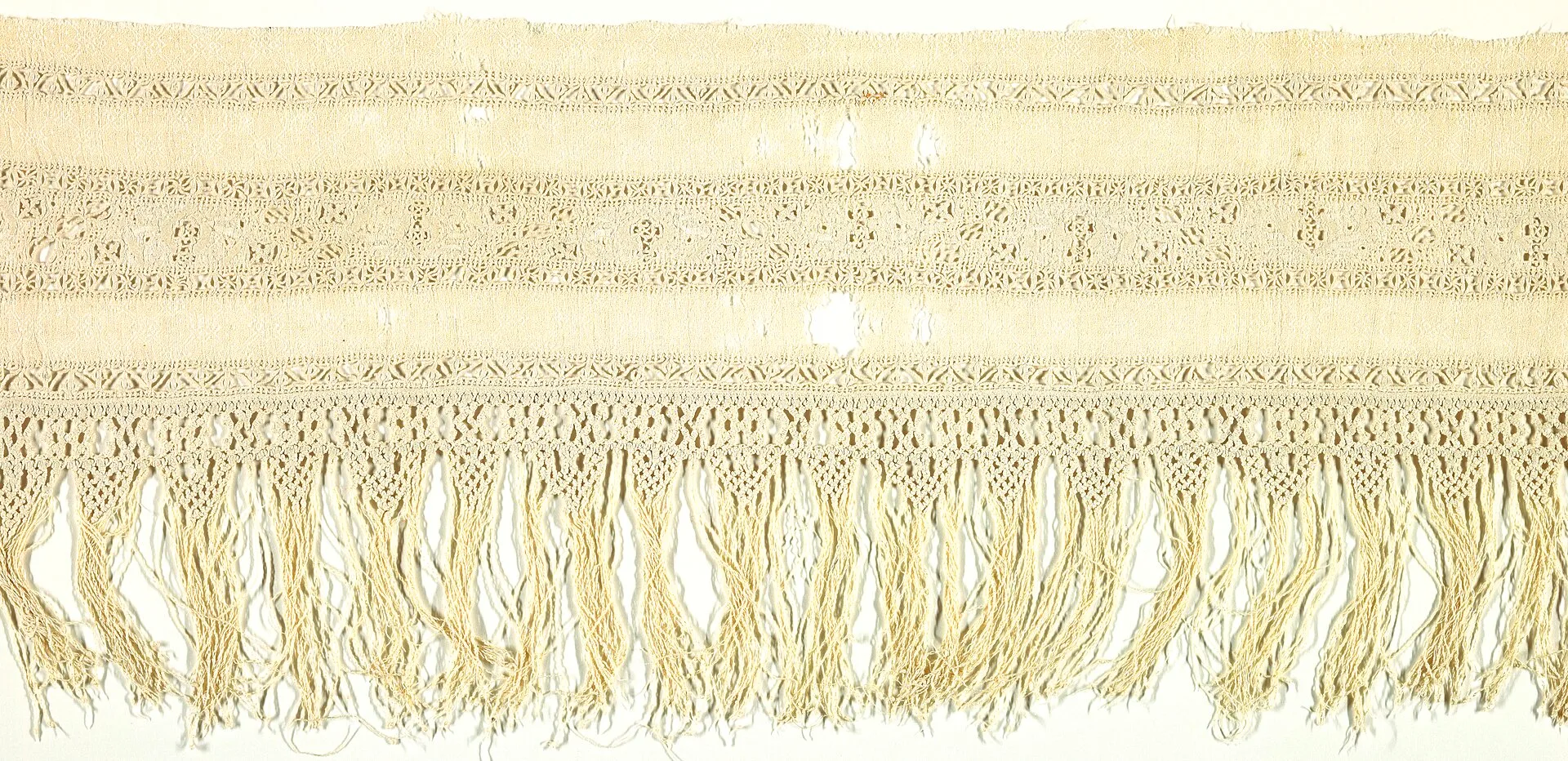
INLAID CLAY FROM STOKE AND PRESSED CEMENT FROM VIVIERS AND BARCELONA
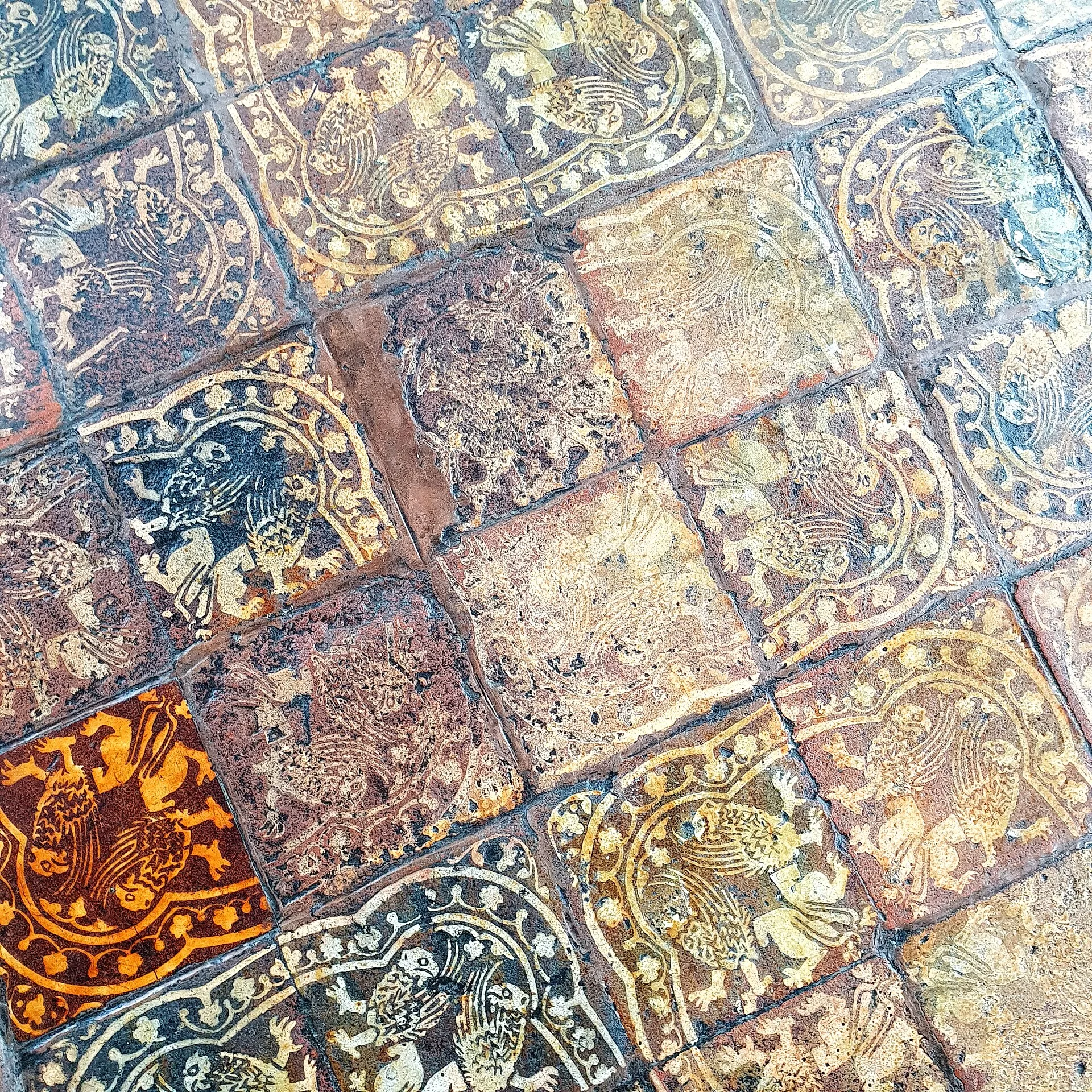
Encaustic cement tiles is a trade name for patterned floor tiles pressed from pigmented cement and never fired. The term joins two products. Encaustic tiles proper are fired clay tiles with a pattern inlaid in coloured clay, a medieval technique revived in 19th-century England by Herbert Minton. Cement tiles, also called hydraulic tiles, are compacted in a press from cement, sand, marble dust and pigment, a process developed in France in the 1850s and taken up in Spain in the 1860s. Le Petit Journal, writing from Singapore, notes that the label "encaustic cement tiles" is often used in error. The clay tile was revived first, at Stoke-on-Trent and the Palace of Westminster; the cement tile followed from Viviers to Barcelona, where it became the dominant flooring of the city by the 1920s.
WHAT ARE ENCAUSTIC TILES?
The US National Park Service, in Preservation Brief 40 of October 1996 by Anne E. Grimmer and Kimberly A. Konrad, defines encaustic tiles as unglazed decorative floor tiles whose patterns are inlaid during manufacture. The brief traces the method to Cistercian monks, who developed it in the 12th century, and records that the skill was lost again in the 16th century. Adam Watrobski, head of architecture and heritage at the Houses of Parliament, writes in The Building Conservation Directory that the process reached England from France at the beginning of the 13th century and was widely used in abbeys and royal palaces. He notes that the term "encaustic" is a 19th-century invention.
The revival began with a patent. Watrobski records that Samuel Wright of Staffordshire registered one in 1830 for a method in which a screw press forced clay into a plaster mould carved with the pattern; the indented design was filled with clay slip and planed level. Wright was not financially successful and sold shares in his patent to Chamberlain & Co of Worcester and to Herbert Minton (1793 to 1858) of Thomas Minton & Sons. The V&A notes that Minton went into production with inlaid tiles from the 1830s, and Watrobski credits him with turning the process into a commercial success. Minton's first encaustic pavement was laid in 1842 at the Temple Church in the City of London.
HERBERT MINTON, PUGIN AND THE PALACE OF WESTMINSTER

Charles Barry, architect of the new Palace of Westminster, chose Augustus Welby Pugin (1812 to 1852) to design its decorative elements, including the floor tiles. In February 1843 Barry proposed that the floors of the halls, galleries and corridors should be formed of encaustic tiles. With Pugin's help, Minton was producing tiles in up to six colours by 1844, and Watrobski estimates that the firm made around 75,000 tiles for the building between 1847 and its official opening in February 1852. The floors cover six main halls and a dozen or so linking corridors and staircases, each framed by stone borders: Valentia slate in the Commons and Hopton Wood stone in the Lords.
The Victoria and Albert Museum holds a tile designed by Pugin in 1847 and made by Minton around 1850, with a three lions pattern drawn for the fireplace of the Prince's Chamber. It is 30 cm square, marked "MINTON & Co. PATENT, STOKE-UPON-TRENT", and was laid in the House of Commons in 1850. The museum describes the Westminster floors as the earliest extensive series of tile floors made in the 19th century and notes that Minton tiles were used extensively in the renovation of medieval churches, where heraldic designs, sometimes commissioned, were popular. In January 1852 Pugin wrote to Minton that the St Stephen's tiles were "vastly superior to any ancient work".
HOW ENCAUSTIC CLAY TILES ARE MADE

The V&A describes clay pressed into a mould that left impressions in the surface, which were filled with coloured liquid clay before the tile was dried and fired. The NPS brief describes clay compacted in layers in the mould, the mould inverted, liquid white clay coloured with dyes poured into the intaglio pattern, and firing in a kiln with high, even heat. It adds that dust pressing, which compressed nearly dry clay between metal dies, changed the industry in the 1840s, and that by 1860 up to six colours were used in a single tile. Watrobski gives the Westminster tiles a thickness of 25 mm, with a core of grog and cheap red clay between two layers of better buff clay.
Encaustic tiles were usually laid with geometric tiles, smaller single-coloured pieces that form patterns when assembled. The NPS brief notes that geometric tiles cost much less to produce and that by the end of the 19th century over 60 shapes and sizes were available in up to ten colours. Peter Thompson, writing in The Building Conservation Directory in 2004, dates these floors in public buildings, churches and expensive villas to the 1860s; by the 1890s they were an essential feature of ordinary Victorian terraced houses. Thompson notes that the floors fell out of fashion in the 1960s and 1970s, and Watrobski that Minton tiles ceased production in the 1960s.
WHERE DID ENCAUSTIC CEMENT TILES COME FROM?
The account in Le Petit Journal credits the French engineer Louis Vicat with setting out the proportions of lime and clay for cement in 1817, without patenting them, and records Joseph Aspdin's British patent of 1824, which gave rise to Portland cement. According to the same account, Etienne Larmande, a public works contractor near the Lafarge works at Viviers, conceived of pressing cement into polychrome tiles, and Auguste Lachave, a mechanic and locksmith from Viviers, helped design the first presses and the pattern dividers that allowed colours to be inlaid. The process was patented in 1853. Its main innovation was that the tiles needed no firing.
Teresa Navas Ferrer of the Polytechnic University of Catalonia records that the first hydraulic mosaic factory in Barcelona was opened by Francisco Garreta in 1864 as a subsidiary of the Garreta-Gojon company, based in the Marseille area. The Diputació de Barcelona heritage inventory dates the origins of the hydraulic floor to 1857 and links its recognition to the 1867 Universal Exhibition in Paris, where the firm Garret, Rivet i Cia presented it as a tile that did not need firing but was consolidated in hydraulic presses. Navas Ferrer names Butsems i Fradera, a maker of artificial stone since 1854, and Orsola, Solà i Cia, operating from 1876, among the Barcelona firms that took up the trade.
HOW ARE ENCAUSTIC CEMENT TILES MADE?

Each tile is made individually. The Diputació de Barcelona inventory describes a face mixture of marble dust, white cement, sand and pigments poured into a mould, the trepa, divided by brass separators that draw the motif. A second layer, the brasatge, of grey cement and sand, absorbs the excess water, and the mould goes into a hydraulic press. Navas Ferrer describes the same build-up in an iron mould: a grey cement mortar forming the main body, a layer of cement powder with silica sand, and a fluid face layer of cement, dry products and pigments, its colours separated by a thin metal stencil known as the laiton. The press was originally hydraulic, hence the product's name.
There is no kiln. Navas Ferrer records that after 24 hours the tiles could be stacked and that pieces were standardised at 20 by 20 cm. The Diputació inventory describes the tiles being sprayed with water and stored in a chamber for about 28 days. The NPS brief illustrates historic cement floor tiles in a house in Old San Juan, Puerto Rico, with a design intended to resemble wood parquet. A 2015 report by Peter Steinhauer for the German press agency DPA found production still largely manual, with patterns applied through tin stencils and strength coming from compacting and drying the cement, and noted that most cement tiles sold in Europe are made in Morocco, Tunisia or India.
BARCELONA, ESCOFET AND THE MODERNISTA FLOOR
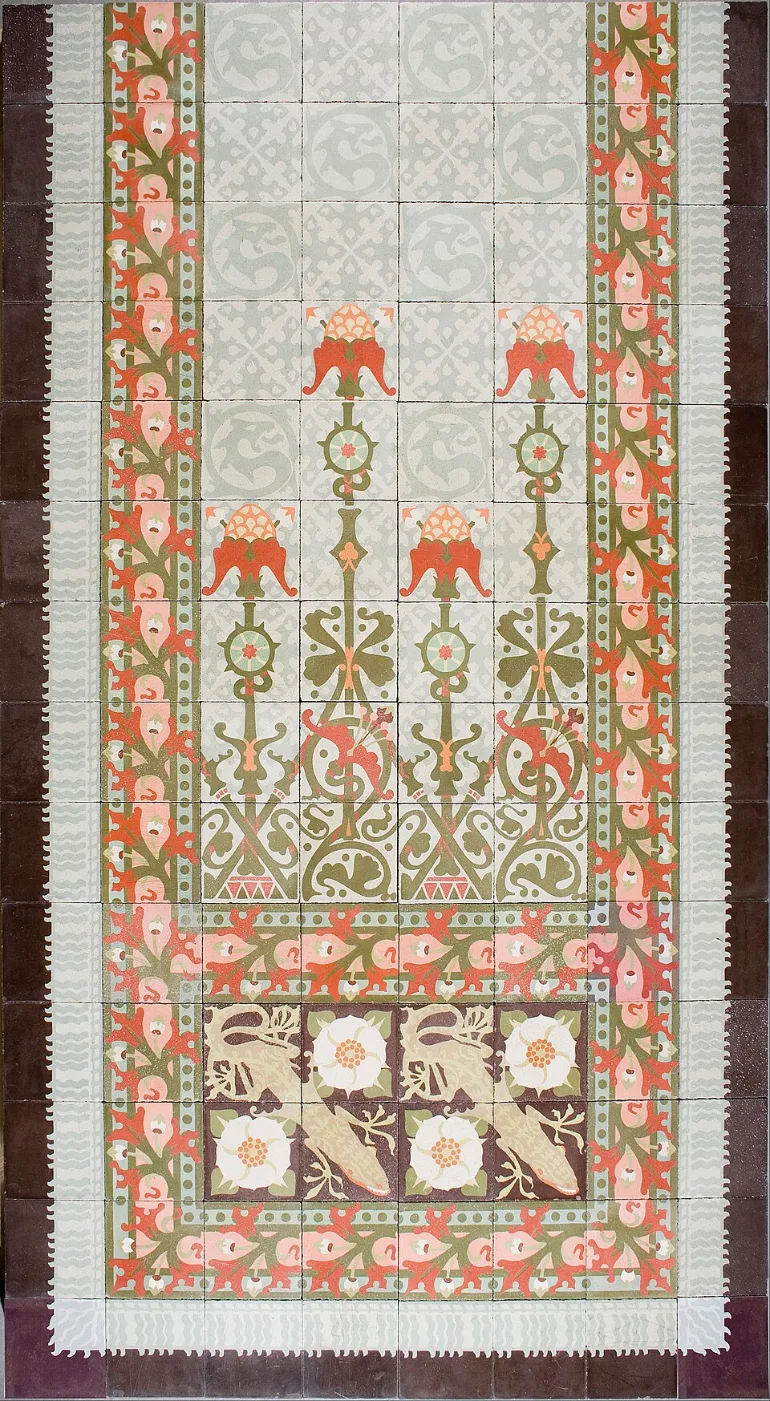
Navas Ferrer writes that in the 1890s hydraulic mosaic became the predominant flooring in Catalan construction, relegating ceramic floors to a niche market. In 1886 Jaume Escofet i Milà, who had learned the trade at Òrsola, Solà i Companyia, and the painter Teòtim de Fortuny i Carpi founded Escofet i Fortuny, with Fortuny supplying much of the 35,000 pesetas of starting capital. The Enciclopèdia Catalana records that the firm won a gold medal at the 1888 Barcelona Universal Exhibition, exhibited in Paris in 1889 and opened a Madrid factory in 1891. By 1909 it had 200 workers at its 8,000 square metre factory on Gasòmetre street, rising to 350 by the late 1920s.
Escofet's catalogues, including a large one published in 1900, credited the architects Gaudí, Sagnier, Gallissà, Pascó, Domènech i Muntaner, Puig i Cadafalch and Font among its designers. The Museu Nacional d'Art de Catalunya holds a hydraulic pavement designed by Gaudí and made by E.F. Escofet y Cia around 1904 to 1906, with octopus, snail and starfish motifs, conceived for Casa Batlló and finally applied to Casa Milà on Passeig de Gràcia. Navas Ferrer notes that hydraulic mosaic was the dominant flooring of the city from the 1920s until almost the 1950s, although by the late 1920s monochrome or lightly patterned tiles were laid throughout whole houses without distinguishing rooms.
CEMENT TILES IN ASIA, DECLINE AND REVIVAL
Le Petit Journal reports that the tiles spread from France to Spain and further afield, were adopted in British India and French Indochina, where French entrepreneurs set up factories early in the 20th century, and were exported to the Dutch East Indies. In Singapore, the collector Victor Lim identifies the Tampenis Cement Tile Works on Sungei Road, operating from 1906 to 1957, as the only recorded local manufacturer. Early 20th-century cement tiles survive at the presbytery of the Cathedral of the Good Shepherd, where about 2,000 were restored, and at the former Tanjong Pagar railway terminus, a separate tradition from the majolica Peranakan tiles of the city's shophouses.
The Diputació de Barcelona inventory records that by the end of the 1950s cheaper products, among them terrazzo, ceramics and stoneware, had ended hydraulic mosaic production, and Le Petit Journal attributes the end of handmade production to labour costs and industrial glazed ceramics. DPA notes that the tiles went out of fashion along with ceiling mouldings and were often covered with linoleum. Demand has returned since the early 2000s, according to Le Petit Journal, which names Vietnam and Morocco as the last countries producing to 19th-century methods. DPA reported that Italy's Bisazza had launched a cement tile range with designers including Tom Dixon, Jaime Hayon and Paola Navone.
ENCAUSTIC CEMENT TILES AND THE BAY, MANDARIN ORIENTAL JUMEIRA

The Bay at Mandarin Oriental Jumeira, Dubai, was completed in 2019. Its interior design places white brick over a geometric tiled floor. Geometric floors of the Victorian type that Peter Thompson describes took their dimensions from a six-inch square and could use up to 600 tiles per square metre, and the NPS brief records that by the end of the 19th century over 60 shapes and sizes of geometric tile were available in up to ten colours. In Barcelona, the hydraulic tile industry standardised its pieces at 20 by 20 cm.
Pressed cement tiles have also returned to hotel interiors: Le Petit Journal records that Philippe Starck used them in a patchwork floor at the M Social hotel on Robertson Quay in Singapore. The Bay has a marble buffet counter and white marble stations with chalkboard menus. A timber-topped bread and pastry island sits under pendants, and green banquettes are set beneath a beamed timber ceiling. The venue has steel-framed glazing and a marble-fronted bar facing the beach terrace and the sea.
SOURCES
- US National Park Service Preservation Brief 40: Preserving Historic Ceramic Tile Floors
- The Building Conservation Directory Encaustic Tiles at the Palace of Westminster, Adam Watrobski
- The Building Conservation Directory Victorian and Edwardian Geometric and Encaustic Floor Tiles, Peter Thompson
- Victoria and Albert Museum Tile, designed by A.W. Pugin, made by Minton (C.150-1982)
- Universitat Politècnica de Catalunya Contemporary Mosaics: The Case of the Hydraulic Mosaic, Teresa Navas Ferrer
- Diputació de Barcelona Paviment hidràulic del Centre Recreatiu de Carme
- Enciclopèdia Catalana Els mosaics artístics dels Escofet
- Museu Nacional d'Art de Catalunya Pavement for Casa Milà: octopus, snail and starfish
- Le Petit Journal Singapour Carreaux de ciment, une présence française insoupçonnée à Singapour
- Gulf Times (DPA) New-old flooring: cement tiling on its way back, Peter Steinhauer