

FROM THE SAVOY AND THE CARLTON TO THE CHEF'S TABLE COUNTER
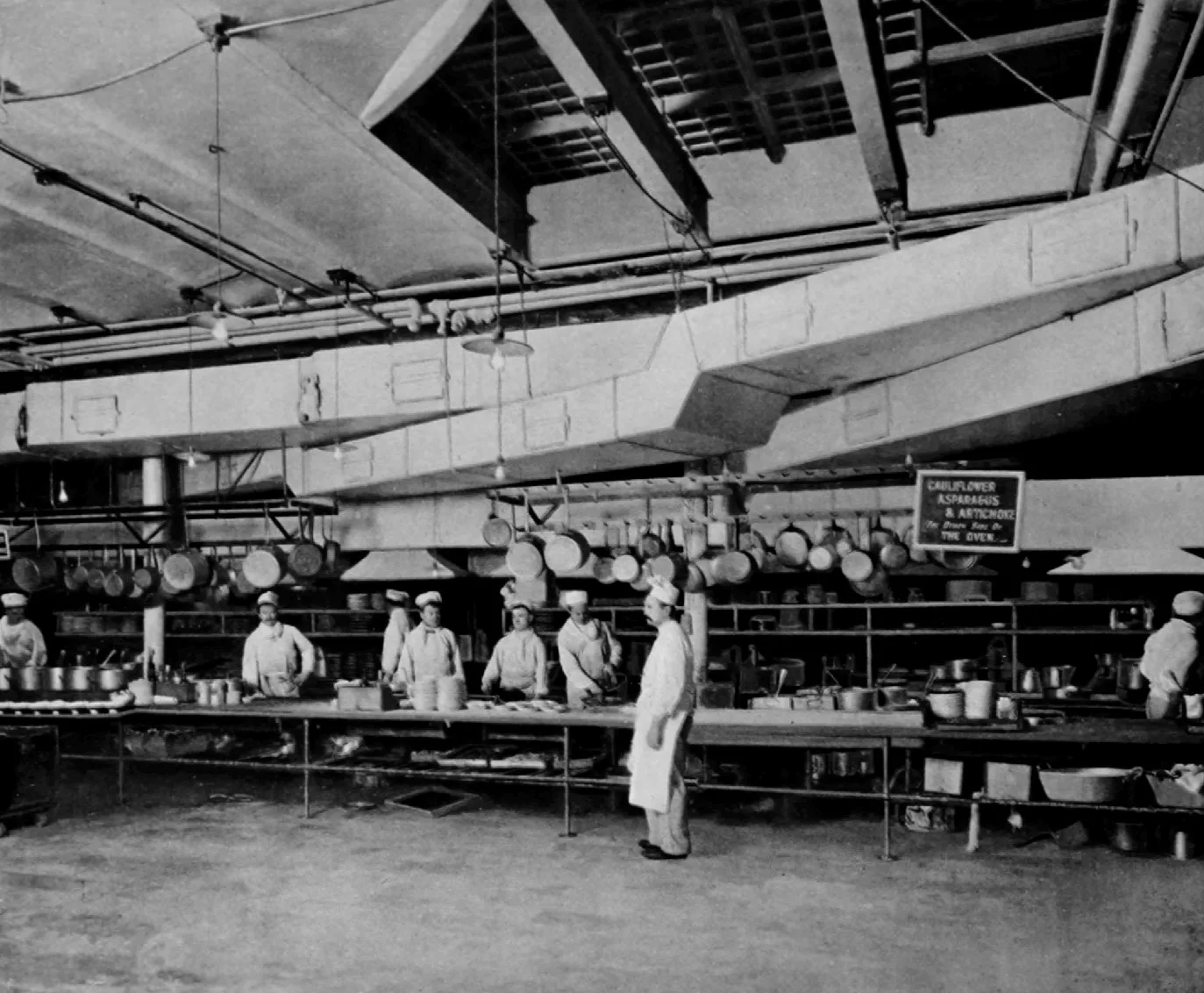
The Escoffier brigade system is the division of a professional kitchen into ranked posts and specialist stations, each run by a cook answerable to the head chef. It takes its name from Georges-Auguste Escoffier, born in Villeneuve-Loubet, near Nice, on 28 October 1846, whom Britannica calls "the king of chefs and the chef of kings". Escoffier directed the kitchens of the Savoy Hotel in London from 1890 and afterwards those of the Carlton Hotel, working with the hotelier César Ritz, and Britannica credits him with setting up the brigade de cuisine at the Savoy. In 1903 he published Le Guide culinaire. The stations he organised, from saucier to pâtissier, are still listed by the Culinary Institute of America.
WHO WAS AUGUSTE ESCOFFIER

According to the Fondation Auguste Escoffier, which runs the museum in his birthplace, Escoffier was the son of a farrier and began his apprenticeship at 13 with his uncle at the Restaurant Français in Nice. He left Nice for Paris in 1865. In 1870 he was enlisted as a cook for the general staff of the Army of the Rhine. He was chef at the Petit Moulin Rouge in Paris from 1873 to 1878 and then ran the Maison Chevet and the Restaurant Maire until the spring of 1884. Britannica ties his later kitchen organisation to his time in the army, describing the brigade as a hierarchical structure inspired by his military service.
In October 1884, the Fondation records, Escoffier became chef of the Grand Hotel in Monte Carlo, which was managed by César Ritz. Paul Levy, writing in The New York Review of Books in 2018, notes that Ritz had lost his previous chef to the Hôtel de Paris at the casino and went looking for Escoffier. Escoffier then followed Ritz to Lucerne to run the kitchens of the National. From then on, the Fondation's chronology follows the same pattern through Monte Carlo, Lucerne, London and Paris: Ritz managed the hotels, and Escoffier ran their kitchens.
ESCOFFIER, CÉSAR RITZ AND THE SAVOY IN LONDON
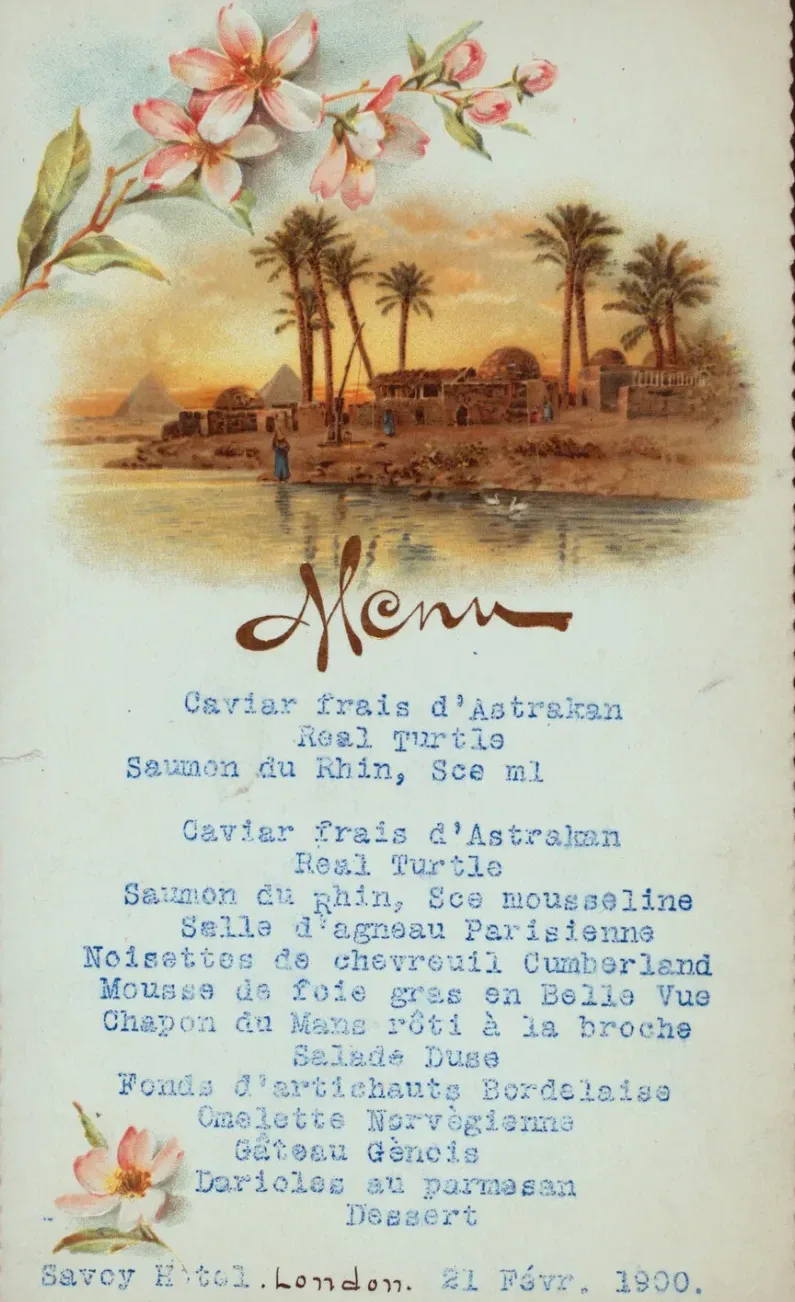
The Savoy opened in 1889, and Levy describes it as London's first luxury hotel. The Fondation records that Ritz took over its management in April 1890, with Escoffier in charge of the kitchens and restaurant; Levy dates Escoffier's arrival to 6 April 1890 and calls him the first celebrity chef de cuisine. Britannica states that Escoffier's worldwide reputation was made as director of the Savoy's kitchens and then at the Carlton. According to Levy, the Prince of Wales became a key client, and Escoffier created set-price menus for English guests who could not follow menu French: for any party of at least four, a personalised seven-course menu at a fixed price.
Levy also describes the working conditions Escoffier changed. Kitchens of the period were extremely hot, and cooks drank beer during the day to rehydrate. Gas burners had by then replaced coal-fired ranges. Escoffier banned drinking, smoking and shouting in the kitchen, and required cooks to keep their whites clean and not to wear them in the street. Levy gives his motto as Surtout, faites simple, "above all, make it simple", while noting that by the standards of nouvelle cuisine his cooking was fussy and heavily sauced.
The best-known story from the Savoy years concerns the Australian soprano Nellie Melba. In the account given by the Fondation, Escoffier created a "Peach Swan" for her in 1894 after hearing her sing in Wagner's Lohengrin at Covent Garden, and the dish became Peach Melba when the Carlton opened in 1899. Tori Avey, writing for the PBS series The History Kitchen, presents the story as Escoffier's own claim: peaches served over vanilla ice cream in a silver dish set on an ice swan, with sweetened raspberry purée added a few years later when the name changed.
WHAT IS THE ESCOFFIER BRIGADE SYSTEM
Britannica describes the brigade de cuisine as a hierarchical kitchen structure in which each member of staff has a specialisation, an arrangement that created efficiencies and streamlined communication. In Levy's summary, Escoffier divided his cooks into parallel teams under his overall command, each team handling one part of a dish under a chef de partie, or station chef. Levy credits the arrangement with faster preparation, less waste and food that reached the diner hotter. The Culinary Institute of America (CIA), the American cookery college, states that Escoffier instituted the system to streamline and simplify work in hotel kitchens, giving each position a station and defined responsibilities so that work was not duplicated.
At the top is the chef de cuisine, who in the CIA's description runs all kitchen operations, including ordering, supervising the stations and developing menu items. Britannica gives the older name gros bonnet for the chef in charge of the kitchen. The sous-chef is second in command, filling in for the chef, handling scheduling and assisting the station cooks. Below them are the chefs de partie, each responsible for one station, and the commis, who in the CIA's words "works under a station chef to learn how the station operates". The tournant works wherever needed in the kitchen, and the communard prepares the meal served to staff during the shift, also called the family meal.
The stations divide the menu by cooking method and course. The saucier is responsible for sautéed items and their sauces, the poissonnier for fish and its sauces, often including butchering the fish, and the rôtisseur for roasted foods and their jus. The full brigade also has a grillardin for grilled food and a friturier for fried food. The entremetier handles hot appetisers and frequently soups, vegetables, pasta and other starches; Britannica's description of the post also includes sweet courses. The garde manger prepares cold food such as salads, cold appetisers and pâtés, and the pâtissier is responsible for baked items, pastries and desserts. The CIA notes that several of these stations are often combined in one.
HOW THE ESCOFFIER BRIGADE SYSTEM HANDLED À LA CARTE ORDERS

The brigade was built for volume. The Fondation records that when the Ritz in Paris opened with a gala on 5 June 1898, Escoffier was a partner in the Ritz Development Company and had supervised the design and organisation of its kitchens. He opened the Carlton Hotel in London on 1 July 1899 and remained there until 1920. Levy notes that Ritz built the Carlton in the Haymarket between 1896 and 1899 to compete directly with the Savoy. At the Carlton, according to the Fondation, Escoffier was supported by a team of sixty cooks and could serve 500 covers at each sitting.
Orders reached the stations through the aboyeur, also called the expediter. The CIA describes the post as accepting orders from the dining room, relaying them to the station chefs and being the last person to see each plate before it leaves; the station is known as "expo", and the chef or sous-chef sometimes fills the role. The same organisation went to sea. The Fondation records that in 1904 the Hamburg-America Line set up an à la carte restaurant service under the name Ritz Carlton Restaurant, with kitchens organised by Escoffier, on liners including the Amerika and the Kaiserin Augusta Victoria, followed by the Imperator in 1913.
WHAT IS LE GUIDE CULINAIRE
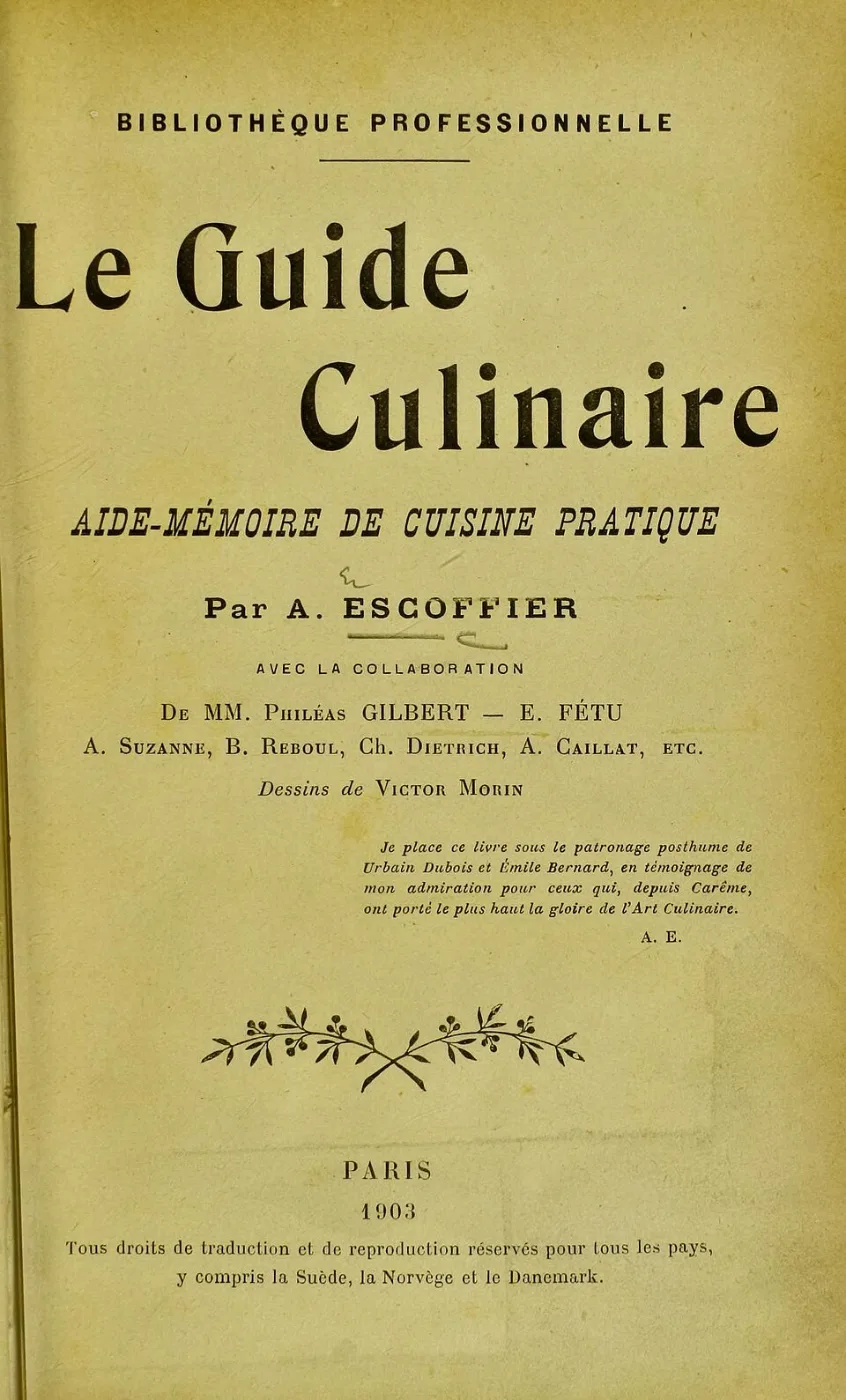
Le Guide culinaire was first published in 1903, and the Fondation records a fourth edition in 1921, the last in Escoffier's lifetime. The English translation, A Guide to Modern Cookery, was published in London by William Heinemann in 1907, with the author credited as "A. Escoffier, of the Carlton Hotel, London". Its chapters open with the fonds de cuisine, the basic stocks, followed by the leading warm sauces, the small compound sauces, cold sauces and compound butters, and savoury jellies, before moving on to hors d'oeuvres, eggs, soups, fish, butcher's meat, poultry and game, roasts and salads, vegetables, savouries and sweets.
In the preface Escoffier sets out why the book was needed. He writes that the fundamental principles of the science were owed to Marie-Antoine Carême and would last as long as cooking itself, but that the menus and the service of his own day required radical change. He refers to "the rapidity with which meals are served nowadays", describes the old elaborate presentation as "a mere hindrance to the modern, rapid service", and notes that "the number of dishes set before the diners" had been "considerably reduced". He also observes that palatial hotels and sumptuous restaurants had opened.
Escoffier's other books include Le Livre des menus (1912) and Ma Cuisine (1934). He died in Monte Carlo on 12 February 1935. His methods also reached Asia. The National Diet Library of Japan records that Nishio Masukichi, fourth head chef of Tsukiji Seiyoken in Tokyo, worked at the Ritz in Paris; that Akiyama Tokuzō, appointed Master Chef of the Imperial Court in 1913, became known as "the Japanese Escoffier" after his French cookery book of more than 1,600 pages appeared in 1923; and that a 1941 compilation is thought to be the first translation of Escoffier in Japan.
HOW THE ESCOFFIER BRIGADE SYSTEM ADAPTED TO OPEN KITCHENS AND CHEF'S TABLES
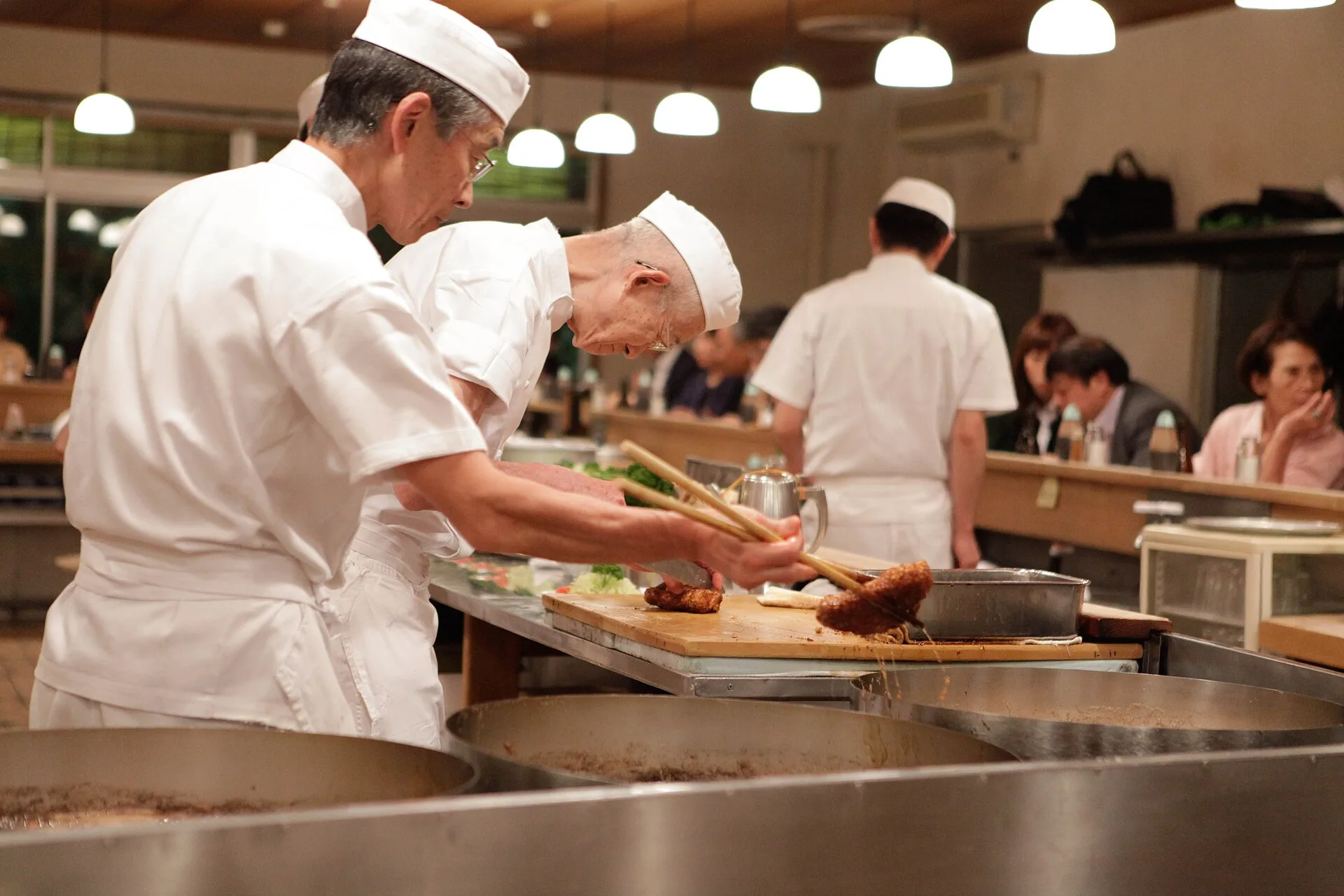
Writing in Saveur in 2009, Hunter Lewis noted that fine-dining kitchens followed the French brigade model for many years, with cooks fixed to stations such as sauces or pastry, and that as menus diversified many kitchens moved to "a more collaborative and less hierarchical design". Lewis traces the open kitchen in New York to Jonathan Waxman, who brought the format from California to Jams in 1984. The CIA describes the usual modern team as an abbreviated brigade of a chef, a sous-chef and line cooks, with line cooks covering many of the classic stations.
The order system has changed with the format. A 2018 MICHELIN Guide feature on the chef's table in Hong Kong describes the kitchen of Gaddi's at The Peninsula during service. A printer produces dockets for each order; head chef Xavier Boyer reads out the orders and places the tickets in sequence on the docket rail, and his chefs sound their acknowledgement. The components come together at the pass, where Boyer checks each plate before calling for service, and he moves the dockets along the rail as tables progress. The chef's table is separated from the pass only by its width and a busy work corridor. Boyer told the Guide, "Let's not call it a 'chef's table'. It's a 'chefs' table'."
OPUS AT MANDARIN ORIENTAL SHENZHEN

Opus is a restaurant at Mandarin Oriental Shenzhen, with interiors completed by Silverfox Studios in 2022. The materials of the dining room are geometric metal and lattice screens, red leather banquettes, blue chairs, brass panelling and globe pendants. The restaurant also has a chef's table counter set beneath a stainless hood, with glass wine cabinets, brass panelling and views over the city. In the preface to the 1907 English edition of Le Guide culinaire, Escoffier wrote that restaurants "allow of observing and of being observed", and referred to "the rapidity with which meals are served nowadays".
In the Escoffier brigade system, the expediter relays each order from the dining room to the station chefs and is the last person to see the plate before it leaves the kitchen. At Gaddi's in Hong Kong, the chef's table is separated from the pass by its width and a work corridor, and the head chef checks each plate there before calling for service. At Opus, the chef's table is a counter beneath a stainless hood, with glass wine cabinets, brass panelling and city views, in a restaurant completed in 2022 whose dining room has red leather banquettes and blue chairs.
SOURCES
- Britannica Auguste Escoffier
- Britannica Kitchen team
- Fondation Auguste Escoffier, Musée Escoffier de l'Art Culinaire Auguste Escoffier
- The New York Review of Books Ritzy Business, Paul Levy
- PBS Opera, Escoffier, and Peaches: The Story Behind the Peach Melba
- The Culinary Institute of America Behind the Kitchen Door: A Who's Who of Restaurant Kitchens
- Internet Archive (Cornell University Library) A Guide to Modern Cookery, A. Escoffier, 1907
- National Diet Library, Japan Akiyama Tokuzō and French cuisine in Japan
- Saveur Open House, Hunter Lewis
- MICHELIN Guide Evolution Of The Chef's Table in Hong Kong


