WATG'S DESIGN, A CONVERTIBLE AUDITORIUM AND A KLAIS ORGAN

The Royal Opera House Muscat is a performing arts complex in Shatti Al-Qurum, a coastal district of Oman's capital, which opened on 12 October 2011 with Puccini's Turandot. Sultan Qaboos bin Said ordered its construction in 2001, and the international firm WATG designed it after winning a design competition in 2003. The complex combines an auditorium that converts from an opera house into a concert hall, a pipe organ built in Germany by Klais, landscaped gardens, an arts annexe and a shopping arcade, the Opera Galleria. Its programme mixes opera, ballet, orchestral concerts, jazz and Arab music, with visiting companies such as the Mariinsky Ballet and American Ballet Theatre. By its ninth anniversary in 2020, the Times of Oman reported, the venue counted an audience of more than one million and 30,000 artists on its stages.
WHEN WAS THE ROYAL OPERA HOUSE MUSCAT BUILT?
According to Arab News, Sultan Qaboos bin Said ordered an opera house for Muscat in 2001. In 2007 the project still carried the name House of Musical Arts, the title under which the design trade magazine I+S Design reported it in 2007. The client was the Royal Court Affairs of the Sultanate of Oman, which in 2003 invited a select group of firms to an international design competition. WATG, a destination design firm founded in 1945, won it and went on to lead the full design and supervision team. Its scope, as I+S Design listed it, covered master planning, architecture, interior design, landscape architecture, decorative lighting, kitchen design, graphics, signage and the engineering services, with acoustic design consultants also part of the team.
Construction of the superstructure began in April 2007, the month in which the Omani contractor Carillion Alawi was awarded the building contract, according to the Times of Oman. At that stage the opening was scheduled for 2010. Arab News recorded that construction was completed in October 2011, and the house opened on 12 October that year. Theatre Projects, the theatre consultancy that has published a case study of the auditorium, describes the building as the first opera house on the Arab peninsula. The finished venue opened as the Royal Opera House Muscat, a name the Times of Oman shortens to ROHM.
WHAT DOES THE ROYAL OPERA HOUSE MUSCAT LOOK LIKE?

WATG's design, as described by I+S Design, reflects modern Omani public buildings and draws on traditional forms: colonnades, terraces and sculptural tower forms. The facades use locally sourced, light-coloured stone with complementary stucco. The Times of Oman gives the construction as reinforced concrete with block infill, clad externally in what the contractor called "Omani marble and render". The main building covers 15,380 square metres over six levels, with three further basement floors below. Arab News described the result as a blend of classical and contemporary architecture, and Theatre Projects as a blend of traditional Arabic and contemporary design.
Writing in The National in October 2011, Feargus O'Sullivan described the building as a classic hump-backed opera house silhouette combined with fort-like towers and cool colonnades, with the colonnades and courtyards giving audiences space to relax. Britannica notes that Oman's restored forts and castles include a series of forts guarding Muscat's harbour, that many of the interior strongholds date to the 17th century, and that Bahla Fort, a stone and mud-brick structure, became a World Heritage site in 1987. It adds that traditional elements of architecture have been incorporated into new buildings across the country.
The site plan in 2007 set the opera house on 8 hectares, about 20 acres, as the first phase of a new urban quarter. Around the building WATG planned a formal landscaped park, a cultural souk with museums, retail and coffee shops, and a village square. The completed complex, as Gulf News described it at the opening in October 2011, includes the opera auditorium, a concert theatre, formal landscaped gardens, a cultural market with shops and restaurants, and an art centre.
INSIDE THE AUDITORIUM: MARBLE, TEAK AND CARVED WOOD
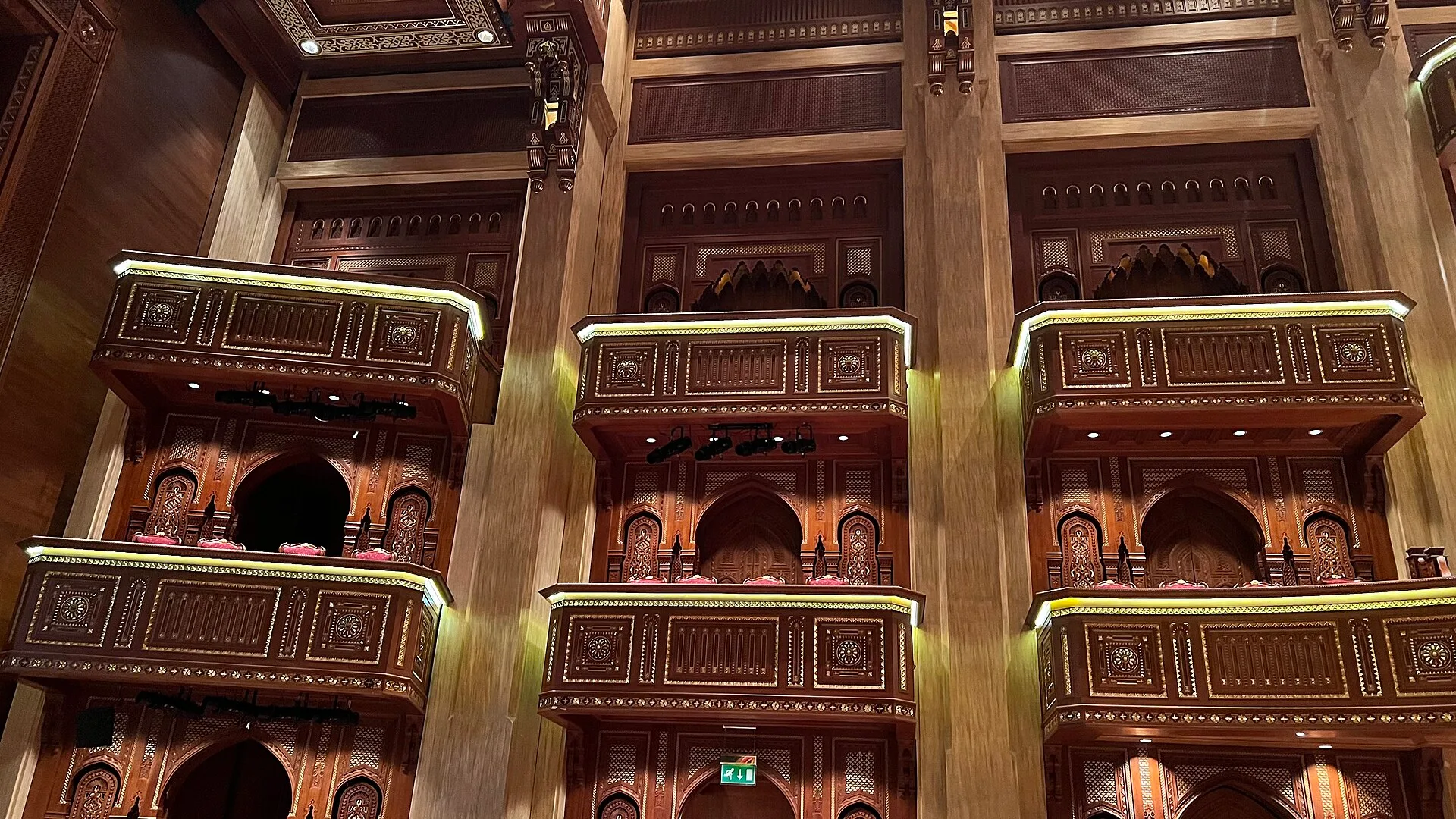
The main auditorium is horseshoe shaped. Gulf News listed its materials as marble, gypsum and wood carving, with inlaid marble, crystal chandeliers and hand-carved wood. Arab News described the same combination of chandeliers, hand-carved wooden fixtures and inlaid marble, called the interior luxurious and noted the small decorative details carried throughout it. The Times of Oman adds dark teak panelling and intricately carved marble work. On sightlines, Arab News reported that even the cheapest seats in the house gave a decent view of the stage.
Each seat carries a touchscreen display, the Mode23 seatback system made by the Italian company Radio Marconi, which shows subtitles in several languages and lets audiences rate performances. Gulf News reported that the Muscat house was the first opera house in the world to install the system. Seat counts published in 2011 vary with the configuration of the hall: Gulf News gave 850 seats for opera and 1,050 for concerts, while Arab News and The National gave a figure of 1,100. I+S Design, writing in 2007, described a 1,000-seat concert hall that could be reconfigured with fewer seats for dramatic and operatic productions.
HOW DOES THE STAGE CONVERT INTO A CONCERT HALL?
The convertible hall was part of WATG's competition design. I+S Design explained that the concert hall's shell is a mobile structure, which can be detached so that an adjustable proscenium drops into place to create a traditional theatre format, a flexibility intended to give the room strong natural acoustics. Theatre Projects describes the conversion in mechanical terms. A 500-ton orchestra shell travels downstage from the back of the house on railway tracks and fits against the auditorium walls. The proscenium arch lifts away, the orchestra pit rises and the front two rows of seats lower into the floor, all under automated control.
At the opening, a member of the venue's press department told Arab News that the adjustable proscenium arch could be moved back to make way for an orchestra pit. The National described the same system as a loose, adjustable shell that lets the proscenium be expanded or reduced to suit the scale of a production, and Gulf News reported that the proscenium and boxes move hydraulically. The technical director, Geoffrey Wheel, told Gulf News that the venue could also operate as a theatre or a cinema and could screen 3D films. Theatre Projects puts the whole facility at 200,000 square feet.
THE KLAIS PIPE ORGAN
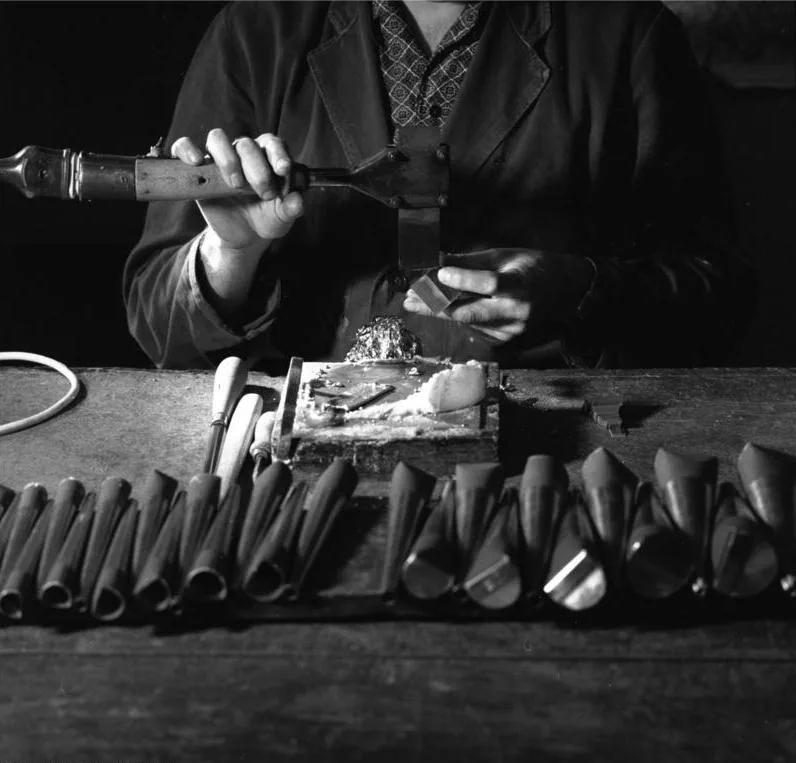
The hall contains a concert organ by Klais, the organ builder of Bonn in Germany. Both Gulf News and The National credited the instrument in 2011 to Philip Klais of Bonn and reported that it was made entirely of wood and decorated with gold leaf. The Times of Oman describes it as having more than 4,000 pipes and calls it one of the largest organs in the Middle East. One of its pipes was specially designed in honour of Sultan Qaboos. Like the stage, the organ can be moved on a hydraulic system, adjusting the performance space for ensembles of different sizes or for different types of event.
The National noted at the opening that the Sultan was fond of pipe music, and the organ has since featured in dedicated pipe organ concerts. The Times of Oman lists visiting recitalists including David Briggs in 2013, Olivier Latry in 2014, Giampaolo Di Rosa in 2016 and Hansjörg Albrecht in 2017. Oman also has its own national orchestra. Britannica records that the Royal Oman Symphony Orchestra was formed in the late 1980s, has performed with the BBC Philharmonic Orchestra and is one of the few national orchestras in the Middle East.
WHAT WAS THE FIRST PERFORMANCE AT THE ROYAL OPERA HOUSE MUSCAT?

The house opened with Puccini's Turandot, the composer's final opera, first performed at La Scala in Milan in 1926. The production was Franco Zeffirelli's staging of his New York Metropolitan Opera Turandot, remade for Muscat with new costumes, sets and cast. Plácido Domingo conducted the chorus and orchestra of the Fondazione Arena di Verona, with Xiu Wei Sun as Princess Turandot and Mario Malagnini as Calaf. Gulf News described a three-tiered set of a Chinese imperial palace courtyard and a cast of more than 300. The National counted more than 1,000 costumes, and Wheel said the production needed 22 sea containers, against the usual 10 to 12 for a large touring opera.
Gala performances featured Domingo and the tenor Andrea Bocelli, and the soprano Renée Fleming appeared in a gala concert. The first season, as Gulf News listed it, continued with the London Philharmonic Orchestra and cellist Yo-Yo Ma under Christoph Eschenbach on 5 November, La Scala Ballet's Giselle, the tribute Umm Kulthum: The Legacy, the singer Magida Al Roumi, the Universal Ballet of Korea's Shim Chung and Wynton Marsalis with the Jazz at Lincoln Center Orchestra. December brought the house's own new production of Carmen, directed by Gianni Quaranta with real horses on stage, and the Mariinsky Ballet's Swan Lake.
BEYOND THE AUDITORIUM: WORKSHOPS, ROHMA AND THE OPERA GALLERIA
Productions on this scale needed support space away from the house. The National reported in 2011 that a production facility was planned in Ghala, about 15 minutes away, with storage for 70 to 80 sea containers and workshops for carpentry, metalwork, painting, costumes, wigs and make-up. The complex later added an annexe, the Royal Opera House Muscat House of Music and Art, known as ROHMA. It stands across the road from the main building and is joined to it by a pedestrian skywalk detailed with Omani architectural elements. Its first event, on 17 January 2019, was an exhibition from the Victoria and Albert Museum in London.
The Opera Galleria is the complex's shopping arcade. The opera house lists 50 shops covering art, gems, fashion and perfume, among them Patek Philippe and Lalique, and dining that includes Fauchon, the London café Richoux, the Indian restaurant The Indus and Al Angham, which serves Omani cuisine. The arcade also houses the Omani Artisan House, run by the Public Authority for Craft Industries, which sells traditional Omani handicrafts. The Galleria also holds the first boutique of the fashion designer Nawal Al Hooti and a Bank Muscat branch serving visitors to both the opera house and the arcade.
MANDARIN ORIENTAL, MUSCAT IN SHATTI AL-QURUM

The Royal Opera House Muscat stands in Shatti Al-Qurum, the coastal district of Muscat in which Mandarin Oriental, Muscat opened on 3 June 2024, more than twelve and a half years after the opera house's first performance of Turandot. Silverfox Studios designed the interiors of five of the hotel's food and beverage outlets: Rawya, The Pool Bar, Essenza, Essenza Bar and The Mandarin Cake Shop. The hotel opened in a district that by 2024 already held the opera house, the Opera Galleria and the ROHMA annexe, whose first event was held in 2019.
Rawya is an elegant European café with subtle Eastern accents. It serves from breakfast to dinner, and its interior is divided into zones that change through the day, so that the room's arrangement at breakfast differs from its arrangement at dinner. At the entrance to the café are a juice bar and a bakery. The Mandarin Cake Shop is organised around a pastry counter, and its interior includes carved lattice screens. The remaining outlets, The Pool Bar, Essenza and Essenza Bar, complete the group of five designed by Silverfox Studios.
SOURCES
- Arab News Royal Opera House Muscat
- I+S Design Construction commences on artful superstructure
- Theatre Projects Royal Opera House Muscat
- The National A look at Muscat's new opera house
- The National Oman's Royal Opera House begins its inaugural season
- Gulf News Royal Opera House a classy affair
- Times of Oman 10 years on, ROHM is still inspiring curiosity and wonder
- Times of Oman Royal Opera House Muscat to present magnificent pipe organ show
- Britannica Oman: Cultural life
- Royal Opera House Muscat Opera Galleria