

DECIBELS, REVERBERATION AND THE LOMBARD EFFECT IN THE DINING ROOM

Why are restaurants so loud? When Zagat asked nearly 13,000 diners across the United States about their habits for its 2018 Dining Trends Survey, noise came top of the list of irritations at 24 per cent, ahead of service at 23 per cent, crowds at 15 per cent, high prices at 12 per cent and parking at 10 per cent. Acoustical research explains the problem in measurable terms. Hard finishes reflect sound instead of absorbing it, large room volumes lengthen reverberation, and diners raise their voices as a room fills, a response known as the Lombard effect. Acousticians measure the result as sound level in decibels and as reverberation time, the number of seconds a sound takes to die away.
WHY ARE RESTAURANTS SO LOUD NOW?
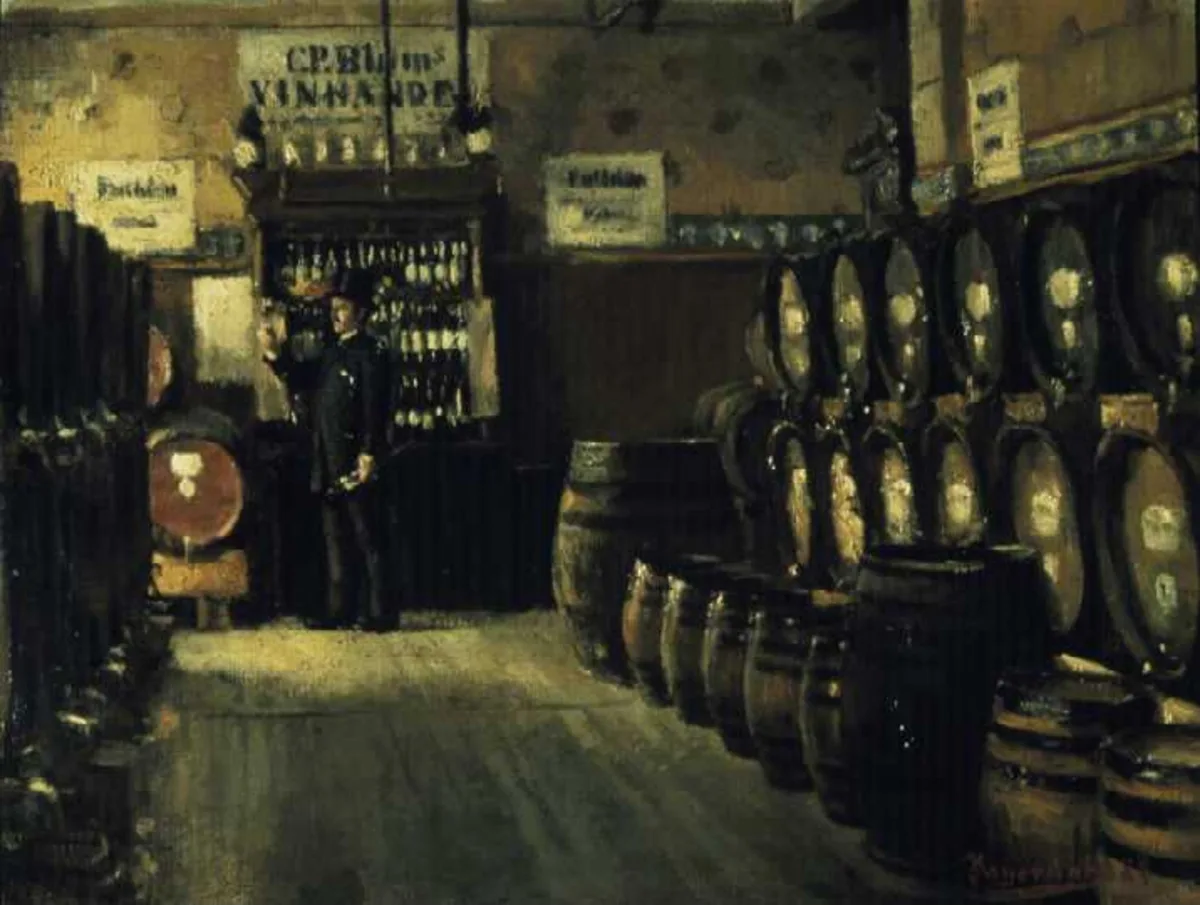
Writing in Popular Science in 2020, Chris Berdik traced the current noise to trends that began in the 1990s. Restaurant owners moved away from carpeting, upholstery and drapes, which were good sound absorbers but had come to be seen as stuffy, and towards high ceilings, bare floors, and walls and furniture made of hard, sound-reflective materials. At the same time, dining rooms were merged with open kitchens and bar areas, and the music was turned up. Lily Wang, an expert in architectural acoustics and a past president of the Acoustical Society of America, told the magazine that architects are trained to think visually and spatially, not about sound.
Washington Post critic Tom Sietsema gave the same diagnosis from the dining table. Interviewed by NPR in 2008 after his article "No Appetite for Noise", he described the tall ceilings, glass and wood surfaces and uncarpeted floor of Brasserie Beck in Washington, and noted that tables were being placed closer together in open, airy rooms. In a 2019 interview with WBUR's Here & Now, he listed marble countertops, brick walls, bare walls and undressed tables as surfaces that reflect sound, alongside overhead televisions, open kitchens and full rooms in which diners raise their voices to be heard.
Brandon Cudequest of the acoustical consultancy Acentech, in a 2026 lay-language paper for the Acoustical Society of America, describes restaurant noise as often a design oversight, for example when a designer does not hire an acoustical consultant and chooses a sound-reflective ceiling instead of a sound-absorbing one. He gives commercial reasons the noise persists after opening: a loud, packed room suggests success and increases turnover, and tight table layouts add paying customers. To show that restaurants have been loud for nearly a century, he reproduces a noise chart adapted from A. H. Davis, published in the Architects' Journal in May 1938.
WHAT IS THE LOMBARD EFFECT?
The mechanism that turns a busy room into a loud one takes its name from É. Lombard, whose paper "Le signe de l'élévation de la voix" appeared in the Annales des Maladies de l'Oreille et du Larynx in 1911. In the definition used by Pasquale Bottalico of the University of Illinois Department of Speech and Hearing Science, speakers unconsciously increase the loudness of their speech in the presence of background noise so that they can still be understood. Bottalico notes that restaurant chatter is more likely to trigger the response than other kinds of background noise. In a restaurant, every diner is both a listener and a source of sound, so each raised voice adds to the background that the next speaker has to overcome.
Bottalico's study, presented to the Acoustical Society of America in Victoria, British Columbia, in November 2018, tested 28 college students with normal hearing, 14 men and 14 women, against restaurant background noise from 35 to 85 dB(A). Participants began to report disturbance above 52.2 dB(A), and their vocal effort rose at double the rate above 57.3 dB(A), roughly the level of normal conversational speech. Their stated willingness to spend time and money in the restaurant fell as the noise increased. Bottalico recommends background noise lower than 50 to 55 dB(A), and cites a 2016 Zagat survey in which 25 per cent of diners named noise as the most irritating part of eating out.
Braxton Boren of American University took a different approach at the Society's December 2022 meeting in Nashville, modelling the Lombard effect with game theory. He framed it as a tragedy of the commons, in which each speaker takes a little more of a shared resource. In his words, "the quiet background" is "the commons". Boren argues that rooms can be designed to increase or decrease Lombard crowd noise, and he lists changing the absorption of a room's walls among the possible mitigations.
HOW IS RESTAURANT NOISE MEASURED IN DECIBELS?
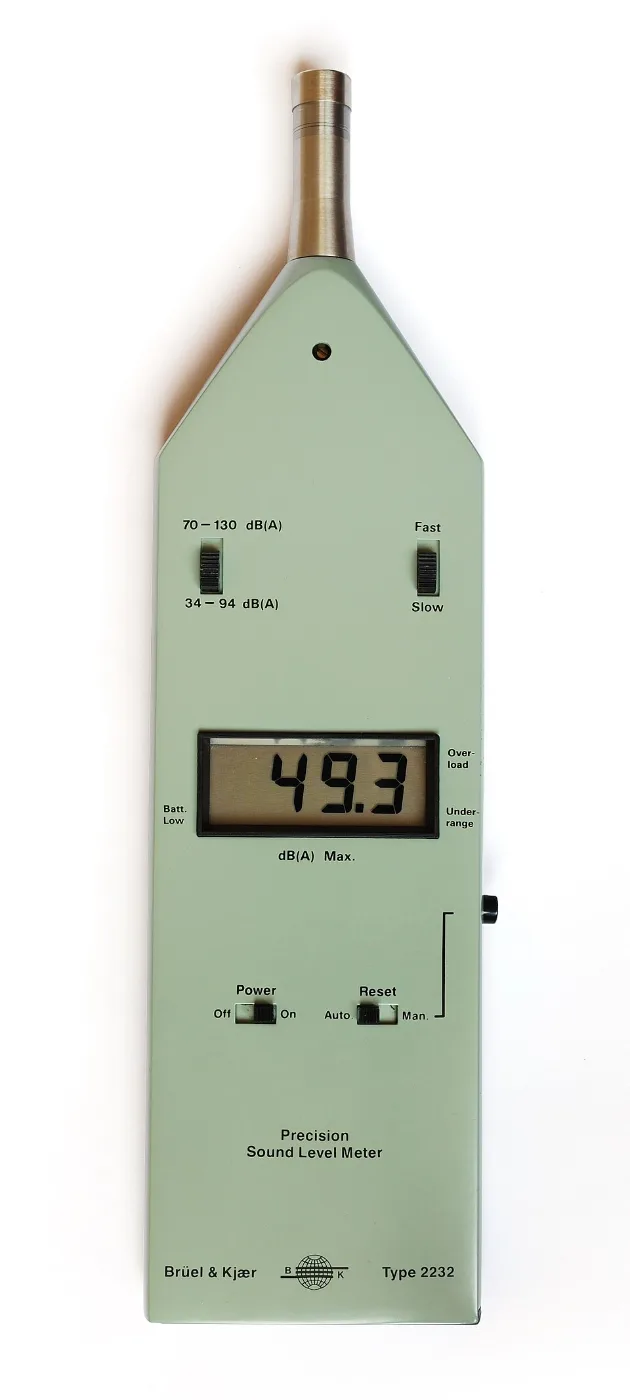
For his 2008 article, Sietsema took a sound level meter to some 20 restaurants. Some measured upwards of 90 decibels, which he compared to city truck traffic, while 60 decibels was the level of his conversation with the NPR presenter in the studio. Asked whether he would add noise ratings to his reviews, he said he would, along with price and website information. By 2019 he told WBUR that his reviews give decibel counts alongside the star ratings, and he described The Dabney in Washington as a loud room at 80 decibels.
Popular Science cites a 1993 study of about a dozen dining establishments in which sound levels peaked at 68 decibels, and a much larger 2018 survey of New York City restaurants in which one quarter reached at least 81 decibels, the average was 77, and only 10 per cent were 70 decibels or below. Cudequest reports that the SoundPrint app has logged more than 100,000 restaurant noise measurements, and that the average "quiet" restaurant measures about 70 dBA, against indoor environments designed for 45 dBA or much quieter. In Hong Kong, W. M. To and A. W. L. Chung measured 67 to 83 dB in restaurants and identified the density of occupancy as the main factor. Cudequest puts the gap between easy and exhausting conversation at only about 7 dB, roughly the difference between a raised and a normal speaking voice.
WHAT IS REVERBERATION TIME (RT60)?
Britannica credits Wallace Sabine with placing architectural acoustics on a firm scientific basis at the beginning of the 20th century. Reverberation time is the time needed for sound intensity in a room to fall by a factor of one million, which equals a drop of 60 decibels, hence the abbreviation RT60. It depends on the volume of the room and the sound-absorbing qualities of its surfaces, and Sabine's formula estimates it as RT = 0.05V/A, where V is the volume in cubic feet and A is the total absorption in sabins. One sabin is the absorption of one square foot of perfectly absorbing surface, such as an open hole in a wall.
The formula explains why a high ceiling lengthens reverberation unless absorption is added to match the extra volume. Materials are rated by absorption coefficients across frequencies from 125 to 4,000 Hz. In Britannica's table, concrete stays between 0.01 and 0.03, plasterboard falls from 0.20 to 0.02, curtains rise from 0.05 to 0.45 and acoustic board rises from 0.25 to 0.90. The room's total absorption is the sum of all its surfaces. Britannica notes that rooms used for talking need a reasonably short reverberation time. Reverberation time in ordinary rooms is measured to the international standard ISO 3382-2:2008.
HOW MANY DINERS CAN A ROOM HOLD? MEASUREMENTS FROM BRATISLAVA
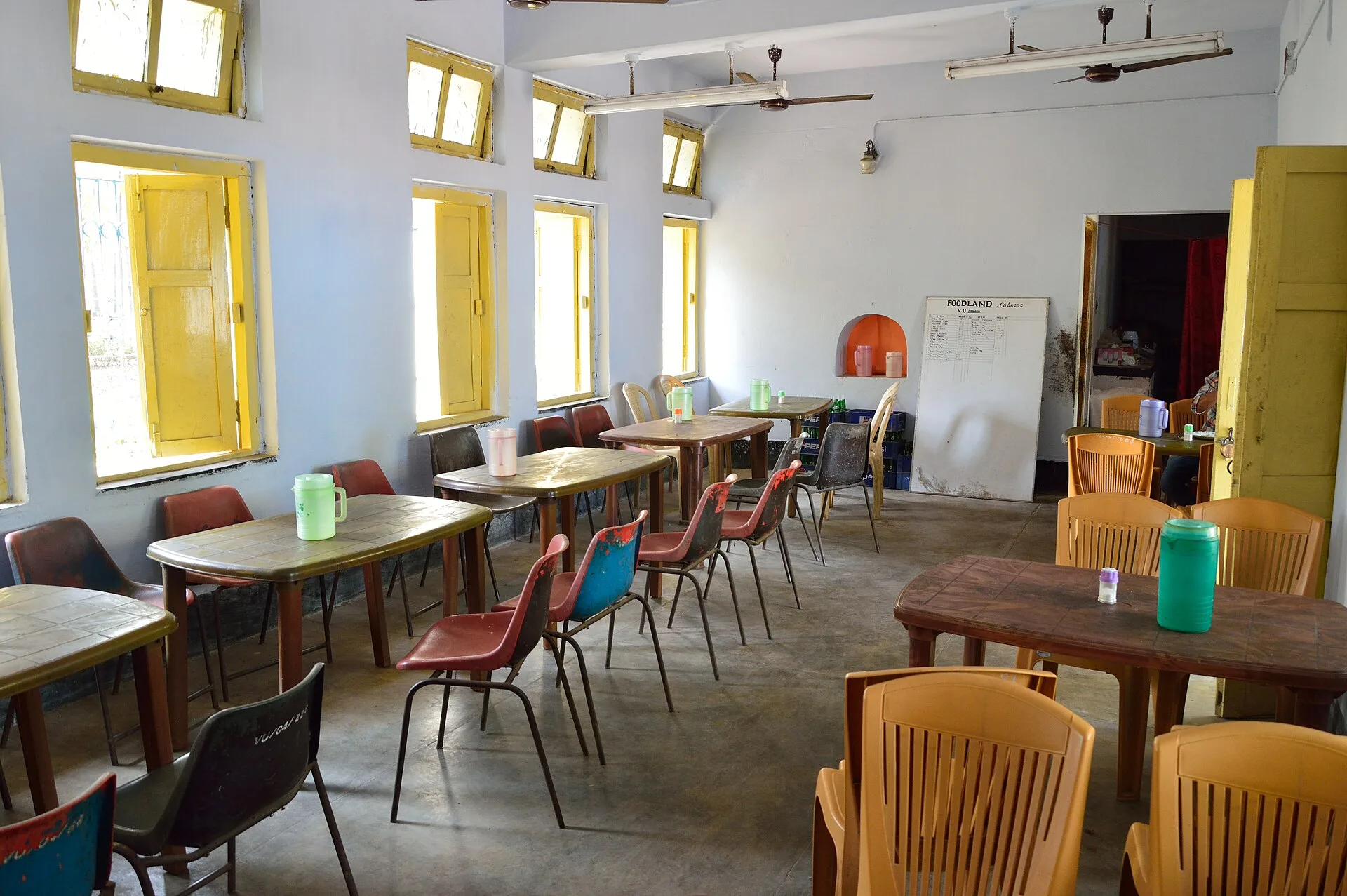
A 2023 paper in Acta Acustica by Lukáš Zelem, Vojtech Chmelík, Christ Glorieux and Monika Rychtáriková measured four eating establishments, including the self-service canteen and the Shupitoo faculty club of the Faculty of Civil Engineering at STU Bratislava in Slovakia. The canteen has a concrete floor with red marble paving, brick walls that are part plastered and part tiled and a suspended gypsum board ceiling. Its reverberation time peaked at 2.5 seconds in the middle frequencies, above the optimum range for comfortable communication in the standard DIN 18041. The faculty club, with a perforated gypsum board wall and a suspended perforated metal ceiling with sound-absorbing properties, measured 1.2 seconds at low frequencies and 0.6 seconds at high frequencies.
The Lombard effect was observed in every room, and measured levels exceeded predictions by up to 12 dB. In the faculty club, the level rose by 3 to 5 dB per doubling of occupants below 30 people and by 6 to 8 dB above that. In the canteen, communication decreased once the absorbing surface fell below 1.5 m² per person, and the level stopped rising from 150 people, or 0.8 m² per person, with background noise as high as 69 dB.
The fourth venue, a restaurant the authors call Breweria 2, showed what layout can do. Its floor is laminated parquet on a polyurethane pad, and glass panels divide the interior into compartments. Noise levels there matched predictions made without any Lombard effect, a result the authors attribute to the compartmentalised layout and the wider spacing between diners. Earlier work by Rychtáriková and Vermeir, cited in the paper, found noise increases of 6 dB per doubling of people in a canteen and 5 dB in a Trappist café.
HOW DO YOU MAKE A LOUD RESTAURANT QUIETER?

Zackery Belanger of Arcgeometer, presenting to the Acoustical Society of America in Seattle in December 2021, wrote that excessive restaurant noise results when patrons feel they are not being heard, and that the solution is to get enough absorption into the room to change the behaviour of the crowd. He adds that the amount of absorption needed is usually fairly low, and proposes acoustic lighting as a way to place it centrally. Popular Science lists retrofit options including foam ceiling panels, perforated wood that lets noise pass through to an absorbent layer behind, acoustic plaster with tiny fibres, and a transparent sound-dampening film for glass. The consultant Nathaniel Fletcher put the cost of a retrofit at a few thousand dollars to tens of thousands. Sietsema reported to WBUR that some restaurants are putting acoustic panels in seat cushions.
Comal in Berkeley, California, opened in 2012 by John Paluska, a former manager of the band Phish, shows several measures in one room. Between its exposed Douglas fir beams, the builders fitted 2-inch-thick rigid fibreglass insulation with a matte black finish, and they hid wood-fibre insulation behind burlap wainscoting. Meyer Sound added panels it calls Libra, with artwork printed on acoustically porous fabric, and its Constellation system of 28 microphones and 95 speakers, which redistributes reverberation. Popular Science reported that seven owners had installed Constellation, at $60,000 to $80,000. Keely Siebein of Siebein Acoustic told the magazine that her firm had nearly five times as many restaurant projects as a decade earlier.
BAZAAR AT MANDARIN ORIENTAL SHENZHEN

Bazaar at Mandarin Oriental Shenzhen, completed in 2022, has open kitchen stations, and its plan also includes a bakery and a bar lounge. At the open dim sum station, bamboo steamers sit under a cylindrical stainless hood. A raw bar is set among the stations, and grill seating is placed under a steel frame with gear-wheel forms. Seating includes rattan armchairs, and the restaurant has city views. The interior is built on a timber post-and-beam structure, with a slatted timber ceiling overhead.
In Sabine's formula, a dining room's reverberation depends on its volume and on the total absorption of all its surfaces, from the ceiling and floor to the furniture, with each material contributing according to its own coefficient. The Bratislava measurements add two further variables, the number of diners in the room and the way the floor plan is divided, both of which apply to any restaurant planned, as Bazaar is, around several open stations, a raw bar, grill seating and a bar lounge.
SOURCES
- Zagat Zagat Releases 2018 Dining Trends Survey
- Popular Science It's not just you: Restaurants have gotten too loud. But there are some fixes.
- NPR Noisy Restaurants Draw Complaints from Diners
- WBUR Here & Now Are Restaurants Getting Too Loud?
- Acoustical Society of America Acoustical consultants are the secret sauce to better restaurants
- Acoustical Society of America 4aNS11: Lombard effect in restaurant setting: how much would you spend to eat at this restaurant?
- Acoustical Society of America Shhhh … Speaking more quietly in restaurants means everyone can be heard
- Acoustical Society of America 4aAA9: The successful application of acoustic lighting in restaurants
- Britannica Acoustics: reverberation time
- Acta Acustica Correlation of room acoustic parameters and noise level in eating establishments


