
FROM THE WALLS OF POMPEII TO NEW YORK SUBWAY CARS, PROTEST SLOGANS AND COMMISSIONED MURALS

Graffiti is writing or drawing scratched or painted onto walls and other public surfaces. When Mount Vesuvius buried Pompeii in 79 CE, it preserved about 11,000 inscriptions. The modern form, which its practitioners call writing, began in the 1960s with teenagers in Philadelphia and New York who repeated a chosen name across their cities. By 1984 graffiti covered every car on the New York subway, and the city's transit authority took until May 1989 to clean the fleet. In the same years Jean-Michel Basquiat and Keith Haring moved from walls into galleries, protesters wrote on the walls of Paris and Berlin, and graffiti's methods passed into commissioned street art, including murals painted for Kuala Lumpur City Hall.
WHAT DID ANCIENT GRAFFITI LOOK LIKE? THE WALLS OF POMPEII
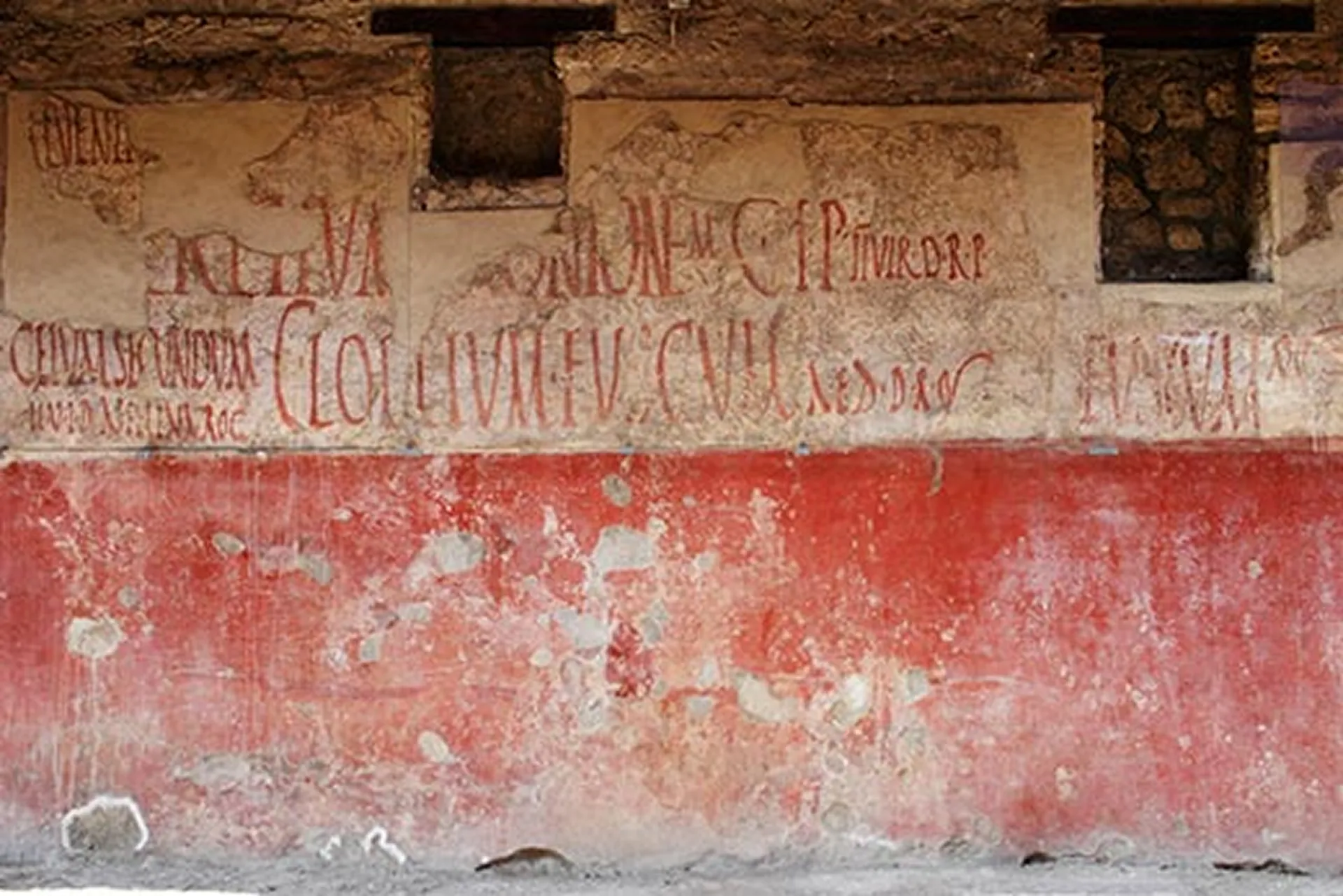
Smithsonian Magazine reports that the eruption of 79 CE preserved roughly 11,000 inscriptions at Pompeii, and scholars divide them into two kinds. Dipinti were painted, often in bright red letters by professional signwriters, and many supported candidates in local elections. Alison Cooley, a historian at the University of Warwick, notes that these notices praised candidates for good character and financial prudence and promised free bread and free shows in the amphitheatre. Graffiti in the strict sense were scratched into plaster by individuals; the Campus ad Amphitheatrum alone carries more than 400. Professional lettering on walls reappears much later in the painted advertisements of nineteenth and twentieth century cities.
The scratched messages record private lives. Rebecca Benefiel, a classicist at Washington and Lee University who catalogues inscriptions for the Ancient Graffiti Project, identified greetings, poetry and gladiators as popular subjects. Successus, a weaver, and his rival Severus traded insults over a barmaid named Iris. Two brothers, Onesimus and Secundus, left notes for each other on a friend's wall, and writers in the stairwell of the House of Maius Castricius added their own twists to well known couplets. One inscription claimed that a politician had the support of petty thieves. Children drew gladiators in charcoal, and one joke, repeated in several places, mocks the walls for carrying so much writing.
WHERE DID MODERN GRAFFITI BEGIN? CORNBREAD AND TAKI 183
In Philadelphia the figure most associated with the start of modern graffiti is Darryl McCray, known as Cornbread. WHYY, the city's public broadcaster, reports that in 1965 McCray, a boy from Brewerytown in North Philadelphia, was sent to juvenile detention for two years. Cafeteria staff there called him Cornbread, and he wrote the name on the back of his shirt. Back on the streets he wrote it on walls and, as the stories about him are told, on an elephant at the Philadelphia Zoo and on the Jackson 5's private jet. WHYY describes him as recognised as the first tagger to write his name consistently in public spaces.
In New York the first famous name was TAKI 183. According to his own account on his official site, TAKI was a diminutive of Demetrius and 183 was his street in Washington Heights, northern Manhattan. In the summer of 1969 a friend told him about a boy in Inwood who wrote his name and street number on walls, and he began to do the same. From the autumn of 1970 he tagged subway stations on his way to high school in Midtown, and as a delivery boy he used packages as cover while writing on light poles.
A New York Times reporter noticed one of his tags on the Upper East Side and found him near his home. The article ran on 21 July 1971 under the headline "'Taki 183' Spawns Pen Pals". TAKI's site credits it with opening the floodgates: he became the first New Yorker famous for writing graffiti, and rumours spread that he had tagged a Secret Service car and the Statue of Liberty. He stopped within a few years, before writing grew into murals covering entire trains.
NEW YORK SUBWAY GRAFFITI AND THE CLEAN CAR PROGRAM, 1970S TO 1989

Through the 1970s and early 1980s, subway graffiti became what the researchers Maryalice Sloan-Howitt and George L. Kelling, writing in the Security Journal in 1990, called a serious public policy problem. Hundreds of young writers made it a way of life. The aim was getting up: keeping a name in circulation on the transit lines, and writers moved from single names to murals covering whole cars. The novelist Norman Mailer treated it in 1974 as a vibrant folk art; the sociologist Nathan Glazer argued in 1979 that riders linked it with serious crime. By 1984 graffiti covered every train car in the system.
Earlier responses had failed. Mayors John Lindsay and Ed Koch both launched campaigns, but cleaning duty for offenders proved too expensive to supervise and attack dogs in the train yards were dropped after media pressure. The change came under David Gunn, president of the New York City Transit Authority from 1983, who announced the Clean Car Program in April 1984. The first two trains, on the number 4 and 7 lines, entered it that May. Once a car was cleaned, it could not leave the yard with graffiti; a tagged car had to be cleaned within two hours or taken out of service.
The programme worked through a fleet of about 6,000 cars in stages, with targets of 1,720 cars by May 1985 and 5,946 by 1988, and Sloan-Howitt and Kelling report that it beat its goal every year. The last graffiti-covered car was removed from service and cleaned on 12 May 1989. Felony arrests for graffiti and vandalism fell from 237 in 1984 to 114 in 1988, and misdemeanour arrests from 2,681 to 974. The transit authority had set itself the goal of a graffiti-free fleet in 1989.
HOW GRAFFITI ENTERED THE GALLERY: SAMO, BASQUIAT AND KEITH HARING

Jean-Michel Basquiat, born in Brooklyn in 1960, left home at 17 and, with the graffiti artists Al Diaz and Shannon Dawson, created the persona SAMO©, which Britannica says was taken to stand for a crude phrase meaning same old. They painted short, cryptic messages on walls in SoHo and the East Village and on a D train. Basquiat's first formal public exhibition was The Times Square Show in 1980. Andy Warhol befriended him in 1983, and in 1985 he was on the cover of the New York Times Magazine. His paintings mixed graffiti and signs with the gestures of Abstract Expressionism. He died of a heroin overdose in 1988, aged 27.
Keith Haring arrived in New York in 1978 to study at the School of Visual Arts and joined the alternative scene around Club 57. In 1980 he began drawing in white chalk on unused advertising panels in subway stations, which were covered in black paper. The Keith Haring Foundation records that he made hundreds, sometimes 40 in a day, and called the subway his laboratory. His first New York solo show was at the Westbeth Painters Space in 1981, followed in 1982 by his SoHo debut at the Tony Shafrazi Gallery. In April 1986 he opened the Pop Shop in SoHo selling merchandise printed with his images.
GRAFFITI AS PROTEST: MAY 1968 IN PARIS AND THE BERLIN WALL
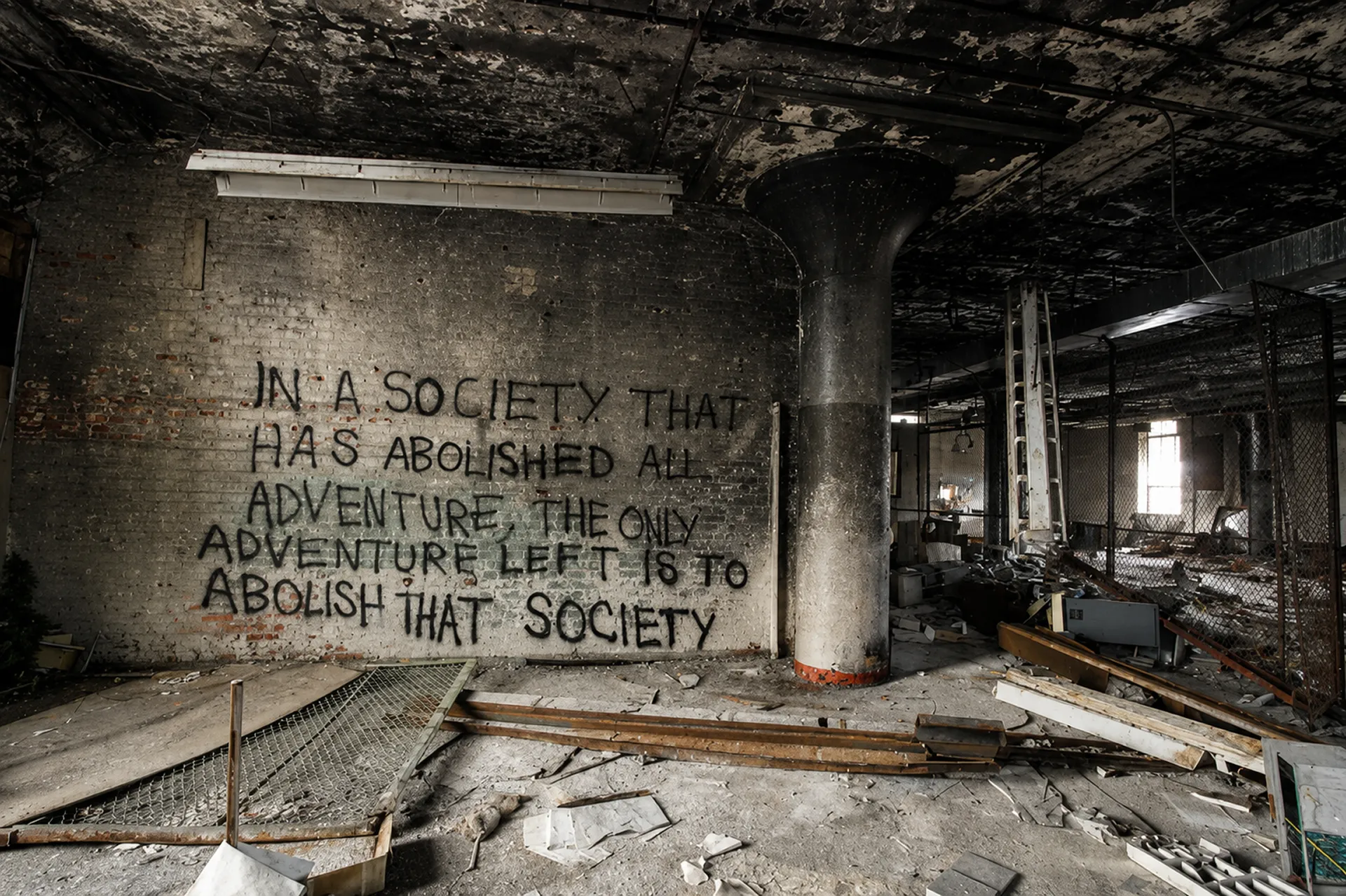
Walls also carried politics. During the uprising of May 1968 in France, students occupied the Sorbonne on the night of Monday 13 May, and its walls were soon covered with slogans. Andrew Feenberg and Jim Freedman, in When Poetry Ruled the Streets, published by State University of New York Press in 2001, record examples in translation, including "It is forbidden to forbid", "All power to the imagination" and "Answer exams with questions". Their list of graffiti from the walls of Paris includes "Beneath the cobblestones is the beach".
In Berlin the Wall itself became a surface for protest. The Berlin Wall Foundation records that people began writing slogans on its western side soon after the first border barriers went up in August 1961. Large, colourful paintings followed in the early 1980s, when two Frenchmen, Thierry Noir and Christophe Bouchet, found the Wall in Kreuzberg and began to paint it. Kiddy Citny, Indiano and Jonathan Borofsky also painted sections, graffiti writers followed in the mid-1980s, and Keith Haring painted a mural on the western side three years before the Wall fell.
WHAT IS STREET ART? PUBLIC MURALS, STENCILS AND BANKSY
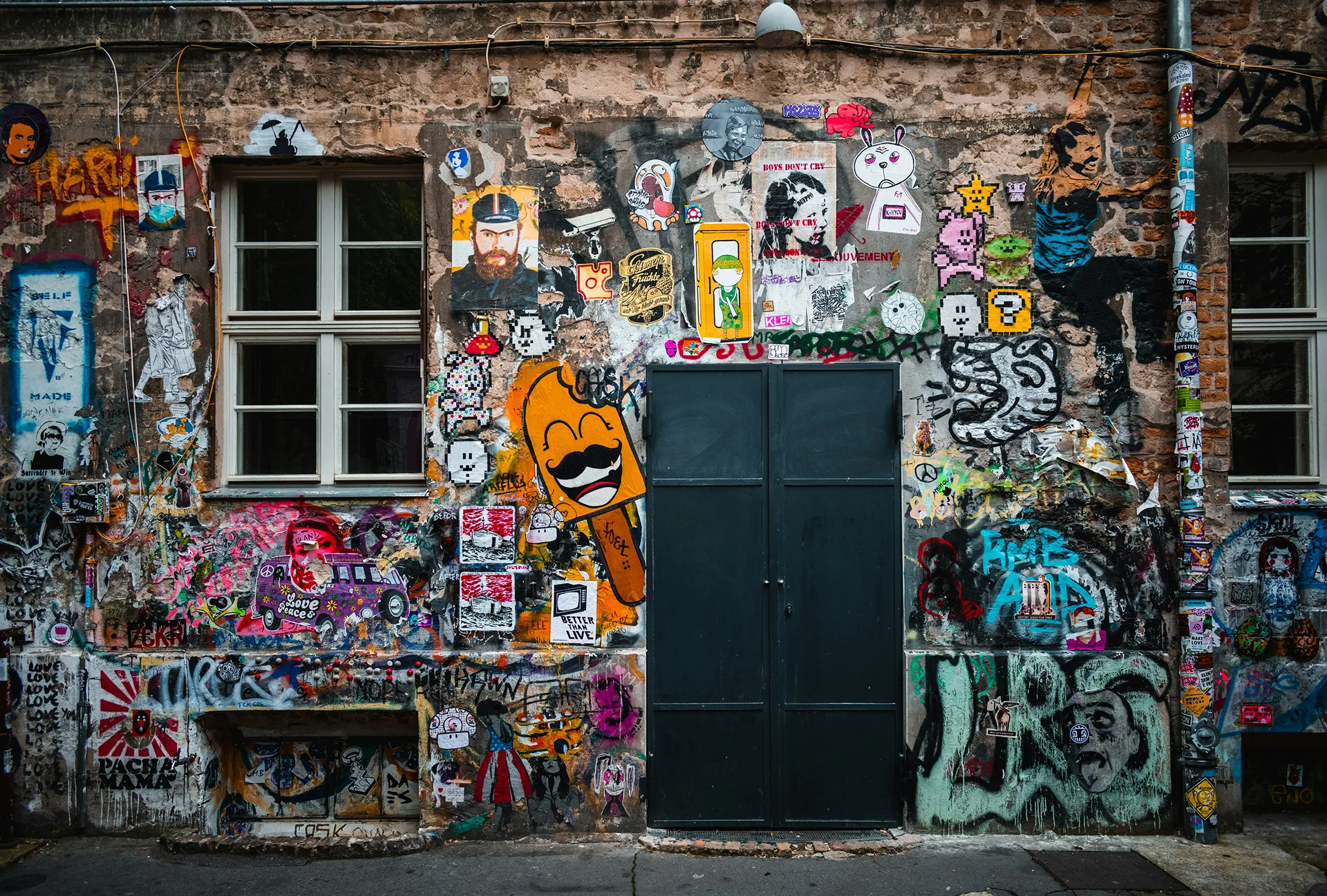
Haring's later career shows how painting in public moved from unauthorised marks to commissioned work. Between 1982 and 1989 he produced more than 50 public artworks in cities around the world, many for charities, hospitals, day care centres and orphanages. They included Crack is Wack (1986) beside New York's FDR Drive, a 1986 mural for the centenary of the Statue of Liberty painted with 900 children, and a 1987 mural on the exterior of Necker Children's Hospital in Paris. He also ran drawing workshops for children in New York, Amsterdam, London, Tokyo and Bordeaux.
Banksy, whom Britannica describes as an anonymous British graffiti artist known for antiauthoritarian work, often made in public places. His year and place of birth are uncertain; Britannica gives 1974 and Bristol, both marked with question marks. Banksy began using stencils in 2000 and developed a recurring set of images that includes rats and policemen. Girl with Balloon, a stencilled mural from 2002, was on Waterloo Bridge in London before it was removed. Britannica notes that he combined graffiti with installation and performance, in projects such as Dismaland and the Walled Off Hotel.
STREET ART AND MURALS IN KUALA LUMPUR
In Kuala Lumpur, City Hall (DBKL) commissions murals directly. In December 2020 Malay Mail, carrying a report from the national news agency Bernama, described DBKL's mural project. A group led by Ruhizad Mohd Ali, who has worked in the creative arts for almost 30 years, had painted murals at Medan Pasar, at the River of Life site beside Masjid Jamek, along the Bukit Nanas walkway on Jalan Ampang, and in a lane at Jalan Alor in Bukit Bintang, which Ruhizad said had been dark, dirty and smelly before the work. The latest pieces covered DBKL feeder pillars, the power boxes that stand on city pavements.
The same report describes how such work is arranged. Bumblebee Consultancy, founded by Christine Ngh, identifies sites and coordinates artists and sponsors with DBKL. Its projects have included the #ChowKitMural, work by the muralist Akid One at Tun Razak Exchange, and the KulSign Festival, backed by Dulux Paint, AirAsia and Disney. Sites named for future facelifts were Bukit Bintang, Petaling Street and Asian Heritage Row, in the centre of a capital shaped by Malay, Chinese and Indian communities. These murals are painted on city walls, walkways and equipment with City Hall's approval.
GRAFFITI ART AT HYATT CENTRIC CITY CENTRE KUALA LUMPUR

Hyatt Centric City Centre Kuala Lumpur, completed in 2024, occupies a repurposed 22-storey building, and Silverfox Studios designed the interiors of the whole hotel tower. The design draws on three local influences: graffiti art, batik and tin mining. The practice of writing names and painting large murals in public dates from the 1960s in Philadelphia and New York, and in Kuala Lumpur it is visible today in the murals commissioned by City Hall on walls, lanes, walkways and feeder pillars across the city centre. The other two influences come from craft and industry. Batik informs pattern, print, colour and layered surface finishes. Tin mining refers to the industry that built Kuala Lumpur. Underfoot, leaf-patterned carpets and hand-tufted rugs evoke reflected water.
SOURCES
- Smithsonian Magazine Pompeii's Graffiti Captures Every Joke, Boast and Argument of an Ancient Roman City Frozen in Time
- WHYY Cornbread, the first graffiti artist, shows new work at Philadelphia gallery
- TAKI 183 TAKI 183: official site and biography
- Security Journal, via ASU Center for Problem-Oriented Policing Sloan-Howitt and Kelling, Subway Graffiti in New York City (1990)
- Britannica Jean-Michel Basquiat
- Keith Haring Foundation Keith Haring: Biography
- State University of New York Press, via Simon Fraser University Feenberg and Freedman, When Poetry Ruled the Streets: The May Events of 1968 (excerpt)
- Berlin Wall Foundation Wall paintings in West Berlin
- Britannica Banksy
- Malay Mail Murals add colours to federal capital, big honour for local artists