

FROM THE LAID BANQUET TABLE TO THE SHARING PLATE MENU

Family style dining puts food on the table in platters and bowls for diners to serve themselves and each other. In eighteenth-century France this was the formal way to lay a dinner, service à la française, until service à la russe, with dishes carried round by servants, replaced it in the nineteenth century. Shared dishes stayed at the centre of the Chinese meal, where the revolving lazy Susan joined the round banquet table in the twentieth century. Southern American boarding houses fed lodgers at communal tables, and from the 2000s British restaurants built menus around small dishes ordered for the table.
WHAT IS FAMILY STYLE DINING AND WHERE DID IT COME FROM?
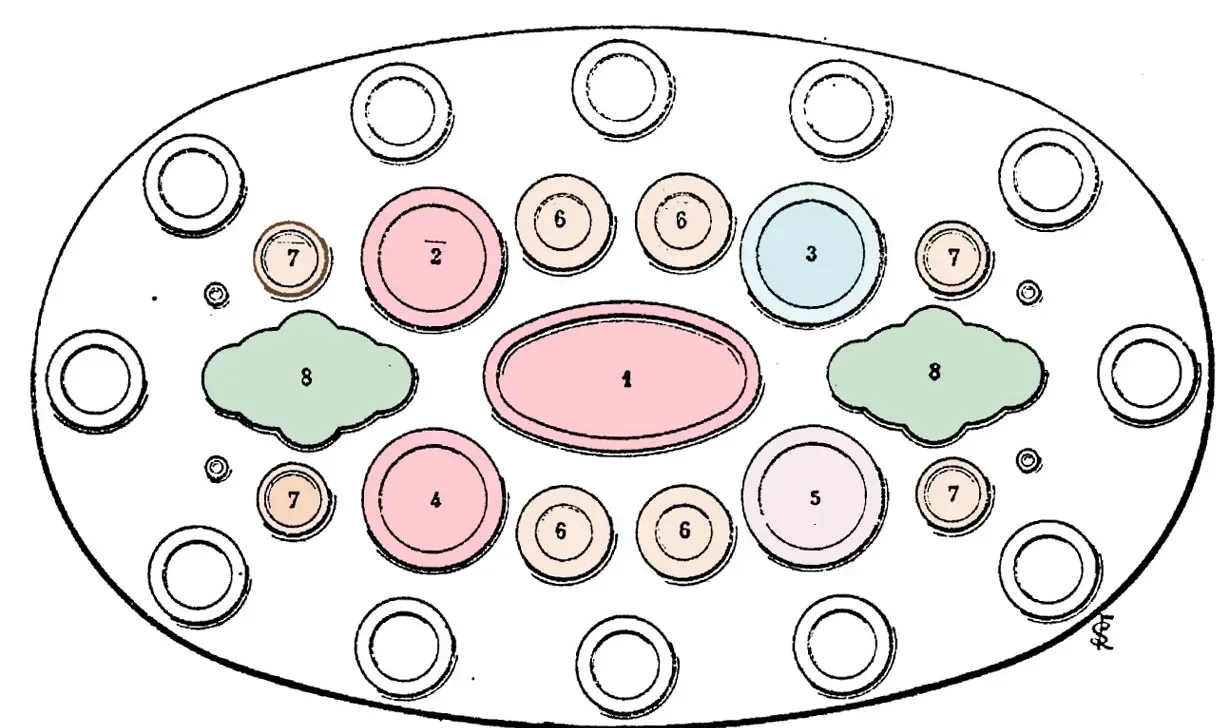
The Metropolitan Museum of Art describes the older European system through a Sèvres porcelain stand made between about 1777 and 1785, decorated by François Antoine Pfeiffer and Nicolas Sinsson and gilded by Henri-François Vincent. The stand belonged to an oval tureen that held the soup or stew of the first course. Under service à la française, the museum explains, serving dishes of various shapes were grouped symmetrically around the tureen, the diners helped themselves from the dishes and vessels close at hand, and servants reset the table for each course.
Sydney Living Museums, which has recreated a French-style setting in the dining room at Rouse Hill House, sets out the same sequence. Every dish of the first course was laid on the table in a symmetrical arrangement before the diners came in, with a roast at one end and soup at the other. The dishes of the second course then replaced them. Between courses the table could be stripped back to polished wood, and the museum notes that this bustle could disrupt a large dinner. Dessert came at the end, after the second course.
The Royal Pavilion in Brighton records an English example at a royal banquet. On 18 January 1817 the Prince Regent gave a banquet there for Grand Duke Nicolas of Russia, with more than 100 dishes prepared by Marie-Antoine Carême. Dinner of this kind consisted of dozens of courses with several dishes served at once, and diners helped themselves and their neighbours. The Pavilion's curator David Beevers describes the table as "very overloaded with plates and food". The Prince Regent also seated men and women beside each other, following French custom, instead of separating them by sex and rank.
HOW SERVICE À LA RUSSE REPLACED THE SHARED TABLE
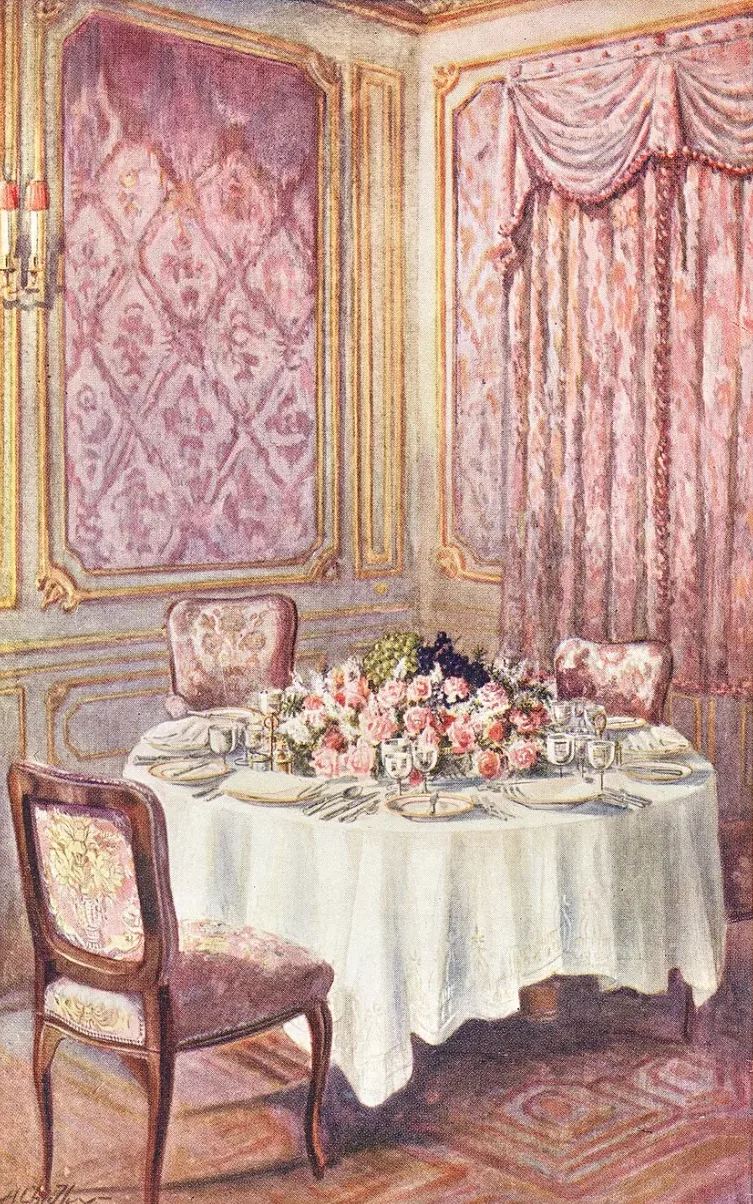
The alternative took its name from the Russian court. Sydney Living Museums dates its first appearance in Paris to about 1810 to 1814 and, noting that accounts differ, credits Prince Borisovitch Kourakine. According to The Servants' Guide and Family Manual, published in London in 1831, the style reached the fashionable tables of London in early 1829. Under service à la russe, which replaced the French system in the early nineteenth century, the Metropolitan Museum notes, guests no longer served themselves but were waited upon by servants.
The table itself changed with it. Large joints were carved at the side table and handed round, and Charles Ranhofer's The Epicurean, published in New York in 1894 and quoted by Sydney Living Museums, states that nothing hot appears on the table. The dessert was set out with the first course, in rows down the centre, and drawn forward later. The space once given to serving dishes filled with lamps, ornaments, vases, potted palms, runners and mirrors, along with specialised cutlery and glassware. The system also needed extra staff to carry the dishes round, since each was offered to the guests in turn instead of being left on the table.
The change was slow. A long piece titled "The Great Dinner Question" in the Hobart Courier in 1859 complained that diners clung to older habits. In 1866 the London confectioners' manual by John and William John Massey proposed a compromise called Anglo-Russe, with the first course served à la russe and the second placed on the table. Carême was the best known critic of the Russian method, and many guides published up to the early 1900s still endorsed the French one. The Observer critic Jay Rayner, interviewed by the Guardian, describes the eventual outcome: nineteenth-century platters gave way to the plated dish, based on the Escoffier system of main dishes.
CHINESE SHARED TABLES AND THE LAZY SUSAN STORY
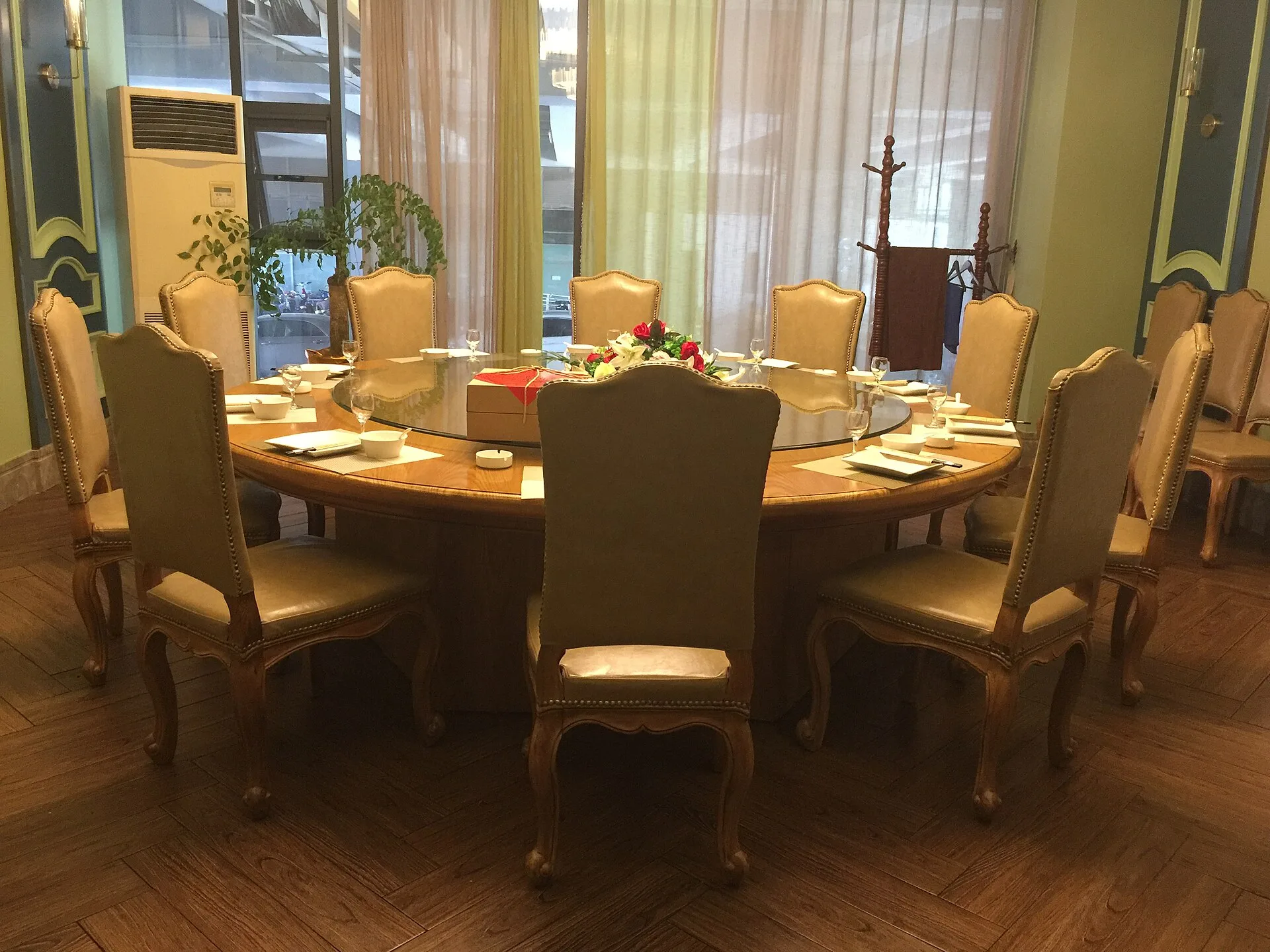
Smithsonian magazine cites the physician Wu Lien-teh, born in Malaysia and educated at Cambridge, who wrote in 1915 that chopsticks were used for picking up solid food from dishes placed on the table. Wu proposed a revolving "hygienic dining tray", with a serving spoon for each dish and a separate set of chopsticks for each diner, and it was presented at a 1917 conference in Canton. The magazine also notes that, according to historical accounts of Chinese furniture, dining tables tended to be rectangular and did not rotate. Small shared dishes are also the basis of the Cantonese teahouse meal of dim sum and yum cha.
A revolving table does appear much earlier in Chinese sources. In 1313 Wang Zhen, an official who helped pioneer movable type, described one in his Book of Agriculture, but it was used to organise type characters and not in the dining room. Lark Mason, an American specialist in Chinese antiques, is quoted by Smithsonian saying he knew of no example used for dining before the twentieth century and suggested European forms reaching China through Hong Kong, Canton or Shanghai. In Europe and America in the early 1900s, the name Lazy Susan, replacing the older dumb-waiter, was applied to revolving tabletops, revolving tables and food lifts used to save domestic labour. Who Susan was is not known.
The restaurant version has an origin story told by one family. In 1953 Johnny Kan opened a Cantonese-style restaurant in San Francisco's Chinatown, and in the mid-1950s George Hall, a trained engineer who had travelled in England and China, built the revolving tabletop at the centre of Kan's banquet room. His niece, the historian Connie Young Yu, believes it was an independent invention. Reports of the device followed: Igor Stravinsky ate from one at a Chinese restaurant in Japan in 1959, the Washington Post described one at a Chinese New Year celebration in 1963, and in 1965 the New York Times reported diners at a big round table turning it to bring each dish within reach.
FAMILY STYLE DINING IN AMERICAN BOARDING HOUSES

Explore Georgia, the state's tourism site, notes that most Southern towns once had a boarding house offering a simple, quiet room and a communal dining room with at least two hearty meals a day. Its regular customers included young working-class labourers, schoolteachers, bankers, washerwomen and middle-class merchants. In 1943 Sema Wilkes took over a boarding house in downtown Savannah with the aim of making a living from comfortable lodging and Southern home cooking served family style in the downstairs dining room. Nearby farmers dug sweet potatoes for her in autumn and shelled whippoorwill peas in summer.
The dining room still operates as Mrs. Wilkes' Dining Room at 107 West Jones Street. A queue forms each morning, and when the doors open at 11 o'clock the lunch crowd takes seats at large tables for ten shared by strangers. The tables are filled with platters of fried chicken, cornbread dressing, sweet potato soufflé, black-eyed peas, okra gumbo, corn muffins and biscuits. The menu changes daily so that regulars can eat something different each visit. The dining room serves lunch only, from Monday to Friday, and by custom closes for the whole of January.
FROM FAMILY STYLE DINING TO SMALL SHARING PLATES
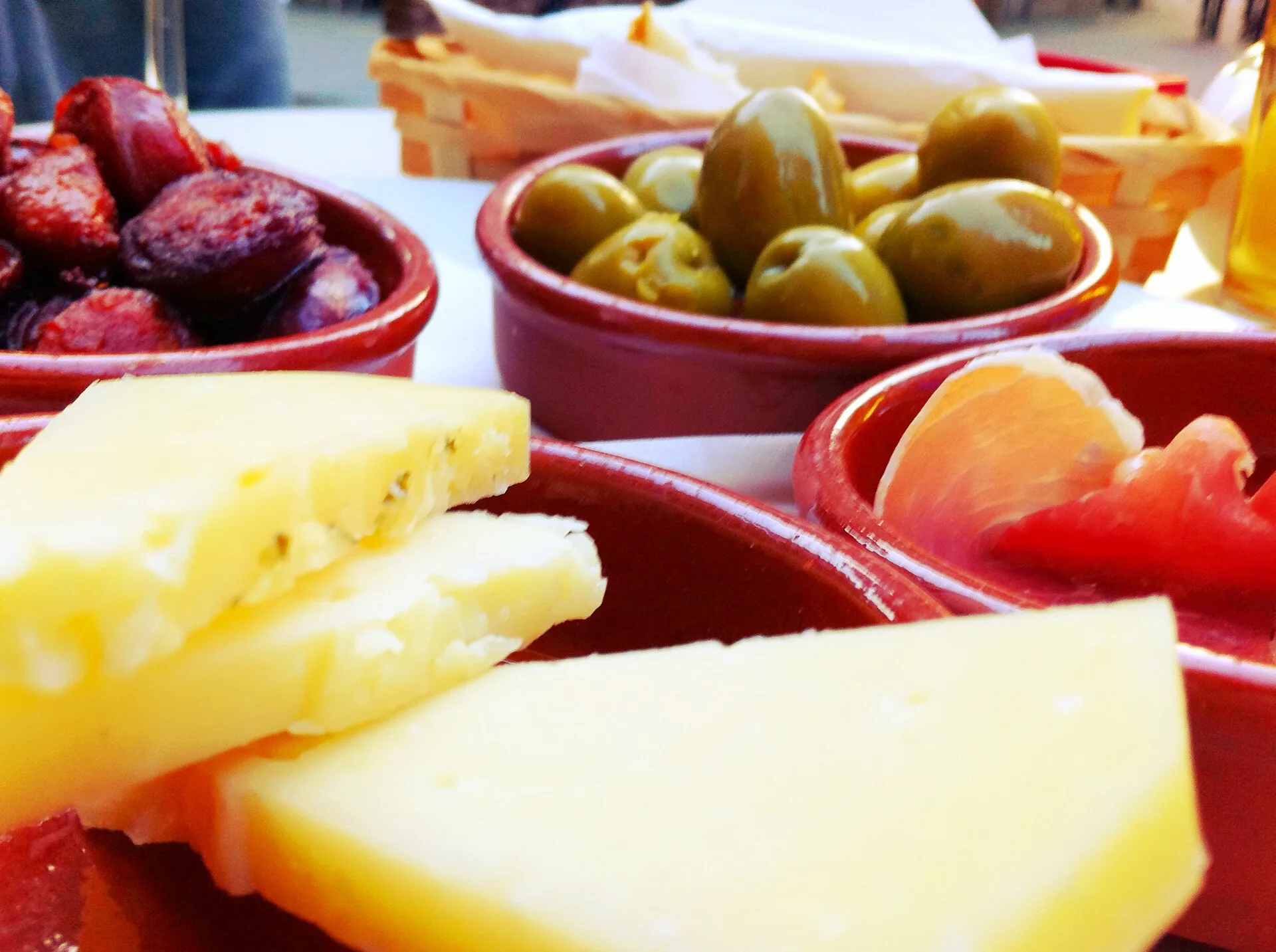
The Guardian's account of the British small-plates menu lists its antecedents as Japanese izakaya, Spain's tapas, and Chinese and Indian cooking, whose shared dishes had become popular in Britain. The trade title Fine Dining Lovers, in a 2025 long read by Joel Hart, traces London's version to 2003, when St John Bread & Wine opened with a long list of reasonably priced dishes meant for sharing, unlike the individually portioned original St John. In 2004 Ottolenghi in Islington opened with a long table that seated strangers together, which Hart links to the same sharing habit.
The restaurant most often credited with the British trend is Polpo, which Russell Norman opened in Soho in 2009. Its menu drew on Venetian cicchetti, the bar snacks Norman had encountered on trips to Venice, alongside sliders and half-portion sharing dishes. Tony Naylor, writing in the Guardian, lists the format that rival operators copied: no bookings, dressed-down staff, paper menus, wine in tumblers and distressed interiors. Norman also opened Spuntino, a diner modelled on New York, in Soho. The food writer George Reynolds connects the rise of small plates to the 2008 financial crisis, after which many people were priced out of opening a traditional restaurant.
The Guardian traces the spread from Noto in Edinburgh and Poco in Bristol to Ora in Belfast and Erst in Manchester. Charlie Mellor opened The Laughing Heart in east London with a small-plates menu in 2016, partly because he had a very limited budget. The chef Jackson Boxer, of Brunswick House, told Fine Dining Lovers that kitchens sent food out in waves, which made sharing a practical necessity, and that "the more minimalistic you made the service, the more ambitious you could make the food". He links the model's success in London to high rents and young diners in small flats who ate out often.
WHAT CRITICS HAVE SAID ABOUT SHARING PLATES
Writing in the Irish Times in April 2024, Finn McRedmond collected the objections. As early as 2010 the New York Times had called to "End the tyranny of small plate dining", and six years later the Telegraph ran the headline "Bring back food monogamy!" In 2018 a New York Times reviewer, quoted by the Guardian, described the format as communal "in the sense that a piranha feast is communal". By 2022 the Guardian reported that diners had fallen "out of love" with small plates, finding them confusing and poor value. McRedmond describes menus of 10 to 12 dishes for five people, with two prawns to split between them.
Several critics point to the economics of the format. Naylor argues that long menus of small plates encourage over-ordering, allow staff to turn tables quickly, and remove the need for a head chef to plate each dish at the pass. The chef Anna Tobias, of Café Deco in London, told Fine Dining Lovers that the format benefits owners more than customers because pricing can hide portion sizes, and that it can produce repetitive menus, with crudo and beef tartare as her examples.
HOW BAZAAR AT MANDARIN ORIENTAL SHENZHEN IS LAID OUT

The 1817 Royal Pavilion banquet set more than 100 dishes on the table at once, and service à la russe later moved the carving of large joints to the side table. Bazaar, the restaurant at Mandarin Oriental Shenzhen with interiors completed by Silverfox Studios in 2022, is planned with open kitchen stations, a bakery, a raw bar and a bar lounge. At the open dim sum station, bamboo steamers are set under a cylindrical stainless steel hood. The grill seating sits beneath a steel frame made with gear-wheel forms.
Johnny Kan's San Francisco banquet room of the 1950s was centred on George Hall's revolving tabletop, and Mrs. Wilkes' Dining Room still seats its lunch crowd at large tables for ten shared by strangers. At Bazaar the fixed elements are architectural. The room is framed in timber post-and-beam construction, with a slatted timber ceiling overhead, and the seating includes rattan armchairs. Beyond the timber structure, the open kitchen stations and the bar lounge, the restaurant has views over the city of Shenzhen.
SOURCES
- The Metropolitan Museum of Art Stand, Sèvres Manufactory, ca. 1777 to 1785
- Sydney Living Museums (Museums of History NSW) Dining a la Rouse
- Brighton & Hove Museums A Regency feast: a banquet held at the Royal Pavilion for Grand Duke Nicolas of Russia, 18 January 1817
- Smithsonian Magazine The Lazy Susan, classic centerpiece of Chinese restaurants, is neither classic nor Chinese
- Explore Georgia Mrs. Wilkes' Dining Room
- The Guardian (via inkl) Still hungry? How we fell out of love with small plates (Imogen West-Knights)
- The Guardian (via inkl) The end of small plates: why the dinner-ruining dishes may finally be over (Tony Naylor)
- The Irish Times The tyranny of small-plate dining: what's the best way to split these two prawns five ways?
- Fine Dining Lovers The long read: the rise and stubborn decline of small plates


