THE ROYAL GUSUKU OF THE RYUKYU KINGS AND THE ARTS OF THEIR COURT
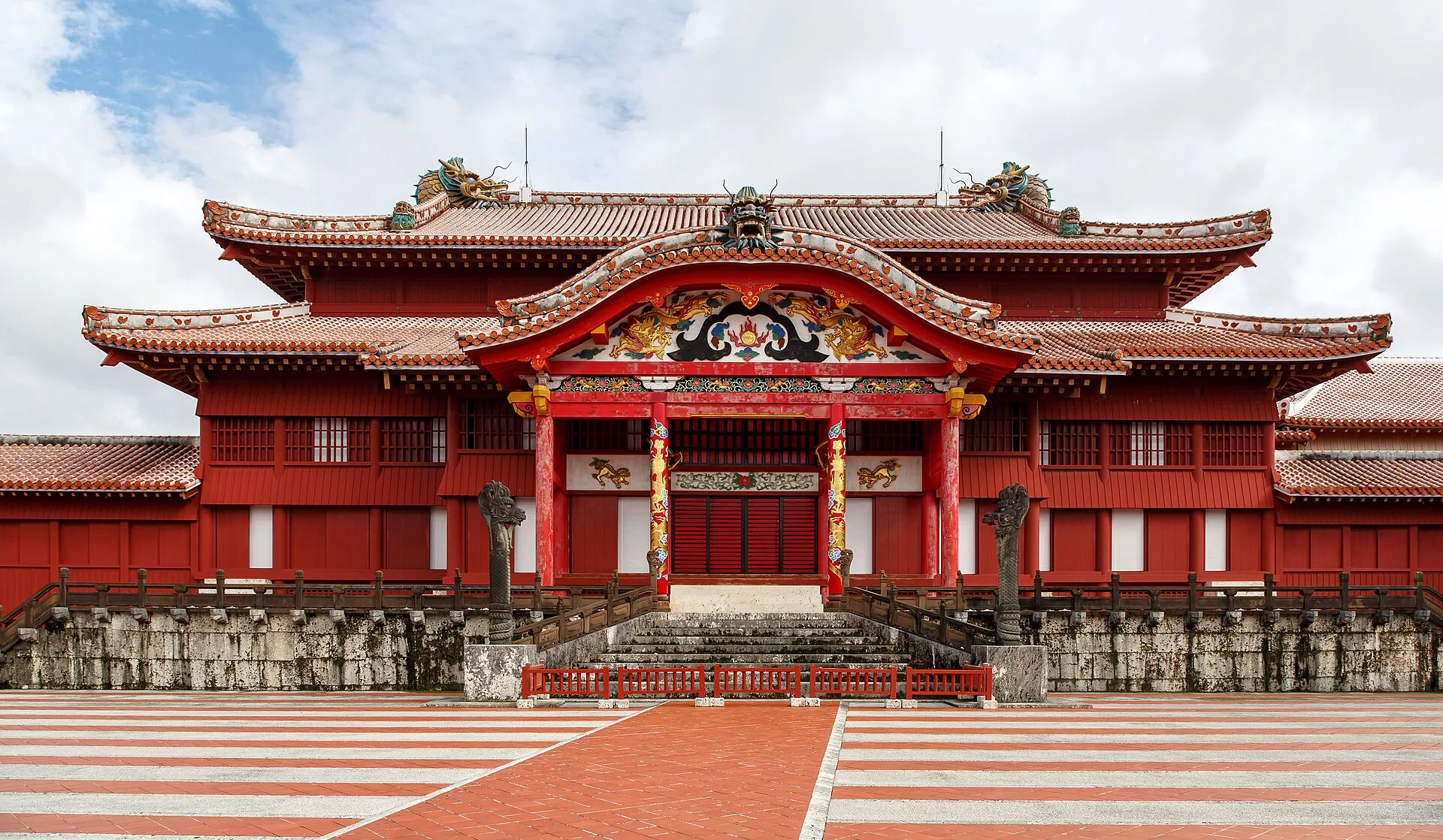
Shuri Castle, known in Japanese as Shurijo, stands on a small hill in Shuri, now part of the city of Naha on Okinawa Island. It was the royal residence and the seat of government of the Ryukyu Kingdom, founded in 1429 when Sho Hashi united Sanzan, and it was the centre of the kingdom's politics, diplomacy and culture. Its gates, its vermilion main hall and the arts practised around the court show the influence of both China and Japan. In December 2000 the Shuri Castle site was inscribed on the UNESCO World Heritage List as part of the Gusuku Sites and Related Properties of the Kingdom of Ryukyu. The main hall and other central buildings were reconstructed and partially opened to the public in 1992.
WHAT IS SHURI CASTLE?
Shuri Castle is a gusuku, one of the stone-walled castles of Okinawa. UNESCO's listing groups it with four other castles on the island, Nakijin, Zakimi, Katsuren and Nakagusuku. The Shuri Castle Park management notes that Shuri shares its main features with the other gusuku, but that the others declined after losing out to Shuri in competition, while Shuri kept those characteristics and continued to develop. Its inner enclosure was completed in the early 15th century and its outer enclosure in the middle of the 16th century. The principal buildings are laid out on an east to west axis and face west, which the park identifies as a distinctive feature of the castle.
The castle was both the residence of the king and the headquarters of the Shuri royal government. It was also the hub of a religious network: priestesses stationed across the kingdom carried out state rituals that were managed from Shuri. The king's court was also where the kingdom's diplomacy was conducted, and where envoys from China were received. Before unification, Sho Shisho, the father of Sho Hashi, became king of Chuzan in 1406. After the kingdom was established in 1429, Sho En took the throne in 1470 and founded what is known as the Second Sho dynasty, whose kings ruled from Shuri for the rest of the kingdom's history.
THE SHUREIMON AND THE GATES OF SHURI CASTLE
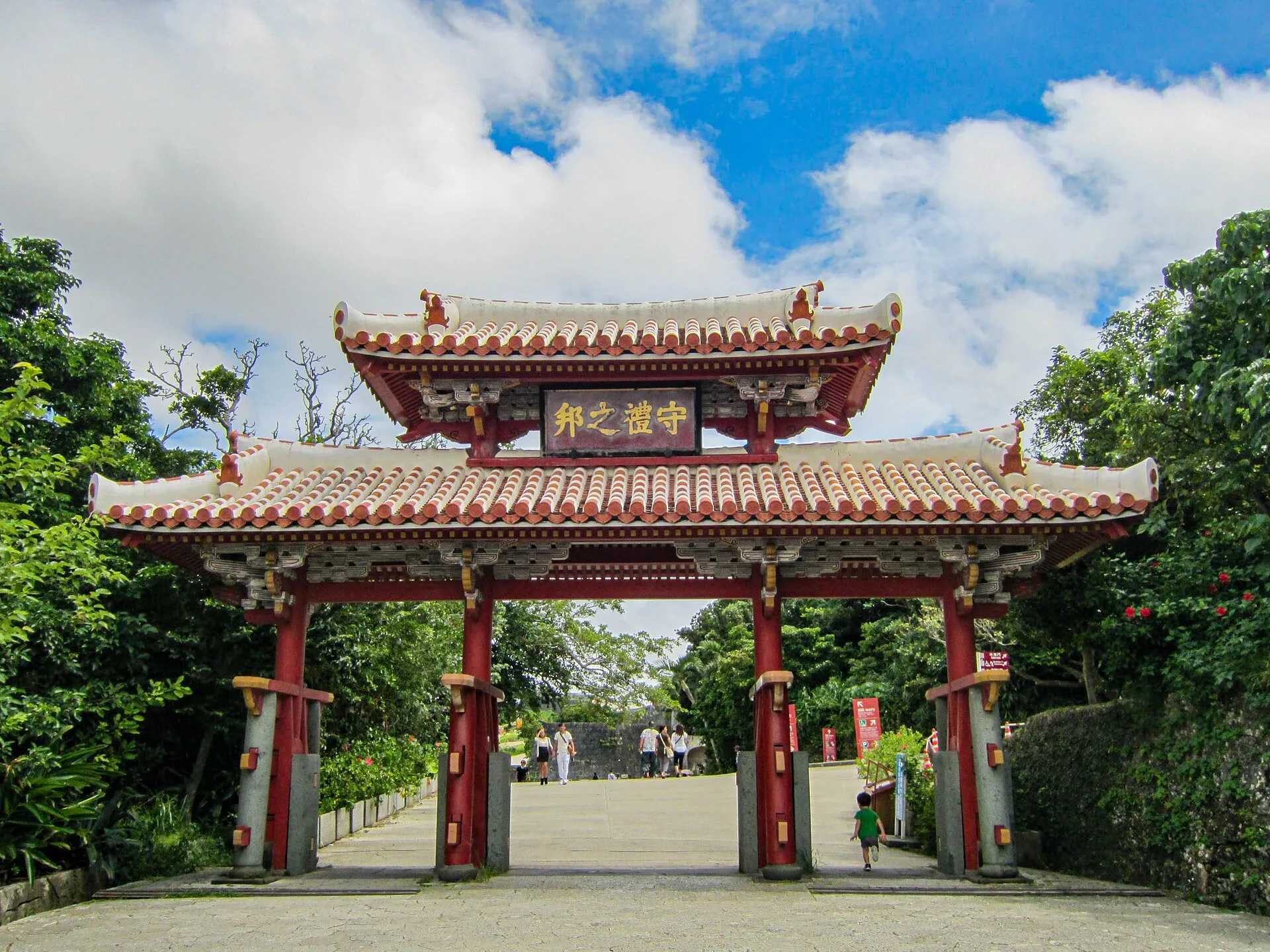
The route to the main hall passes through a sequence of gates. The best known, the Shureimon, was first erected between 1527 and 1555, during the reign of King Sho Sei, the fourth ruler of the Second Sho dynasty. It takes the form of a Chinese paifang, a ceremonial gateway, and its plaque bears the characters 守礼之邦, describing Ryukyu as a country that values courtesy and good manners. The Shuri Castle Park guide calls it the most balanced and elegant of the castle's gates. The Shureimon was designated a National Treasure in 1933 and was rebuilt in 1958.
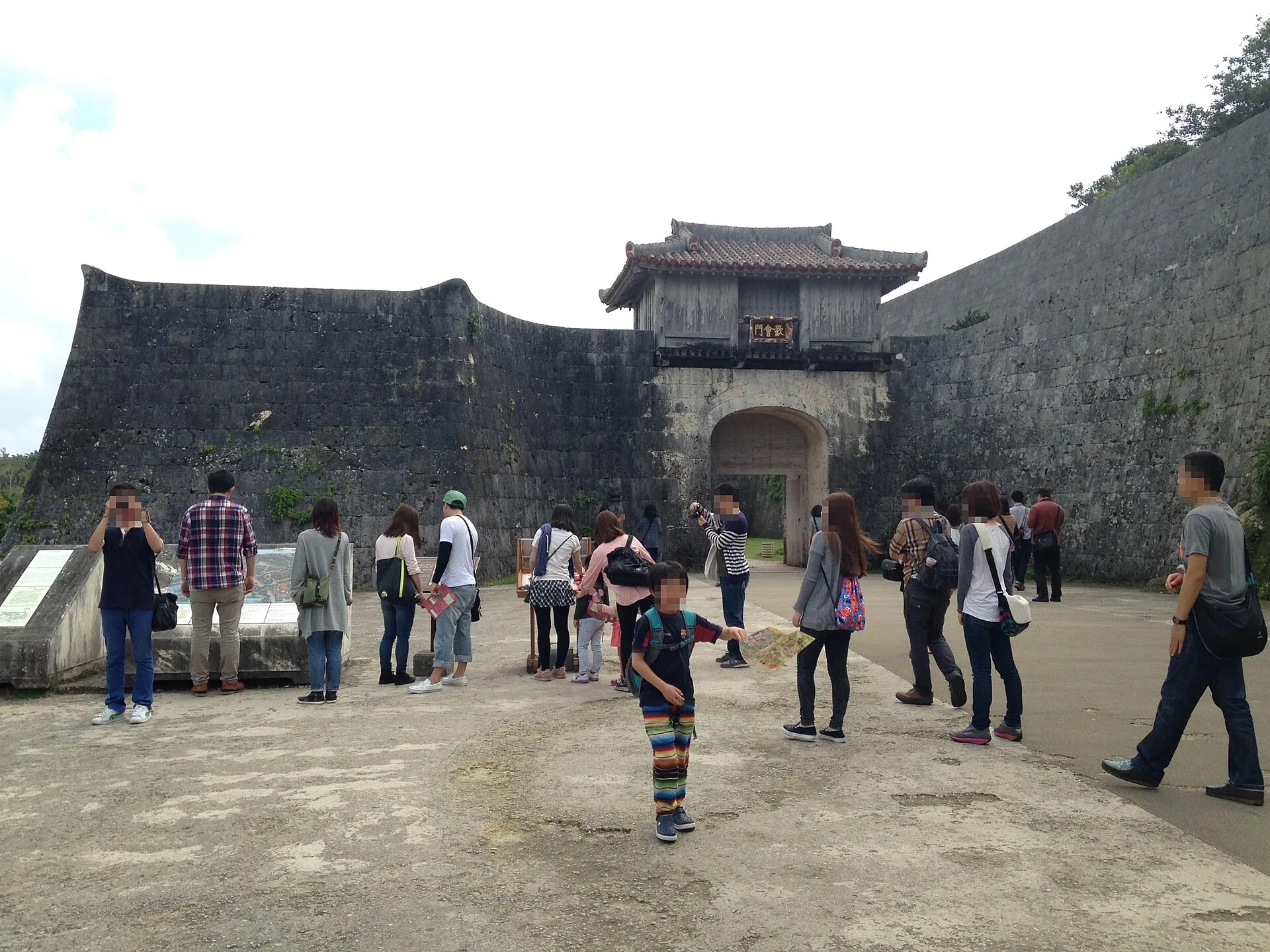
Beyond it, the Kankaimon is the first main gate into the outer enclosure. Its name means welcome, and it was chosen to greet the envoys who came from China. Built around 1477 to 1500 in the reign of King Sho Shin, it is a stone arch topped by a wooden watchtower, with a pair of shisa guardian lions on either side. The second gate, the Zuisenmon of around 1470, takes its name, meaning auspicious spring, from the Ryuhi spring in front of it. The third, the Rokokumon or water clock gate, held a water tank in its tower that measured time by the water that leaked from it; officials then struck drums and rang bells to announce the hour. High officials dismounted from their palanquins at this gate as a mark of respect to the king.
THE SEIDEN MAIN HALL AND ITS KARAHAFU GABLE
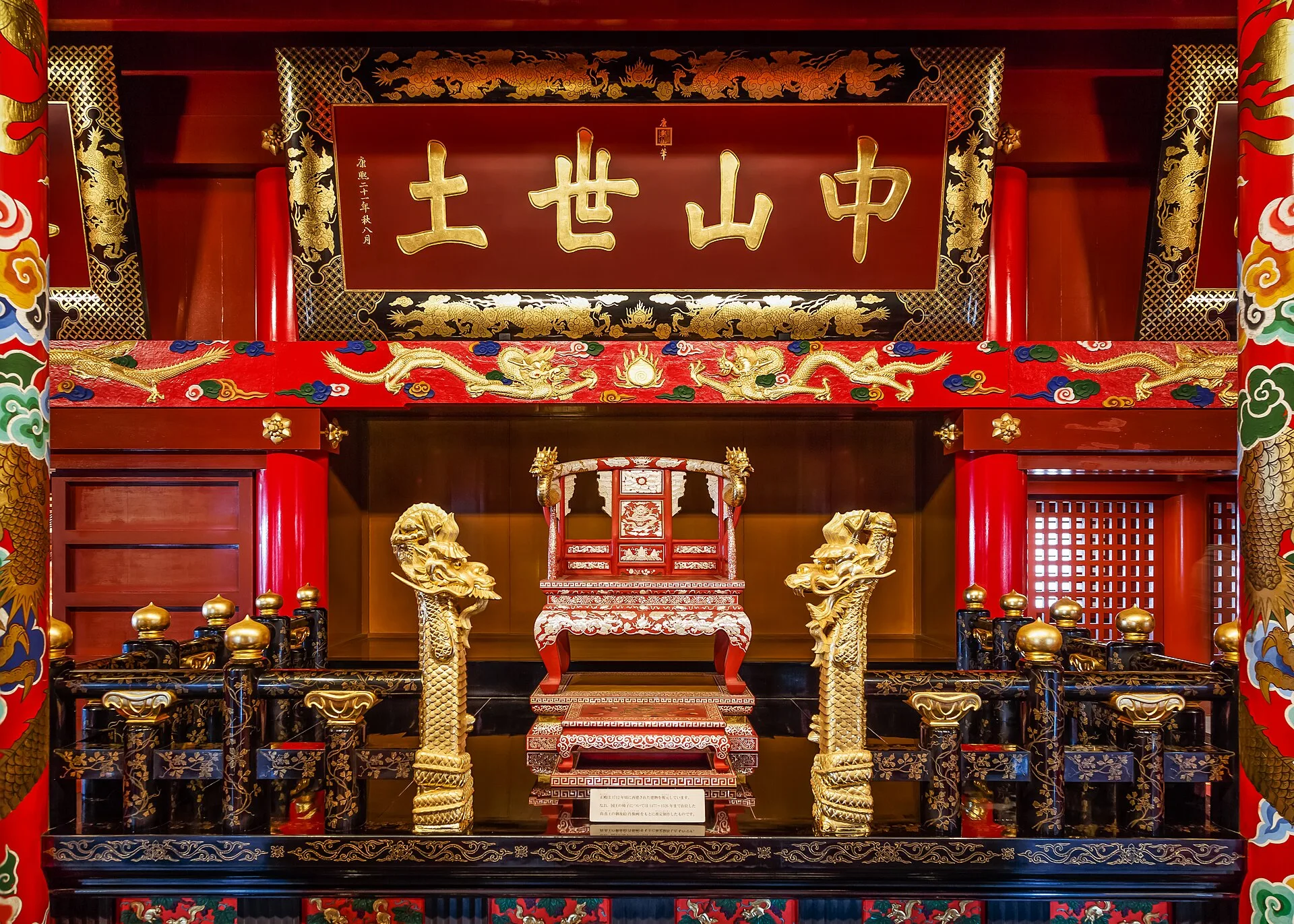
The Shuri Castle Park management describes the castle as showing the influence of Chinese and Japanese architecture in many places, and names the Seiden, or main hall, together with the South Hall and North Hall, as the representative examples. The centre of the Seiden's facade is its karahafu, a gable with a bow-shaped curve. Despite the character for Tang, meaning China, in its name, the form is Japanese and is found mainly on Japanese shrines and temples. At Shuri the curve appears only at the front, while the rear is a plain triangular gable. The Ryukyu court wrote the name with a different character for ha, because the usual one means break, a change recorded in the official history Kyuyo. Vivid red paint and many dragons decorate the roofs and walls.
The hall accumulated its features over several centuries. In 1458 the Bridge of Nations Bell was placed at the Seiden, and in 1508 bluestone pieces named Sekikoran and Dairyuchu were installed. A dragon head roof cresting was added in 1682, and in 1729 the king's throne was moved to the centre of the hall. The Seiden underwent major repairs in 1768. In 1925 it was designated a National Treasure, and a major repair of the castle was carried out in the 1930s. Later the site became a campus of the University of the Ryukyus, and reconstruction began after the university moved away.
CHINESE ENVOYS AND THE KINGDOM'S TRADE
UNESCO's justification for the Gusuku Sites states that the Ryukyu Islands served as a centre of economic and cultural interchange between Southeast Asia, China, Korea and Japan, and the Shuri Castle Park management describes Shuri Castle as the centre of the kingdom's diplomacy. Contact with China dates from 1372, when King Satto of Chuzan sent the first envoy to Ming China. Goods made under royal supervision were part of the exchange: lacquerware was a major export in the kingdom's international trade, and the royal government at Shuri managed the production of lacquer pieces sent as gifts to the Chinese emperor and to the Japanese shogun and regional lords.
The Chinese investiture envoys, known in Japanese as sapposhi, left their own mark at the castle. During their stays they praised the water of the Ryuhi spring, recited Chinese poems and left inscriptions, which were carved into seven stone stelae on both sides of the stairway leading up to the Zuisenmon. The oldest, dated 1719 and titled Chuzan Daiichi, was written by Xu Baoguang, vice envoy to King Sho Kei. The stelae span about 150 years, from Xu Baoguang to Zhao Xin. The spring supplied drinking water to the king and his family, and while an envoy was in Ryukyu its water was carried daily to the Tenshikan, the envoys' lodging near Naha Port. The present stelae were restored using rubbings collected around 1926.
RYUKYU LACQUER, PAINTING AND TEXTILES AT THE SHURI COURT
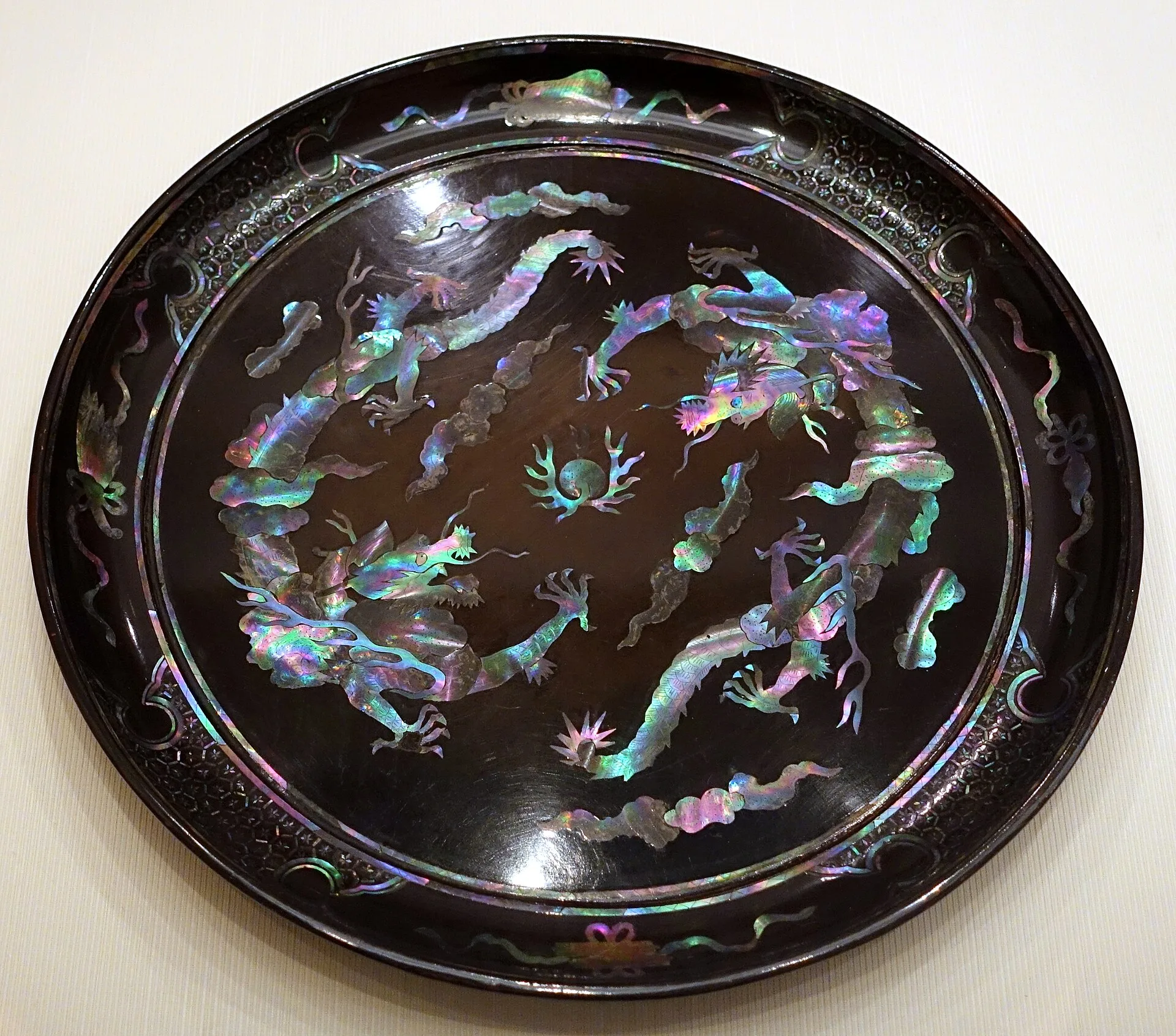
According to the Suntory Museum of Art, whose 2018 exhibition The Ryukyu Kingdom: A Treasure Chest of Beauty surveyed the court arts, Ryukyu lacquer developed through trade with China and other neighbouring countries. Production of the lacquerware used as royal gifts was managed by the Kaizuri-bugyosho, or Shell-polishing Office, a royal government facility in Shuri, and painters attached to the office designed the pieces. Mother-of-pearl inlay, gold inlay and mitsuda-e, a form of oil painting, were used to render Chinese-style motifs such as auspicious designs, bird-and-flower scenes and landscapes. One of the oldest datable gold inlay pieces is a black lacquer round outer box with a green lacquer inner box, offered in 1500 by a priestess on Kumejima together with sacred jewels bestowed by the king.
The same office shaped painting and textiles. Most Ryukyu painters worked at the Kaizuri-bugyosho, some trained with artists of the Satsuma domain or were sent to Fuzhou in China, and the museum names Yamaguchi (Kamiya) Soki, 1672 to 1743, and Zamami Yosho, 1718 to 1767. Artists from the office also made design sketches for woven and dyed motifs, and Ryukyu weavers drew on Chinese and Southeast Asian techniques including kasuri ikat and hanaori brocade. Bingata, the stencil-resist dyed cloth, was worn mainly by the royal family and aristocracy. In 2006 artefacts of the Sho family were designated National Treasures as Ryukyu Sho Dynasty Related Artifacts.
KUMIODORI AND THE PERFORMING ARTS OF THE RYUKYU COURT
The Shuri Castle Park management records that performing arts and music were widely performed in and around the castle, and that many specialists in the fine arts and crafts were active there. The best documented of the court's performing arts is kumiodori, which the National Theatre Okinawa states was first created and performed in 1719 to entertain Chinese investiture envoys, the same year as Xu Baoguang's inscription at the Ryuhi spring. UNESCO describes kumiodori as dramas that recount local historical events or legends and combine Okinawan traditions with elements from China and from mainland Japanese theatre, including Kabuki and Nogaku, the tradition of Noh theatre.
The music is accompanied by a traditional three-stringed instrument, with phrasing that follows the rhythm of traditional poetry and the Ryukyu scale, and the works are sung in the ancient Okinawan language. The performers' movements are said to evoke a priestess at ancient Okinawan rituals, and the hairdressing, costumes and decorations use techniques unique to Okinawa. All roles are played by men, and the classic works emphasise loyalty and filial duty. Kumiodori was inscribed on UNESCO's Representative List of the Intangible Cultural Heritage of Humanity in 2010 and is designated a National Important Intangible Cultural Property in Japan. The Traditional Kumiodori Preservation Society trains performers, revives discontinued dramas and stages regular performances, and the National Theatre Okinawa preserves, promotes and performs the form.
THE UNESCO LISTING AND THE RECONSTRUCTION OF SHURI CASTLE
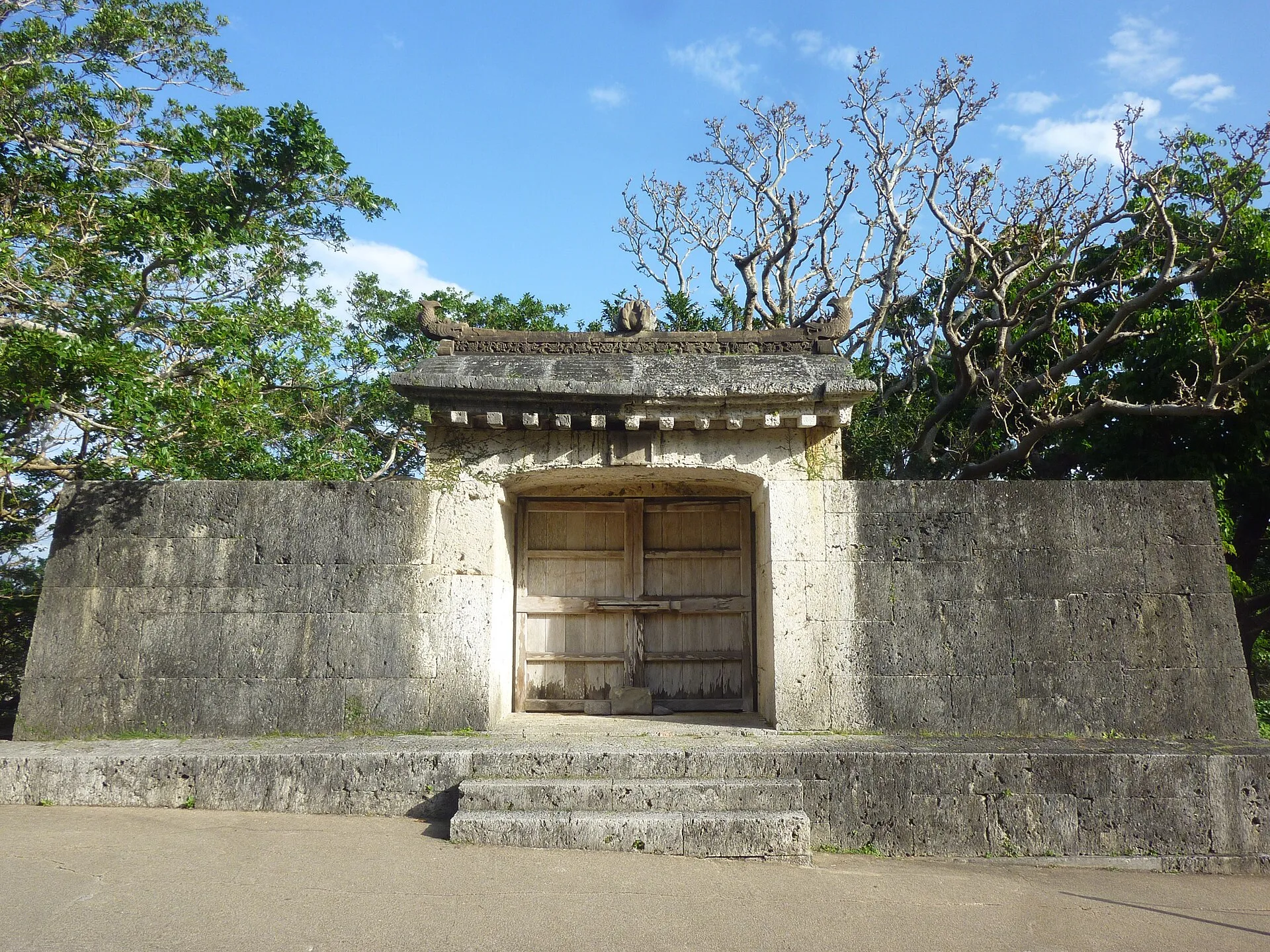
The Gusuku Sites and Related Properties of the Kingdom of Ryukyu comprise nine components on Okinawa Island covering 54.9 hectares, with a buffer zone of 559.7 hectares, inscribed under criteria (ii), (iii) and (vi). UNESCO describes them as two stone monuments, five castles and two cultural landscapes. Besides Shuri Castle and the four other gusuku, they are the Sonohyan-utaki Ishimon, Tamaudun, Shikinaen, whose royal villa and garden UNESCO describes as recreated with great precision, and Seifa-utaki. At Shuri, the Shuri Castle Park management records that it was the castle ruins that were registered. UNESCO's evaluation records that restoration followed strict rules and describes the rebuilt main hall as an exact replica of the lost structure.
Restoration of the Seiden began in 1989, and the castle was partially restored, including the Seiden, on 3 November 1992, when Shurijo Castle Park first opened in part to the public. The reconstruction is modelled on the castle as it stood from the 18th century onwards. The main hall was destroyed by fire in October 2019 and is being rebuilt, and The Japan Times reported in October 2025 that its exterior had largely regained its appearance, that crews had moved on to interior painting and decorative work, and that full completion was slated for autumn 2026.
HENSHIN AND A RYUKYU PATTERN IN JAKARTA

Henshin, a Nikkei restaurant and rooftop bar on floors 67 to 69 of The Westin Jakarta, opened in 2017. Silverfox Studios designed the whole venue, covering all three floors and the arrival tunnel that leads into them. Its name, henshin, is a Japanese word that means transformation. The interior includes elements drawn from Japan and Okinawa: translucent sake barrel forms lit in blue, and a large bingata pattern on the ceiling of the 69th floor, the uppermost of the three levels.
Bingata motifs combined mainland Asian designs such as the phoenix, dragon and peony with Japanese ones such as the pine, cherry and plum. At the Shuri court, artists of the Kaizuri-bugyosho, the royal government office in Shuri, made design sketches for woven and dyed motifs, and painters attached to the same office designed the lacquerware sent as gifts to China and Japan. At Henshin, a bingata pattern is applied across a ceiling rather than to cloth, on the top floor of the three that Silverfox designed.
SOURCES
- UNESCO World Heritage Centre Gusuku Sites and Related Properties of the Kingdom of Ryukyu
- Shurijo Castle Park About Shurijo Castle
- Shurijo Castle Park History of Shurijo Castle
- Shurijo Castle Park The Road to the Seiden
- Shurijo Castle Park The secret of the Seiden's karahafu
- Shurijo Castle Park The seven investiture stelae
- The Japan Times Shuri Castle reconstruction
- Suntory Museum of Art The Ryukyu Kingdom: A Treasure Chest of Beauty
- UNESCO Intangible Cultural Heritage Kumiodori, traditional Okinawan musical theatre
- National Theatre Okinawa via Google Arts & Culture Kumi Odori