

FROM A LEXINGTON AVENUE CONVERSION TO MORE THAN 70 HOTELS

W Hotels is a hotel brand launched by Starwood Hotels & Resorts in 1998 with W New York, a conversion of the Doral Inn at 541 Lexington Avenue in Manhattan. Barry Sternlicht, Starwood's president and chief executive, conceived it as a business hotel with a residential feel. The first property renamed the lobby the living room, gave guests a single telephone button for any request and planned an independent restaurant for locals as well as hotel guests. By August 2000 the brand had about 20 hotels in American cities. In 2009 it opened W Barcelona in a sail-shaped tower by Ricardo Bofill, and in 2011 W London Leicester Square behind a glass veil. Marriott International bought Starwood in 2016, and the brand has more than 70 hotels worldwide.
WHEN DID W HOTELS LAUNCH?

Starwood Hotels & Resorts Worldwide announced the W brand on 2 April 1998. Its press release presented W as a hotel for discerning business travellers that combined a residential feel in the guestrooms with "a hip, urban style throughout". Hilary Billings, Starwood's senior vice president of brand development and design, said business travellers wanted the comfort and style of their own homes while they worked, and that W would offer both. Sternlicht called the launch "an important evolution in the hotel industry". The release described rooms with a plush bed, a large mahogany desk, a chaise longue, natural fabrics and custom accessories, alongside an independent restaurant designed to attract guests and locals, a café and newsstand open day and night, and a health club.
The first property was the Doral Inn at 541 Lexington Avenue, which Starwood converted into W New York. Caterer & Hotelkeeper reported in February 2000 that the hotel had opened in December 1998 after a $100 million conversion and had 722 bedrooms. Rockwell Group designed it, the firm's first full hotel project, and David Rockwell later said in Hospitality Design that it "was the beginning of the age of boutique hotels". Caterer & Hotelkeeper called W the first boutique brand in the United States. The 1998 release had set out the same idea in commercial terms: boutique-style individuality in each hotel, backed by reliable business amenities, including email, business services, scanners, printers and computers.
WHAT MADE THE FIRST W HOTEL DIFFERENT?
Sternlicht set three requirements for the rooms, according to Caterer & Hotelkeeper: the bed as the focal point, high-technology facilities and an element of surprise. The lobbies were called "living rooms" and furnished with open fires, libraries and generous seating. Hospitality Design later summarised Sternlicht's idea as "living rooms instead of lobbies", in hotels fuelled by fashion and music. The longer history of lobbies used as social rooms is traced in the history of the hotel lobby as a public living room. Starwood's 1998 release had already described the W lobby as a comfortable, active space for relaxing or socialising.
Service was organised around one telephone button. Guests pressed Whatever/Whenever to request anything from non-allergenic pillows to a last-minute tuxedo fitting, and Starwood later described Whatever/Whenever as the brand's signature service promise. Caterer & Hotelkeeper noted that some early guests did not understand what the button was for. Slate, writing in August 2000, listed the other ingredients of the brand: dark, muted colours, brushed metal, custom-designed furniture and tasteful photographs, staff in black T-shirts instead of white jackets, goose down comforters, 250 thread count sheets, Aveda products and dual-line cordless phones, with internet access delivered through the television. The same article noted a $125 price on the bathrobe and an $8 shot of Maker's Mark at the bar.
HOW W HOTELS EXPANDED ACROSS THE UNITED STATES

The 1998 release scheduled two further New York conversions, the Doral Tuscany and the Doral Court on East 39th Street, for early 1999, and seven more W hotels by June 1999 in Los Angeles, Chicago, Seattle, San Francisco and Denver. By February 2000, Caterer & Hotelkeeper counted eight W hotels operating in the United States and Hawaii, with 11 more planned for 2000 and 2001. Standard rooms cost $289 to $399 a night and suites $599 to $1,100. About 90 per cent of guests were business travellers and 10 per cent leisure travellers, and the target was the high-spending corporate market. The brand also planned hotels in London, Paris, Milan and Tokyo.
W New York ran at more than 80 per cent occupancy, and figures from Starwood's Preferred Guest programme showed a repeat redemption rate of 41 per cent among W guests, double the figure for other Starwood brands. By August 2000, Slate counted about 20 W hotels, in cities including San Francisco, Atlanta, Seattle and New Orleans, and reported that the brand's average room rate had risen 31 per cent over the previous year. Slate described the aim as becoming "the McDonald's of fauxhemian exclusivity". The same year W New York Union Square opened inside the Empire-style Guardian Life Insurance Company Building. David Rockwell, the architect of the original W New York, had previously designed the New York restaurant Nobu and the Monkey Bar, according to Caterer & Hotelkeeper.
W BARCELONA AND RICARDO BOFILL'S SAIL-SHAPED TOWER
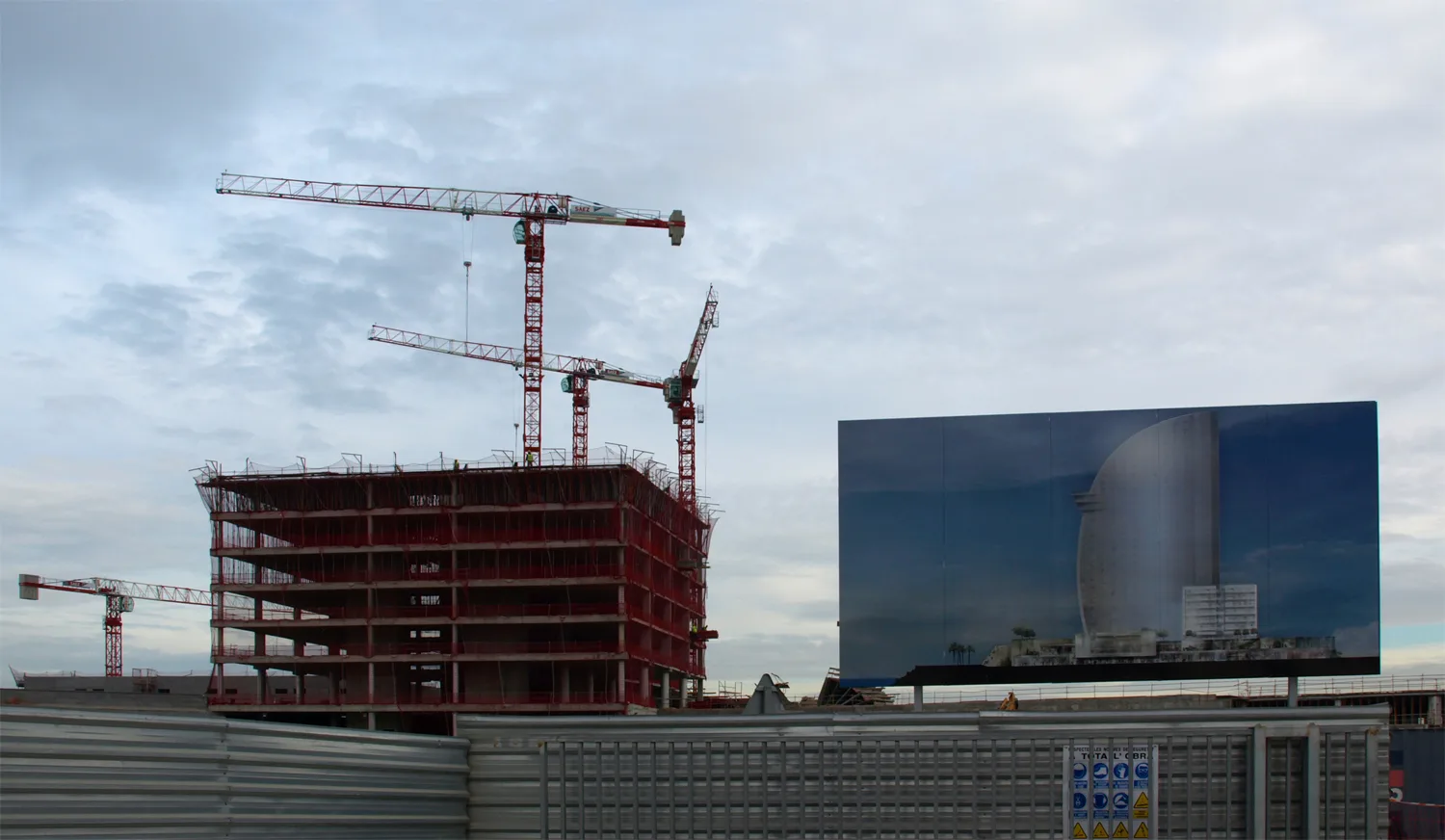
W Barcelona opened in October 2009. Starwood announced it as the brand's first hotel in Western Europe, and Hospitality Design reported it as W's debut in Spain. The building was designed by the Spanish architect Ricardo Bofill. Starwood described a 26-storey, slender, sail-shaped tower set perpendicular to the dock, with views of the sea or the city from nearly every guest room. It had 473 guest rooms, including 67 suites, and more than 2,500 square metres of meeting and event space, among them a Great Room with unobstructed sea views. At the time, Starwood presented W as a contemporary lifestyle brand with 34 hotels and retreats, against eight in February 2000.
The signature restaurant was by the Catalan chef Carles Abellan, who held a Michelin star, and Ignite Group designed Eclipse, the rooftop bar. Starwood's release described each W hotel as a mix of innovative design and passions around fashion and music, and said Bofill's building would set a "dramatic stage" for the brand's lifestyle positioning. Hospitality Design described the 26-storey structure as looking out over the Mediterranean Sea and the city. In 2025 Hospitality Design reported that Rockwell Group, designer of the first W in New York, was reimagining W Barcelona.
W LONDON LEICESTER SQUARE AND ITS GLASS VEIL

In London, W took the corner of Leicester Square and Wardour Street in the West End, a site formerly occupied by the Swiss Centre. The architects Jestico + Whiles designed the ten-storey building with the developer McAleer & Rushe Group, and the Dutch agency Concrete designed the interiors. Hotel Designs reported that the interior concept took "the dual personality of the quintessential Englishman or woman" and applied it to pairings such as work and play, formal and party, and day and night. The hotel had 192 guest rooms and 10 two-level branded residences, with a W The Store retail outlet. The opening moved from summer 2010 to autumn 2010 and then to February 2011, and Travel Agent Central reported a public opening on Valentine's Day 2011.
The exterior is a fritted, translucent glass veil suspended from the face of the building. Jestico + Whiles describe it as calm by day and an animated digital canvas at night. A ceramic frit on optically corrected glass lets the veil hold and project light without blocking views from the rooms, and hundreds of Barco lights provide colour mixing, with intensity and saturation controlled from inside the hotel. Travel Agent Central credited the lighting artist Jason Bruges with producing the light installation. The architects compare the veil to a theatre curtain. Behind it, blocks of rooms pull back into the building envelope to form double and triple height atria, while shops, bars and restaurants occupy the lower floors and the hotel entrance is on Wardour Street.
HOW W HOTELS USE LOCAL INSPIRATION IN DESIGN
In Asia, W Hong Kong sits at 1 Austin Road West, Kowloon Station, in West Kowloon. According to the hotel, two design firms worked on it to create an enchanted forest theme, in which the forest represents Hong Kong's skyscrapers as a symbolic urban canopy. Its rooftop pool is on the 76th floor, 211 metres above the ground, with the spa on the 72nd floor and the gym on the 73rd, and rooms and suites range from 40 to 200 square metres.
Sternlicht sold Starwood to Marriott International in 2016, bringing W into the Marriott portfolio. Hospitality Design reported in 2025 that Marriott later decided the brand needed a "sophisticated reboot", and that the original W New York on Lexington Avenue has since closed. The revised design approach considers "the social, cultural, and historical contextual insights of each destination", with themes of whimsy, tactility and "clean maximalism". Examples include W Austin, which draws on the city's music and nature, and W Hollywood, which reflects the indoor and outdoor lifestyle of Los Angeles. Designers on recent W projects include Rockwell Group, AvroKO and Meyer Davis, and Hospitality Design puts the brand at more than 70 hotels worldwide.
W AMMAN: THE FIRST W HOTEL IN JORDAN

W Amman opened in April 2018 as W's first hotel in Jordan, nearly 20 years after W New York opened on Lexington Avenue and two years after Marriott's acquisition of Starwood. Silverfox Studios designed the full interiors of the 40-storey hotel, which has a faceted, shard-like façade. The interiors take their inspiration from two Jordanian sources: the rose-coloured rock and canyon of Petra, and Amman's hillside city built in limestone. Elsewhere in the brand, W Hong Kong takes an enchanted forest theme from its city's towers and W Austin draws on local music and nature.
Arrival is through a "Canyon Walk" that recalls the Siq at Petra, using angled planes and lines of light. Beyond the arrival, the design shapes movement through the hotel into forms based on canyons and shards, a sequence described as a "Journey of Discoveries". The first W hotel in 1998 called its lobby the living room and furnished it with open fires, libraries and seating. At W Amman, the arrival sequence is the Canyon Walk, and the interiors Silverfox designed carry the canyon and shard forms of the Journey of Discoveries through the movement of guests around the 40-storey hotel.
SOURCES
- Hotel Online (Starwood Hotels & Resorts press release, April 1998) Starwood Hotels & Resorts Worldwide, Inc. Announces the Launch of 'W' Hotels
- The Caterer (Caterer & Hotelkeeper, February 2000) W for wow
- Slate W Hotels: The McDonald's of Hipster Exclusivity
- Hospitality Design W Hotels 2.0 Elevates the Brand Into Its Luxury Era
- Hospitality Design W Treks to Spain
- Franchising.com (Starwood Hotels & Resorts press release, October 2009) W Hotels Worldwide Opens First Western European Hotel with the New W Barcelona
- Hotel Designs UPDATE: W London Hotel Leicester Square, opening February 2011
- Travel Agent Central W London Leicester Square Sets Opening Date
- Jestico + Whiles W London
- Marriott W Hong Kong


