CHINESE ARTISTS, MALACCA PLANTS AND SINGAPORE'S BOTANICAL ART COLLECTIONS
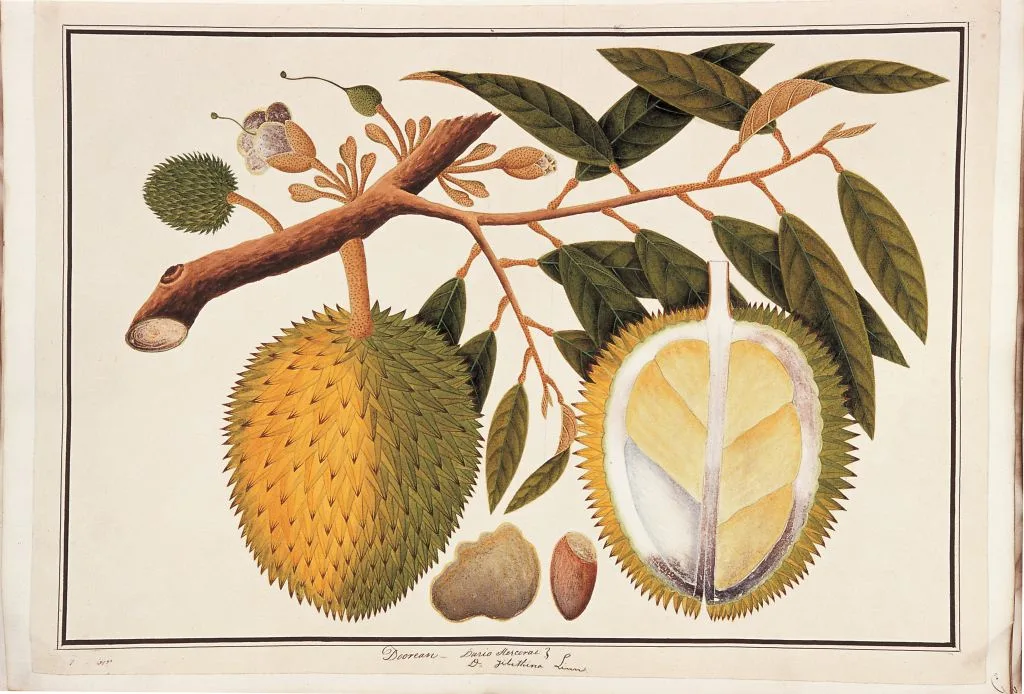
Botanical illustration uses drawing and painting to document plants accurately enough to serve science. In Singapore, the best-known early body of such work is the William Farquhar Collection of Natural History Drawings at the National Museum of Singapore: 477 watercolours of plants and animals from Malacca, Singapore and the Malay Peninsula, painted in the early 19th century by artists attributed to the Canton school of Chinese export painting, working for William Farquhar. Each sheet is labelled with the name of its subject, and the plant drawings include durian, mangosteen, nutmeg and 28 studies of palms. The collection was held by the Royal Asiatic Society for 166 years before it came to Singapore in the 1990s. Its history links European natural history painting, the export painting studios of southern China and the botanical art collection that the Singapore Botanic Gardens has built since 1890.
WHAT IS BOTANICAL ILLUSTRATION
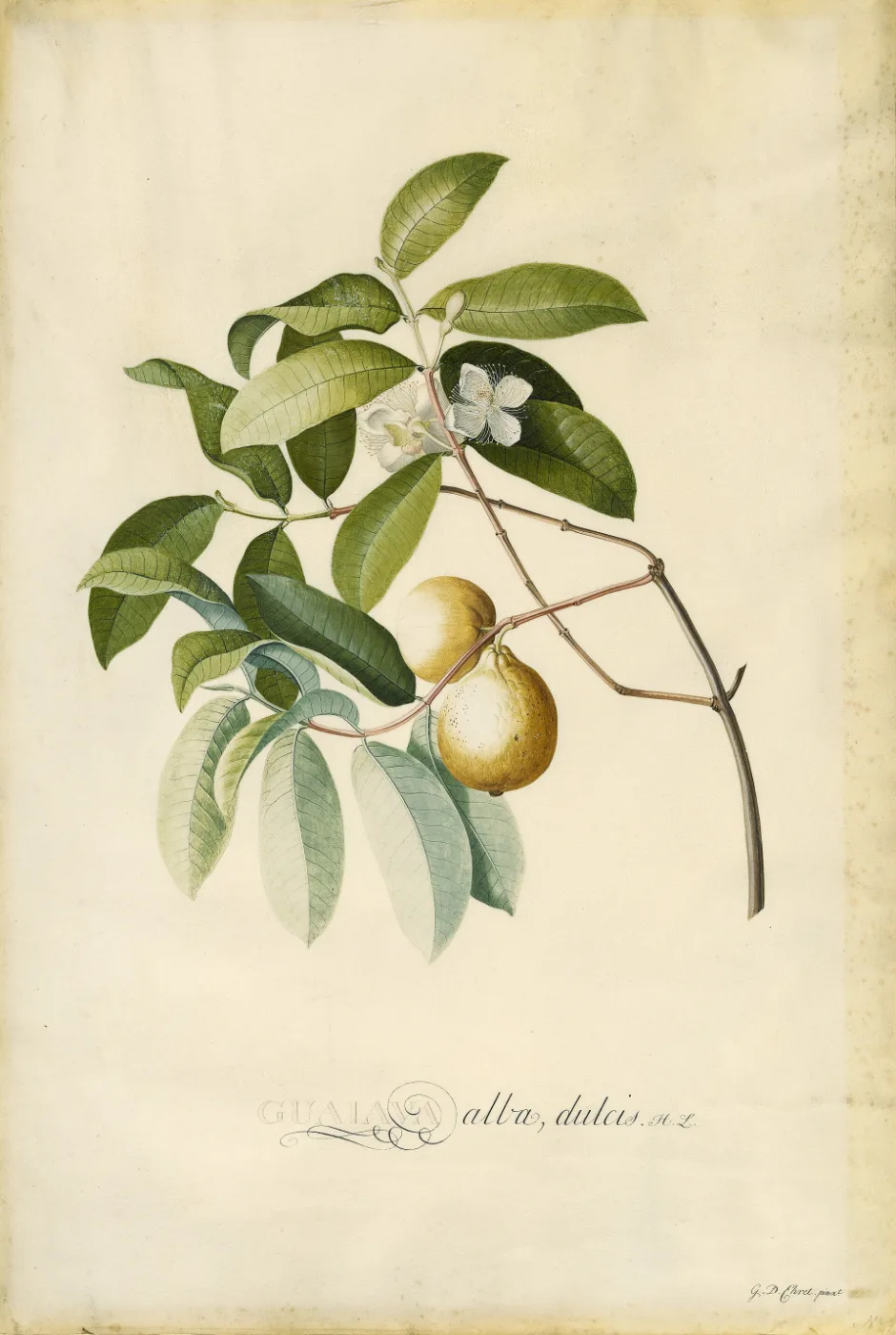
In Europe, botanical illustration developed alongside the scientific classification of plants. Georg Dionysius Ehret (1708 to 1770), one of the leading botanical illustrators of the 18th century, produced illustrations for several important botanical publications and helped promote the binomial system of plant classification devised by Carolus Linnaeus. The Victoria and Albert Museum holds his study of the American Turk's-cap lily, Lilium superbum, painted in watercolour and bodycolour on vellum in the 1740s. Ehret's own text records that the lily first flowered in August 1738 in Peter Collinson's garden near London, where he often studied plants. Dr C. J. Trew reproduced a version of the picture in Plantae Selectae, published in Nuremberg between 1750 and 1773.
In Asia, natural history pictures for European patrons were often painted by local artists. In India, the style known as Company school developed in the second half of the 18th century in response to the tastes of British men serving with the East India Company. It first appeared in Murshidabad in West Bengal and spread to Benares, Delhi, Lucknow and Patna. Its painters worked in watercolour on paper and on mica, and depicted daily life, festivals and ceremonies, but Britannica judges the studies of natural life to be the most successful works in the style. In southern China a parallel tradition grew up in Canton, now known as the Canton school of export painting, and the National Heritage Board of Singapore states that the Farquhar drawings are generally accepted to be the work of its artists.
WHO WAS WILLIAM FARQUHAR
William Farquhar worked for the East India Company from the age of 17 and became a lieutenant in the Madras Engineers at 19. He arrived in Malacca in 1795 as a Chief Engineer and stayed for more than two decades, until 1818. In 1813 he was officially appointed Resident and Commandant of Malacca. According to the National Heritage Board, he spoke fluent Malay, knew local customs and was well respected, and he was affectionately known as the "Rajah of Malacca". The years in Malacca, 1795 to 1818, are the period over which, in the account of the Gardens' Bulletin Singapore, he assembled his collection of drawings of the plants and animals of the region.
Farquhar's interest in natural history went beyond commissioning pictures. He took part in the discovery and identification of several indigenous species, among them the Malayan tapir, which he kept as a pet. The wild nutmeg Gymnacranthera farquhariana is named after him. In Singapore he later supervised the planting of cloves and nutmeg at the foot of Fort Canning Hill. The National Heritage Board states that the drawings he commissioned were designed to be scientifically accurate, with each subject depicted in detail and labelled with its scientific or common name.
HOW THE FARQUHAR DRAWINGS WERE MADE

The names of the artists were not recorded. The National Heritage Board states that they are generally accepted to have been painted by Chinese artists of the Canton school of export painting. Lim Chong Keat, writing in the Gardens' Bulletin Singapore in 1996, describes them as the work of local artists "said to be Chinese". He notes that the Hunter watercolours of 1802, another early set of natural history paintings from the region, are thought to have been painted by Chinese artists, probably in Penang, while in India, for work such as Roxburgh's at Calcutta, Indian artists were employed for most botanical and zoological renderings.
Dating rests on the paper and the albums. Some sheets carry watermarks dated 1796, and Lim dates the album containing several of the palm drawings to about 1805 to 1818. The National Museum of Singapore catalogues individual drawings as watercolour on paper, dated 1803 to 1818 and made in Malacca, with images of about 38 by 54 centimetres mounted on sheets of 58 by 44 centimetres. The National Heritage Board describes the labels as giving scientific names and common names in Jawi Malay and English, and Lim records inscriptions in English, Jawi and romanised Malay, in pen and in pencil, whose dates are difficult to determine.
WHICH PLANTS AND FRUITS THE FARQUHAR DRAWINGS SHOW
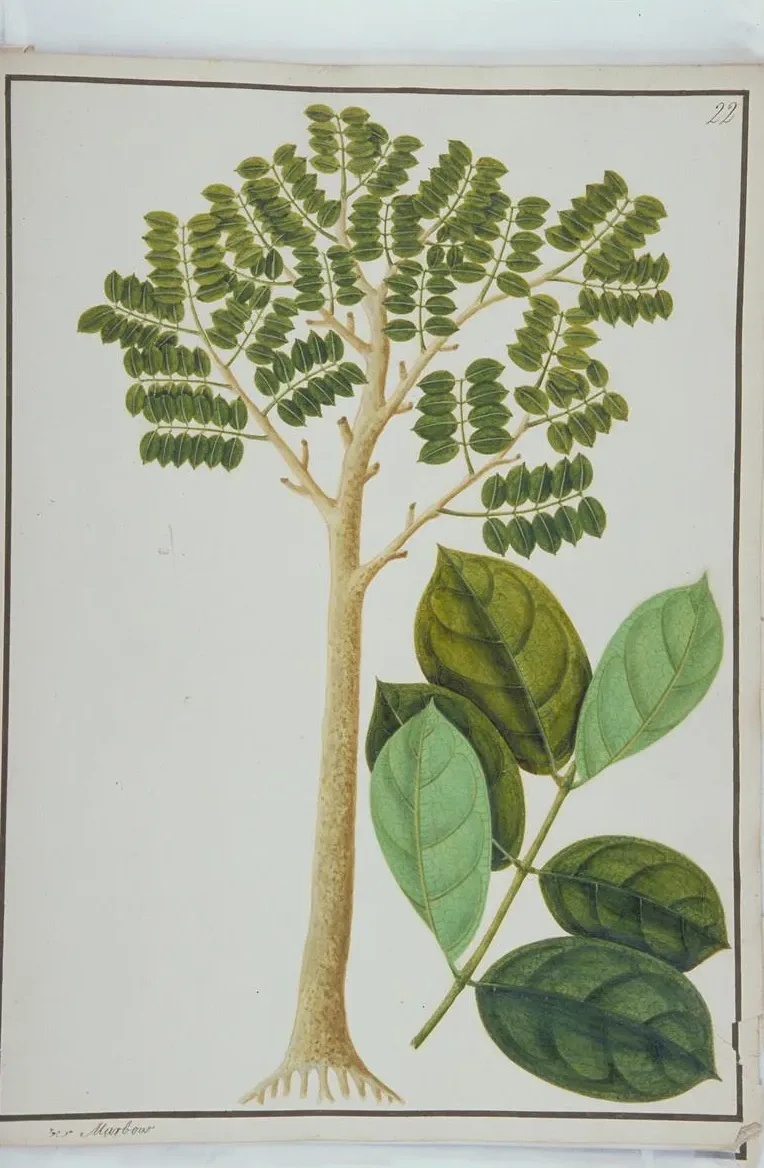
The fruit trees of Malacca are among the subjects. The National Museum of Singapore's catalogue includes a durian painted together with a pied cuckoo-shrike, and separate sheets showing the mangosteen, each dated 1803 to 1818 and recorded as from Malacca; the durian sheet has an image of 37.9 by 54.4 centimetres. Spice plants appear as well, among them a painting of nutmeg dated about 1810. The animal drawings follow the same approach. The black-capped kingfisher, which the National Heritage Board describes as a common bird in Singapore, often first seen as a quick flash of blue diving into the island's waterways for a meal, is shown with its wings fully spread, about to land or take off from its branch.
Palms form a large botanical group within the set. Lim's study identifies 28 palm drawings, 16 in two bound volumes and 12 in two albums. They include the climbing palms that supply rattan, in the genera Calamus, Daemonorops, Korthalsia and Plectocomia, as well as Pinanga, Licuala longipes, Caryota mitis, the coconut palm Cocos nucifera, the areca palm Areca catechu, the nipa palm Nypa fruticans, the sago palm Metroxylon sagu and Oncosperma tigillarium. Lim describes the drawings as artistically charming and botanically informative, though some are naive and not fully accurate.
Some sheets have particular scientific interest. Lim suggests that certain drawings of plants collected on Mount Ophir may represent original holotypes, and that one drawing resembling Iguanura may show an undescribed species. A drawing of the coco-de-mer, Lodoicea maldivica, pencilled "Lodoicea Sechellarum" and probably made around 1818, has a duplicate in another collection at Kew. Lim notes that the duplicate means the drawing cannot be taken as unique evidence of where the palm was growing. Lim also cites a 1778 record of a three-year-old palm growing in a private garden to estimate that, if drawn around 1818, the palm would have been 43 years old.
HOW THE DRAWINGS CAME TO THE NATIONAL MUSEUM OF SINGAPORE

In 1818 Farquhar showed the drawings to Dr William Jack, who, according to Lim, was rather critical of their botanical adequacy. In 1827 Farquhar presented the collection to the Royal Asiatic Society. The second volume of plants is inscribed "Drawings of Plants from Malacca Presented by Col. Farquhar Vol. 2". The Society later placed the drawings on permanent loan with the Natural History Museum in London, and its archive holds a copy of the original 1935 letter concerning that loan. The botanist I. H. Burkill published identifications of the plants in the Gardens' Bulletin in 1949 and 1955, and these have since been revised by later researchers.
The drawings later needed conservation work that the Society could not afford and the Natural History Museum could not fund, and the Society decided to sell them through Sotheby's. The Society's archive keeps a preview catalogue for October 1993, the catalogue of the sale "Topographical Paintings, Watercolours and Drawings" held on 20 October 1993, and a catalogue dedicated to the Farquhar Collection. The buyer, Goh Geok Khim, donated the drawings to Singapore; the Society's file records that they were given to the National Heritage Board for display at the Singapore Art Museum. Today they belong to the National Museum of Singapore, which credits each sheet as a gift of Mr G. K. Goh, under accession numbers beginning 1995.
BOTANICAL ILLUSTRATION AT THE SINGAPORE BOTANIC GARDENS

A second collection of botanical art was built by the Singapore Botanic Gardens. Henry Nicholas Ridley, the Gardens' first director, hired its first artist in 1890, and many more followed. According to the Gardens' taxonomist Michele Rodda, the artists were commissioned to depict rare native species, edible and useful plants, and ornamental garden hybrids, and the subjects shifted over time with the Gardens' priorities. The collection now holds more than 2,000 botanical paintings, together with hundreds of sketches, line drawings and photographs, and study of its primary sources during curation has revealed much of its history.
The Gardens opened the Botanical Art Gallery to the public on 13 March 2021 as part of the Gallop Extension. It occupies Gallop House No. 7, known as Inverturret, a conserved house built in 1906, and NParks describes it as Singapore's first permanent display of botanical art. The gallery shows a selection of the collection, including original watercolours, ink drawings, prints and printing blocks, with the aim of showing the role of art in documenting the plants of Singapore and the region. It also hosts a Community Arts Residency supported by the National Arts Council's Arts and Culture Nodes initiative and a private donor.
The Gardens still commission botanical artists. Since 2014 the Gardens' botanical artists have been engaged to make pen-and-ink illustrations for the Flora of Singapore book series. Rodda, who specialises in the frangipani family, Apocynaceae, of Southeast Asia and neighbouring regions, traces the history in Tropical Plants in Focus: Botanical Illustration at the Singapore Botanic Gardens (2021). NParks summarises the book as following botanical illustration in Singapore from before the Gardens were established, through its peak in the late 19th century, to the present, and the illustrations reproduced in it can be seen at the gallery.
EMBU AT MANDARIN ORIENTAL, SINGAPORE: CANOPY, TIMBER AND RATTAN

Silverfox Studios completed Embu, the all-day dining restaurant on level 3 of Mandarin Oriental, Singapore, in September 2023, with the design led by Susan Heng and Patrick Waring. The restaurant is named from the Tembusu, a tree known for its fragrant flowers and sturdy wood. Its design draws on the themes of Singapore's Garden City: canopy, botanical planting, pavilions and greenhouses. The Tembusu also informs the structure of the restaurant, since its curved louvred timber canopies and framing echo the perpendicular branching of the tree.
The floor is laid with Peranakan black-and-white porcelain tiles, and the interior uses open-weave rattan. Rattans are palms, and Lim's study of the Farquhar drawings records rattans of four genera, Calamus, Daemonorops, Korthalsia and Plectocomia, painted in Malacca in the early 19th century alongside the coconut, areca, nipa and sago palms, in a collection inscribed in English, Jawi and romanised Malay. The drawings are held by the National Museum of Singapore, while the Singapore Botanic Gardens keep their own collection of more than 2,000 botanical paintings.
SOURCES
- National Heritage Board, Roots Black-capped Kingfisher, Malacca, early 19th century, watercolour on paper
- National Heritage Board, Roots William Farquhar: The First Resident
- National Museum of Singapore, Roots Durian and Pied Cuckoo-Shrike, William Farquhar Collection of Natural History Drawings
- National Museum of Singapore, Roots Mangosteen, William Farquhar Collection of Natural History Drawings
- Royal Asiatic Society Archives RAS COLL4/3/8: Sale of the Farquhar Collection of Natural History Drawings of Malacca
- Gardens' Bulletin Singapore (Lim Chong Keat) Palms in the Farquhar Collection of Natural History Drawings
- Nanyang Technological University, On Museums Botanical Illustration at the Singapore Botanic Gardens: Curation and Display of a Scientific Collection
- National Parks Board Conserved houses and nature playgarden at Gallop Extension of the Singapore Botanic Gardens open
- Victoria and Albert Museum American Turk's-cap lily, Georg Dionysius Ehret
- Encyclopaedia Britannica Company school