PORCELAIN CABINETS, JAPANNED FURNITURE, PAINTED PAPER AND PAGODAS

Chinoiserie is the name given to a Western style of the 17th and 18th centuries that Britannica defines as "fanciful European interpretations of Chinese styles". It covered interior design, furniture, pottery, textiles and gardens. Blue-and-white porcelain, lacquer, silk and painted papers reached Europe on the ships of the trading companies, and workshops from Delft to Meissen set out to reproduce them. The results mixed Chinese and Japanese motifs with Baroque and Rococo forms, and they described an imagined East rather than Chinese design as it was practised in China. Its history runs from the porcelain rooms of 17th-century palaces to the Great Pagoda at Kew and a revival in the 1930s.
WHAT IS CHINOISERIE AND WHERE DID IT COME FROM?
According to Britannica, English and Italian craftsmen began borrowing decorative motifs from Chinese cabinets, porcelain and embroideries in the early 1600s,, and others followed. English and Dutch merchants formed East India Companies in the early 17th century to share the risk of trading with Asia, and the National Trust notes that the companies commissioned goods from Asian suppliers to suit European taste, including Chinese porcelain, Japanese lacquer and Indian chintz. Tea, porcelain and silk were imported in bulk, while company employees brought in smaller quantities of lacquer, paintings and prints privately. By the late 1600s, the Metropolitan Museum of Art records, shiploads of porcelain were being auctioned in Portugal, England and Holland.
The style was used mainly alongside Baroque and Rococo design. Britannica lists its usual features as extensive gilding and lacquering, blue-and-white wares such as Delftware, asymmetrical forms, distorted perspective and figures and motifs presented as oriental. The style's lightness, asymmetry and capricious motifs also appear in the paintings of Antoine Watteau and François Boucher. The fashion also had critics: the Met notes that some 18th-century writers dismissed chinoiserie as "monstrous and unnatural". The museum's 2025 exhibition, Monstrous Beauty: A Feminist Revision of Chinoiserie, presented the style as the product of European demand for foreign luxuries and of fantasies about an imaginary Far East.
CHINOISERIE IN PORCELAIN: FROM DELFTWARE TO MEISSEN

Chinese blue-and-white porcelain began arriving in Europe by sea in the 16th century, and the Met notes that merchants first used it as ballast. The Met's Monstrous Beauty exhibition included a soft-paste porcelain ewer made by the Medici Porcelain Manufactory in Florence about 1575 to 1580. Demand grew with the spread of tea. Catherine of Braganza arrived in England in 1662, and tea went on to become a national drink that stood for civility. Porcelain, according to the Met, came to be associated with female taste over the same period.
In the Netherlands, potters had made tin-enamelled earthenware since the end of the 16th century, first in the style of Italian majolica. Britannica records that Ming blue-and-white porcelain, known in Holland as kraakporselein or carrack porcelain, reached the country in the early 1600s and inspired the tin-glazed wares that became known as delft. Between the 1620s and the 1640s production concentrated in the town of Delft, where potters took over disused breweries and often kept their names, such as The Golden Flowerpot. Many pieces closely copied blue-painted Chinese porcelain. Later polychrome wares imitated Chinese famille verte and famille noire and Imari-type wares, enamel colours arrived around 1720, and heavily gilded pieces were known as Delft dorée.
True hard-paste porcelain was first made in Europe in Saxony. The alchemist Johann Friedrich Böttger and the physicist Ehrenfried Walter von Tschirnhaus found its secret around 1707, and the Meissen factory near Dresden began production in 1710. Britannica calls it the first successfully produced true porcelain in Europe. The Met's exhibition included a Meissen Guanyin of 1710 to 1713 and a bowl of about 1724 attributed to Johann Gregor Höroldt. The factory reached its high point after 1731 under the modeller Johann Joachim Kändler, introduced its underglaze blue onion pattern around 1739, and set the style of European porcelain until about 1756, when Sèvres in France took the lead.
CHINESE ROOMS AND PORCELAIN CABINETS IN EUROPEAN PALACES
Whole rooms were fitted out in the Chinese taste. Britannica cites the Trianon de porcelaine at Versailles, built by Louis Le Vau for Louis XIV in 1670 and 1671 and later destroyed, as an early example. According to Britannica, no court residence, especially in Germany, was complete without its Chinese room. One example is the Lackkabinett, or lacquer cabinet, at Schloss Ludwigsburg in Württemberg, made between 1714 and 1722. The Met's 2025 exhibition showed a design for the Porcelain Cabinet at Charlottenburg Palace, engraved by Martin Engelbrecht after Eosander von Göthe.
The Met identifies Mary II, queen of England, as a collector whose obsession with chinoiserie in the late 1600s influenced generations of women collectors across Europe; a section of the museum's exhibition was titled Surrogate Bodies: Mary II and Porcelain Obsessions. After her death one writer attacked the spending on porcelain she had encouraged as a "fatal excess". Porcelain figures of Asian subjects appeared in the 18th century. The Met's exhibition included a Meissen figure of Asia made about 1745 to 1755 and the Chelsea factory's Chinese musicians of about 1755.
JAPANNING: HOW EUROPE IMITATED ASIAN LACQUER

The making of genuine Asian lacquer is covered in the Silverfox history of Chinese lacquerware. European workshops answered with japanning, which the Smithsonian Libraries define as the European imitation of East Asian lacquerwork. The term came from the heavy black lacquer associated with Japan. In 1688 John Stalker and George Parker published A Treatise of Japanning and Varnishing, printed in Oxford for the authors and also sold in London. It gave instructions for the lacquer process and for making all kinds of varnish, with 24 large copperplate engravings showing more than a hundred patterns for japan work.
The Smithsonian Libraries, whose Cooper Hewitt library holds a copy, describe the treatise as the first to give detailed pattern illustrations. Imported lacquer was also built into European furniture. The Met's 2025 exhibition included a mirror of about 1680 in a Coromandel lacquer frame, and a combined work, writing and reading table made about 1775 to 1780 by the cabinetmaker Martin Carlin with Japanese lacquer. At the Royal Pavilion in Brighton, the Royal Collection Trust notes a French secretaire set with Japanese lacquer panels.
CHINESE WALLPAPER IN BRITISH COUNTRY HOUSES
Paper wallcoverings developed in late 17th-century Europe as a cheaper alternative to tapestries and painted leather. The National Trust records that Chinese paintings and prints were first used as wallpaper by inserting them into gaps in panelling or assembling them into collages, as in the study collages of the 1740s or 1750s at Saltram in Devon. Research has shown that the first wallpapers made in China for Europe, from about 1750, were woodblock-printed and coloured by hand. At Felbrigg Hall in Norfolk, the London paper-hanger John Scrutton hung such sheets, each more than two metres tall, in the Chinese Room in 1752, trimming the margins to make a continuous garden panorama.
From the late 1750s fully hand-painted papers replaced the printed ones. Several painters worked on each sheet, each specialising in architecture, rockwork, foliage or figures. Bird-and-flower designs drew on the long Chinese tradition of bird-and-flower painting, and from about 1770 they were given brightly coloured backgrounds. Common symbols included ducks for loyalty, pheasants for beauty, peonies for fame and bamboo for humility. At Nostell Priory in Yorkshire, Thomas Chippendale supplied the furniture and also sourced and hung the wallpaper. The National Trust now cares for 18 historic houses with Chinese wallcoverings, which it describes as the largest collection of historic Chinese wallpapers on permanent public display in the world.
CHIPPENDALE, KEW AND CHINOISERIE IN FURNITURE AND GARDENS

Thomas Chippendale, baptised in Otley in West Yorkshire in 1718, set up his cabinet-making firm in London in the mid-18th century. In 1754 he published The Gentleman and Cabinet-Maker's Director, subtitled as designs of household furniture "in the Gothic, Chinese and Modern Taste". The first edition, a copy of which is held by the Metropolitan Museum of Art, has 161 engraved plates of Gothic, Chinese and Rococo designs and plainer domestic pieces. A virtually identical second edition followed in 1755 and an enlarged third edition in 1762. The book brought Chippendale clients such as the actor David Garrick, and his patterns were popular abroad, especially in North America.
Britannica notes that pagodas and tea pavilions appeared in European parks during the 18th century, and that the architect Sir William Chambers's Designs of Chinese Buildings (1757) was especially influential on the Continent. Chambers, who had visited China twice according to Historic Royal Palaces, completed the Great Pagoda at Kew in 1762 for the royal family. It stands 163 feet high, with 253 steps to the top, and was inspired by the Porcelain Pagoda at Nanjing. It was the largest of 16 structures on a royal circuit in the garden. Its 80 iridescent wooden dragons were removed during roof repairs in 1784; a restoration completed in 2018 replaced all 80, using 3D printing and hand carving.
FROM THE BRIGHTON PAVILION TO CHINOISERIE REVIVALS

The Royal Pavilion at Brighton carried chinoiserie into the 19th century. Henry Holland enlarged a seaside house for George, Prince of Wales, in 1787, and John Nash remodelled it between 1815 and 1822, adding Indian-inspired domes and minarets outside. The Royal Collection Trust records that the interiors, designed by Frederick Crace and Robert Jones, reflected the prince's love of Asian art in the style known as chinoiserie, and often combined objects of mixed origin. The furnishings were later moved to Buckingham Palace and Windsor Castle. Queen Victoria returned many of them in 1864 and Queen Mary in the 1920s, and they were used in the restoration of the building as a Regency museum.
Britannica records that chinoiserie waned in the 19th century as Turkish, Egyptian, Gothic and Greek styles competed with it, and that it had a brief revival in interior design in the 1930s. Chinese papers were still hung at Belton House in Lincolnshire around 1840; in the late 19th century historic Chinese papers were sold as antiques, many to the United States. The National Trust treats Chinese wallpaper as a living tradition, citing the modern paper in the Dining Room at Avebury Manor in Wiltshire. The Met's exhibition, held from 25 March to 17 August 2025, set nearly 200 works from 16th-century Europe beside installations by Asian and Asian American women artists, among them Yeesookyung's Translated Vase of 2023.
SILK, EMBROIDERY, BLUE AND GOLD AT MAN WAH
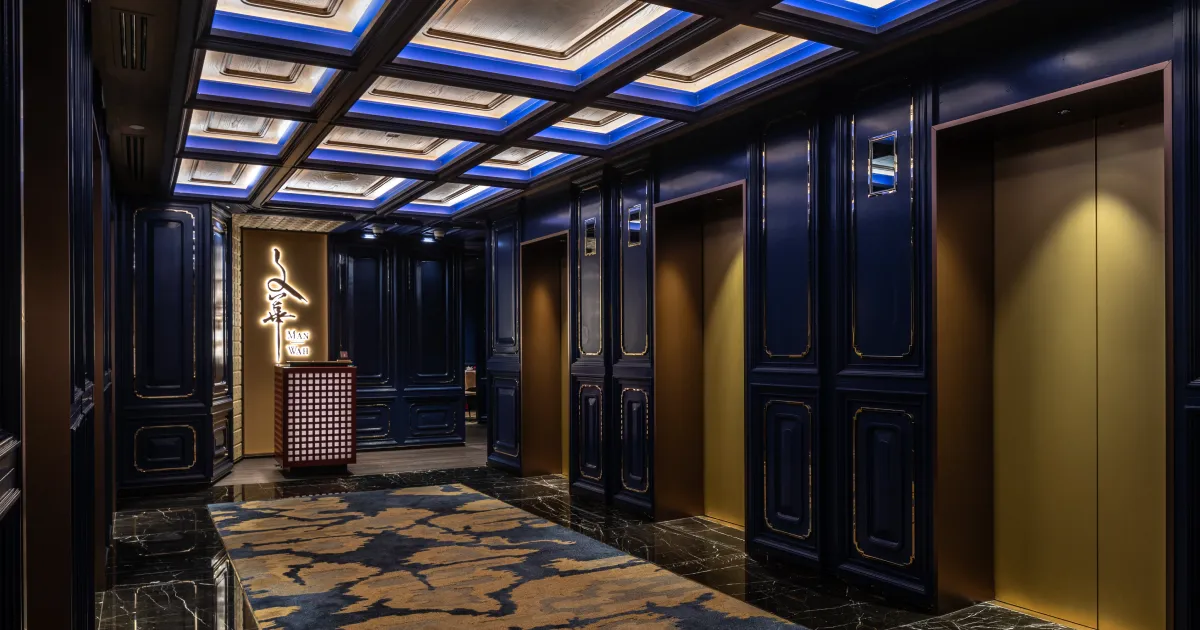
Man Wah is the Cantonese restaurant on the 25th floor of Mandarin Oriental, Hong Kong, and holds One MICHELIN Star. Silverfox Studios' 2021 redesign of the interiors interprets the Hong Kong skyline and Victoria Harbour seen from its windows, together with references to the hotel's heritage. Its lanterns reinterpret the original Man Wah lanterns as clustered brass cages with embroidered, pleated shades. Embroidered dragon and floral artwork is set on a navy wall panel, and the walls carry navy panelling with gold trim. The bespoke blue and gold carpet is made in silk, with hand-carved patterning that evokes light on the harbour.
Several of these materials appear earlier in this history. Silk was one of the goods the East India Companies imported from Asia in bulk, alongside tea and porcelain. Chinese embroideries were among the sources from which English and Italian craftsmen took decorative motifs in the early 1600s, and bird-and-flower designs drawn from Chinese painting appeared on the Chinese wallpapers hung in British country houses in the 18th century. Gilding was one of the features Britannica lists as typical of chinoiserie, and blue and white was the colour scheme of the Ming porcelain copied at Delft, where heavily gilded pieces were sold as Delft dorée.
SOURCES
- Britannica Chinoiserie
- The Metropolitan Museum of Art Monstrous Beauty: A Feminist Revision of Chinoiserie
- The Metropolitan Museum of Art Monstrous Beauty: Inside the Exhibition
- Britannica Dutch ware
- Britannica Meissen porcelain
- Smithsonian Libraries and Archives A Treatise of Japanning and Varnishing
- National Trust Chinese wallpaper in National Trust collections
- The Metropolitan Museum of Art The Gentleman and Cabinet-maker's Director
- Historic Royal Palaces The Great Pagoda
- Royal Collection Trust Brighton Pavilion: The Making of a Pleasure Palace