HAMMER MARKS ON COPPER, SILVER, TIN AND STEEL IN JAPANESE CRAFT
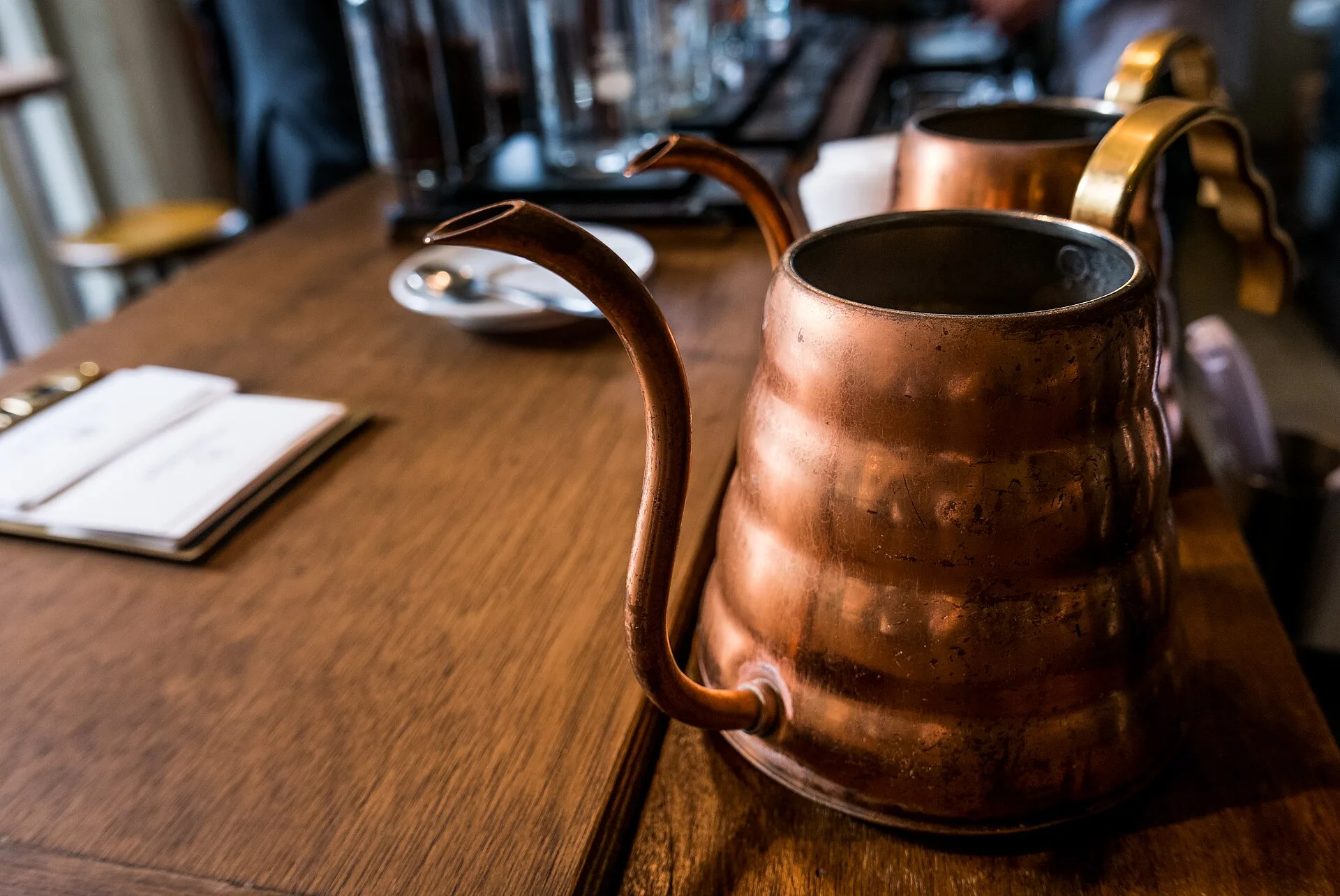
Tsuchime is the Japanese term for the marks a hammer leaves on metal. Shogakukan's Nihon Kokugo Daijiten defines it as a mark made by striking with a hammer, and also as the trace that remains afterwards. In Japanese craft these marks are both a result of forming a vessel by hand and a deliberate surface finish. They appear on hammered copperware from Tsubame in Niigata Prefecture, on Tokyo silverware, on Osaka tinware and on the backs of forged plane blades from Yoita. The official descriptions of these designated traditional crafts set out the hammers, stakes, heating and colouring steps involved, and two of Japan's Living National Treasures, Tamagawa Norio and Osumi Yukie, were designated for tankin, the hammering of metal into vessels.
WHAT DOES TSUCHIME MEAN?
The dictionary writes the word 槌目, while the Association for the Promotion of Traditional Craft Industries (Densan) writes it 鎚目 in its description of Tsubame copperware. Both forms are read tsuchime, and the first character, read tsuchi, is the hammer. Densan explains the related term tsuiki in the same way: it means to raise metal by striking it with a tsuchi, repeatedly hammering one flat copper sheet into a three-dimensional form. Densan uses the word tsuchime in two senses. A levelling hammer gives copper its tsuchime to make the surface even, and the finished body is dressed with a tsuchime pattern before it is coloured.
Tsuchime belongs to tankin, the Japanese discipline of hammered metalwork. Shogakukan's encyclopedia Nipponica describes tankin as a technique that uses the ability of metal to stretch and shrink to make objects, and lists uchimono and tsuiki among its other names. It divides tankin in Japan into three branches: tsuiki, in which a sheet is hammered into a vessel; sheet-metal work, in which plates are bent and joined; and oshidashi, used for small Buddhist relief images in the Nara period. Heibonsha's World Encyclopedia divides Japanese metalwork as a whole into casting, chasing and tankin, and states that the name tankin began when Okakura Tenshin set up a metalwork department at the Tokyo School of Fine Arts.
WHERE DID JAPANESE HAMMERED METALWORK COME FROM?

According to Nipponica, hammered metal objects survive from Mesopotamia and Egypt around 3000 BCE and from Shang dynasty China around 1500 BCE. The technique reached Japan from the continent in the Yayoi period, together with mining and metallurgy. Tsuiki work is already found on swords, horse trappings and personal ornaments of the Kofun period, and from the Nara period onwards it was widely used for Buddhist bowls, long-handled censers, basins and gongs. In the Meiji period the metalworker Yamada Sōmi became known for this method, forming lions and pigeons from a single sheet of iron. The Smithsonian's National Museum of Asian Art lists tea-water containers, gongs, bells, swords and armour among the objects Japanese smiths historically made by hammering.
The range of metals has widened over time. Nipponica notes that gold, silver and copper were the most common early materials, followed by copper alloys such as bronze, white bronze and brass, together with iron and tin; in recent years platinum, aluminium and stainless steel have been added. The same entry records that pressing and metal spinning made mass production of hammered forms possible in the modern era. The Britannica Japan concise encyclopedia adds that industry now relies on powered methods such as steam hammers and spinning, while hand hammering remains widely used in art and craft production.
HOW IS A TSUCHIME FINISH MADE?
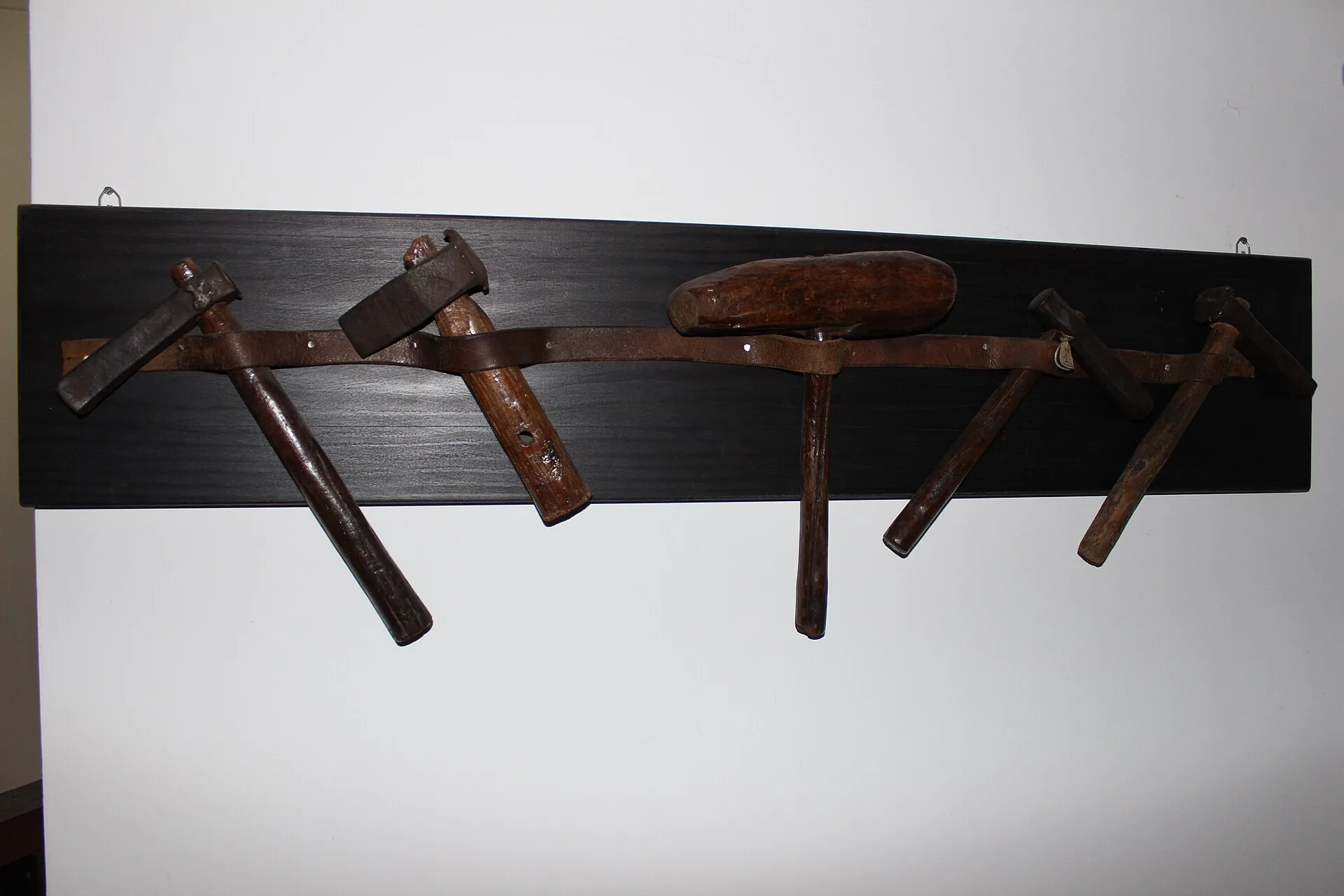
Densan's description of Tsubame copperware sets out the process step by step. A copper sheet is cut to size and its sides are raised with a wooden mallet over a wooden block with hollows in it. The sheet is then hooked over an L-shaped iron stake called a torikuchi, also known as ategane, and drawn inwards with a metal hammer. Densan counts several hundred types of stake, chosen according to the shape of the piece, each set into a hole in a zelkova wood block called an agariban, on which the craftsman sits. Hammering hardens copper, so the piece is heated to about 650°C, which changes its structure and softens it. Drawing and annealing are repeated many times before the body and spout are balanced.
The finish depends on the hammer. Densan names the tsume-zuchi, used to form the body; the narashi-zuchi, a levelling hammer that applies tsuchime to neaten the surface; the arashi-zuchi, a roughening hammer that puts a pattern on the skin of the metal; and separate hammers for chasing. A note by Nancy Cook for the Metal Museum in Memphis describes raising as starting with a flat sheet, usually copper or silver, shaped in a series of concentric circles and hammered and heated over and over until the vessel takes form. The National Museum of Asian Art calls hammering "a rhythmic process that gradually transforms metal".
TSUBAME TSUIKI COPPERWARE AND ITS HAMMER MARKS
Tsubame lies in Niigata Prefecture, and the city's tourism guide dates the start of its metalworking to the making of Japanese nails about 400 years ago. Densan records that hammered copper arrived in the mid Edo period, when itinerant craftsmen from Sendai brought the technique, and that the first pieces were kettles made from copper mined on Mount Yahiko. After the Meiji Restoration, exchange with other regions increased and the work came to be recognised as an art craft, laying the foundation for Tsubame's later metal industry. The guide adds that demand for Western tableware in the Meiji period made cutlery one of the city's main industries. Tsubame tsuiki copperware was designated a traditional craft on 22 June 1981.
Densan lists three forming methods: raised work hammered from one sheet, spun work, and work rolled from sheet with joined seams. Decoration includes pattern striking, chasing and inlay, all done by hand, and the base metal is copper or silver of at least 925 parts per 1,000. Colour comes last. For the black finish the piece is coated with tin, fired at about 800°C, treated with potassium sulphide and polished, then boiled in a mixture of verdigris and copper sulphate, giving a deep, lustrous black purple. For the red finish the piece is boiled in the same liquid for anything from tens of minutes to several hours, producing a bright reddish yellow.
One of the city's workshops is Gyokusendo, which Tsubame's tourism guide describes as a traditional crafts and hammered copperware shop in operation since 1816. Its kettles are hammered from single sheets of copper, and its buildings are registered Tangible Cultural Properties. The guide states that only Gyokusendo has the skills to hammer a kettle from a single sheet without seams. Densan names this construction as the distinguishing skill of Tsubame work: hammering a flat sheet until even the spout of a kettle is raised from the same piece of copper. It describes the results as supple curves and neat forms made from a single sheet with hammers alone. The main products listed for the craft are tea utensils, kitchenware, sake vessels and stationery.
TSUCHIME ON SILVER, TIN AND STEEL

Tokyo Ginki, the silverware of Tokyo, was designated a traditional craft on 12 January 1979. Densan traces it to the mid Edo period, when silversmiths called shiroganeshi made the base vessels that metal engravers decorated, and notes that silver tea kettles and tea caddies were already made in the Muromachi period as the tea ceremony developed. Silver of at least 925 parts per 1,000 is shaped with a wooden mallet over a zelkova block, then refined with hammer and stake. Once the form is set, patterns such as rock, mat, basket weave and tortoiseshell are struck in with hammers that carry the pattern on their faces, and round hammer marks are among the listed decorations. Repeated hammering also dulls the shine to a subdued silver.
Osaka Naniwa tinware, designated on 27 April 1983, shows tsuchime on a cast metal. Densan reports that tinware is said to have reached Japan about 1,300 years ago with envoys to the Sui court, and that Osaka's production centre formed in the mid Edo period. The tin must be at least 97 per cent pure; it is cast, turned on a lathe with special planes and polished. Densan lists tsuchime striking as one of the approved decorations, applied during the middle stage of work together with cutting and bending. On steel, the Echigo Yoita forged blades of Nagaoka, designated in 1986, include a step in which a patterned hammer is struck against the back of each plane blade, whose centre is also slightly recessed so it sits evenly when fitted into the plane body.
LIVING NATIONAL TREASURES OF HAMMERED METAL
Japan's Living National Treasure system has recognised hammering as a discipline in its own right. The Metropolitan Museum of Art records that Tamagawa Norio, born in 1942 into a family of copperware masters in Niigata Prefecture, apprenticed in Tokyo from 1963 to 1965 with Sekiya Shirō (1907 to 1994), himself a Living National Treasure. Tamagawa was designated in 2010 for his hammering, or tankin, technique. The Met holds his Wood-Grain Metal Vase of 2019, made of hammered silver, copper and the copper and gold alloy shakudō and given to the museum in 2020. Its surface uses mokume-gane, a laminate of several alloys whose layered pattern often resembles wood grain or marble.
Osumi Yukie, born in 1945, graduated from Tokyo University of the Arts in 1969 and in 2015 became the first female metalworker designated a Living National Treasure, for the raising of vessels. According to the Metal Museum, she combines raising with nunome zogan, a textile inlay in which cross-hatched chisel lines hold hammered gold, silver or lead foil. She and Tanaka Terukazu, also born in 1945, are shown shaping and decorating metal vessels in a film on working processes for Striking Objects: Contemporary Japanese Metalwork, which opened at the Smithsonian's Arthur M. Sackler Gallery on 2 March 2024. The museum states that a gift from Shirley Z. Johnson made its collection of contemporary Japanese metalwork the largest in the United States.
HAND-BEATEN BRASS AT STRAWFIRE, ABU DHABI
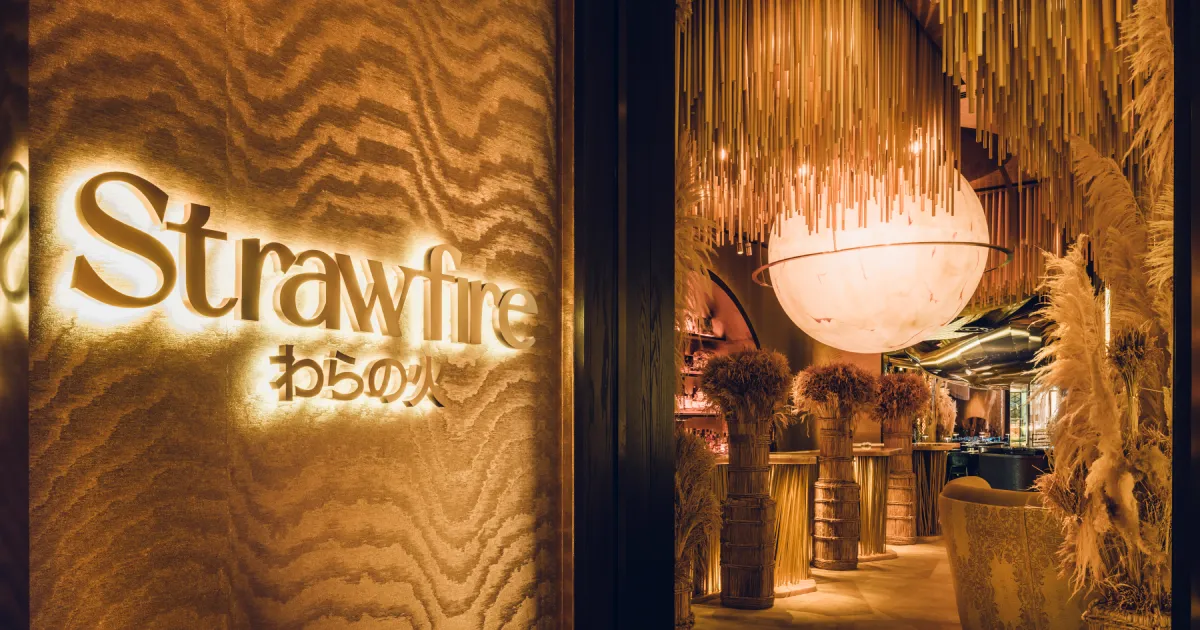
Strawfire is a Japanese restaurant by chef Ross Shonhan at Emirates Palace Mandarin Oriental, Abu Dhabi, completed in 2024. The design of the restaurant is built around rice straw, known in Japanese as wara, and warayaki grilling. Two groups of colours run through the interior: straw tones of cream, gold and mustard, and fire tones of orange, gold and rust. In the booths, straw bales stand up to 2 m high, and a back-lit kumiko screen shows the shadows of the chefs at work.
The warayaki counter sits under a hood of hand-beaten brass. Brass is one of the copper alloys that Nipponica lists among the metals worked by hammering in the tankin tradition, alongside the copper of Tsubame kettles, the silver of Tokyo Ginki and the tin of Osaka. In the Tsubame and Tokyo workshops described by Densan, sheet metal is formed by hand with wooden mallets, iron stakes and several types of hammer. At Strawfire, hand-beaten brass is the material of the hood above the warayaki counter, with faceted gold tiles across its front.
SOURCES
- Kotobank (Shogakukan, Seisen-ban Nihon Kokugo Daijiten) 槌目 (tsuchime)
- Kotobank (Shogakukan Nipponica; Heibonsha World Encyclopedia; Britannica Japan) 鍛金 (tankin)
- Association for the Promotion of Traditional Craft Industries (Densan) 燕鎚起銅器 (Tsubame Tsuiki Doki)
- Association for the Promotion of Traditional Craft Industries (Densan) TOKYO Ginki (Silversmithing)
- Association for the Promotion of Traditional Craft Industries (Densan) 大阪浪華錫器 (Osaka Naniwa Suzuki)
- Association for the Promotion of Traditional Craft Industries (Densan) ECHIGO YOITA Uchihamono (Forged Blades)
- Tsubame City Tourist Association To the Journey of Japanese Comfort: Tsubame and Yahiko, Niigata
- The Metropolitan Museum of Art Tamagawa Norio, Wood-Grain Metal Vase
- Metal Museum Beyond the Gallery: Yukie Osumi
- Smithsonian National Museum of Asian Art Striking Objects: Contemporary Japanese Metalwork